
Joe Biden eyes Washington veterans for key administration posts
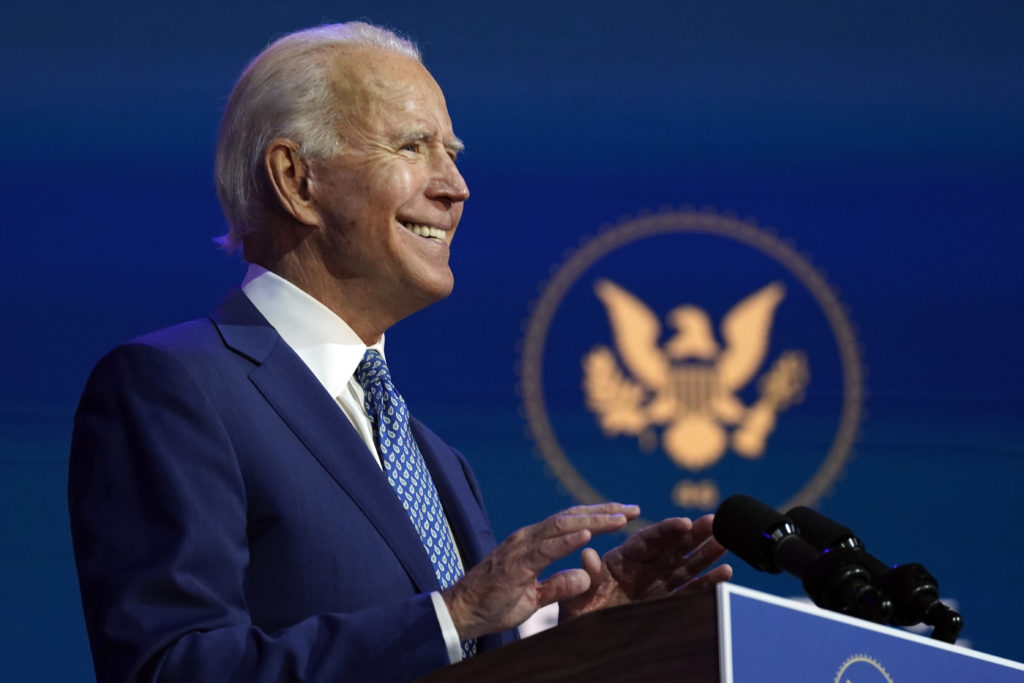
President-elect Joe Biden is looking to build out his nascent White House staff with more traditional Washington insiders, a notable departure from four years in which President Donald Trump filled his team with outsiders and government antagonists. Ron Klain is an early favorite to become Biden’s chief of staff, according to multiple people familiar with planning who spoke on condition of anonymity to speak freely about private discussions. He has decades of Washington experience that includes being Biden’s chief of staff when he was vice president, in addition to serving as the Ebola response coordinator in 2014 and having a central role in the Obama administration’s financial crisis response. Delaware Sen. Chris Coons, a longtime Biden ally and friend, is seen as a potential choice for secretary of state. Rep. Karen Bass of California, whom Biden considered for vice president, is seen as a potential housing and urban development secretary. Both served in Congress for the past decade. Biden is expected to move quickly to name a chief of staff, but other top Cabinet positions will likely take longer. The names under consideration represent Biden’s effort to move Washington past the tumult of President Donald Trump’s administration and fill out his government with more seasoned professionals. The task is taking on even greater urgency than in past transitions because Biden will take office in January amid a raging pandemic that will likely consume the early days of his presidency and require a full government response. Biden made clear on Monday that he would focus on the pandemic by forming a coronavirus advisory board. Former Surgeon General Vivek Murthy, who was named a co-chair of that panel, is seen as a contender for the top job at the Department of Health and Human Services. New Mexico Gov. Michelle Lujan Grisham, who ran her state’s health department, is also being eyed for the position. Even for roles where Biden has the opportunity to make history and appoint the first woman or African American Cabinet secretary, like at defense and treasury, Biden is said to be considering options with decades of experience in their chosen fields. Roger Ferguson, who served as vice-chair of the Federal Reserve under Bill Clinton and George W. Bush, is a potential treasury secretary, while Michele Flournoy, a former undersecretary of defense, is seen as a top pick to lead the Pentagon. Some Democrats are hopeful that the more traditional picks will help rebuild morale among the thousands of civil servants who felt thwarted at doing their jobs under Trump. “You’re not only talking about people who have an expertise in government functions, you’re talking about people who have a great deal of respect for government functions,” said Ed Espinoza, former western states political director for the Democratic National Committee. “That’s a key distinction between the Trump administration and a Biden administration.” It’s a striking shift from Trump, who built out his Cabinet with a raft of unorthodox picks, many of whom were openly skeptical of the federal government’s role in the jobs they were tasked with. Betsy DeVos, an advocate for steering federal money to private charter schools, led the Education Department. Scott Pruitt, the former Oklahoma attorney general who’s a skeptic of the science showing humans contribute to climate change, ran the Environmental Protection Agency. And Republican Rep. Mick Mulvaney of South Carolina, who initially served as White House budget director, supported shutting down the government to rein in federal spending and was critical of some of the proposals Trump aimed to invest in, like a massive infrastructure policy. Still, Biden faces a number of major unknowns as he prepares for the presidency. First, the scope of Biden’s first-term agenda will hinge on which party controls the Senate, which remains in question with two special Senate elections in Georgia scheduled for the first week in January. Democrats have acknowledged they will likely need to pare back some of Biden’s campaign trail promises even if they do hold the majority in a closely divided Senate, and a slim majority could also affect the kinds of nominees Biden can hope to get approved for top Cabinet slots. The most imminent unknown for Biden, however, remains to what extent Trump and his administration will work with the former vice president as his team begins its efforts to transition the government. The General Services Administration is tasked with formally recognizing Biden as president-elect, beginning the transition process. But the agency’s Trump-appointed administrator, Emily Murphy, has not started the process and has given no guidance on when she will do so. That lack of clarity is fueling questions about whether Trump, who has not publicly recognized Biden’s victory and has falsely claimed the election was stolen, will impede Democrats as they try to establish a government. There is little precedent in the modern era of a president erecting such hurdles for his successor. The stakes are especially high this year because of the coronavirus pandemic, which will require a comprehensive government response. “America’s national security and economic interests depend on the federal government signaling clearly and swiftly that the United States government will respect the will of the American people and engage in a smooth and peaceful transfer of power,” Jen Psaki, a Biden transition aide, tweeted Sunday. South Carolina Rep. Jim Clyburn, an ally of Biden’s on Capitol Hill, said that if Trump continues to drag his feet, then he hopes that “my conservative friends in Congress will have an intervention.” “This country is bigger than one person, and to allow the people of this country to suffer — we are near 245,000 deaths, and we’re still messing around and won’t get the relief that people need,” he said. Indeed, some Republicans on Capitol Hill called for a smooth transition Monday. Maine Sen. Susan Collins, a moderate Republican and occasional Trump antagonist, congratulated Biden on his victory and said in a statement that “presidential transitions are important” and that Biden and Vice President-elect Kamala Harris should “be given every opportunity
Donald Trump fires Mark Esper as Pentagon chief after election defeat

President Donald Trump fired Defense Secretary Mark Esper on Monday, an unprecedented move by a president struggling to accept election defeat and angry at a Pentagon leader he believes wasn’t loyal enough. The decision was widely expected as Trump had grown increasingly unhappy with Esper over the summer, including sharp differences between them over the use of the military during the civil unrest in June. But the move could unsettle international allies and Pentagon leadership and injects another element of uncertainty to a rocky transition period as Joe Biden prepares to assume the presidency. Presidents who win reelection often replace Cabinet members, but losing presidents have kept their Pentagon chiefs in place until Inauguration Day to preserve stability in the name of national security. Trump announced the news in a tweet, saying that “effective immediately” Christopher Miller, the director of the National Counterterrorism Center, will serve as acting secretary, sidestepping the department’s No.2-ranking official, Deputy Defense Secretary David Norquist. “Chris will do a GREAT job!” Trump tweeted. “Mark Esper has been terminated. I would like to thank him for his service.” In a letter to Trump, Esper referred to his efforts to keep the Pentagon apolitical — a resistance that often angered Trump. Esper said he served as defense secretary and Army secretary “in full faith to my sworn oath to support and defend the Constitution, and to safeguard the country and its interests while keeping the Department out of politics and abiding by the values Americans hold dear.” The Associated Press obtained a copy of the letter. Esper didn’t thank Trump, but he also didn’t openly criticize the president or his policies. He said he accepts Trump’s decision to replace him, adding, “I step aside knowing there is much we achieved at the Defense Department over the last eighteen months to protect the nation and improve the readiness, capabilities, and professionalism of the joint force, while fundamentally transforming and preparing the military for the future.” U.S. defense officials said Miller arrived at the Pentagon in the early afternoon to take over the job, and that White House chief of staff Mark Meadows informed Esper of the firing before Trump announced the move on Twitter. Esper and Miller were in the building at the same time for a while, but Esper left by the end of the day, said defense officials who spoke on condition of anonymity to discuss internal matters. Trump’s abrupt move to dump Esper triggers questions about what the president may try to do before he leaves office, including adjustments in troop presence overseas or other national security changes. More broadly, the U.S. military continued to operate as usual. U.S. officials said Gen. Mark Milley, chairman of the Joint Chiefs of Staff, met with Miller on Monday and also gathered the top military commanders and chiefs for a secure meeting. Officials said Miller’s message so far is that he won’t make immediate changes, and the department will stay the course. Military leaders, meanwhile, were calling top officials in their various geographic regions to assure them that the U.S. military is maintaining a stable presence around the world. In a separate message to the force, Esper expressed a twinge of disappointment, saying “I step aside knowing that there is much more we could accomplish together to advance America’s national security.” He said much was achieved, and “through thick and thin, however, we have always put People and Country first,” he said. Trump’s decision brings to five the number of men who have held the job of defense chief under Trump — either in an acting capacity or confirmed by the Senate. The move was quickly condemned by Democratic members of Congress. “Dismissing politically appointed national security leaders during a transition is a destabilizing move that will only embolden our adversaries and put our country at greater risk,” said Rep. Adam Smith, D-Wash., chairman of the House Armed Services Committee. “President Trump’s decision to fire Secretary Esper out of spite is not just childish, it’s also reckless.” Former military leaders weighed in. Jim Stavridis, a retired four-star Navy admiral, wrote on Twitter that, “Things are already unstable internationally, and this does not help.” Republicans praised Esper but largely avoided criticizing Trump. GOP Sen. Jim Inhofe, the Senate Armed Services Committee chairman, told reporters it was Trump’s decision and said, “I learned a long time ago I don’t tell the president not to do anything.” Biden has not said who he would appoint as defense chief, but is widely rumored to be considering naming the first woman to the post — Michele Flournoy. Flournoy has served multiple times in the Pentagon, starting in the 1990s and most recently as the undersecretary of defense for policy from 2009 to 2012. She is well known on Capitol Hill as a moderate Democrat and is regarded among U.S. allies and partners as a steady hand who favors strong U.S. military cooperation abroad. Miller most recently served as director of the National Counterterrorism Center and before that was a deputy assistant defense secretary and top adviser to Trump on counterterrorism issues. He spent more than 30 years in the military, including as an Army Green Beret, and was deployed multiple times to both Iraq and Afghanistan. After his retirement from the military, Miller worked as a defense contractor. Esper’s strained relationship with Trump came close to collapse last summer during civil unrest that triggered a debate within the administration over the proper role of the military in combating domestic unrest. Esper’s opposition to using active duty troops to help quell protests in Washington, D.C., infuriated Trump, and led to wide speculation that the defense chief was prepared to quit if faced with such an issue again. The tensions fueled rumors that Esper would be ousted if Trump won reelection. Presidents historically have put a high priority on stability at the Pentagon during political transitions. Since the creation of the Defense Department and the position of defense secretary in 1947, the only three presidents
