
Cuban leaders beef up police patrols after rare protests
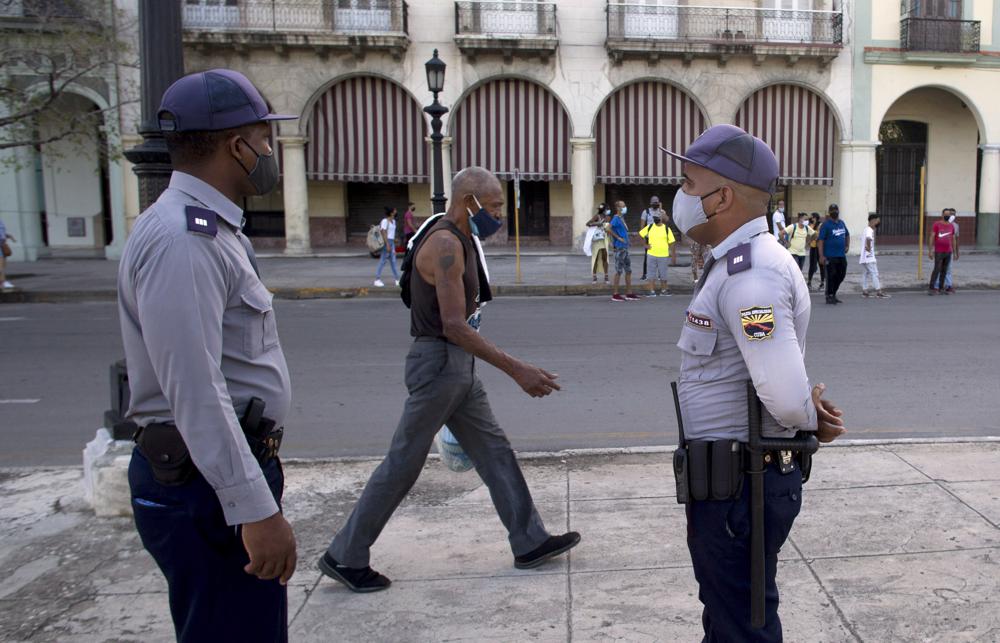
Cuban police are out in force on the country’s streets as the president is accusing Cuban Americans of using social media to spur a rare outpouring of weekend protests over high prices and food shortages. The demonstrations in several cities and towns were some of the biggest displays of antigovernment sentiment seen in years in tightly controlled Cuba, which is facing a surge of coronavirus cases as it struggles with its worst economic crisis in decades as a consequence of U.S. sanctions imposed by President Donald Trump’s administration. Many young people took part in Sunday’s demonstrations in Havana. Protests were also held elsewhere on the island, including in the small town of San Antonio de los Baños, where people objected to power outages and were visited by President Miguel Díaz-Canel. He entered a few homes, where he took questions from residents. Authorities appeared determined to put a stop to the demonstrations. More than a dozen protesters were detained, including a leading Cuban dissident who was arrested trying to attend a march in the city of Santiago, 559 miles (900 kilometers) east. The demonstrators disrupted traffic in the capital for several hours until some threw rocks, and police moved in and broke them up. Internet service was spotty, possibly indicating an effort to prevent protesters from communicating with each other. “We’ve seen how the campaign against Cuba was growing on social media in the past few weeks,″ Díaz-Canel said Monday in a nationally televised appearance in which his entire Cabinet was present. “That’s the way it’s done: Try to create inconformity, dissatisfaction by manipulating emotions and feelings.” In a statement Monday, U.S. President Joe Biden said Cuban protesters were asserting their basic rights. “We stand with the Cuban people and their clarion call for freedom and relief from the tragic grip of the pandemic and from the decades of repression and economic suffering to which they have been subjected by Cuba’s authoritarian regime,″ Biden said. The U.S. urges the Cuban government to serve their people ’’rather than enriching themselves,″ Biden added. U.N. deputy spokesman Farhan Haq on Monday stressed the U.N. position “on the need for freedom of expression and peaceful assembly to be respected fully, and we expect that that will be the case.” The demonstrations were extremely unusual on an island where little dissent against the government is tolerated. The last major public demonstration of discontent over economic hardship took place nearly 30 years in 1994. Last year, there were small demonstrations by artists and other groups, but nothing as big or widespread as what erupted this past weekend. In the Havana protest on Sunday, police initially trailed behind as protesters chanted, “Freedom!” “Enough!” and “Unite!” One motorcyclist pulled out a U.S. flag, but it was snatched from him by others. “We are fed up with the queues, the shortages. That’s why I’m here,” one middle-aged protester told The Associated Press. He declined to identify himself for fear of being arrested later. Later, about 300 pro-government protesters arrived with a large Cuban flag, shouting slogans in favor of the late President Fidel Castro and the Cuban revolution. Some assaulted an AP videojournalist, smashing his camera. AP photojournalist Ramón Espinosa was then beaten by a group of police officers in uniforms and civilian clothes; he suffered a broken nose and an eye injury. The demonstration grew to a few thousand in the vicinity of Galeano Avenue, and the marchers pressed on despite a few charges by police officers and tear gas barrages. People standing on many balconies along the central artery in the Centro Habana neighborhood applauded the protesters passing by. Others joined in the march. About 2 1/2 hours into the march, some protesters pulled up cobblestones and threw them at police, at which point officers began arresting people, and the marchers dispersed. AP journalists counted at least 20 people who were taken away in police cars or by individuals in civilian clothes. Although many people tried to take out their cellphones and broadcast the protest live, Cuban authorities shut down internet service throughout the afternoon Sunday. On Monday, Cuban authorities were blocking Facebook, WhatsApp, Instagram, and Telegram said Alp Toker, director of Netblocks, a London-based internet monitoring firm. “This does seem to be a response to social media-fueled protest,” he said. Twitter did not appear to be blocked, though Toker noted Cuba has the ability to cut it off if it wants to. Republished with the permission of the Associated Press.
Cuba’s Fidel Castro, who defied U.S. for 50 years, dies at 90

Former President Fidel Castro, who led a rebel army to improbable victory in Cuba, embraced Soviet-style communism and defied the power of 10 U.S. presidents during his half-century rule, has died at age 90. With a shaking voice, President Raul Castro said on state television that his older brother died at 10:29 p.m. Friday. He ended the announcement by shouting the revolutionary slogan: “Toward victory, always!” Castro’s reign over the island-nation 90 miles (145 kilometers) from Florida was marked by the U.S.-backed Bay of Pigs invasion in 1961 and the Cuban Missile Crisis a year later that brought the world to the brink of nuclear war. The bearded revolutionary, who survived a crippling U.S. trade embargo as well as dozens, possibly hundreds, of assassination plots, died 10 years after ill health forced him to hand power over to Raul. Castro overcame imprisonment at the hands of dictator Fulgencio Batista, exile in Mexico and a disastrous start to his rebellion before triumphantly riding into Havana in January 1959 to become, at age 32, the youngest leader in Latin America. For decades, he served as an inspiration and source of support to revolutionaries from Latin America to Africa. His commitment to socialism was unwavering, though his power finally began to fade in mid-2006 when a gastrointestinal ailment forced him to hand over the presidency to Raul in 2008, provisionally at first and then permanently. His defiant image lingered long after he gave up his trademark Cohiba cigars for health reasons and his tall frame grew stooped. “Socialism or death” remained Castro’s rallying cry even as Western-style democracy swept the globe and other communist regimes in China and Vietnam embraced capitalism, leaving this island of 11 million people an economically crippled Marxist curiosity. He survived long enough to see Raul Castro negotiate an opening with U.S. President Barack Obama on Dec. 17, 2014, when Washington and Havana announced they would move to restore diplomatic ties for the first time since they were severed in 1961. He cautiously blessed the historic deal with his lifelong enemy in a letter published after a month-long silence. Obama made a historic visit to Havana in March 2016. Carlos Rodriguez, 15, was sitting in Havana’s Miramar neighborhood when he heard that Fidel Castro had died. “Fidel? Fidel?” he said, slapping his head in shock. “That’s not what I was expecting. One always thought that he would last forever. It doesn’t seem true.” “It’s a tragedy,” said 22-year-old nurse Dayan Montalvo. “We all grew up with him. I feel really hurt by the news that we just heard.” Fidel Castro Ruz was born Aug. 13, 1926, in eastern Cuba’s sugar country, where his Spanish immigrant father worked first recruiting labor for U.S. sugar companies and later built up a prosperous plantation of his own. Castro attended Jesuit schools, then the University of Havana, where he received law and social science degrees. His life as a rebel began in 1953 with a reckless attack on the Moncada military barracks in the eastern city of Santiago. Most of his comrades were killed and Fidel and his brother Raul went to prison. Fidel turned his trial defense into a manifesto that he smuggled out of jail, famously declaring, “History will absolve me.” Freed under a pardon, Castro fled to Mexico and organized a rebel band that returned in 1956, sailing across the Gulf of Mexico to Cuba on a yacht named Granma. After losing most of his group in a bungled landing, he rallied support in Cuba’s eastern Sierra Maestra mountains. Three years later, tens of thousands spilled into the streets of Havana to celebrate Batista’s downfall and catch a glimpse of Castro as his rebel caravan arrived in the capital on Jan. 8, 1959. The U.S. was among the first to formally recognize his government, cautiously trusting Castro’s early assurances he merely wanted to restore democracy, not install socialism. Within months, Castro was imposing radical economic reforms. Members of the old government went before summary courts, and at least 582 were shot by firing squads over two years. Independent newspapers were closed and in the early years, homosexuals were herded into camps for “re-education.” In 1964, Castro acknowledged holding 15,000 political prisoners. Hundreds of thousands of Cubans fled, including Castro’s daughter Alina Fernandez Revuelta and his younger sister Juana. Still, the revolution thrilled millions in Cuba and across Latin America who saw it as an example of how the seemingly arrogant Yankees could be defied. And many on the island were happy to see the seizure of property of the landed class, the expulsion of American gangsters and the closure of their casinos. Castro’s speeches, lasting up to six hours, became the soundtrack of Cuban life and his 269-minute speech to the U.N. General Assembly in 1960 set the world body’s record for length that still stood more than five decades later. As Castro moved into the Soviet bloc, Washington began working to oust him, cutting U.S. purchases of sugar, the island’s economic mainstay. Castro, in turn, confiscated $1 billion in U.S. assets. The American government imposed a trade embargo, banning virtually all U.S. exports to the island except for food and medicine, and it severed diplomatic ties on Jan. 3, 1961. On April 16 of that year, Castro declared his revolution to be socialist, and the next day, about 1,400 Cuban exiles stormed the beach at the Bay of Pigs on Cuba’s south coast. But the CIA-backed invasion failed. The debacle forced the U.S. to give up on the idea of invading Cuba, but that didn’t stop Washington and Castro’s exiled enemies from trying to do him in. By Cuban count, he was the target of more than 630 assassination plots by militant Cuban exiles or the U.S. government. The biggest crisis of the Cold War between Washington and Moscow exploded on Oct. 22, 1962, when President John F. Kennedy announced there were Soviet nuclear missiles in Cuba and imposed a naval blockade of the island. Humankind held its
