
Donald Trump’s trap: GOP nominee can’t let go of perceived slights

For Donald Trump, it’s become a familiar pattern. The Republican nominee can’t let go of a perceived slight, no matter the potential damage to his presidential campaign or political reputation. Trump spent the days after winning the Republican nomination criticizing a U.S. district court judge’s Mexican heritage. The morning after accepting the Republican nomination at the party’s convention, Trump re-litigated months-old grievances with primary rival Ted Cruz. Now, he’s sparring with an American Muslim family whose son was killed in Iraq. Republican leaders have urged Trump to drop his attacks on Khizr and Ghazala Khan, who appeared at last week’s Democratic convention and harshly criticized the GOP nominee. It’s not just the optics of picking a fight with a military family that has GOP officials eager for Trump to move on, but the timing of his attacks: Election Day is just three months away. Those who have worked with Trump say that in private meetings, he can often appear amenable to putting a controversy aside. But the businessman can quickly be drawn back in by an interview, especially if he believes he’s already answered the question, or if he grows irritated by commentary on cable television. “It’s just who he is,” said Stuart Jolly, a former campaign staffer and current political director for the pro-Trump Great America PAC. Others who have worked with Trump say the only way to ensure he moves on is to wait for him to tire of an issue or get drawn into another matter. Newt Gingrich, the former House speaker who has advised Trump, said the candidate’s inability to back away from a political land mine “makes him vulnerable.” “His whole experience up until running for office was in a very combative New York media market,” Gingrich said. “He’s been doing it now for over 30 years. It’s a very deeply held habit.” Khizr Kahn delivered an emotional address at last week’s Democratic convention, with his wife standing by his side. The Pakistan-born Khan told the story of his son, U.S. Army Capt. Humayun Khan, who was posthumously awarded a Bronze Star and Purple Heart after his death in 2004. Khan said that if Trump were president and enacted his proposed temporary ban on foreign Muslims coming to the U.S., a position Trump has backed away from in recent weeks, his son would have never been allowed into the country. He also questioned whether Trump had ever read the Constitution. Trump responded by implying Ghazala Khan’s religion preventing her from speaking at the convention, though she later said talking publicly about her late son was still too difficult. On Monday, Trump tweeted that he was being “viciously attacked” by Khizr Khan. Trump’s unwillingness to let the matter subside sparked outrage Monday from a chorus of Republicans. Arizona Sen. John McCain, a former prisoner of war, said Trump did not have “unfettered license to defame those who are the best among us.” Rep. Mike Coffman, a vulnerable Republican in a competitive Colorado district, said he was “deeply offended when Donald Trump fails to honor the sacrifices of all of our brave soldiers who were lost in that war.” Missouri Sen. Roy Blunt said the Khans “deserve to be heard and respected.” “My advice to Donald Trump has been and will continue to be to focus on jobs and national security and stop responding to every criticism whether it’s from a grieving family or Hillary Clinton,” Blunt said in a statement. However, none of the Republican lawmakers pulled back their support of Trump’s White House campaign. In his first rally after a weekend of controversy, Trump spoke at length and took several questions at an event Monday in Columbus, Ohio — never once mentioning the Khans. But when asked about Khizr Khan on Fox News Channel’s “Hannity,” Trump responded, “I guess it’s part of my life.” “His son died 12 years ago,” Trump added. “If I were president, his son wouldn’t have died, because I wouldn’t have been in the war, if I was president back then.” Trump backers attending the Ohio rally dismissed the issue, underscoring how the businessman was able to survive numerous such firestorms in the GOP primaries. “I think the Democrats laid a trap for him,” said Tom McClanahan, a 54-year-old from Johnston, Ohio. “I think they knew what they were doing when they asked that family to speak at the convention. They knew he’d respond.” Dale Brown, a maintenance supervisor from Grove City, Ohio, whose son is in the Navy, said Democrats were blowing Trump’s comments out of proportion and had “politicized this by asking that family to speak.” But the real test for Trump isn’t the opinion of the loyal supporters who attend his rallies. It’s the broader general election audience, a far more diverse group still weighing Trump’s readiness for the White House. Republished with permission of the Associated Press.
Koch network refusing to help Donald Trump
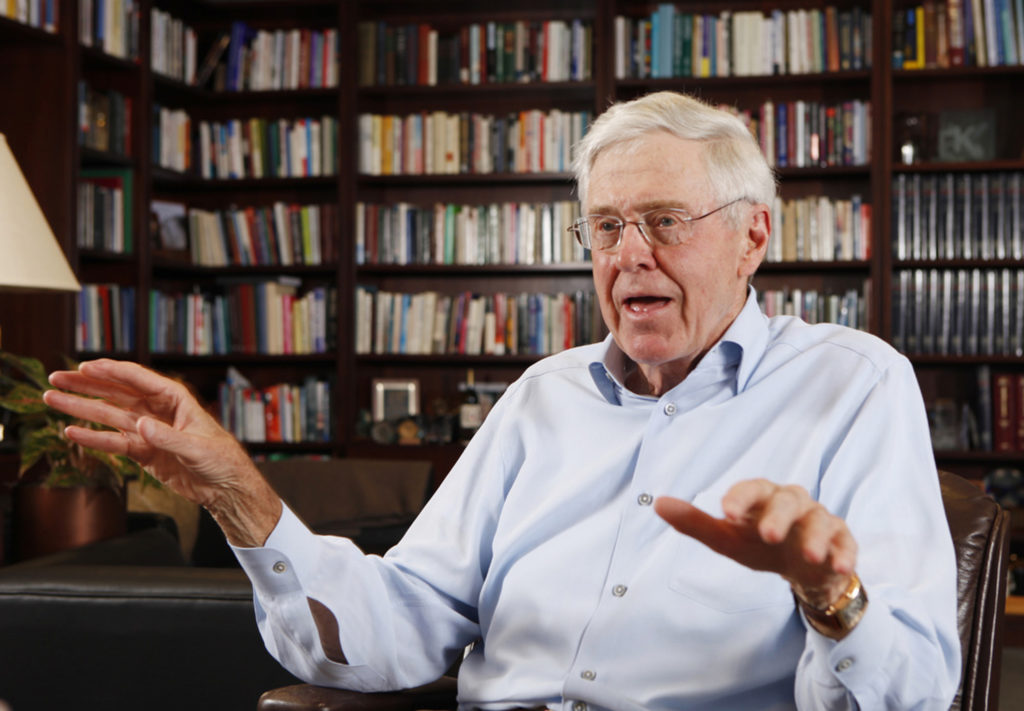
From a luxury hotel on the edge of the Rocky Mountains, some of the nation’s most powerful Republican donors are rebelling against Donald Trump. Billionaire industrialist Charles Koch, host of the exclusive weekend retreat, did not mention Trump by name as warned that political leaders are giving “frightening” answers to America’s challenges. One of his chief lieutenants was more direct as he made clear that Koch’s expansive political network would not use its tremendous resources to help Trump win this fall. “We’re focused on the Senate,” said Mark Holden, general counsel and senior vice president of Koch Industries. He noted that none of the presidential candidates are aligned with the Koch network “from a values, and beliefs and policy perspective.” Trump’s dire warnings of growing crime in America, Holden said, simply aren’t accurate. “We’re much safer,” Holden said. “That’s what the data shows.” Koch described the 2016 “political situation” this way: “We don’t really, in some cases, don’t really have good options.” The comments came Saturday, the first of a three-day gathering for donors who promise to give at least $100,000 each year to the various groups backed by the Koch brothers’ Freedom Partners — a network of education, policy and political entities that aim to promote a smaller, less intrusive government. The ambitious Koch network has invested hundreds of millions of dollars to influence politics and public policy over the last decade, but don’t plan to spend anything to help Trump, even if some of the 400 or so deep-pocketed donors gathered in Colorado Springs this weekend think it should. Trump thumbed his nose at the gathering from Twitter. “I turned down a meeting with Charles and David Koch,” the New York billionaire tweeted. “Much better for them to meet with the puppets of politics, they will do much better!” The weekend’s agenda for the estimated 400 donors gathered in Colorado Springs featured a series of policy discussions and appearances from at least three governors, four senators and four members of the House of Representatives, including House Speaker Paul Ryan. Kentucky Gov. Matt Bevin and Arizona Gov. Doug Ducey talked up policy successes in their states on Saturday night, avoiding discussion of the 2016 presidential contest altogether. When it was his turn, Colorado Sen. Cory Gardner touched on the race for the White House, although he did not mention Trump’s name. “Forty years worth of Supreme Court justices are going to be determined this November,” Gardner told donors, a reference to the next president’s ability to fill at least one existing vacancy on the high court. Those yet to appear include Wisconsin Gov. Scott Walker, Texas Sen. John Cornyn, South Carolina Sen. Tim Scott, Utah Sen. Mike Lee, Rep. Mike Pompeo of Kansas. Rep Jason Chaffetz of Utah and Rep. Mike Coffman of Colorado. Koch later told his guests that America’s frustrated electorate is looking at the wrong place — politicians — for answers. “And to me, the answers they’re getting are frightening,” he said without naming any politicians, “because by and large, these answers will make matters worse.” Charles and David Koch have hosted such gatherings of donors and politicians for years, but usually in private. The weekend’s event includes a small number of reporters, including one from The Associated Press. Koch has put the network’s budget at roughly $750 million through the end of 2016. A significant portion was supposed to be directed at electing a Republican to the White House. It will instead go to helping Republican Senate candidates in at least five states: Ohio, Pennsylvania, Nevada, Wisconsin and Florida, Holden said, noting that the network has dedicated $42 million so far to television and digital advertising to benefit Republican Senate candidates. In some cases, the network may try to link Democratic Senate candidates to Clinton, he added, but there are no plans to go after her exclusively in paid advertising. The organization may invest in a handful of races for governor and House of Representatives as well. And while the network will not be a Trump ally, it won’t necessarily be a Trump adversary either. “We have no intention to go after Donald Trump,” Holden said. Republished with permission of the Associated Press.
