Conservatives welcome Donald Trump with delight – and wariness

For the past eight years, thousands of conservative activists have descended on Washington each spring with dreams of putting a Republican in the White House. This year, they’re learning reality can be complicated. With Donald Trump‘s presidential victory, the future of the conservative movement has become entwined with an unconventional New York businessman better known for his deal-making than any ideological principles. It’s an uneasy marriage of political convenience at best. Some conservatives worry whether they can trust their new president to follow decades of orthodoxy on issues like international affairs, small government, abortion and opposition to expanded legal protections for LGBT Americans — and what it means for their movement if he doesn’t. “Donald Trump may have come to the Republican Party in an unconventional and circuitous route, but the fact is that we now need him to succeed lest the larger conservative project fails,” said evangelical leader Ralph Reed, who mobilized his organization to campaign for Trump during the campaign. “Our success is inextricably tied to his success.” As conservatives filtered into their convention hall Wednesday for their annual gathering, many said they still have nagging doubts about Trump even as they cheer his early actions. A Wednesday night decision to reverse an Obama-era directive that said transgender students should be allowed to use public school bathrooms and locker rooms matching their chosen gender identity has thrilled social conservatives. “He’s said that on multiple occasions that he’s not a conservative, especially socially,” said Zach Weidlich, a junior at the University of South Alabama, “but my mind-set was, give him a chance, especially now that he’s elected.’” “He was the better of two evils given the choice,” added Timmy Finn. “I agree with his policies, however, I think he’s moving a little too fast.” Trump has a somewhat tortured history with the Conservative Political Action Conference, an annual convention that’s part ideological pep talk, part political boot camp for activists. Over the past six years, he’s been both booed and cheered. He’s rejected speaking slots and galvanized attendees with big promises of economic growth and electoral victory. At times, he has seemed to delight in taunting them. “I’m a conservative, but don’t forget: This is called the Republican Party, not the Conservative Party,” he said in a May interview on ABC’s “This Week.” Matt Schlapp, chairman of the American Conservative Union, which hosts CPAC, said Trump’s aggressive style is more important than ideological purity. “Conservatives weren’t looking for somebody who knew how to explain all the philosophies. They were actually looking for somebody who would just fight,” he said. “Can you think of anybody in America who fits that bill more than Donald Trump?” Trump is to address the group Friday morning. Vice President Mike Pence is to speak Thursday as are White House chief of staff Reince Priebus and senior advisers Steve Bannon and Kellyanne Conway. The tensions between Trump’s brand of populist politics and conservative ideology will be on full display at the three-day conference, which features panels like: “Conservatives: Where we come from, where we are and where we are going” and “The Alt-Right Ain’t Right At All.” Along with Trump come his supporters, including the populists, party newcomers and nationalists that have long existed on the fringes of conservativism and have gotten new voice during the early days of his administration. Pro-Brexit British politician Nigel Farage will speak a few hours after Trump. Organizers invited provocateur Milo Yiannopoulos after protesters at the University of California at Berkeley protested to stop his appearance on campus. But the former editor at Breitbart News, the website previously run by Bannon, was disinvited this week after video clips surfaced in which he appeared to defend sexual relationships between men and boys as young as 13. Trump “is giving rise to a conservative voice that for the first time in a long time unabashedly, unapologetically puts America first,” said Republican strategist Hogan Gidley. “That ‘America First’ moniker can very well shape this country, but also the electorate and the Republican Party and conservative movement for decades.” Trump’s early moves — including a flurry of executive orders and his nomination of federal Judge Neil Gorsuch to the Supreme Court — have cheered conservatives. They’ve also applauded his Cabinet picks, which include some of the most conservative members of Congress. The ACU awarded his team a 91.52 percent conservative rating — 28 points higher than Ronald Reagan and well above George H.W. Bush who received a 78.15 rating. But key items on the conservative wish list remain shrouded in uncertainty. The effort to repeal President Barack Obama‘s health care law is not moving as quickly as many hoped, and Republicans also have yet to coalesce around revamping the nation’s tax code. No proposals have surfaced to pursue Trump’s campaign promises to build a border wall with Mexico that could cost $15 billion or more or to buttress the nation’s infrastructure with a $1 trillion plan. Conservatives fear that those plans could result in massive amounts of new spending and that Trump’s penchant for deal-making could leave them on the wrong side of the transaction. “There is wariness,” said Tim Phillips, president of Koch-brothers-backed Americans for Prosperity. But with a Republican-controlled Congress, others believe there’s no way to lose. “He sits in a room with Mitch McConnell and Paul Ryan. Is there a bad a deal to made with those three in the room?” asked veteran anti-tax activist Grover Norquist. “A deal between those three will, I think, always make me happy.” Republished with permission of The Associated Press.
Conservative forces clash in Donald Trump’s early days
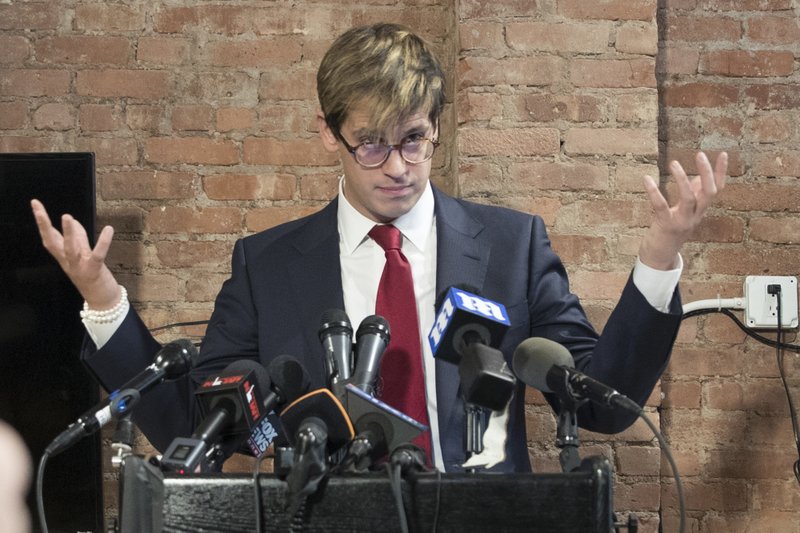
Milo Yiannopoulos represented the conservative movement’s struggle with powerful and conflicting forces in the early days of Donald Trump‘s presidency, even before he lost his job and speaking slot in this week’s Conservative Political Action Conference. The 33-year-old British professional provocateur is among the new players in Trump’s Republican Party, which is increasingly defined by a say-anything populism and a loose affiliation with white nationalists. Yiannopoulos, both loved and hated for his divisive comments about women, minorities and Muslims, offered a pointed message to political leaders on Tuesday even as he apologized for making explosive statements about sexual relationships between boys and men. “America is crying out for somebody who will say the unsayable,” he declared. He added, “The populist, nationalist revolution that is happening, the anti-political correctness pro-free speech revolution that is happening all over the Western world, is not going anywhere.” Indeed, the conservative movement is in flux as thousands of adherents prepare to gather in suburban Washington for its largest annual gathering. Not long ago, the conference showcased the far-right fringe and the Republican Party’s rigid devotion to conservative ideology. Yet in the age of unfiltered Trump, CPAC may be outflanked by the likes of Yiannopoulos and the president’s chief counselor, Steve Bannon, whose confrontational brand of Republican politics ignores decades of conservative orthodoxy on key issues. Conservative leaders interviewed by The Associated Press this week described a clash between their sincere optimism over the Republican Party’s extraordinary success last fall and pangs of anxiety over its uncertain direction. “I think the conservative movement is hopeful, but wary,” said Tim Phillips, president of Koch-brothers-backed Americans for Prosperity. Conference organizers have coordinated a program specifically designed to distance the conservative movement from the racists and bigots who joined the GOP in recent years, all the while cheering Trump’s vows to build a wall and expel millions of immigrants living in the country illegally. “There is nothing about their views or their ideology that is consistent with conservatism,” said Dan Schneider, executive director of the American Conservative Union, which hosts CPAC. He dismissed the white nationalists as “nothing more than garden variety” fascists. At the same time, American Conservative Union Chairman Matt Schlapp said Yiannopoulos was “playing an important role in pushing back against what’s happening on college campuses.” “There’s plenty of things he’s said I find offensive and inappropriate,” Schlapp added. “Quite honestly, like a lot of people, I was hoping to learn a lot more about him by his appearance at CPAC. We just believe that when the new information came to light, that the CPAC stage was not the appropriate place for him to defend his reputation on those comments.” Yiannopoulos was removed from the conference speaking program earlier in the week following new scrutiny of video clips in which he appeared to defend sexual relationships between men and boys as young as 13. He also left his job as an editor on the far-right, pro-Trump website, Breitbart News, and lost a book deal with Simon & Schuster. In one of the videos, Yiannopoulos, who is gay, said relationships between boys and men could “help those young boys discover who they are and give them security and safety and provide them with love and a reliable sort of rock, where they can’t speak to their parents.” “I understand that my usual blend of British sarcasm, provocation and gallows humor might have come across as flippancy, a lack of care for other victims or, worse, advocacy. I am horrified by that impression,” he said. Despite this week’s focus on Yiannopoulos, the debate over the future of the conservative movement extends well beyond one troubled activist. Trump himself is hardly regarded as a traditional conservative. “When Donald Trump walks out on stage at CPAC this week, he will be addressing a crowd that largely supported someone else in the Republican primaries,” said longtime evangelical leader Ralph Reed, chairman of the Faith & Freedom Coalition, suggesting that both sides need each other going forward. Yet some worry that Trump has abandoned long-held conservative bedrock issues, such as free trade and small government. The president and Republicans in Congress have also been slow to repeal the federal health care law as promised. “It’s time to get moving,” Phillips said. On social issues, however, Trump appears to be tacking right. White House spokesman Sean Spicer told reporters Tuesday that the Justice Department would soon issue new directives on the use of school bathrooms for transgender students. The announcement alarmed LGBT groups that urged Trump to safeguard Obama-era guidelines allowing students to use school restrooms that match their gender identity, not their birth gender. Conservative leaders cheered the news. Yiannopoulos, meanwhile, described himself as “the most interesting thing happening in American conservativism.” “I have an opportunity now through what has happened to reach an even larger audience, and I intend to do so,” he said. Republished with permission of The Associated Press.