
Ketanji Brown Jackson confirmed as first Black female high court justice
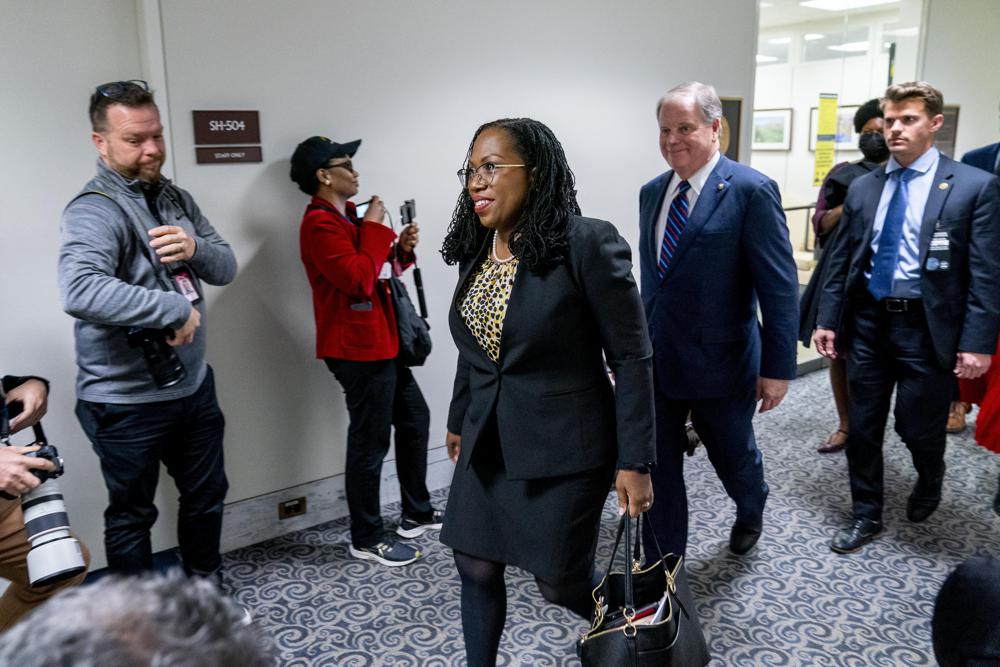
The Senate confirmed Ketanji Brown Jackson to the Supreme Court on Thursday, shattering a historic barrier by securing her place as the first Black female justice and giving President Joe Biden a bipartisan endorsement for his promised effort to diversify the high court. Cheers rang out in the Senate chamber as Jackson, a 51-year-old appeals court judge with nine years of experience on the federal bench, was confirmed 53-47, mostly along party lines but with three Republican votes. Presiding over the vote was Vice President Kamala Harris, also the first Black woman to reach her high office. Biden tweeted afterward that “we’ve taken another step toward making our highest court reflect the diversity of America.” Senate Majority Leader Chuck Schumer exulted that it was “a wonderful day, a joyous day, an inspiring day — for the Senate, for the Supreme Court, and for the United States of America.” Harris said as she left the Capitol that she was “overjoyed, deeply moved.” Jackson will take her seat when Justice Stephen Breyer retires this summer, solidifying the liberal wing of the 6-3 conservative-dominated court. She joined Biden at the White House to watch the vote, embracing as it came in. The two were expected to speak, along with Harris, at the White House Friday. During four days of Senate hearings last month, Jackson spoke of her parents’ struggles through racial segregation and said her “path was clearer” than theirs as a Black American after the enactment of civil rights laws. She attended Harvard University, served as a public defender, worked at a private law firm, and was appointed as a member of the U.S. Sentencing Commission. She told senators she would apply the law “without fear or favor,” and pushed back on Republican attempts to portray her as too lenient on criminals she had sentenced. Jackson will be just the third Black justice, after Thurgood Marshall and Clarence Thomas, and the sixth woman. She will join three other women, Sonia Sotomayor, Elena Kagan, and Amy Coney Barrett – meaning that four of the nine justices will be women for the first time in history. Her eventual elevation to the court will be a respite for Democrats who fought three bruising battles over former President Donald Trump’s nominees and watched Republicans cement a conservative majority in the final days of Trump’s term with Barrett’s confirmation. While Jackson won’t change the balance, she will secure a legacy on the court for Biden and fulfill his 2020 campaign pledge to nominate the first Black female justice. “This is a tremendously historic day in the White House and in the country,” said White House press secretary Jen Psaki after the vote. “And this is a fulfillment of a promise the president made to the country.” The atmosphere was joyful, though the Senate was divided, as Thursday’s votes were cast. Senators of both parties sat at their desks and stood to vote, a tradition reserved for the most important matters. The upper galleries were almost full for the first time since the beginning of the pandemic two years ago, and about a dozen House members, part of the Congressional Black Caucus, stood at the back of the chamber. Harris called out the tally, pausing with emotion, and Democrats erupted in loud applause and cheers, Schumer pumping his fists. A handful of Republicans stayed and clapped, but most by then had left. Despite Republican criticism of her record, Jackson eventually won three GOP votes. The final tally was far from the overwhelming bipartisan confirmations for Breyer and other justices in decades past, but it was still a significant accomplishment for Biden in the 50-50 split Senate after GOP senators aggressively worked to paint Jackson as too liberal and soft on crime. Statements from Republican Sens. Susan Collins of Maine, Lisa Murkowski of Alaska, and Mitt Romney of Utah all said the same thing — they might not always agree with Jackson, but they found her to be enormously well qualified for the job. Collins and Murkowski both decried increasingly partisan confirmation fights, which only worsened during the battles over Trump’s three picks. Collins said the process was “broken,” and Murkowski called it “corrosive” and “more detached from reality by the year.” Biden, a veteran of a more bipartisan Senate, said from the day of Breyer’s retirement announcement in January that he wanted support from both parties for his history-making nominee, and he invited Republicans to the White House as he made his decision. It was an attempted reset from Trump’s presidency, when Democrats vociferously opposed the three nominees, and from the end of President Barack Obama’s when Republicans blocked nominee Merrick Garland from getting a vote. Once sworn in, Jackson will be the second-youngest member of the court after Barrett, 50. She will join a court on which no one is yet 75, the first time that has happened in nearly 30 years. Jackson’s first term will be marked by cases involving race, both in college admissions and voting rights. She has pledged to sit out the court’s consideration of Harvard’s admissions program since she is a member of its board of overseers. But the court could split off a second case involving a challenge to the University of North Carolina’s admissions process, which might allow her to weigh in on the issue. Judith Browne Dianis, executive director of the Advancement Project, a civil rights organization, said Jackson will make the court more reflective of communities that are most impacted by the judiciary. “The highest court in the land now will have a firsthand perspective of how the law impacts communities of color — via voting rights, police misconduct, abortion access, housing discrimination, or the criminal legal system, among other issues,” she said. “This will ultimately benefit all Americans.” Jackson could wait as long as three months to be sworn in, as the court’s session generally ends in late June or early July. She remains a judge on the federal appeals court in Washington, but she stepped away from cases there when she was nominated in February. Republicans spent
GOP blocks Senate COVID bill, demands votes on immigration
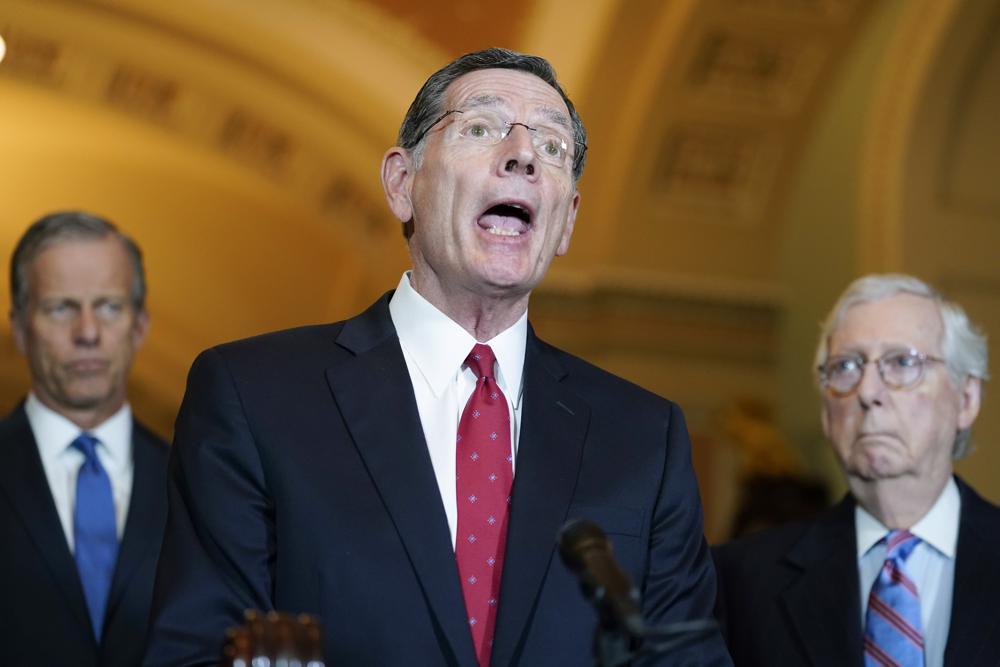
Republicans blocked a Democratic attempt Tuesday to begin Senate debate on a $10 billion COVID-19 compromise, pressing to entangle the bipartisan package with an election-year showdown over immigration restrictions that poses a politically uncomfortable fight for Democrats. A day after Democratic and GOP bargainers reached an agreement on providing the money for treatments, vaccines, and testing, a Democratic move to push the measure past a procedural hurdle failed 52-47. All 50 Republicans opposed the move, leaving Democrats 13 votes short of the 60 votes they had needed to prevail. Hours earlier, Republicans said they’d withhold crucial support for the measure unless Democrats agreed to votes on an amendment preventing President Joe Biden from lifting Trump-era curbs on migrants entering the U.S. With Biden polling poorly on his handling of immigration and Democrats divided on the issue, Republicans see a focus on migrants as a fertile line of attack. “I think there will have to be” an amendment preserving the immigration restrictions “in order to move the bill,” bolstering federal pandemic efforts, Senate Minority Leader Mitch McConnell, R-Ky., told reporters. “I don’t think there are probably 10 Republican votes at the moment for a process that doesn’t include” a vote on language retaining the immigration barriers, said No. 2 Senate GOP leader John Thune of South Dakota. At least 10 GOP votes will be needed in the 50-50 Senate for the measure to reach the 60 votes it must have for approval. Biden and Senate Majority Leader Chuck Schumer, D-N.Y., want Congress to approve the pandemic bill before lawmakers leave in days for a two-week recess. Tuesday’s vote suggested that could be hard. ”This is a potentially devastating vote for every single American who was worried about the possibility of a new variant rearing its nasty head within a few months,” Schumer said after the vote. The new omicron variant, BA.2, is expected to spark a fresh increase in U.S. COVID-19 cases. Around 980,000 Americans and over 6 million people worldwide have died from the disease. The $10 billion pandemic package is far less than the $22.5 billion Biden initially sought. It also lacks $5 billion Biden wanted to battle the pandemic overseas — money that fell victim to disagreements over GOP demands that the measure be entirely paid for with budget savings. At least half the bill would be used for research and to produce therapeutics to treat COVID-19. Money would also be used to buy vaccines and tests and to research new variants. The measure is paid for by pulling back unspent funds provided earlier for protecting aviation manufacturing jobs, assisting entertainment venues shuttered by the pandemic, and other programs. Administration officials have said the government has run out of money to finance COVID-19 testing and treatments for people without insurance, and is running low on money for boosters, free monoclonal antibody treatments, and care for people with immune system weaknesses. At the 2020 height of the pandemic, President Donald Trump imposed immigration curbs letting authorities immediately expel asylum seekers and migrants for public health reasons. The ban is set to expire May 23, triggering what, by all accounts, will be a massive increase in the number of people trying to cross the Mexican border into the U.S. That confronts Democrats with messy choices ahead of fall elections when they’re expected to struggle to retain their hair-breadth majorities in the House and Senate. Many of the party’s lawmakers and their liberal supporters want the U.S. to open its doors to more immigrants. But moderates and some Democrats confronting tight November reelections worry about lifting the restrictions and alienating centrist voters. Shortly before Tuesday’s vote, Senate Majority Leader Chuck Schumer, D-N.Y., showed no taste for exposing his party to a divisive immigration vote. “This is a bipartisan agreement that does a whole lot of important good for the American people. Vaccines, testing, therapeutics,” he said. “It should not be held hostage for an extraneous issue.” Jeff Zients, head of White House COVID-19 task force, expressed the same view about an immigration provision. “This should not be included on any funding bill,” he told reporters. “The decision should be made by the CDC. That’s where it has been, and that’s where it belongs.” But Rep. Bennie Thompson, D-Miss., chairman of the House Homeland Security Committee, said he would still support a Senate COVID-19 aid bill if it included the GOP effort to retain the Trump immigration restrictions. “Why wouldn’t I?” he said in a brief interview. The federal Centers for Disease Control and Prevention, which initiated the move two years ago, said earlier this month that it would lift the ban next month. The restrictions, known as Title 42, have been harder to justify as pandemic restrictions have eased. Trump administration officials cast the curbs as a way to keep COVID-19 from spreading further in the U.S. Democrats considered that an excuse for Trump, whose anti-immigrant rhetoric was a hallmark of his presidency, to keep migrants from entering the country. Sen. Catherine Cortez Masto, D-Nev., who faces a competitive reelection this fall, declined to say Tuesday whether she would support retaining the Trump-era ban, saying she wanted to see its language. But she said the Biden administration needs to do more. “I’ve been very clear with the administration. I need a plan; we need a plan,” she said in a brief interview. “There’s going to be a surge at the border. There should be a plan, and I’ve been calling for it all along.” Republished with the permission of the Associated Press.
Bipartisan deal near on trimmed $10 billion COVID bill

Lawmakers moved to the brink Thursday of shaking hands on a scaled-back bipartisan compromise providing a fresh $10 billion to combat COVID-19, a deal that could set up final congressional approval next week. The price tag was down from an earlier $15.6 billion agreement between the two parties that collapsed weeks ago after House Democrats rejected cutting unused pandemic aid to states to help pay for it. President Joe Biden requested $22.5 billion in early March. With leaders hoping to move the package through Congress quickly, the lowered cost seemed to reflect both parties’ calculations that agreeing soon to additional savings would be too hard. The effort, which would finance steps like vaccines, treatments, and tests, comes as Biden and other Democrats have warned the government is running out of money to counter the pandemic. At the same time, the more transmissible omicron variant BA.2 has been spreading quickly in the U.S. and abroad. “We’ve reached an agreement in principle on all the spending and all of the offsets,” Sen. Mitt Romney of Utah, the lead Republican bargainer, told reporters, using Washington-speak for savings. “It’s entirely balanced by offsets.” Senate Majority Leader Chuck Schumer, D-N.Y., and others were more circumspect. “We are getting close to a final agreement that would garner bipartisan support,” Schumer said on the Senate floor. He said lawmakers were still finalizing the bill’s components and language and awaiting a cost estimate from the nonpartisan Congressional Budget Office. Sen. Patty Murray, D-Wash., chair of the Senate health committee and another bargainer, said, “I’m hoping,” when asked about Romney’s assessment. Once clinched, an agreement would represent a semblance of bipartisan cooperation in battling the pandemic that dissolved a year ago, when a far larger, $1.9 trillion measure proposed by the new president cleared Congress with only Democratic votes. That bill was laden with spending to help struggling families, businesses, and communities, while this one would be aimed exclusively at public health. Many Republicans have been willing to go along with the new expenditures but have insisted on paying for them with unspent funds from previous bills Congress has enacted to address the pandemic. Half the new measure’s $10 billion would be used for treatments, said Sen. Roy Blunt, R-Mo., who has helped negotiate the agreement. He said top federal health officials would be given wide discretion on spending the rest of it, but it would include research and other steps for battling the disease, which has killed around 975,000 Americans and millions across the world. Romney and others said savings the two parties had agreed to for the new bill would not include the cuts in state assistance that House Democrats opposed. He said some unused funds would be culled from another pandemic program that gives state and local governments funds for grants to local businesses. Blunt said both sides had also agreed to savings that include pulling back an unspent $2.2 billion for aiding entertainment venues closed during the pandemic and more than $2 billion still available for assisting aviation manufacturing. Romney said the $10 billion might include $1 billion for vaccines, treatments, and other support for countries overseas. Blunt said that figure seemed unresolved. One-third of the earlier $15.6 billion measure had been slated to go abroad. The lowered figure for assisting other countries encountered opposition in the House, where some Democrats wanted to boost the figure. Epidemiologists have cited the need to vaccinate more people around the world and reduce the virus’ opportunities for spinning off new variants. “It’s a problem,” House Speaker Nancy Pelosi, D-Calif., told reporters. “It’s a shame.” Kate Bedingfield, White House communications director, said officials were “very hopeful” an agreement would be reached and prodded lawmakers to include funds to help other countries cope with the disease. “We’re not going to be able to put this pandemic behind us until we stop the spread and proliferation of new variants globally,” Bedingfield said. Leaders hope Congress can approve the legislation before lawmakers leave for a spring recess after next week. Republicans have leverage in the Democratic-controlled, 50-50 Senate because 60 votes are needed to pass most major bills. Romney and Blunt both said they believed a finalized package they described would attract significantly more than the 10 GOP votes needed. Since the pandemic began, Congress has approved more than $5 trillion to address the economic and health crises it produced. Only a small fraction of that has been for public health programs like vaccines. In an interview earlier Thursday with Punchbowl News, Senate Republican Leader Mitch McConnell, R-Ky., said the measure’s price tag seemed to have fallen to $10 billion because Democrats weren’t agreeing to additional savings. Minutes later, Schumer took to the Senate floor and mentioned no figures but suggested its size could fall. “I’m pleading with my Republican colleagues, join us,” Schumer said. “We want more than you do, but we have to get something done. We have to get something done.” Asked if he thought an agreement could be reached before lawmakers’ recess, McConnell said, “We’ll see. Hope so.” Republished with the permission of the Associated Press.
Ketanji Brown Jackson on track for confirmation, but GOP votes in doubt
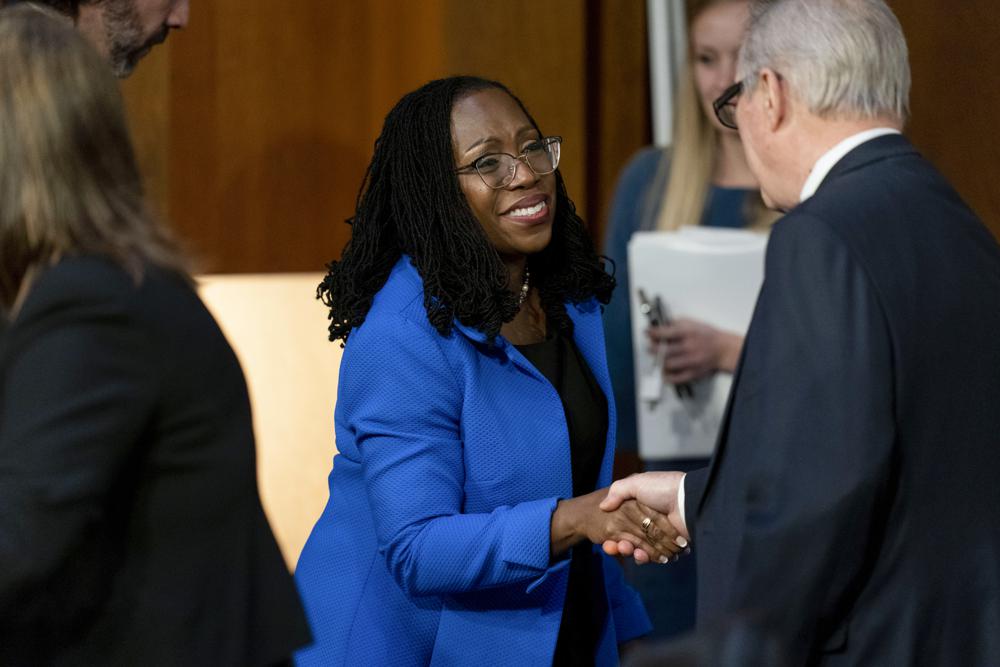
After more than 30 hours of hearings, the Senate is on track to confirm Ketanji Brown Jackson as the first Black woman on the Supreme Court. But Democrats seem unlikely to confirm her with a robust bipartisan vote, dashing President Joe Biden’s hopes for a grand reset after partisan battles over other high court nominees. On Thursday, just hours after the hearings came to a close, Senate Republican Leader Mitch McConnell announced he will vote against Jackson’s confirmation. He said in a Senate floor speech that he “cannot and will not” support her for a lifetime appointment. McConnell slammed the liberal groups that have supported Jackson, and he criticized her for refusing to take a position on the size of the nine-member court, even though that decision is ultimately up to Congress. Some advocacy groups have pushed for enlarging the court after three justices nominated by former President Donald Trump cemented a 6-3 conservative majority. McConnell also cited concerns about her sentencing of criminal defendants — a subject that dominated much of the four days of hearings and was part of a coordinated GOP effort to portray her as soft on crime. His position was expected and does not affect Jackson’s trajectory to be confirmed by mid-April. But the leader’s quick declaration could prompt many of his fellow Republicans to follow suit, thwarting Biden’s efforts to bring back the overwhelming bipartisan votes that were commonplace for Supreme Court nominees when he first came to the Senate five decades ago. “I think whomever I pick will get a vote from Republican side,” Biden said after Justice Stephen Breyer announced he would step down from the court this summer. As he started his search for a replacement, the president made a point of inviting Republican senators to the White House to hear their advice. While many GOP senators have praised Jackson’s vast experience and qualifications, it was clear at the hearings that Biden’s outreach had little effect. Republicans on the Senate Judiciary Committee interrogated Jackson about her nine-year record as a federal judge, frequently interrupting her answers. Jackson, supported by committee Democrats, pushed back aggressively on Republicans who said she gave light sentences to sex offenders, explaining her sentencing process in detail and telling them “nothing could be further from the truth.” The focus on crime dovetails with an emerging GOP theme for this year’s midterm elections and is likely to be decisive for many Republican senators. Others have brought up separate reasons to vote against her — from her support from liberal groups to her so-called “judicial philosophy.” One or more Republicans could still cast a vote for Jackson’s confirmation, but the contentious nature of the four-day hearings laid bare a familiar partisan dynamic, seen over years of pitched fighting over judicial nominations. Senate Judiciary Committee Chairman Dick Durbin, who has been privately lobbying GOP colleagues to support Jackson, said after McConnell’s announcement that it will be “sad for our country and sad as a commentary on where the parties are today” if her historic nomination is approved on a strictly partisan vote. “The Republicans are testing their messages for the November election,” Durbin said. Durbin said he is “still hoping that several Republicans — I hope many more” will vote for her. If not, Democrats can confirm Jackson without any GOP support in the 50-50 Senate, with Vice President Kamala Harris breaking a tie. As talk turned to the voting ahead, the Judiciary panel held its final day of Senate hearings Thursday with a top lawyers’ group, which said its review found Jackson has a “sterling” reputation and “exceptional” competence and is well qualified to sit on the Supreme Court. “Outstanding, excellent, superior, superb,” testified Ann Claire Williams, chair of the American Bar Association committee that makes recommendations on federal judges. “Those are the comments from virtually everyone we interviewed.” Williams said the group spoke to more than 250 judges and lawyers about Jackson. “The question we kept asking ourselves: How does one human being do so much so extraordinary well?” Jackson would be the third Black justice, after Thurgood Marshall and Clarence Thomas, and the sixth woman. She would also be the first former public defender on the court, and the first justice with experience representing indigent criminal defendants since Marshall. Her confirmation would not alter the current 6-3 conservative majority on the court. Durbin noted at Thursday’s hearing that some Republican senators argued that Jackson was out of the mainstream when it comes to sentencing, and he asked the ABA whether such a concern would have surfaced in their interviews with the judges and lawyers who worked with her. “It never came up in any of these interviews,” Williams said. During questioning Tuesday and Wednesday, GOP senators aggressively queried Jackson on the sentences she handed down to child pornography offenders in her nine years as a federal judge, her legal advocacy on behalf of suspected terrorists held at Guantanamo Bay, her thoughts on critical race theory, and even her religious views. Many of the hours of questioning were spent on the specifics of the child pornography cases, with the discussion led by several GOP senators who are eyeing the presidency. Pushing back, Jackson said she bases sentences on many factors, not just federal guidelines. Sentencing is not a “numbers game,” she said, noting that there are no mandatory sentences for sex offenders and that there has been significant debate on the subject. Democratic senators cited outside experts who said her sentences were within the norm. Some of those cases have given her nightmares, Jackson said, and were “among the worst that I have seen.” The GOP criticism was countered by effusive praise from Democrats and by reflections on the historic nature of her nomination. The most riveting came from New Jersey Sen. Cory Booker, who used his time Wednesday not to ask questions but to tearfully speak and draw tears from Jackson as well. Booker, who is Black, said he sees “my ancestors and yours” when he looks at Jackson. “I know what it’s taken
Mo Brooks responds to Donald Trump’s decision to rescind his U.S. Senate endorsement
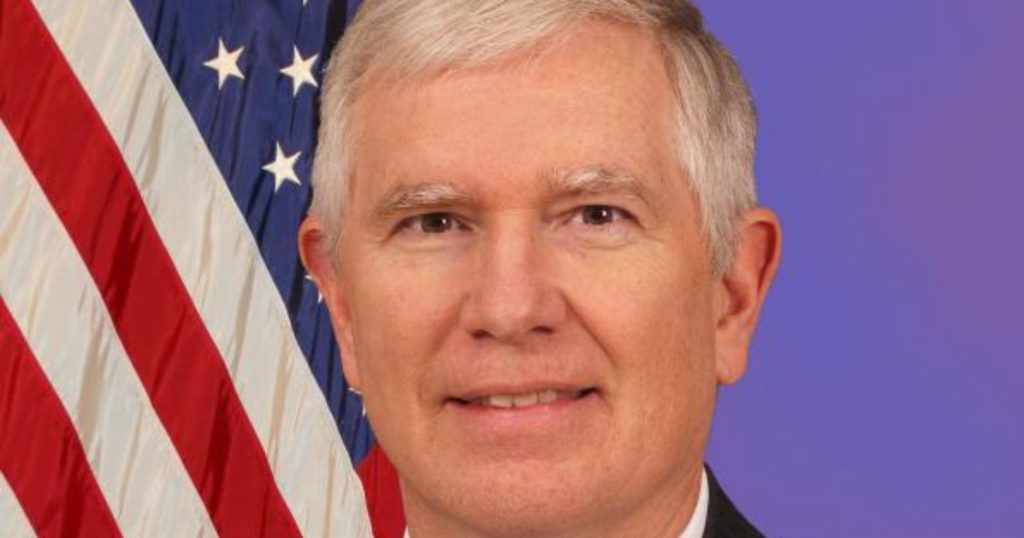
Congressman Mo Brooks responded to former President Donald Trump rescinding his endorsement of Brooks in Alabama’s U.S. Senate race. In a statement on his campaign website, Brooks stated, “It’s disappointing that, just like in 2017, President Trump lets Mitch McConnell manipulate him again. Every single negative TV ad against our campaign has come from McConnell and his allies. I wish President Trump wouldn’t fall for McConnell’s ploys, but, once again, he has. “I have not changed. I am the only proven America First candidate in this Senate race. I am the only candidate who fought voter fraud and election theft when it counted, between November 3 and January 6. “I repeat what has prompted President Trump’s ire. The only legal way America can prevent 2020’s election debacle is for patriotic Americans to focus on and win the 2022 and 2024 elections so that we have the power to enact laws that give us honest and accurate elections. “President Trump asked me to rescind the 2020 elections, immediately remove Joe Biden from the White House, immediately put President Trump back in the White House, and hold a new special election for the presidency. As a lawyer, I’ve repeatedly advised President Trump that January 6 was the final election contest verdict and neither the U.S. Constitution nor the U.S. Code permit what President Trump asks. Period. “I’ve told President Trump the truth knowing full well that it might cause President Trump to rescind his endorsement. But I took a sworn oath to defend and protect the U.S. Constitution. I honor my oath. That is the way I am. I break my sworn oath for no man. “I’m still the most conservative candidate in the race. Katie Britt’s campaign is supported and funded by McConnell allies, and she’s still a high taxing, open borders, cheap foreign labor, Chamber of Commerce lobbyist. “There’s only one conservative option in this race, and I am confident that the people of Alabama will see that on Election Day,” Brooks concluded.
Volodymyr Zelenskyy’s ‘desperate’ plea to Congress: Send more planes

Fighting for his country’s survival, Ukraine’s leader made a “desperate” plea Saturday to American lawmakers for the United States to help get more warplanes to his military and cut off Russian oil imports as Kyiv tries to stave off the Russian invasion. President Volodymyr Zelenskyy opened the private video call with U.S. lawmakers by telling them this may be the last time they see him alive. He has remained in Kyiv, the capital, which has a vast Russian armored column threatening from the north. Appearing in what is now his trademark army-green shirt in front of a white wall with the Ukrainian flag, he told them Ukraine needs to secure its skies, either through a no-fly zone enforced by NATO or through the provision of more warplanes so Ukraine could better defend itself. Zelenskyy has been pleading for a no-fly zone for days, but NATO has refused, saying it could provoke a widespread war with Russia. The hourlong exchange with some 300 members of Congress and their staffs came as Russian troops continued to shell encircled cities, and the number of Ukrainians who have fled the country grew to 1.4 million. “President Zelenskyy made a desperate plea,” said Senate Majority Leader Chuck Schumer. He said Zelenskyy wants the U.S. to facilitate the transfer of planes from Eastern European allies. “I will do all I can to help the administration to facilitate their transfer,” Schumer said. The U.S. is considering sending American-made F-16s as backfill to former Soviet bloc countries in Eastern Europe that are now members of NATO. They, in turn, would send Ukraine their own Soviet-era MiGs, which Ukrainian pilots are trained to fly. There appears to be a logistical problem, however, in sending the F-16s to Poland or other East European allies because of a production backlog. These countries would essentially have to give their MiGs to the Ukrainians and accept an IOU from the U.S. for the F-16s. The situation is further complicated because the next shipment of F-16s is set for Taiwan, and Congress would be reluctant to delay those deliveries as it eyes China. Secretary of State Antony Blinken indicated the fighter jets are under consideration after meeting with Ukrainian Foreign Minister Dymtro Kuleba at the Poland-Ukraine border outside the town of Korczowa. “We are talking about and working on everything,” Blinken told reporters. Blinken reiterated that the U.S. support for Ukraine “not only has been unprecedented, not only is it going to continue, it’s going to increase.” The U.S. Congress is working on a $10 billion package of military and humanitarian aid to Ukraine. Schumer told Zelenskyy lawmakers hope to send it quickly to Ukraine, according to a person on the call, and granted anonymity to discuss it. When Senate Republican leader Mitch McConnell asked about the types of military support his country needs, Zelenskyy said drones as well as planes would be the most helpful. During the call, Democratic Sen. Joe Manchin of West Virginia asked Zelenskyy about the idea of banning the import of Russian oil to the U.S., according to two other people granted anonymity to discuss the private call. They said Zelenskyy indicated such a ban would be effective in putting pressure on Russia. Republicans and a growing number of Democrats, including Speaker Nancy Pelosi, back the idea of a Russian oil import ban. The Biden administration has so far resisted that step, worried about rising prices at the pump. Zelenskyy urged U.S. lawmakers to sanction Russia’s oil and gas sector, which has so far escaped the mounting sanctions imposed by the Biden administration and other countries. The Ukrainian leader also urged lawmakers to suspend Visa and Mastercard credit card access in Russia — and the two announced later Saturday that they were doing just that. Mastercard said cards issued by Russian banks will no longer be supported by its network, and any card issued outside the country will not work at Russian stores or ATMs. Visa said it’s working with clients and partners in Russia to cease all Visa transactions over the coming days. In a video posted to Twitter after the call, Sen. Lindsey Graham, R-S.C., said: “Anything that could hurt the Russian economy will help the Ukrainian people and may make this war more difficult for Putin.” Zelenskyy’s office said he also suggested the U.S. consider imposing an embargo on all Russian goods and stripping Russia of its most-favored-nation trade status. Lawmakers are concerned that Zelenskyy will be killed in the Russian invasion. They are also worried that a Ukrainian government under assault will be unable to function and to receive aid. When one lawmaker asked diplomatically what would happen if he was killed, Zelenskyy acknowledged the concerns but implored Congress to do whatever it can to help Ukraine fight off Russia’s assault on his country. Sen. Ben Sasse, R-Neb., said in a statement that Zelenskyy’s “message is simple: ‘close the skies or give us planes.’”
Congress backs Joe Biden on Russia sanctions, clamors for more
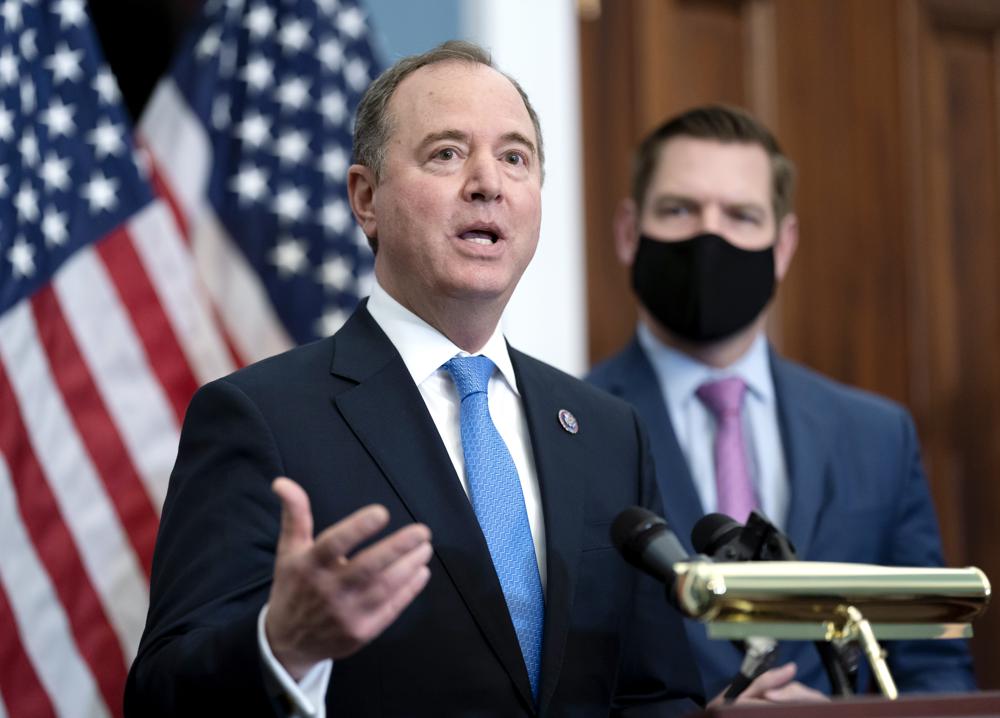
With rare but fragile alignment, the U.S. Congress is largely backing President Joe Biden’s decision to confront Russia with potentially escalating sanctions for the crisis in Ukraine as lawmakers brace for perhaps the most daunting foreign policy crisis the nation has faced in a generation. But the next steps are highly volatile. With isolationist impulses rising at home, Congress has no appetite for war. Yet Americans also appear ambivalent about the U.S. working to keep the peace. New polling from The Associated Press and NORC says just 26% of Americans want the U.S. to play a major role in the Russia-Ukraine conflict. House Speaker Nancy Pelosi said Wednesday that Russia’s aggression toward Ukraine is “an attack on democracy,” vowing that the U.S. will stand united with its allies around the world in swiftly imposing sanctions on Russia and ensuring financial and political support for an independent Ukraine. Pelosi, who returned to the Capitol from a diplomatic overseas trip, situated the aggression from Russia toward Ukraine alongside intervention in the United States’ own democratic process during the 2016 election. “There will be a price to pay for Vladimir Putin,” she said, flanked by lawmakers who had joined her delegation at the annual security conference in Munich. While Republican critics of the Biden administration — and even some Democrats — want the White House to go even tougher with swifter and more severe sanctions on Russia, most have given varying degrees of support for the White House strategy, including Biden’s move Wednesday to sanction the company building the Russia-to-Germany Nord Stream 2 gas pipeline. The top Republican on the Foreign Relations Committee, Sen. Jim Risch of Idaho, said sanctions on Nord Stream 2 are “long overdue, but I cannot overstate how critical they are to showing Putin that violating a nation’s sovereignty has consequences.” Risch, who has worked with colleagues on a bipartisan basis for years trying to end the pipeline, said: “It is good to see President Biden do the right thing.” Republican leaders have sought to steer the conversation to their preferred terms, as the party whose defense hawks once led the nation on the national security front. But it’s not at all clear whether today’s GOP can keep Republicans from tapping into an impassioned non-interventionist strain unleashed by Donald Trump’s “America First” approach. It was Trump who sought to strip protections for Ukraine from the Republican Party platform for the 2016 election and who was impeached by the House for abuse of power after he pressured the Ukrainian president to dig up dirt on Biden ahead of the 2020 campaign. This week, Trump cheered on Putin as he massed military forces near Ukraine’s border and recognized the independence of its separatist regions in a move Biden and others warned was the start of an invasion of Ukraine. As president, Trump had been critical of NATO, working to distance the U.S. from the historic partnership and berating allies to contribute more money to defense. Senate Republican leader Mitch McConnell, a longtime champion of NATO, spoke highly of the Western alliance this week, but some within his party are gravitating away from that traditional Republican position and toward Trump’s views. McConnell said he wants to see Biden impose the “toughest possible sanctions.” Other Republicans, though, most notably Sen. Josh Hawley of Missouri, a potential Republican presidential hopeful, has said the U.S. should be paying closer attention to the greater challenges he believes are posed by China. Still, most Republican senators are backing Biden’s sanctions on Putin, even if some are clamoring for more and taking political punches at Biden for seeming too tepid. Republican Sen. Lindsey Graham of South Carolina, a sometimes Trump ally who is also one of the party’s leading defense hawks and who used to globetrot with fellow GOP Sen. John McCain, invoked his late colleague this week in urging Biden to confront Putin more forcefully. Graham said Congress should impose “sanctions from hell” on Putin and his regime when lawmakers return to work next week. Sen. Ted Cruz, who had single-handedly blocked Biden’s nominees for various State Department posts to halt the Russia-to-Germany pipeline, said with the announced new sanctions, he would lift his blockade. “President Biden has now taken positive steps,” Cruz, R-Texas, said in a statement. “But much more still needs to be done to deter and counter the threat that Putin poses to our allies in Ukraine and across Europe.” Pelosi said Russians need to understand what their leader is doing. “It’s stunning to see in this day and age a tyrant roll into a country,” Pelosi said. “This is the same tyrant who attacked our democracy in 2016,” It’s unclear what more, if anything, Congress will do to confront Russia, as lawmakers hold back their own legislative response to Putin while Biden engages U.S. allies in a more global strategy. The Senate has bipartisan support for a robust sanctions package, but after running into differences over the scope and timing of the response decided to shelve a vote as the White House pursued its own approach. Graham has suggested a supplemental spending package for Ukraine, which already receives money and defensive equipment from the U.S., but it does not yet appear that additional funds are being considered. Republished with the permission of the Associated Press.
$2T bill stalled, Senate Dems seem ready to move on for now
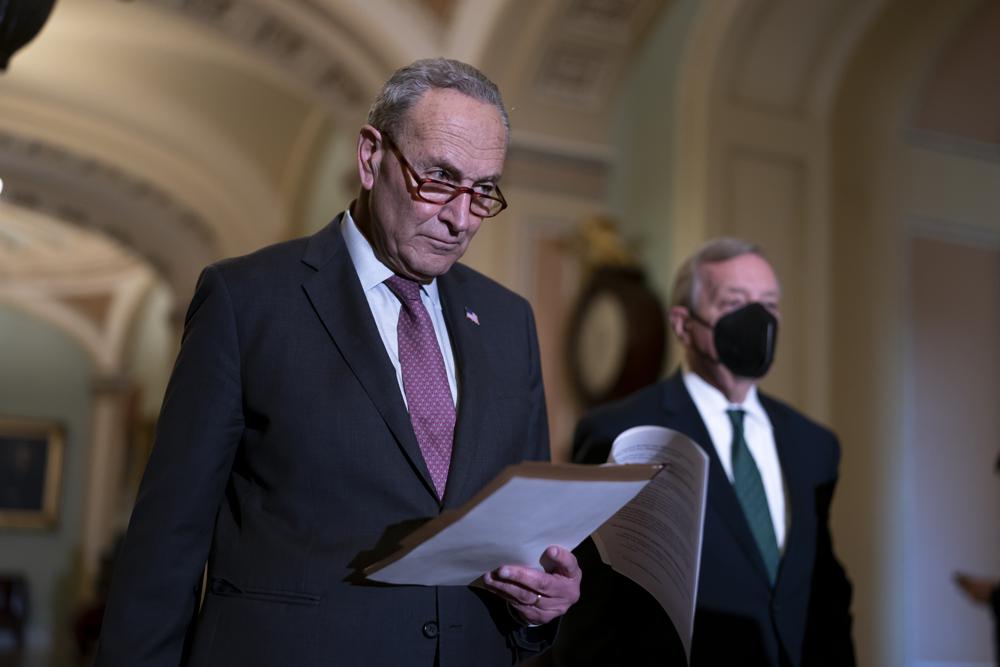
Democrats’ vast social and environment package was stuck in the Senate on Thursday as leaders’ hopes for an accord with holdout Sen. Joe Manchin and approval of their flagship domestic measure in the year’s waning days seemed all but dead. After a closed-door lunch among Senate Democrats, Sen. Ben Cardin, D-Md., told reporters that a statement by President Joe Biden was expected shortly giving an update on “his conversations with Sen. Manchin and others.” Talks on the 10-year, roughly $2 trillion bill between Biden and Manchin, who wants to cut and reshape the measure, are said to have yielded little progress. Majority Leader Chuck Schumer, D-N.Y., had set Senate passage before Christmas as his goal, but disputes with Manchin and other Democrats remain. It has become clear that the party is seeking explicit intervention from Biden in hopes he will cut a deal with Manchin, D-W.Va., or urge lawmakers to delay action until January. Biden “wants to get this done as soon as possible,” White House spokesperson Karine Jean-Pierre told reporters. She added, “But we understand it’s going to take time, and we’re going to continue to do the work.” Schumer barely mentioned the legislation as the day’s business began. Instead, he described Democrats’ efforts to break a logjam on voting rights legislation and a pile of nominations the Senate will consider “as we continue working to bring the Senate to a position where we can move forward” on the social and environment bill. Using his sway in a 50-50 Senate where Democrats need unanimity to prevail, Manchin has continued his drive to force his party to cut the bill’s cost and eliminate programs he opposes. All Republicans oppose the package, arguing the measure carrying many of Biden’s paramount domestic priorities is too expensive and would worsen inflation. “The best Christmas gift Washington could give working families would be putting this bad bill on ice,” said Senate Minority Leader Mitch McConnell, R-Ky. The rocky status of the Biden-Manchin talks was described Wednesday by a person who spoke only on condition of anonymity. The person said Manchin was pushing to eliminate the bill’s renewal of expanded benefits under the child tax credit, a keystone of Democratic efforts to reduce child poverty. Manchin told reporters Wednesday that assertions he wants to strip the child tax credit improvements were “a lot of bad rumors.” Asked if he backed eliminating one of the bill’s child tax credit improvements — monthly checks sent to millions of families — he said, “I’m not negotiating with any of you.” Adding further doubt about quick Senate action this year, Biden suggested that Democrats should instead prioritize voting rights legislation, a primary party goal that Republicans have long stymied. Democrats face an uphill fight on the voting measure, but focusing on it would let them wage a battle that energizes the party’s voters while lawmakers work behind the scenes on the social and environment bill. Asked whether Congress should quickly consider the voting legislation and delay the $2 trillion bill to next year, Biden told reporters, “If we can get the congressional voting rights done, we should do it.” He added, “There’s nothing domestically more important than voting rights.” Biden spoke Wednesday as he toured tornado damage in Dawson Springs, Kentucky. Letting the social and environment legislation slip into next year, when congressional elections will be held, would be ominous for the bill’s ultimate prospects. With Democrats having blown past previous self-imposed deadlines on the push, another delay would fuel Republican accusations that they are incompetently running a government they control. Democrats are bracing for November elections when the GOP has a real chance of winning control of the House and Senate. Word of Manchin’s stance prompted a backlash from colleagues, whom he’s frustrated for months with constant demands to cut the bill’s size and scope. The measure also has money for health care, universal prekindergarten, and climate change programs largely paid for with tax boosts on big corporations and the rich. The second-ranking Democrat, Sen. Richard Durbin of Illinois, said “the level of emotion” among Democrats over the child tax credit “is very high,” and said he was “stunned” when he heard about Manchin’s demands. Manchin has wanted the overall bill’s 10-year price tag to fall below $2 trillion. He also wants all its programs to last the full decade. The current bill would extend the enhanced child tax credit for just one year, a device to contain the bill’s cost. Renewing the improved benefits for ten years would increase its current one-year cost of around $100 billion to over $1 trillion, and doing that while cutting the overall bill’s size would wreak havoc on Democrats’ other priorities in the bill. The Treasury Department says the expanded tax credit has helped the families of 61 million children. Another impediment to Democrats is a time-consuming review by the Senate parliamentarian, Elizabeth MacDonough, about whether many of the bill’s provisions violate the chamber’s rules and should be dropped. Her written opinions on that, including on provisions letting many migrants remain temporarily in the U.S., may not be ready until the weekend or later. Manchin’s other demands have included removing a new requirement for paid family leave. Disputes among other lawmakers include how to increase federal tax deductions for state and local taxes. The House approved its version of the legislation in November. Republished with the permission of the Associated Press.
Senate votes to raise debt limit by $2.5T, avoiding default
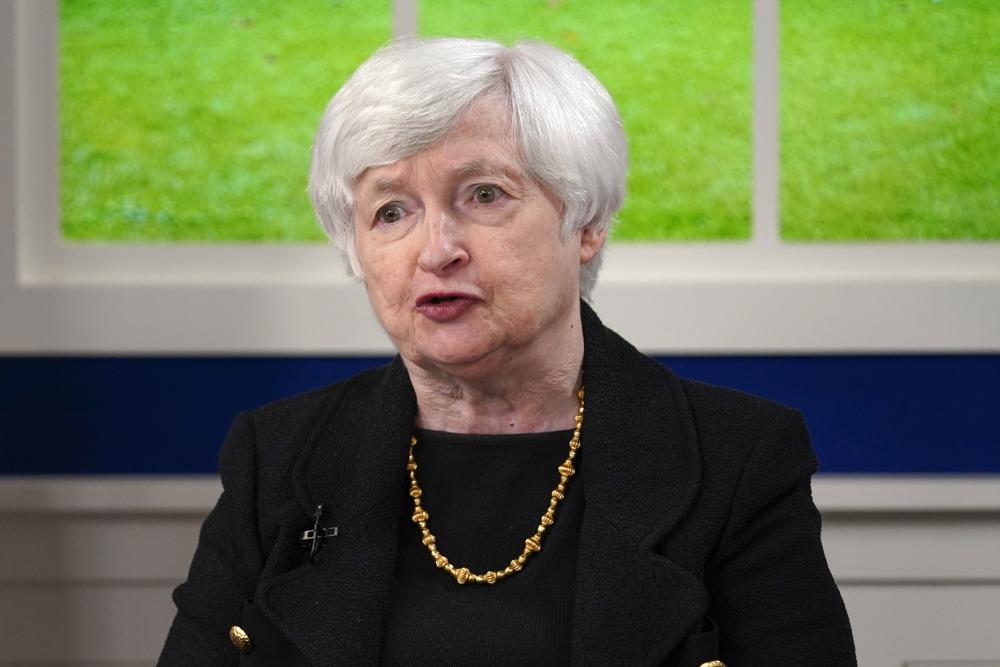
The Senate approved legislation Tuesday to lift the nation’s debt limit by $2.5 trillion under a deal struck between party leaders, defusing a volatile issue until after next year’s midterm elections while saddling majority Democrats with a tough vote. The 50-49 party-line vote came just one day shy of a deadline set by Treasury Secretary Janet Yellen, who warned last month that she was running out of maneuvering room to avoid the nation’s first-ever default. The measure now moves to the House where a vote could come as early as Tuesday night, sending it to President Joe Biden’s desk. “This is about paying debt accumulated by both parties, so I’m pleased Republicans and Democrats came together,” Senate Majority Leader Chuck Schumer, D-N.Y., said of the agreement, which created a workaround that allowed Democrats to avoid a Republican filibuster. Despite a seemingly straightforward name, the nation’s debt limit does little to curtail future debt. Established in 1917, it instead serves as a brake on spending decisions already approved by Congress and the White House — some decades ago — that if left unpaid, could cripple markets, send the economy into a tailspin and shake global confidence in the U.S. That hasn’t stopped Republican saber-rattling. For months, they’ve used the debt limit to attack Democrats’ big-spending social and environmental agenda while pledging to staunchly oppose the current effort to increase the threshold. As recently as October, Senate Minority Leader Mitch McConnell said he would not “be a party to any future effort to mitigate the consequences of Democratic mismanagement.” In striking a deal, McConnell backtracked on his word. But he also got much of what he wanted: Democrats taking a politically difficult vote without Republican support while increasing the limit by a staggering dollar figure that is sure to appear in future attack ads. “If they jam through another taxing and spending spree, this massive debt increase will just be the beginning,” the Kentucky Republican said Tuesday. The decision, however, has proven unpopular with some Republicans, particularly Donald Trump. The former president has railed against the deal repeatedly, calling McConnell a “Broken Old Crow” who “didn’t have the guts to play the Debt Ceiling card, which would have given the Republicans a complete victory on virtually everything.” “GET RID OF MITCH!” Trump said in a statement issued Sunday. Republican Sen. Mike Lee of Utah also criticized the intricate process Schumer and McConnell agreed to, which he warned could be used in the future to “launder” potentially unpopular votes while bypassing the Senate’s normal mode of operation. Under the agreement, an amendment was made to an unrelated Medicare bill that passed last week with Republican votes. It created a one-time, fast-track process for raising the debt limit that allowed Democrats to do so with a simple majority, bypassing the 60 vote threshold to avoid a GOP filibuster. Lee said the process was intended to make the Republican votes last week “appear as something other than helping Democrats raise the debt ceiling,” which he said Republican leadership “committed, in writing no less, not to do.” Yet Republican arguments against debt limit increases often ignore inconvenient facts. The nation’s current debt load of $28.9 trillion has been racking up for decades. Major drivers include popular spending programs like Social Security and Medicare, interest on the debt, and recent COVID-19 relief packages. But taxation is also a major factor, and a series of tax cuts enacted by Republican presidents in recent decades has added to it, too. The national debt includes $7.8 trillion heaped onto the pile during Trump’s four-year presidency, an analysis of Treasury records shows. The GOP-championed 2017 tax cut is projected to add between $1 trillion and $2 trillion to the debt, according to the nonpartisan Tax Policy Center. Republished with the permission of the Associated Press.
Bob Dole honored in Kansas as tough but compassionate statesman

Fellow Kansans on Saturday celebrated Bob Dole as a tough but compassionate patriot shaped by small-town values, a strong partisan leader who could nevertheless work with political opponents, and a war hero who ultimately became “the greatest of the Greatest Generation.” Dole made his last journey to his prairie state for memorial services in his western Kansas hometown of Russell and at the Statehouse in Topeka. He was honored for the military service during World War II that left him severely wounded and the distinguished political career that followed his recovery. Elected officials and former elected officials from both parties said Dole embodied the state’s motto, “To the stars through difficulties,” and never stopped trying to help others. “He did not hide in a time of crisis. He looked for solutions,” former U.S. Rep. Jim Slattery, a Kansas Democrat, said during the Statehouse event. ”I often told Bob he was the toughest man I ever knew, both physically and mentally, but he had a tender heart.” Dole died Sunday at the age of 98 after a lifetime of service that included nearly 36 years in Congress and running as the GOP nominee for president in 1996. U.S. Senate Minority Leader Mitch McConnell, who served more than a decade with Dole in the Senate and later surpassed Dole as the longest-serving GOP leader there, attended both Kansas events as well. Saturday’s events began with a public viewing of his casket and a memorial service at a Roman Catholic church in Russell, the small town some 240 miles (386 kilometers) west of Kansas City where he grew up during the Great Depression. Speakers for the state capital event Saturday afternoon noted that Dole’s career in elective office began in the Kansas House in the early 1950s. The dignitaries at both events included Democratic Gov. Laura Kelly, Kansas’ two Republican U.S. senators, Roger Marshall and Jerry Moran, and former GOP U.S. Sens. Pat Roberts and Nancy Kassebaum Baker. Kelly said in remarks in Dole’s hometown that Russell was “where his roots run deepest.” Dignitaries in dark, formal business attire mixed in the congregation with local residents dressed in less formal farm and work clothes, a KWCH-TV live stream showed. “As we gather here today to come together to salute our state’s most favorite of favorite sons and the greatest of the Greatest Generation, we pause to reflect with immense gratitude on all that Bob Dole’s life meant to Kansas and to Kansans, to our nation and to the world,” Kelly said. Dole — known for a caustic wit that he sometimes turned on himself — also was honored Friday during a service at Washington National Cathedral. President Joe Biden was among the speakers there. Another tribute followed at the World War II Memorial in Washington — a monument to Dole’s generation that he worked to get built. Dole became known as a congressional leader who could bridge partisan divides to pass legislation such as the landmark Americans with Disabilities Act aimed at preventing discrimination on the basis of disability. In Russell, Moran attributed that ability to Dole’s ties to a small town, where people who disagree on politics still mix in their daily lives. Speakers also pleaded for more civility in politics, with Kelly calling on her Statehouse audience to “pledge ourselves to be more like Bob Dole.” Moran added: “Think of all the things he’s been through and how hope had to be so important to his life to get through the day.” Dole will be buried in Arlington National Cemetery, but his casket was flown Friday evening to Salina, Kansas, then transported 70 miles (113 kilometers) west to his boyhood hometown, which now has about 4,400 residents. Oil production allowed Russell to boom when Dole was growing up, even during the Great Depression, with the first local well drilled in 1923, the year he was born. In Russell, Moran quoted Dole’s speech accepting the 1996 presidential nomination, in which Dole said, “the first thing you learn on the prairie is the relative size of a man compared to the lay of the land.” “His family and this community endured the Dust Bowl of the Great Depression,” Moran said. “In Russell, you could feel and see the challenges, the obstacles, the barriers that were put in people’s lives. Nothing was easy.” Republished with the permission of the Associated Press.
Senate leader, presidential candidate Bob Dole dies at 98

Bob Dole, who overcame disabling war wounds to become a sharp-tongued Senate leader from Kansas, a Republican presidential candidate and then a symbol and celebrant of his dwindling generation of World War II veterans, died Sunday. He was 98. His wife, Elizabeth Dole, said in an announcement posted on social media that he died in his sleep. Dole announced in February 2021 that he’d been diagnosed with stage 4 lung cancer. During his 36-year career on Capitol Hill, Dole became one of the most influential legislators and party leaders in the Senate, combining a talent for compromise with a caustic wit, which he often turned on himself but didn’t hesitate to turn on others, too. He shaped tax policy, foreign policy, farm and nutrition programs, and rights for the disabled, enshrining protections against discrimination in employment, education, and public services in the Americans with Disabilities Act. Today’s accessible government offices and national parks, sidewalk ramps, and the sign-language interpreters at official local events are just some of the more visible hallmarks of his legacy and that of the fellow lawmakers he rounded up for that sweeping civil rights legislation 30 years ago. Dole devoted his later years to the cause of wounded veterans, their fallen comrades at Arlington National Cemetery, and remembrance of the fading generation of World War II vets. Thousands of old soldiers massed on the National Mall in 2004 for what Dole, speaking at the dedication of the World War II Memorial there, called “our final reunion.” He’d been a driving force in its creation. “Our ranks have dwindled,” he said then. “Yet if we gather in the twilight, it is brightened by the knowledge that we have kept faith with our comrades.” Long gone from Kansas, Dole made his life in the capital, at the center of power and then in its shadow upon his retirement, living all the while at the storied Watergate complex. When he left politics and joined a law firm staffed by prominent Democrats, he joked that he brought his dog to work so he would have another Republican to talk to. He tried three times to become president. The last was in 1996 when he won the Republican nomination only to see President Bill Clinton reelected. He sought his party’s presidential nomination in 1980 and 1988 and was the 1976 GOP vice presidential candidate on the losing ticket with President Gerald Ford. Through all of that, he carried the mark of war. Charging a German position in northern Italy in 1945, Dole was hit by a shell fragment that crushed two vertebrae and paralyzed his arms and legs. The young Army platoon leader spent three years recovering in a hospital and never regained use of his right hand. To avoid embarrassing those trying to shake his right hand, Dole always clutched a pen in it and reached out with his left. Dole could be merciless with his rivals, whether Democrat or Republican. When George H.W. Bush defeated him in the 1988 New Hampshire Republican primary, Dole snapped: “Stop lying about my record.” If that pales next to the scorching insults in today’s political arena, it was shocking at the time. But when Bush died in December 2018, old rivalries were forgotten as Dole appeared before Bush’s casket in the Capitol Rotunda. As an aide lifted him from his wheelchair, Dole slowly steadied himself and saluted his one-time nemesis with his left hand, his chin quivering. In a vice presidential debate two decades earlier with Walter Mondale, Dole had famously and audaciously branded all of America’s wars that century “Democrat wars.” Mondale shot back that Dole had just “richly earned his reputation as a hatchet man.” Dole at first denied saying what he had just said on that very public stage, then backed down and eventually acknowledged he’d gone too far. “I was supposed to go for the jugular,” he said, “and I did — my own.” For all of his bare-knuckle ways, he was a deep believer in the Senate as an institution and commanded respect and even affection from many Democrats. Just days after Dole announced his dire cancer diagnosis, President Joe Biden visited him at his home to wish him well. The White House said the two were close friends from their days in the Senate. Biden recalled in a statement Sunday that one of his first meetings outside the White House after being sworn-in as president was with the Doles at their Washington home. “Like all true friendships, regardless of how much time has passed, we picked up right where we left off, as though it were only yesterday that we were sharing a laugh in the Senate dining room or debating the great issues of the day, often against each other, on the Senate floor,” Biden said. “I saw in his eyes the same light, bravery, and determination I’ve seen so many times before.” Biden ordered that U.S. flags be flown at half-staff at the White House and all public buildings and grounds until sunset Thursday. Dole won a seat in Congress in 1960, representing a western Kansas House district. He moved up to the Senate eight years later when Republican incumbent Frank Carlson retired. There, he antagonized his Senate colleagues with fiercely partisan and sarcastic rhetoric, delivered at the behest of President Richard Nixon. The Kansan was rewarded for his loyalty with the chairmanship of the Republican National Committee in 1971 before Nixon’s presidency collapsed in the Watergate scandal. He served as a committee chairman, majority leader, and minority leader in the Senate during the 1980s and ’90s. Altogether, he was the Republicans’ leader in the Senate for nearly 11½ years, a record until Kentucky Sen. Mitch McConnell broke it in 2018. It was during this period that he earned a reputation as a shrewd, pragmatic legislator, tireless in fashioning compromises. After Republicans won Senate control, Dole became chairman of the tax-writing Finance Committee and won acclaim from deficit hawks and others for his handling of a 1982 tax
House votes to avert shutdown, but quick Senate approval in doubt
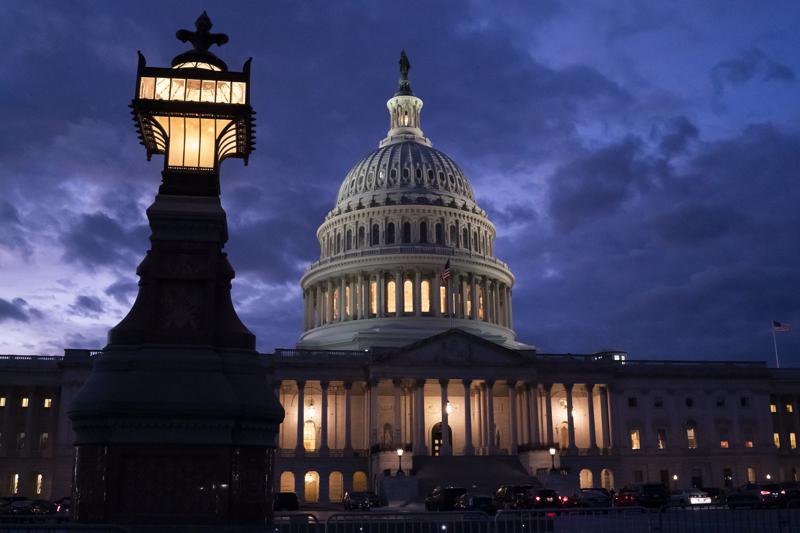
The House passed a bill Thursday that funds the government through February 18 and avoids a short-term shutdown after midnight Friday, but quick Senate approval was in doubt because of a fight over President Joe Biden’s COVID-19 vaccine mandates. An agreement among congressional leaders announced earlier in the day would keep the government running for 11 more weeks, generally at current spending levels, while adding $7 billion to aid Afghanistan evacuees. The Democratic-led House passed the measure by a 221-212 vote. The Republican leadership urged members to vote no; the lone GOP vote for the bill came from Illinois Rep. Adam Kinzinger. Lawmakers bemoaned the short-term fix and blamed the opposing party for the lack of progress on this year’s spending bills. Rep. Rosa DeLauro, chair of the House Appropriations Committee, said the measure would, however, allow for negotiations on a package covering the remainder of the budget year through September. “Make no mistake, a vote against this continuing resolution is a vote to shut government down,” DeLauro said during the House debate. Before the House acted, President Joe Biden said he had spoken with Senate leaders, and he played down fears of a shutdown. “There is a plan in place unless somebody decides to be totally erratic, and I don’t think that will happen,” Biden said. Conservative Republicans opposed to Biden’s vaccine rules want Congress to take a hard stand against the mandated shots for workers at larger businesses, even if that means shutting down federal offices over the weekend. It was just the latest instance of the brinkmanship around government funding that has triggered several costly shutdowns and partial closures over the past two decades. The longest shutdown in history happened under President Donald Trump — 35 days stretching into January 2019, when Democrats refused to approve money for his U.S-Mexico border wall. Both parties agree the stoppages are irresponsible, yet few deadlines pass without a late scramble to avoid them. Republicans said during the debate that they had made it clear in the summer that they would not support spending bills that include “irresponsible spending increases and extreme policies.” “Unfortunately, that is exactly where we find ourselves,” said Rep. Kay Granger, R-Texas. Democrats were able to use their majority to advance the spending bill. They have a more difficult task in the 50-50 Senate, where objections by just one senator can slow a final vote past Friday’s midnight deadline. That could mean a short-term shutdown into the weekend. Sen. Mike Lee, R-Utah, said Democrats knew last month from a letter that several Republicans would use all means at their disposal to oppose legislation that funds or allows the enforcement of the employer vaccine mandate. He blamed Senate Majority Leader Chuck Schumer, D-N.Y., for not negotiating and for ignoring their position. If the choice is between “suspending nonessential functions” or standing idle while Americans lose their ability to work, “I’ll stand with American workers every time,” Lee said. GOP senators said the idea is to vote on stripping money that the Occupational Safety and Health Administration would use to implement the requirement that private employers with 100 or more workers ensure they are vaccinated or regularly tested. “This is a chance to correct a wrong,” said Sen. Roger Marshall, R-Kan., who undertook a similar effort against vaccine mandates during the last government funding standoff. Schumer said it was “not easy to reach this deal” and that while most Republicans do not want a shutdown, a “few individual Republican senators appear determined to derail this important legislation because of their opposition to the president’s lifesaving vaccine guidelines.” “Let’s be clear, if there is a shutdown, it will be a Republican, anti-vaccine shutdown,” Schumer said. The White House sees vaccinations as the quickest way to end a pandemic that has killed more than 780,000 people in the United States and is still evolving, as seen Wednesday with the country’s first detected case of a troubling new variant. Courts have knocked back against the mandates, including a ruling this week blocking enforcement of a requirement for some health care workers. For some Republicans, the court cases and lawmakers’ fears about a potentially disruptive shutdown are factors against engaging in a high-stakes shutdown. “One of the things I’m a little concerned about is: Why would we make ourselves the object of public attention by creating the specter of a government shutdown?” said Texas Sen. John Cornyn, a GOP leader. “There’s too much chaos in our country right now, too much concern about omicron. The last thing we need is more confusion and fear,” said Sen. Mitt Romney, R-Utah. Senate Minority Leader Mitch McConnell, R-Ky., reiterated that there will be no shutdown. “We’re not going to do that,” he said Thursday. The administration has pursued vaccine requirements for several groups of workers, but the effort is facing legal setbacks. A federal judge this week blocked the administration from enforcing a vaccine mandate on thousands of health care workers in 10 states. Earlier, a federal appeals court temporarily halted the OSHA requirement affecting employers with 100 or more workers. The administration has also put in place policies requiring millions of federal employees and federal contractors, including military troops, to be fully vaccinated. Those efforts are also under challenge. Polling from The Associated Press shows Americans are divided over Biden’s effort to vaccinate workers, with Democrats overwhelmingly for it while most Republicans are against. Some Republicans prefer an effort from Sen. Mike Braun, R-Ind., to vote to reject the administration’s mandates in a congressional review action expected next week, separate from the funding fight. Separately, some health care providers protested the stopgap spending measure. Hospitals say it does nothing to shield them from Medicare payment cuts scheduled to go into effect amid uncertainty about the new omicron variant. Republished with the permission of the Associated Press.
