
Raphael Warnock and Kelly Loeffler work to consolidate voters for runoff

When Georgia Republican Kelly Loeffler and Democrat Raphael Warnock advanced to the Jan. 5 U.S. Senate runoff, they faced the immediate challenge of winning over the 2 million voters who chose one of the 18 other candidates in November’s election. Polls show they have largely succeeded, and that could give Loeffler, the incumbent, a small advantage. Republican U.S. Rep. Doug Collins came in third in the November vote that ended with the Republican candidates winning 48,000 more votes than the Democratic candidates. In Georgia’s second runoff election, Republican U.S. Sen David Perdue started with an even wider lead, having won 88,000 more votes in November than Democrat Jon Ossoff. Since he didn’t get a majority, however, Perdue was forced into a runoff. Turnout could be the deciding factor. Through Wednesday, nearly 2.1 million voters had cast ballots, roughly on pace with the Nov. 3 general election. It’s unclear how the Christmas holiday will affect the pace of balloting. In-person early voting runs as late as Dec. 31 in some counties. On Sunday night, President Donald Trump tweeted that he would visit Georgia on Jan. 4, the eve of the runoff, for a rally in support of Perdue and Loeffler. One thing helping line voters up is the decision of the candidates in both races to run as tickets, with joint appearances and advertisements. J. Miles Coleman of the University of Virginia Center for Politics said the joint effort has helped Warnock wrap up Democratic voters. “He and Ossoff have done a better job of running as a ticket,” Coleman said. “I think overall that’s going to benefit Warnock and help him consolidate some of his support.” With the candidates running as tickets, it’s unlikely the parties will split the seats. Two wins would put Democrats in control of the U.S. Senate with Vice President-elect Kamala Harris breaking a 50-50 tie. A split or two GOP wins would keep Republicans in control. Deborah Jackson, a former mayor of the Atlanta suburb of Lithonia, came in fourth in November, the runner-up Democrat behind Warnock. She benefitted from being a Black woman, a known quantity in the Democratic stronghold of DeKalb County and the first Democrat listed on a ballot so long that Warnock had to remind supporters to go all the way down to find his name. “I had tangible and practical experience,” Jackson said. “I think some people were interested in that.” She said some people were offended that leading state and national Democrats tried to clear the field for Warnock, but said she’s still supporting him without reservation. “The Democrats need to be in control of the Senate, or at least there needs to be a balance,” Jackson said. At least one of Jackson’s supporters agrees. Laura Durojaiye of Stonecrest said she’s already voted for Warnock. “I think he’ll get all her votes,” Durojaiye said, saying she thinks Warnock is someone who will learn in the Senate and back her priorities of addressing climate change and societal inequity. Shane Hazel, the Libertarian who won the key sliver of votes that forced Perdue and Ossoff into a runoff, said his voters may sit the runoff out, telling Hazel “they will never vote for anybody out of fear again.” One of the top early voting counties in the state is Rabun — in Georgia’s northeastern corner — where Trump and Perdue both won 78% of the vote. “I’m convinced the Democrats could run Mother Teresa and get 20%,” said Ed Henderson, secretary of the Rabun County Republican Party. As in the other counties in his northeast Georgia congressional district, Collins was the top vote-getter in the Senate special election. “This was Collins country,” Henderson said. Collins, though, has been a strong supporter of Loeffler and Perdue. Although nearly 40% of Rabun’s registered voters have already cast ballots, Henderson said he worries that Trump’s ceaseless attacks on the integrity of Georgia’s presidential election will hurt Republican turnout there, citing the “godlike reverence” residents have for the president, “My biggest problem this election cycle is there is a distrust of the system,” Henderson said, saying a handful of hardcore Republicans have told him they are sitting the election out, saying they believe Trump was cheated, despite little credible evidence of wrongdoing. Henderson also frets that Loeffler has never been to his county, so far from Atlanta that many watch out-of-state television. “It would be greatly helpful if they would come up here in person and tell our voters they would like to get our vote,” Henderson said of the Republican candidates. Democrats have their own trouble. Early voting is lagging in Georgia’s smaller urban areas including Savannah, Augusta, Macon, and Columbus, and Democratic vote totals have been disappointing in rural areas. “The Democrats have really struggled to turn out Black voters in rural parts of the state,” Coleman said. “Are the Democrats going to be able to do well enough in the rural parts of the state?” Republished with the permission of the Associated Press.
Rush Limbaugh draws bipartisan criticism for Pete Buttigieg remarks
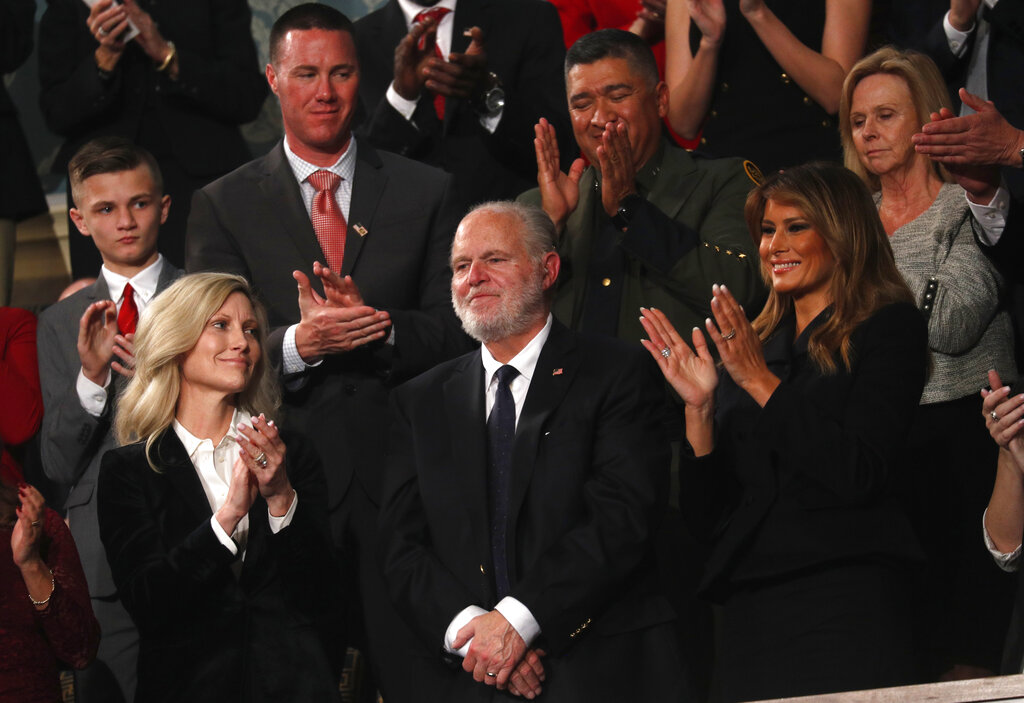
Limbaugh’s comments came eight days after Donald Trump awarded him the nation’s top civilian honor.
CIA’s Gina Haspel can tap undercover work in Russian operations
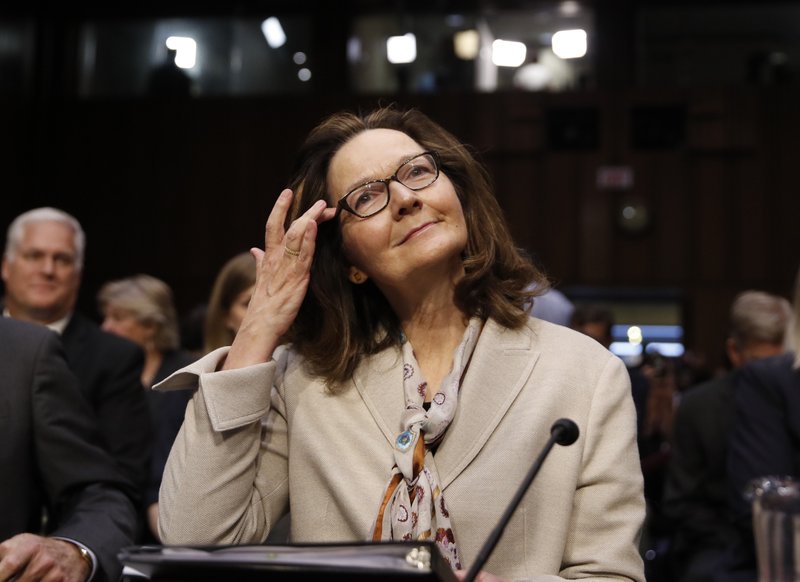
Scrutiny of the 33-year spy career of new CIA director Gina Haspel has focused on her undercover role in the harsh interrogation of suspected terrorists, but she cut her teeth in intelligence operations against Russia. She’s sure to tap that latter experience as she takes over at the nation’s premier intelligence agency at a time of rising tension with Moscow. President Donald Trump has characterized it as worse than during the Cold War, and it’s been aggravated by investigations into Moscow’s interference in the election that brought Trump to power. The 61-year-old Haspel, confirmed by the Senate this past week as the CIA’s first female director, began her career in the mid-1980s when the Soviet Union was in its twilight. Even after the communist power disintegrated, U.S. and Russian spy services held to Cold War mode. Haspel worked in the shadows to counter Kremlin efforts to infiltrate the U.S. government. Russia has been a priority target throughout her career. That was clear when former Sen. Evan Bayh, D-Ind., introduced Haspel at her Senate hearing: “She is a clear-eyed, hard-nosed expert on Russia,” he said. Haspel, an Air Force brat from Ashland, Kentucky, joined the CIA in January 1985 when she was 28. At the time, then-CIA Director William Casey was working to counter Soviet expansion, curtail Moscow’s influence, win the Cold War, and bolster up U.S. intelligence operations. She didn’t become a reports officer, analyzing information from the field; that was the most likely career track for a woman in the CIA at that time. Instead, Haspel chose to be a case officer out in the streets, meeting assets and collecting intelligence. Details of Haspel’s career are sketchy because much of it remains classified, including places where she was posted, but the CIA has provided an overview. Her first posting was in Africa, where she had a memorable encounter with Mother Teresa. On her return, Haspel spent time learning Russian and Turkish. By then, the Berlin Wall had fallen and the Soviet Union was about to break apart. Frosty relations between Washington and Moscow warmed. Within a few years, President Bill Clinton was trading jokes with Russian leader Boris Yeltsin in what was dubbed the “Boris and Bill” show. But the CIA saw a continuing threat from Russian intelligence. “The Soviet Union collapsed, but their intel services did not collapse,” said former senior CIA official Dan Hoffman, who knows Haspel well and agreed to talk to The Associated Press about her career. “They were still running penetrations of the U.S. government.” The CIA also knew it had a KGB mole in its midst, but it wasn’t until February 1994 that Aldrich Ames was arrested. The turncoat had disclosed the names of Russians who had been helping the CIA. Several were later executed. The arrest of Ames and other double agents underscored the need for a strong counterintelligence capability “and that means recruiting Russians,” said Hoffman, who was finishing his first tour in Moscow when Haspel was working in Russian operations. “That was what we were doing.” Haspel would go on to serve as deputy group chief of Russian operations in the CIA’s Central Eurasia Division, which manages Russian spy cases around the world and efforts to target and develop potential sources, according to John Sipher, who replaced Haspel in that position. Those involved in Russian operations at the end of the 1990s had a front row seat to a time of great transition in Russia, said retired senior CIA official Mark Kelton, who also worked with Haspel on Russia. Vladimir Putin, a KGB agent, had moved to Moscow, becoming acting president of Russia on the last day of 1999 when Yeltsin resigned. “Russia is a formidable, strategic challenge now so understanding where these people came from and how they got where they are is crucially important,” Kelton said. “The Russian services remain the most professional adversaries we face.” In all, Haspel has spent 17 of her 33 years in the agency overseas. Kelton said her ability to synthesize information quickly was “quite impressive” and she also ably handled the “rough school” of Russian operations. “There wasn’t a lot of wasted time on small talk,” Hoffman said about Haspel’s demeanor. “That’s not her style. She was just right down to business — let’s get the job done.” In addition to Russia, Haspel also was deeply involved in the CIA’s fight against terrorism. As station chief in an undisclosed country in Eurasia, she helped in the successful arrest of two al-Qaida associates linked to 1998 bombings of U.S. embassies in Kenya and Tanzania that killed 158 people, including 12 Americans. Their capture also led to the seizure of computers containing details of a terrorist plot, according to a U.S. intelligence official with knowledge of the incident. The official was not authorized to publicly discuss the case and spoke only on condition of anonymity. After 9/11, Haspel joined the CIA’s Counterterrorism Center, and it was during this time that she supervised a secret site in Thailand where suspected terrorists were subjected to harsh interrogation, including waterboarding, which simulates drowning. Her work in the program drew impassioned protests from human rights activists and other critics and made her confirmation vote the closest for any CIA director in seven decades. One of the detainees at that site was Abd al Rahim al-Nashiri, a Saudi accused in the bombing of the U.S. Navy destroyer Cole off the coast of Yemen that killed 17 American sailors. Al-Nashiri is aware that Haspel was picked to lead the CIA, according to Dr. Sondra Crosby, who met with him this past week at the U.S. military prison at Guantanamo Bay, Cuba, where he’s been detained since 2006. Crosby, who has treated 20 people tortured in the fight against terrorism, including two at CIA secret sites, is happy that Haspel has pledged not to allow the CIA to engage in the use of such harsh interrogation techniques again. Still, she’s wary. “Mr. al-Nashiri is probably the most severely damaged person
