
New speaker lays out legislative agenda, receives broad support from party
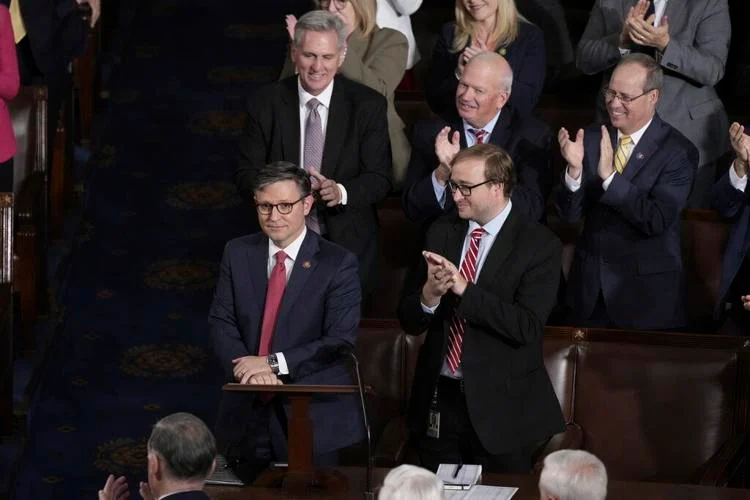
By Casey Harper | The Center Square U.S. House Speaker Mike Johnson, R-La., has laid out his vision for the House and legislative goals, but he faces the daunting task of reuniting a divided party in a slim majority and funding the government before the partial shutdown deadline in the middle of November. Before the vote to elect Johnson as speaker on Wednesday, Johnson sent a memo to his fellow Republicans asking for their support and promising an “ambitious” legislative agenda. “In the interest of time, I would propose that we seek consensus to discharge the last two appropriations bills-Labor, HHS, and Education and Commerce, Justice, and Science-from the Appropriations Committee,” Johnson said. “We should also create a new working group to address Member concerns with the Agriculture, Rural Development, and Food and Drug Administration appropriations bill. As all of this is being completed, if another stopgap measure is needed to extend government funding beyond the November 17 deadline, I would propose a measure that expires on January 15 or April 15 (based on what can obtain Conference consensus), to ensure the Senate cannot jam the House with a Christmas omnibus.” Johnson went on to suggest an immediate schedule for the House floor: Week of October 23: Energy and Water Week of October 30: Legislative Branch, Interior and Environment, THUD Week of November 6: FSGG, CIS Week of November 13: Labor/HHS, Ag In his acceptance speech, Johnson said support for Israel would be a top priority. Johnson, though, has been skeptical of more funding for Ukraine, which could complicate President Joe Biden’s latest request for about $60 billion for the embattled nation. “Our nation’s greatest ally in the Middle East is under attack,” Johnson said in his acceptance speech. “The first bill that I’ll bring to this floor in just a little while will be in support of our dear friend, Israel. And we’re overdue in getting that done.” At the same time, Johnson must deal with a controversial item almost immediately: a motion filed by Rep. Marjorie Taylor Greene, R-Ga., to censure Rep. Rashida Tlaib, D-Minn., for Tlaib’s “antisemitic activity, sympathizing with terrorist organizations” like Hamas and leading an insurrection at the U.S. Capitol, an apparent reference to an Oct. 18 protest where anti-Israel protestors took over a House office building. Because of House rules, Johnson must take the motion up for a vote, which is politically charged because of its direct comparison to the Jan. 6 storming of the Capitol and the attacks Democrats have levied against Republicans to this day over the incident. Notably, former President Donald Trump faces an indictment and criminal charges for his role in protesting the results of the 2020 election, which critics say led to the Jan. 6 protests. A vote on that censure resolution is expected next week. “Tlaib led a pro-Hamas insurrection into the Capitol complex, has repeatedly displayed her anti-Semitic beliefs, and shown her hatred for Israel,” Green wrote on X. “She must be held accountable and censured.” After his election as speaker, Republicans were quick to praise Johnson, who received unanimous Republican support, after he received the speakership. “House Speaker Mike Johnson is a proven conservative who is honorable, smart, and will do a great job leading the House Republican Conference,” Ways and Means Committee Chairman Jason Smith, R-Mo., said in a statement. “I’m excited to work hand-in-hand with Speaker Johnson to advance the policies we need to secure our southern border, increase support for Israel, and bring relief to working-class Americans who are struggling to get by in President Joe Biden’s economy.” Rep. Nancy Mace, R-S.C., was one of the handful of Republicans who voted to oust former House Speaker Kevin McCarthy, R-Calif., which kicked off more than three weeks of scrambling to find a new speaker. She released a statement after Johnson’s vote saying that while the process was difficult, it was “well worth it.” “Eight of us had the audacity to listen to the American people and vote to vacate the former Speaker,” she said.“We told the American people they deserved someone who would be honest and represent their interests, not Washington’s. “While we fully understand we don’t always see eye-to-eye with Mike Johnson, today the American people can finally be proud of their speaker,” she added. Johnson thanked his supporters this week and called for leadership with “bold, decisive action.” “It has been an arduous few weeks and a reminder that the House is as complicated and diverse as the people we represent,” Johnson wrote on X. “The urgency of this moment demands bold, decisive action to restore trust, advance our legislative priorities, and demonstrate good governance. Our House Republican Conference is united, and eager to work. As Speaker, I will ensure the House delivers results and inspires change for the American people. We will restore trust in this body.” Trump, who was actively campaigning for and against different speaker nominees, congratulated Johnson when talking to reporters, saying, “he will be a great speaker of the House.” Johnson promised an array of accomplishments upon taking the speakership, but whether he can succeed in the divided House remains to be seen. “We will advance a comprehensive conservative policy agenda, combat the harmful policies of the Biden Administration, and support our allies abroad,” Johnson said in a statement after winning the speakership. “And we will restore sanity to a government desperately in need of it. Let’s get back to work.” Republished with the permission of The Center Square.
Kevin McCarthy preps House GOP debt deal to draw Joe Biden into talks
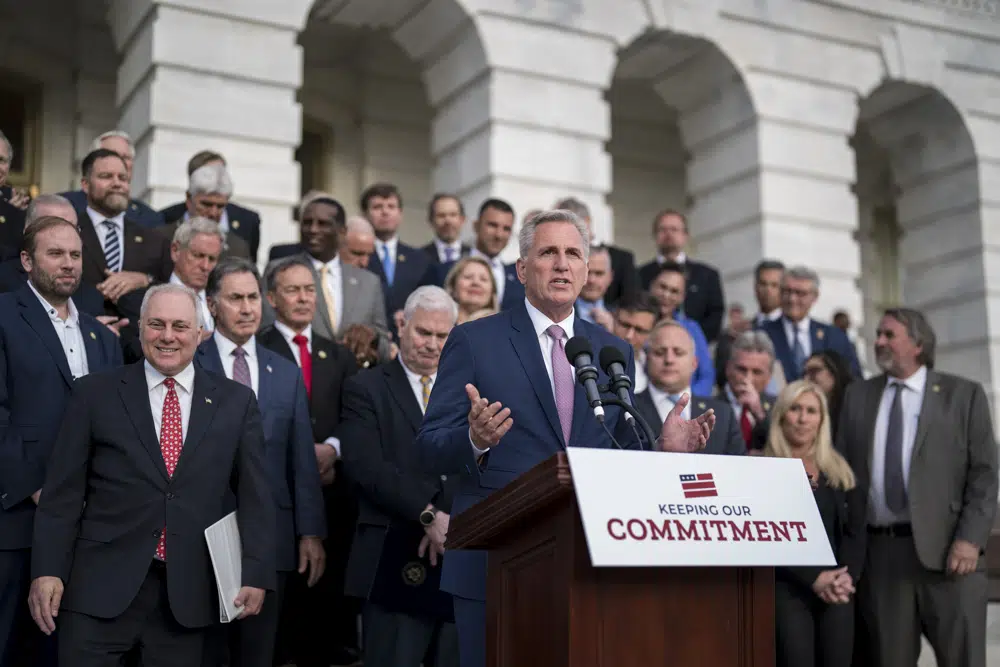
Speaker Kevin McCarthy convened House Republicans behind closed doors Tuesday to build support for his plan to allow the nation’s debt limit to rise in return for strictly limiting future federal spending increases to 1% a year. It’s a bid, including other major policy changes, to draw President Joe Biden into negotiations. The typically fractured House Republican majority has appeared surprisingly open to the plan, which McCarthy outlined in a high-profile speech Monday on Wall Street, but it remains a work in progress. While the proposal has almost no chance of passage in the Democratic Senate, McCarthy wants to pass it in the Republican House to kickstart White House talks. “I’m confident we’ll have it and comfortable we’ll pass it,” said Rep. Tom Cole, R-Okla., the chairman of the Rules Committee, who said a bill could come up for a vote as soon as next week. Even some of McCarthy’s skeptics from the House Freedom Caucus — including those who initially refused to back him to be speaker — seemed ready to give his debt ceiling proposal a look. But others remained deeply skeptical, showing the limits of the embattled speaker’s grip on his majority. Rep. Matt Gaetz, R-Fla., a McCarthy holdout for speaker, said Tuesday he was unsold on the plan and suggested changes. And Rep. Clay Higgins, R-La., said as he exited the session, “There is no ‘this.’ We’re discussing what the ‘this’ will be.” The nation’s legal debt limit must be raised soon to keep the U.S. from defaulting on its fiscal obligations. That high-stakes fight will play out in the weeks ahead as Biden confronts the new era of divided government with Republicans in charge of the House and eager to flex their majority power. If McCarthy succeeds in having the House pass his proposal, he would be able to enter into talks with the White House, showing that he has the backing of his fellow GOP lawmakers. Biden administration officials have privately expressed doubts about the benefits of negotiating with McCarthy out of skepticism that he can rally conservative Republican votes. Democratic Minority Leader Hakeem Jeffries quipped on CNBC that the House Republicans’ budget plan is “in the witness protection program.” The proposal the Republican speaker outlined is far-reaching and expected to be rejected by the White House. It would raise the debt limit into next year — putting it squarely into the 2024 presidential election in exchange for rolling back spending to fiscal 2022 levels, recouping tens of billions of dollars of unspent COVID-19 relief funds, and imposing a 1% cap on future non-defense spending each year for the decade. The 1 percent spending cap would not include mandated Social Security and Medicare money. Additionally, McCarthy’s plan would impose new work requirements on recipients of government aid, cutting billions from the federal safety net. And it would tack on H.R. 1, a sweeping energy package of oil and gas drilling and permit changes that would undo much of Biden’s climate change agenda. The Treasury Department has said the government probably will need to raise the debt ceiling, now at $31 trillion, by summer. For now, Treasury is taking “extraordinary measures” to allow continued borrowing to pay off already accrued bills, but that will eventually run out. Unable to pass an actual Republican budget through the House, as Biden challenges him to do, McCarthy instead has been working furiously behind the scenes with his leadership team to unite the “five families” — the often warring factions of Republican caucuses, including the House Freedom Caucus — to join together on his new plan. He and the leadership team discussed the ideas Tuesday at the House Republicans’ private session in hopes of turning the slides of ideas into a firm legislative package. “I find all indications to be we’re going to put a very serious proposal on the floor and pass it with 218 or more votes,” said Freedom Caucus member Rep. Dan Bishop, R-N.C., as lawmakers arrived at the Capitol late Monday evening, referring to the majority needed for passage. But by Tuesday, no vote was set, according to a person familiar with the private meeting and granted anonymity to discuss it. “I still have more questions than answers at this point,” said Rep. Nancy Mace, R-S.C., complaining there were only a few slides of information. In many ways, this is the easy part for McCarthy: A vote as soon as next week would hardly be binding since the proposal would be dead on arrival in the Senate. That political dynamic may make it easier for McCarthy to rally his ranks behind the plan if Republicans see it as merely a starting point in negotiations designed to push Biden to the table. House Freedom Caucus Chairman Rep. Scott Perry, R-Pa., said late Monday the plan was a step in the right direction, but he still needed details. “Kevin McCarthy is going to get 218 votes on this deal,” said Rep. Dusty Johnson, R-S.D., a chairman of the conservative Main Street Caucus, referring to the majority needed for passage. Said Rep. Kevin Hern of Oklahoma, the chairman of the powerful Republican Study Committee: “There’s still hard work ahead of us, but I believe we can get 218 votes by the end of next week.” Senate Majority Leader Chuck Schumer said if McCarthy continues down this path of negotiating over the need to raise the debt limit, the U.S. would be headed for a default. “No one should confuse this wish list as anything more than a recycling of the same bad ideas we’ve heard about for weeks, and it’s still not clear that Speaker McCarthy has the votes to even pass this,” Schumer said. Republished with the permission of The Associated Press.
House passes same-sex marriage bill in retort to high court

The U.S. House overwhelmingly approved legislation Tuesday to protect same-sex and interracial marriages amid concerns that the Supreme Court ruling overturning Roe v. Wade abortion access could jeopardize other rights criticized by many conservatives. In a robust but lopsided debate, Democrats argued intensely and often personally in favor of enshrining marriage equality in federal law, while Republicans steered clear of openly rejecting gay marriage. Instead, leading Republicans portrayed the bill as unnecessary amid other issues facing the nation. Tuesday’s election-year roll call, 267-157, was partly political strategy, forcing all House members, Republicans, and Democrats, to go on the record. It also reflected the legislative branch pushing back against an aggressive court that has raised questions about revisiting other apparently settled U.S. laws. Wary of political fallout, GOP leaders did not press their members to hold the party line against the bill, aides said. In all, 47 Republicans joined all Democrats in voting for passage. “For me, this is personal,” said Rep. Mondaire Jones, D-N.Y., who said he was among the openly gay members of the House. “Imagine telling the next generation of Americans, my generation, we no longer have the right to marry who we love,” he said. “Congress can’t allow that to happen.” While the Respect for Marriage Act easily passed the House with a Democratic majority, it is likely to stall in the evenly split Senate, where most Republicans would probably join a filibuster to block it. It’s one of several bills, including those enshrining abortion access, that Democrats are proposing to confront the court’s conservative majority. Another bill guaranteeing access to contraceptive services is set for a vote later this week. House GOP leaders split over the issue, with Minority Leader Kevin McCarthy and Whip Rep. Steve Scalise voting against the marriage rights bill, but the No. 3 Republican Rep. Elise Stefanik of New York voting in favor. In a notable silence, Senate Republican leader Mitch McConnell declined to express his view on the bill, leaving an open question over how strongly his party would fight it if it should come up for a vote in the upper chamber. Key Republicans in the House have shifted in recent years on the same-sex marriage issue, including Rep. Liz Cheney of Wyoming, who joined those voting in favor on Tuesday. Said another Republican, Rep. Nancy Mace of South Carolina, in a statement about her yes vote: “If gay couples want to be as happily or miserably married as straight couples, more power to them.” Polling shows a majority of Americans favor preserving rights to marry, regardless of sex, gender, race, or ethnicity, a long-building shift in modern mores toward inclusion. A Gallup poll in June showed broad and increasing support for same-sex marriage, with 70% of U.S. adults saying they think such unions should be recognized by law as valid. The poll showed majority support among both Democrats (83%) and Republicans (55%). Approval of interracial marriage in the U.S. hit a six-decade high at 94% in September, according to Gallup. Ahead of Tuesday’s voting, a number of lawmakers joined protesters demonstrating against the abortion ruling outside the Supreme Court, which sits across from the Capitol and remains fenced off for security during tumultuous political times. Capitol Police said among those arrested were 16 members of Congress. “The extremist right-wing majority on the Supreme Court has put our country down a perilous path,” said Rep. Mary Gay Scanlon, D-Pa., in a floor speech setting Tuesday’s debate in motion. “It’s time for our colleagues across the aisle to stand up and be counted. Will they vote to protect these fundamental freedoms? Or will they vote to let states take those freedoms away?” But Republicans insisted the court was only focused on abortion access in June when it struck down the nearly 50-year-old Roe v. Wade ruling, and they argued that same-sex marriage and other rights were not threatened. In fact, almost none of the Republicans who rose to speak during the debate directly broached the subject of same-sex or interracial marriage. “We are here for a political charade; we are here for political messaging,” said Rep. Jim Jordan of Ohio, the top Republican on the Judiciary Committee. That same tack could be expected in the Senate. Sen. Josh Hawley, R-Mo., said, “The predicate of this is just wrong. I don’t think the Supreme Court is going to overturn any of that stuff.” As several Democrats spoke of inequalities they said they or their loved ones had faced in same-sex marriages, the Republicans talked about rising gas prices, inflation, and crime, including recent threats to justices in connection with the abortion ruling. For Republicans in Congress, the Trump-era confirmation of conservative justices to the Supreme Court has fulfilled a long-term GOP goal of revisiting many social, environmental, and regulatory issues the party has been unable to tackle on its own by passing bills that could be signed into law. The Respect for Marriage Act would repeal a law from the Clinton era that defines marriage as a heterogeneous relationship between a man and a woman. It would also provide legal protections for interracial marriages by prohibiting any state from denying out-of-state marriage licenses and benefits on the basis of sex, race, ethnicity, or national origin. The 1996 law, the Defense of Marriage Act, had basically been sidelined by Obama-era court rulings, including Obergefell v. Hodges, which established the rights of same-sex couples to marry nationwide, a landmark case for gay rights. But last month, writing for the majority in overturning Roe v. Wade, Justice Samuel Alito argued for a more narrow interpretation of the rights guaranteed to Americans, noting that the right to an abortion was not spelled out in the Constitution. In a concurring opinion, Justice Clarence Thomas went further, saying other rulings similar to Roe, including those around same-sex marriage and the right for couples to use contraception, should be reconsidered. While Alito insisted in the majority opinion that “this decision concerns the constitutional right to abortion and no other right,” others have taken notice. “The MAGA
