
Fed lawyers deciding next step in Donald Trump travel ban fight
Government lawyers fighting to defend President Donald Trump‘s executive order on immigration said Friday that “all options” are being considered after a federal appeals court ruled against the president’s ban on travelers from seven predominantly Muslim nations. A Justice Department lawyer who spoke at a hearing in Virginia said the administration was weighing whether to challenge a 9th U.S. Circuit Court of Appeals ruling that upheld a temporary block on Trump’s ban, saying it was unlikely to survive a legal challenge. “We may appeal. We may not,” attorney Erez Reuveni said. “All options are being considered.” It could appeal the restraining order on Trump’s travel ban to the U.S. Supreme Court or it could attempt to remake the case in the district court. Reuveni was appearing at a hearing before Judge Leonie Brinkema at which the state of Virginia was challenging the ban. The judge did not rule. She noted that “the status quo remains” because of the 9th circuit’s decision and suggested that a well-reasoned ruling would take time and could not be written “overnight.” Michael Kelly, a spokesman for Virginia Attorney General Mark Herring, said Friday’s hearing in a federal court in a Washington, D.C., suburb posed the most significant state challenge yet to Trump’s order. In a statement, he said it “will be the most in-depth examination of the merits of the arguments against the ban.” Lawyers for Herring, a Democrat, are asking the judge for a preliminary injunction barring the Trump administration from enforcing that portion of the Jan. 27 executive order that bars anyone from those countries — Iran, Iraq, Libya, Somalia, Sudan, Syria and Yemen — from entering the U.S. for 90 days. The state is not challenging that portion of Trump’s order suspending entry of refugees for four months. “If the Commonwealth is successful in securing a preliminary injunction, it would indicate that Virginia is likely to prevail on the merits of its challenge to President Trump’s ban, and it will be a more durable injunction that will last all the way through trial — so potentially weeks or months,” Kelly wrote. In a court document filed ahead of the hearing, Virginia’s lawyers challenge the constitutionality of the executive order and say there is “overwhelming evidence” that the executive order “resulted from animus toward Muslims.” Virginia also says the state, its residents and its public universities are harmed. One example it gives: university students and faculty from countries named in the executive order who are in the U.S. on work or student visas can’t leave for fear of not being allowed back in. Until it was temporarily blocked by a federal judge in Seattle a week ago, the ban made headlines amid tearful stories of families separated and lives upended. Among them were two Yemeni brothers whose family sued in Virginia before the brothers, both green card holders, were allowed back into the country. The federal government has since said green card holders will not be barred from re-entering the U.S. In the specific Virginia challenge, lawyers for the federal government wrote in a court filing opposing a preliminary injunction that Virginia doesn’t have the right to challenge the ban — and that the court doesn’t have the power to review the president’s executive order. “Judicial second-guessing of the President’s determination that a temporary suspension of entry of certain classes of aliens was necessary at this time to protect national security would constitute an impermissible intrusion” on his constitutional authority, lawyers Dennis Barghaan and Reuveni wrote. Even if Virginia’s challenge is allowed to proceed, a preliminary injunction is not warranted, the U.S. government lawyers wrote. Republished with permission of The Associated Press.
Donald Trump nominee decried criticism of judges, senators agree
President Donald Trump insisted Thursday that comments by his Supreme Court nominee criticizing his own attacks on the judiciary were “misrepresented,” even as Republican and Democratic lawmakers vouched for the veracity of the remarks. Trump responded after private rebukes from Judge Neil Gorsuch, who said in meetings with lawmakers on Wednesday that the president’s comments about federal judges were “disheartening.” Gorsuch, who was nominated by Trump last week to the nation’s highest court, made the comments in meetings with senators after Trump accused an appeals court panel considering his immigration and refugee executive order of being “so political.” Over the weekend, he labeled a judge who ruled on his executive order a “so-called judge” and referred to the ruling as “ridiculous.” Democratic Sen. Richard Blumenthal of Connecticut first relayed Gorsuch’s remarks on Wednesday following a meeting with him. Trump’s own confirmation team for Gorsuch later confirmed he had made the remarks. But Trump said during a Thursday luncheon with senators that Blumenthal had misrepresented Gorsuch. “His comments were misrepresented. And what you should do is ask Senator Blumenthal about his Vietnam record that didn’t exist after years of saying it did,” he said. Blumenthal, who served in the Marine Corps Reserves during Vietnam, apologized in 2010 for saying he had served in Vietnam. The president made the comments while making the case for Gorsuch during a luncheon with 10 senators, including six of Blumenthal’s fellow Democrats. Blumenthal, a former state attorney general, argued Thursday that Gorsuch would need to go further to publicly denounce Trump’s verbal assault on judicial independence. “He needs to condemn Donald Trump’s attacks publicly and it needs to be much stronger, more explicit and direct than has been done so far,” Blumenthal said. “Unless it is done publicly in a clear condemnation, it will not establish his independence.” Lawmakers from both parties quickly vouched for the veracity of the remarks the senator said Gorsuch made. GOP former Sen. Kelly Ayotte, who is helping with Gorsuch’s confirmation and was at the meeting, issued a statement saying Gorsuch made clear he was not referring to any specific case. But she said the nominee said he finds any criticism of a judge’s integrity and independence to be “disheartening and demoralizing.” Senate Minority Leader Chuck Schumer, D-N.Y., and Sen. Ben Sasse, R-Neb., each confirmed that Gorsuch made the same comments to them. Sasse told MSNBC’s “Morning Joe,” ”Frankly, he got pretty passionate about it.” He added that Gorsuch said any attack on the “‘brothers or sisters of the robe is an attack on all judges’.” Fellow Connecticut Democratic Sen. Chris Murphy came to Blumenthal’s defense Thursday, lashing out in a tweet directed at Trump: “Ha! As a prosecutor, Dick used to put guys like u in jail. Now, u use your position to mock vets, he uses his to make their lives better.” Gorsuch’s comments came at the end of a week of meetings with members of the Senate, which is considering his nomination. His response may have been aimed at drawing a line of separation with the new president. The 9th U.S. Circuit Court of Appeals is weighing the appeal of Trump’s executive order on immigration, which included a temporary travel ban on people from seven Muslim-majority countries. In a hearing Tuesday, judges on the appeals court challenged the administration’s claim that the ban was motivated by terrorism fears, but they also questioned an attorney’s argument that it unconstitutionally targeted Muslims. Trump told visiting police chiefs Wednesday that a portion of the immigration law gives him the power to enact the ban, calling it “beautifully written” and saying, “A bad high school student would understand this.” “Courts seem to be so political and it would be so great for our justice system if they would be able to read a statement and do what’s right,” Trump added. “And that has to do with the security of our country, which is so important.” Since a lower-court judge blocked the order last week, Trump has assailed the decision, leading legal experts, Democrats and some Republicans to question whether his remarks might jeopardize the independence of the judiciary. Others have expressed fears he may be attempting to use political influence to sway the courts. The president has repeatedly said foreigners are “pouring in” since the ban was put on hold and suggested that blocking the order would be dangerous for U.S. citizens. On Wednesday he tweeted, “Big increase in traffic into our country from certain areas, while our people are far more vulnerable, as we wait for what should be EASY D!” The administration has not provided any information to support his claims. Republished with permission of The Associated Press.
Dems force delays in votes on Jeff Sessions, Steve Mnuchin, Tom Price
Democrats forced delays Tuesday in planned Senate committee votes on President Donald Trump‘s picks for Health and Treasury secretaries and attorney general, amid growing Democratic surliness over the administration’s aggressive early moves against refugees and an expected bitter battle over filling the Supreme Court vacancy. Democrats abruptly boycotted a Senate Finance Committee meeting called to vote on Rep. Tom Price, R-Ga., the Health nominee and Steve Mnuchin, Trump’s Treasury selection, saying both had misled Congress about their financial backgrounds. The Democrats’ action prevented the Finance panel from acting because under committee rules, 13 of its members — including at least one Democrat — must be present for votes. It was unclear when the panel would reschedule to votes. At the Senate Judiciary Committee, a meeting considering Sen. Jeff Sessions, R-Ala., to be attorney general lasted so long — chiefly because of lengthy Democratic speeches — that Chairman Charles Grassley, R-Iowa, said the panel would meet again Wednesday. The meeting on Sessions’ nomination was coming with Democrats and demonstrators around the country in an uproar over Trump’s executive order temporarily blocking refugees. Even some Republicans were warning it could hinder anti-terrorism efforts. Not everything ground to a halt. The Senate education committee voted 12-11 to send Trump’s pick to head the Education Department, Betsy DeVos, to the full Senate for a confirmation vote. The Senate Energy and Natural Resources Committee quickly approved former Texas Gov. Rick Perry as Energy secretary by 16-7, and Rep. Ryan Zinke, R-Mont., to head Interior by 16-6. And the full Senate easily confirmed Elaine Chao to become transportation secretary by a 93-6 vote. Chao was labor secretary under President George W. Bush, and is wife of Senate Majority Leader Mitch McConnell, R-Ky. Just before the Finance committee was scheduled to vote on Price and Mnuchin, Democrats called a briefing for reporters and announced their plan to force a delay. Sen. Debbie Stabenow, D-Mich., said Price and Mnuchin would hold positions “that directly affect peoples’ lives every day. The truth matters.” Finance Committee Chairman Orrin Hatch, R-Utah, accused Democrats of “a lack of desire to fulfill their constitutional responsibilities.” “They ought to stop posturing and acting like idiots,” he said. In 2013 when Democrats controlled the Senate, Republicans boycotted a committee vote on Gina McCarthy to head the Environmental Protection Agency, temporarily stalling it. Democrats cited one report in The Wall Street Journal that Price received a special, discounted offer to buy stock in a biomedical company, which contradicted his testimony to Congress. They said another report in The Columbus Dispatch showed documents revealing that Mnuchin had not been truthful with the Senate in the confirmation process in comments about how his bank OneWest had handled home foreclosures. Republicans have supported both men, and both have strongly defended their actions. Democrats have opposed Price, a seven-term congressional veteran, for his staunch backing of his party’s drive to scuttle Obama’s health care law and to reshape Medicare and Medicaid, which help older and low-income people afford medical care. They’ve also assailed Price for buying stocks of health care firms, accusing him of using insider information and conflicts of interest for backing legislation that could help his investments. Price says his trades were largely managed by brokers and that he’s followed congressional ethics rules. Democrats have criticized Mnuchin for not initially revealing nearly $100 million in assets, and were expected to vote against both nominees. They’ve also accused him of failing to protect homeowners from foreclosures and criticized him for not initially disclosing all his assets. DeVos, a wealthy GOP donor and conservative activist, has long supported charter schools and allowing school choice. That’s prompted opposition from Democrats and teachers’ unions who view her stance as a threat to federal dollars that support public education. Critics have also mocked her for suggesting that guns could be justified in schools to protect students from grizzly bears. Two prominent Republicans on the education committee, Sens. Susan Collins of Maine and Lisa Murkowski of Alaska, said they remained uncertain if they will vote for her on the Senate floor. Murkowski said DeVos has yet to prove that she deeply cares about America’s struggling schools and its children. Republished with permission of the Associated Press.
Panel sends Alabama chief justice’s ethics case to trial
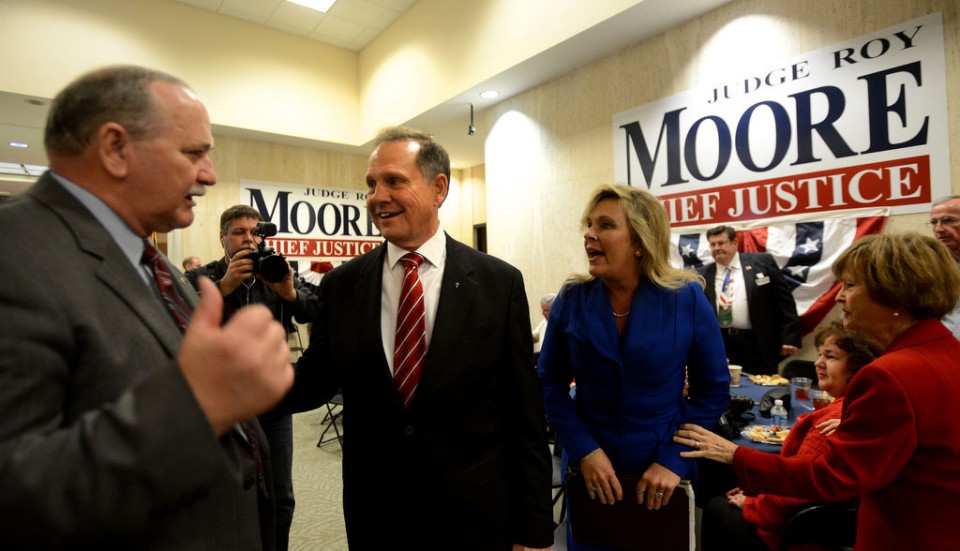
A state judicial panel on Monday refused to dismiss an ethics complaint against Alabama Chief Justice Roy Moore, saying that Moore will go to trial in September on accusations that he urged 68 probate judges to defy the federal courts on same-sex marriage. The Alabama Court of the Judiciary, a state panel that disciplines judges, refused dueling requests to either dismiss the complaint against Moore outright or go ahead and remove him from office. Chief Judge Michael Joiner said the case will go to trial Sept. 28. The panel of nine judges will hear the case and decide whether Moore violated judicial ethics and if so, what punishment he will face. The decision came down shortly after the conclusion of a 60-minute hearing in which Moore was alternately portrayed as a politician on a mission to block gay couples from marrying in Alabama or a judge who was merely trying answer questions from confused probate judges. Moore — who was ousted from office by the court in 2003 for refusing to remove a Ten Commandments monument from the state judicial building — could be removed as chief justice for a second time. “We are here to talk about Chief Justice Roy Moore and his repeated refusal to follow the rule of law,” John Carroll, a former federal magistrate representing the Judicial Inquiry Commission, told the court. Carroll said Moore abused his power as chief justice to promote a private agenda against same-sex marriage. The complaint stems from a Jan. 6 memo he sent probate judges. Moore wrote that a March order from the state Supreme Court to refuse marriage licenses to gay couples remained in full force and effect. The order came even though the U.S. Supreme Court had effectively legalized same-sex marriage nationwide six months prior and a federal judge said Alabama should follow that decision. A lawyer for Moore said the chief justice was only clarifying the status of the state injunction that was issued in March because probate judges were asking questions about it. “The probate judges were flapping in the wind. They were wondering what to do,” his lawyer, Mat Staver, told the court. Moore’s order was merely a legal “truism” that the order had not been lifted by the state court, he argued. Staver, in defending Moore, repeatedly emphasized a section of the January order where Moore told the probate judges that he was not at “liberty to provide any guidance to Alabama probate judges on the effect of (the U.S. Supreme Court ruling) on the existing orders of the Alabama Supreme Court.” Carroll countered that Moore’s intent was clear: to try to urge probate judges to fight against same-sex marriage. Moore acted on his own by sending the order after unsuccessfully urging his fellow justices to take some action regarding the March order in the wake of the U.S. Supreme Court decision, something pointing out by both sides in the hearing. The Monday hearing took on some of the theater and spectacle that accompanied the 2003 dismissal with passionate protests outside the court. Moore’s supporters and opponents held dueling rallies outside the court building ahead of the hearing, at times standing within a few feet of each other as they chanted and waved competing signs such as “No Moore” or “Judge Moore is right.” Moore entered the packed courtroom to applause from his supporters. After the hearing, he spoke to a sign-waving crowd outside, saying there is “no evidence” he broke judicial ethics and that he never told judges what to do. “They said I tried to influence them. I said it’s their decision,” Moore said. Moore said the complaint was filed against him by people who “don’t want anybody opposing any agenda of the homosexual movement.” The Southern Poverty Law Center, a civil rights legal advocacy group, filed the complaint against Moore that led to the ethics charges, and its director said Moore was clearly urging the judges to defy the courts on gay marriage and was now trying to “save his skin by playing word games.” “Alabama is a great state and deserves better than a chief justice who thinks he is above the law. We’ve said it many times. He acts as if he is the ayatollah of Alabama,” SPLC President Richard Cohen said after the hearing. Ambrosia Starling, the stage name of a small-town Alabama drag queen, was among the speakers against Moore. “We lost the war between the states. That means the Supreme Court holds the final authority over jurisdiction of law,” Starling drawled. Linda Chasom drove three hours from Georgia to attend the rally in support of Moore. She said she thought Moore was being persecuted for his conservative Christian beliefs. “My family is being persecuted. Judge Roy Moore is part of my family as a believer,” Chasom said. Republished with permission of the Associated Press.
Donald Trump’s trap: GOP nominee can’t let go of perceived slights

For Donald Trump, it’s become a familiar pattern. The Republican nominee can’t let go of a perceived slight, no matter the potential damage to his presidential campaign or political reputation. Trump spent the days after winning the Republican nomination criticizing a U.S. district court judge’s Mexican heritage. The morning after accepting the Republican nomination at the party’s convention, Trump re-litigated months-old grievances with primary rival Ted Cruz. Now, he’s sparring with an American Muslim family whose son was killed in Iraq. Republican leaders have urged Trump to drop his attacks on Khizr and Ghazala Khan, who appeared at last week’s Democratic convention and harshly criticized the GOP nominee. It’s not just the optics of picking a fight with a military family that has GOP officials eager for Trump to move on, but the timing of his attacks: Election Day is just three months away. Those who have worked with Trump say that in private meetings, he can often appear amenable to putting a controversy aside. But the businessman can quickly be drawn back in by an interview, especially if he believes he’s already answered the question, or if he grows irritated by commentary on cable television. “It’s just who he is,” said Stuart Jolly, a former campaign staffer and current political director for the pro-Trump Great America PAC. Others who have worked with Trump say the only way to ensure he moves on is to wait for him to tire of an issue or get drawn into another matter. Newt Gingrich, the former House speaker who has advised Trump, said the candidate’s inability to back away from a political land mine “makes him vulnerable.” “His whole experience up until running for office was in a very combative New York media market,” Gingrich said. “He’s been doing it now for over 30 years. It’s a very deeply held habit.” Khizr Kahn delivered an emotional address at last week’s Democratic convention, with his wife standing by his side. The Pakistan-born Khan told the story of his son, U.S. Army Capt. Humayun Khan, who was posthumously awarded a Bronze Star and Purple Heart after his death in 2004. Khan said that if Trump were president and enacted his proposed temporary ban on foreign Muslims coming to the U.S., a position Trump has backed away from in recent weeks, his son would have never been allowed into the country. He also questioned whether Trump had ever read the Constitution. Trump responded by implying Ghazala Khan’s religion preventing her from speaking at the convention, though she later said talking publicly about her late son was still too difficult. On Monday, Trump tweeted that he was being “viciously attacked” by Khizr Khan. Trump’s unwillingness to let the matter subside sparked outrage Monday from a chorus of Republicans. Arizona Sen. John McCain, a former prisoner of war, said Trump did not have “unfettered license to defame those who are the best among us.” Rep. Mike Coffman, a vulnerable Republican in a competitive Colorado district, said he was “deeply offended when Donald Trump fails to honor the sacrifices of all of our brave soldiers who were lost in that war.” Missouri Sen. Roy Blunt said the Khans “deserve to be heard and respected.” “My advice to Donald Trump has been and will continue to be to focus on jobs and national security and stop responding to every criticism whether it’s from a grieving family or Hillary Clinton,” Blunt said in a statement. However, none of the Republican lawmakers pulled back their support of Trump’s White House campaign. In his first rally after a weekend of controversy, Trump spoke at length and took several questions at an event Monday in Columbus, Ohio — never once mentioning the Khans. But when asked about Khizr Khan on Fox News Channel’s “Hannity,” Trump responded, “I guess it’s part of my life.” “His son died 12 years ago,” Trump added. “If I were president, his son wouldn’t have died, because I wouldn’t have been in the war, if I was president back then.” Trump backers attending the Ohio rally dismissed the issue, underscoring how the businessman was able to survive numerous such firestorms in the GOP primaries. “I think the Democrats laid a trap for him,” said Tom McClanahan, a 54-year-old from Johnston, Ohio. “I think they knew what they were doing when they asked that family to speak at the convention. They knew he’d respond.” Dale Brown, a maintenance supervisor from Grove City, Ohio, whose son is in the Navy, said Democrats were blowing Trump’s comments out of proportion and had “politicized this by asking that family to speak.” But the real test for Trump isn’t the opinion of the loyal supporters who attend his rallies. It’s the broader general election audience, a far more diverse group still weighing Trump’s readiness for the White House. Republished with permission of the Associated Press.
