
Rep. Gary Palmer and staff get firsthand look at Alabama’s National Carbon Capture Center
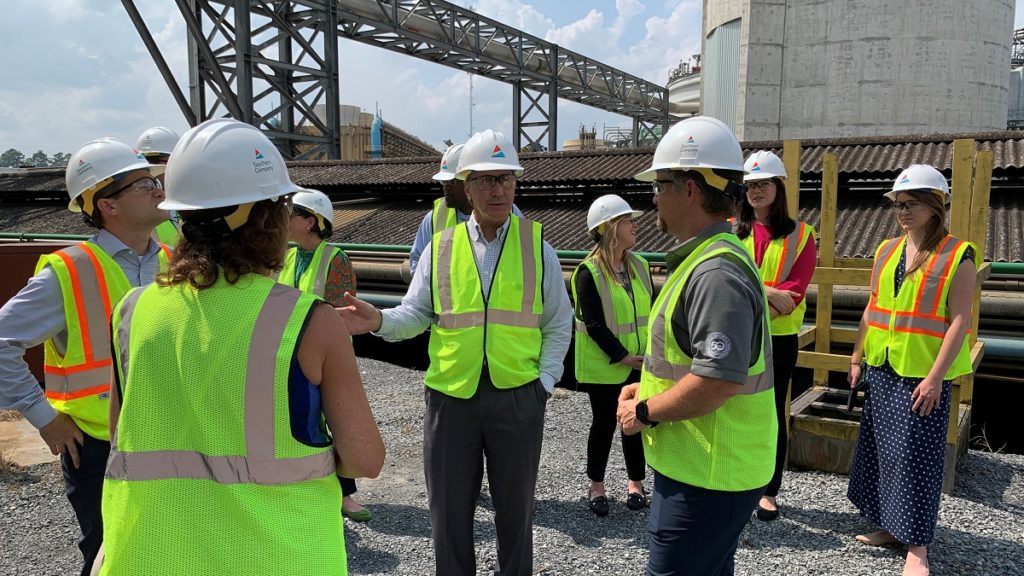
U.S. Rep. Gary Palmer (R-Hoover) got a firsthand look at one of Alabama’s premier energy research facilities Wednesday, taking his entire staff for a tour of the National Carbon Capture Center (NCCC) in Wilsonville. The facility is operated by Southern Company at Alabama Power’s Plant E.C. Gaston. Earlier this year, Palmer was the first representative from Alabama in more than 30 years to be appointed to the House Committee on Energy and Commerce, which has jurisdiction over a broad range of areas, including energy, interstate and foreign commerce, and environmental policy. In Wilsonville, Palmer learned how Alabama experts at the U.S. Department of Energy (DOE) facility are finding solutions to deliver on President Joe Biden’s ambitious climate change goals, which include cutting America’s carbon emissions in half by 2030 and reaching net-zero greenhouse gas emissions no later than 2050. “We are happy to have Congressman Palmer and his entire staff at the National Carbon Capture Center here at Alabama Power’s Plant Gaston,” said Alex McCrary, Alabama Power director of Corporate Affairs. “Rep. Palmer understands the importance of our company’s efforts at the NCCC and the role carbon capture will play in the future of energy. We appreciate he and his staff taking the time to learn more and are grateful for the work they do in Washington on behalf of our great state.” Established in 2009 as a neutral test bed for DOE’s National Energy Technology Laboratory (NETL), the NCCC is nationally and internationally recognized for accelerating the development of next-generation technologies designed to remove carbon dioxide from a power plant’s flue gas stream. Technology developers from seven countries have come to the Alabama facility to learn from its infrastructure and the expertise employees offer. “Rep. Palmer’s support of our work is invaluable as Southern Company seeks to advance technologies that will create an affordable, reliable, net-zero energy future,” said John Northington, NCCC director and director of net-zero technologies for Southern Company R&D. “Achieving decarbonization will take a diverse portfolio of solutions, and our real-world testing of carbon capture is critical in propelling promising technologies toward commercialization.” Palmer and his staff learned how the NCCC is moving into the emerging area of carbon utilization, where carbon emissions are used to manufacture value-added products like cement. A test for Carbon XPRIZE winner CarbonBuilt this spring successfully produced low-carbon concrete. Sectors like cement and steel face a particular challenge in decarbonizing their businesses. Under a collaborative agreement with NETL, renewed in October 2020, the center’s research scope was formally expanded to new areas of technology development. This expansion included carbon capture for natural gas power generation in addition to carbon utilization and negative-emission solutions, such as direct air capture. The project has reduced the cost of carbon capture from power generation by approximately 40%.
Wilsonville research facility marks technology testing milestone
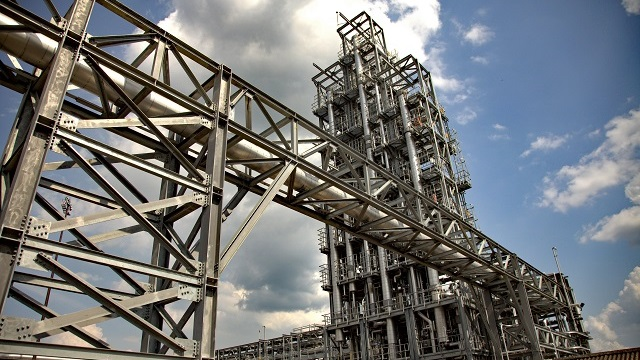
The National Carbon Capture Center, a U.S. Department of Energy (DOE)-sponsored research facility at Alabama Power’s Plant Gaston in Wilsonville, recently surpassed 100,000 hours of technology testing. The milestone marks significant work by the internationally known test facility, which is managed and operated by Southern Company. The center works to accelerate the development of advanced technologies to reduce greenhouse gas emissions from natural-gas and coal power plants. “It has been an honor to collaborate with DOE, its National Energy Technology Laboratory and our partners at the National Carbon Capture Center to evaluate and demonstrate next-generation carbon capture technologies,” said Southern Company Executive Vice President and Chief Operating Officer Kimberly S. Greene. “I also commend our highly skilled employees, whose commitment to building the future of energy through innovation is at the heart of this achievement.” Since its creation by DOE’s Office of Fossil Energy in 2009, the National Carbon Capture Center has worked with third-party technology developers, including more than 30 government, industry, university and research organizations from seven countries. The facility offers a pathway to move novel carbon capture technologies out of the laboratory and demonstrate them in the real-world conditions of a power plant. The National Carbon Capture Center is also active internationally as co-founder and chair of the International Test Center Network, a coalition of facilities focused on accelerating the research, development and deployment of carbon capture, utilization and storage technologies. Under the center’s guidance, testing collaboration and knowledge sharing is ongoing in Australia, Canada, China, the European Union, India, Japan, Korea, the United Arab Emirates and the U.S. While technology development at the National Carbon Capture Center currently focuses on post-combustion carbon capture technologies for coal-fueled power generation, the facility is expanding Its testing of carbon capture technologies for natural gas power plants. Republished with permission from the Alabama NewsCenter.
