
Despite risks, Ben Carson not backing off Nazi, slavery examples
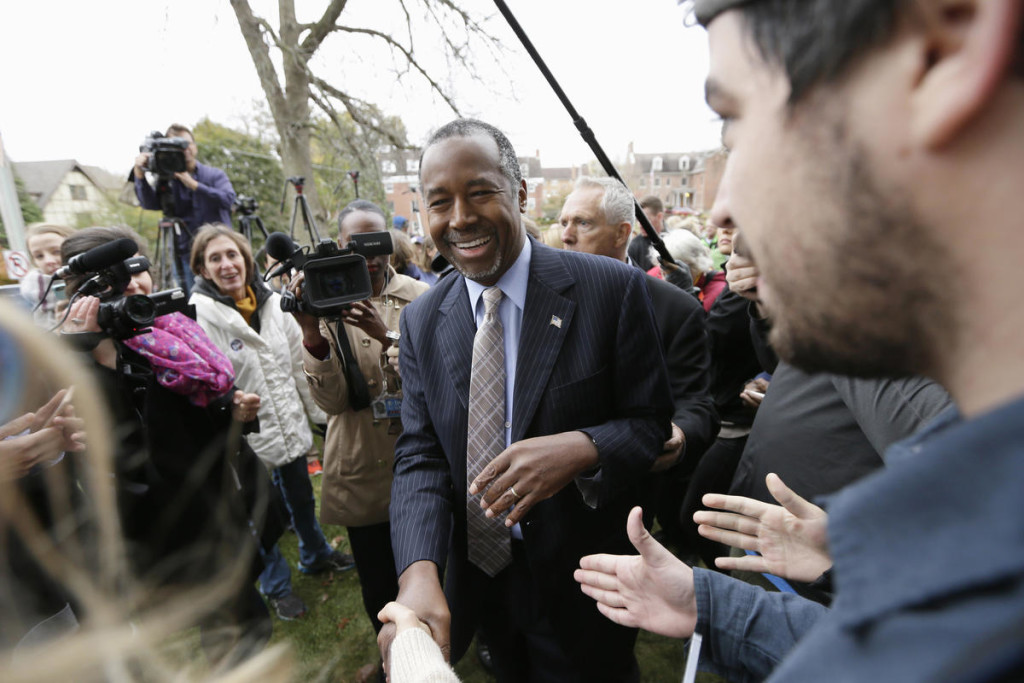
The Republican candidates for president will gather Wednesday for their third debate amid fresh volatility in an already chaotic race, with Ben Carson surging past Donald Trump in Iowa and one-time front-runner Jeb Bush under pressure to prove he’s still a viable candidate for the GOP nomination. The soft-spoken Carson has been a low-key presence in the first two GOP debates, but the retired neurosurgeon is likely to get more attention from moderators — as well as his fellow candidates — after a series of preference polls show him atop the field in Iowa. Trump has already shown he’s eager to take on Carson, jabbing him for his speaking style and raising questions about his Seventh Day Adventist faith. “We’ll see how Ben holds up to the scrutiny,” Trump said Tuesday on MSNBC. Meanwhile, Bush will be grasping for momentum after one of the most trying stretches of his White House campaign. Slower-than-expected fundraising has led Bush to slash spending and overhaul his campaign structure, and he’s voiced frustration with the way the unusual race has progressed. If the election is going to be about fighting to get nothing done, he says, “I don’t want any part of it.” There will be 10 candidates on stage in the prime-time debate in Boulder, Colorado, all seeking a share of a smaller spotlight: This debate on CNBC will run for only two hours after the last affair went on for more than three. Among the participants are two senators: Florida’s Marco Rubio and Ted Cruz of Texas. Rubio has sought to capitalize on Bush’s stumbles, but faces his own financial concerns. Cruz is positioning himself to inherit Trump’s supporters if the real estate mogul’s campaign collapses. Taken together, it’s a Republican field that remains crowded and unwieldy three months before the lead-off Iowa caucuses and New Hampshire primary. The political rookies appealing to voter anger with Washington have ceded no ground and establishment politicians are still waiting for the race to turn their way — and increasingly wondering if it ever will. Trump remains the dominant force, commanding media attention, drawing large crowds and leading in most early voting states. But his dip in Iowa has prompted some speculation among Republicans that the tide could be turning against the bombastic billionaire. “His only hope of staying competitive is to entertain voters with his provocateur-in-chief routine right up until Election Day,” said Josh Holmes, a former adviser to Senate Majority Leader Mitch McConnell. “He’s the one candidate where ‘acting presidential’ actually has a detrimental effect on his campaign.” While Carson is unknown to many Americans, he’s built a loyal following with Tea Party-aligned voters and religious conservatives. His campaign has started running new television advertisements in early voting states that center on his experience as a doctor and highlight his status as a political outsider. Carson has raised eyebrows with his incendiary comments about Muslims and references to Nazis and slavery on the campaign trail, rhetoric he’s made no apologies for. His standing in early states has only appeared to strengthen with each controversial comment. Carson’s biggest weakness may be his glaring lack of specific policy proposals. The issues listed on his campaign website are vague, including a tax plan that calls for a “fairer, simpler, and more equitable” system. On foreign policy, he’s said, “all options should remain on the table when dealing with international bullies,” such as Russian President Vladimir Putin. Carson could be pushed Wednesday on domestic policy, with debate host CNBC promising to focus on economic issues, including taxes and job growth. Policy discussions are usually a welcome refuge for Bush, the wonky former Florida governor. But his challenge Wednesday is less about highlighting his mastery of the issues and more about showing his supporters he has the temperament to fight through a long and grueling primary. “You’ve got a guy here speaking from experience, speaking with knowledge about issues, speaking with a reasonable approach to matters,” said Pat Hickey, a Bush supporter from Nevada. “The problem, though, is: Do those things seem to matter to the electorate?” With a well-funded super PAC standing by, Bush doesn’t appear to be on the brink of a campaign collapse, even if he performs poorly in the debate. But a stronger performance could help soothe supporter anxiety. Also on stage event Wednesday will be Ohio Gov. John Kasich, New Jersey Gov. Chris Christie, former Arkansas Gov. Mike Huckabee, Kentucky Sen. Rand Paul and former technology executive Carly Fiorina. Each will be eager for the kind of standout moment that Fiorina had in the second debate to jumpstart their campaigns. The four lowest-polling candidates will participate in an earlier undercard event: South Carolina Sen. Lindsay Graham, former Pennsylvania Sen. Rick Santorum, Louisiana Gov. Bobby Jindal and former New York Gov. George Pataki. None has gotten close to breaking into the upper tier of candidates.
Martin Dyckman: Winner-take-all winner could be Trump

Our next president may well owe the office to arrogant billionaires or be one himself. Meanwhile, The New York Times reports that fewer than 400 families account for nearly half the $388-million already invested in that election still more than a year away. Did America shed blood to be rid of monarchy only to have it come to this? And yet the vast moral and political corruption unleashed by the U.S. Supreme Court’s confusion of free spending with free speech is only one of four ways in which government of the people, for the people and by the people has gone off the track. Voting districts in nearly every state are drawn by the party in power to control the outcomes. The elections themselves are monopolized by two increasingly polarized political parties, excluding the increasing numbers of citizens who want nothing to do with either of them. The elections, whether primary or general, can be won with much less than majorities by unpopular candidates who would not be the second choices of most voters. Florida is powerless to control the money. That will take a constitutional amendment or the election of a president who would insist that his or her Supreme Court nominees agree that the Buckley and Citizens United cases were wrongly decided. Florida has made inroads on the gerrymandering through the adoption of the Fair Districts initiatives five years ago and the state Supreme Court’s willingness to enforce them. But that fortunate condition is imperiled by the next four court appointments, which will be controlled by Rick Scott‘s nominating commission. Time is running very short for people who believe in judicial independence to do something about that. The “All Voters Vote” initiative petitions now circulating would break the shared monopoly of the Republicans and Democrats by allowing everyone to vote in an open primary that could nominate two candidates of the same party — or of no party — for state offices and Congress. That’s good for the growing number of voters who claim no party — presently 27 percent — or who identify with the Greens and other minor parties. To that extent, it would be a significant improvement for everyone. Jim Smith, the former Florida secretary of state and a supporter of the initiative, acknowledges that it hasn’t done much to change the lineup of elected officials in Louisiana and California, the other two open-primary states. He is right, however, in saying that it has “changed the conversation — and it’s a conversation that a broader spectrum of voters want to hear candidates talk about.” Republican candidates in districts with sizable Democratic minorities would have to think twice about toeing the Tea Party line. Democratic candidates in safely blue districts would need to court Republican votes for the first time. But “Top Two” is still vulnerable to the winner-take-all weakness. In 1991, a 12-candidate field in Louisiana’s open primary left voters with a dismal runoff choice: former Gov. Edwin Edwards, whose corruption was flagrant, or David Duke, a former Ku Klux Klan grand wizard and an avowed Nazi. There were bumper stickers saying, “Elect the crook — it’s important,” and so the voters did. Edwards went to federal prison in 2002. That same year, 16 candidates sought the French presidency. Nearly everyone assumed there would be a runoff between a conservative, Jacques Chirac, whose ethics were as suspect as Edwards’, and the prime minister, Socialist Lionel Jospin. Chirac ran first, as expected, with 19.8 percent of the vote. But Jospin was edged out of the running by Jean Marie le Pen of the far right National Front, an ultranationalist party. Although nearly two-thirds of the voters had preferred other candidates, their final options were, as in Louisiana, between two obviously unappealing politicians: a suspected crook and a presumed fascist. (Chirac won.) There’s a way to avoid such dismal outcomes. It’s called ranked-choice voting, a task that computer science makes simple. To see how simple — and have some fun — go to this website: www.fairvote.org. There are links on the page to exercises where you can cast rank-ordered votes for political parties and for the Republican and Democratic presidential candidates. Here’s how the presidential game played out for me and for other participants on Monday. In the Republican poll, Donald Trump led the first round, but with only 18 percent. Bobby Jindal ran last and was eliminated. The second-choice votes of his supporters were distributed. There were 15 more rounds, all conducted instantly by computer. Marco Rubio fell out in the 12th and Jeb Bush in the 13th. In the 16th and last round, Trump finally gave way to Rand Paul, who won the nomination with 51.28 percent support. Bernie Sanders led the Democrats with 46 percent. Hillary Clinton ran third, trailing Joe Biden, who isn’t an announced candidate. Martin O’Malley ran last, with 6 percent, and the second choices of his supporters were counted. Clinton was gone in the fourth round. In the sixth and final, Sanders’s support increased to 51.9 percent and he became the nominee. These results are hardly scientific and not necessarily predictive. The samples were small and self-selected. Anyone could vote in either race, and the biases were obviously liberal. But they’re interesting nonetheless. The two “nominees,” Paul and Sanders, project more authenticity than nearly all the others. As for Trump, he piled up more second-choice votes than everyone except Paul. If the Republican Party of Florida still insists on a March 15 winner-take-all primary, which will be well after many of the trailing and financially poorer candidates have dropped out, Trump could easily win it all. Martin Dyckman is a retired associate editor of the St. Petersburg Times. He lives in Western North Carolina.
