
Alabama one of few statehouses to feature memorials to historical women
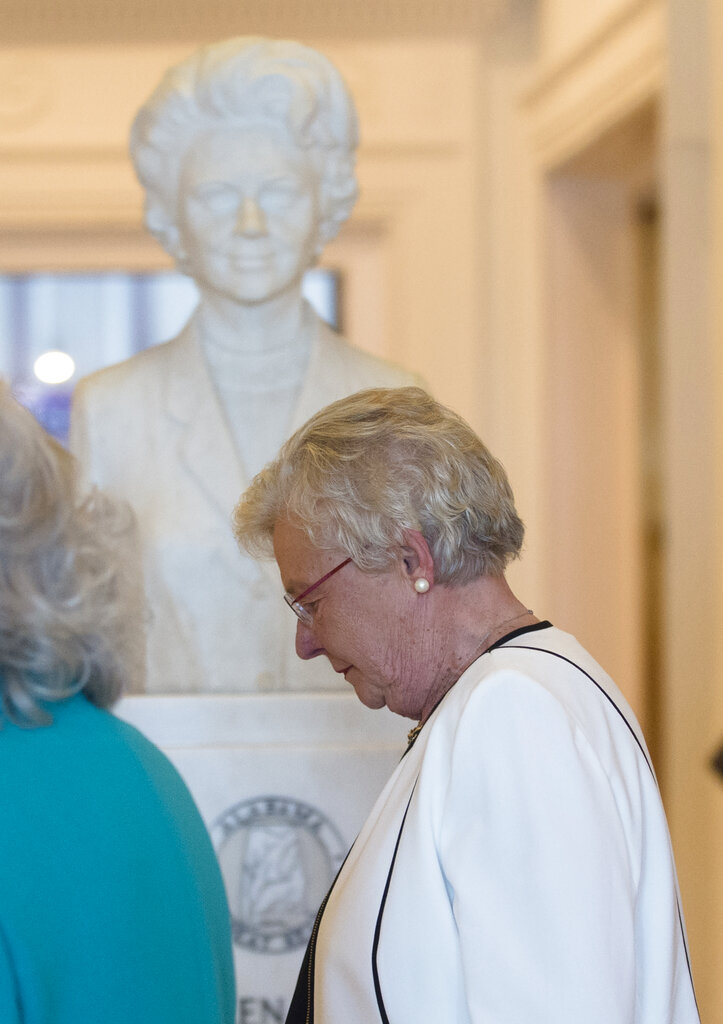
Few states have a memorial to honor women in their state house.
Trump administration to rescind Obama-era guidance on affirmative action
The Trump administration is rescinding Obama-era guidance that encouraged schools to take a student’s race into account to encourage diversity in admissions, a U.S. official said Tuesday. The shift would give schools and universities the federal government’s blessing to take a race-neutral approach to the students they consider for admission. Such guidance does not have the force of law, but schools could use it to help defend themselves against lawsuits over their admission policies. The action comes amid Supreme Court turnover expected to produce a more critical eye toward schools’ affirmative action policies. The high court’s most recent significant ruling on the subject bolstered colleges’ use of race among many factors in the college admission process. But the opinion’s author, Anthony Kennedy, announced his resignation last week, giving President Donald Trump a chance to replace him with a justice who will be more reliably skeptical of affirmative action. A formal announcement was expected later Tuesday from the Justice and Education departments, according to the official, who spoke on condition of anonymity because the official was not authorized to speak on the record. The guidance from the Obama administration gave schools a framework for “considering race to further the compelling interests in achieving diversity and avoiding racial isolation.” In a 2011 policy document, the administration said schools have a “compelling interest” in ensuring a diverse student body, and that while race should not be the primary factor in an admission decision, schools could lawfully consider it in the interest of achieving diversity. “Institutions are not required to implement race-neutral approaches if, in their judgment, the approaches would be unworkable,” the guidance said. “In some cases, race-neutral approaches will be unworkable because they will be ineffective to achieve the diversity the institution seeks.” The administration issued a similar guidance document in 2016 aimed at giving schools a framework for “considering race to further the compelling interests in achieving diversity and avoiding racial isolation.” The Obama approach replaced Bush-era policy from a decade earlier that discouraged affirmative action programs and instead encouraged the use of race-neutral alternatives, like percentage plans and economic diversity programs. The Trump administration signaled Tuesday that it planned to reinstate the Bush administration’s philosophy. Civil liberties groups immediately decried the move, saying it went against decades of court rulings that permit colleges and universities to take race into account. “We condemn the Department of Education’s politically motivated attack on affirmative action and deliberate attempt to discourage colleges and universities from pursuing racial diversity at our nation’s colleges and universities,” Kristen Clarke, president and executive director of the Lawyers’ Committee for Civil Rights Under Law, said in a statement. In 2016, the Supreme Court, in an opinion written by Kennedy, granted affirmative action policies a narrow victory by permitting race to be among the factors considered in the college admission process. Kennedy wrote that the University of Texas’ admission plan was in line with past court decisions that allowed for the consideration of race to promote diversity on college campuses. The ruling bitterly disappointed conservatives who thought that Kennedy would be part of a Supreme Court majority to outlaw affirmative action in education. Justice Antonin Scalia died after the court heard arguments in the case but before the decision was handed down. Eight states already prohibit the use of race in public college admissions: Arizona, California, Florida, Michigan, Nebraska, New Hampshire, Oklahoma and Washington. The Wall Street Journal first reported the move. Republished with the permission of the Associated Press.
Americans offer hope, prayer in assessing Donald Trump’s 100 days

They are young and old: a high school student who can’t yet vote, a Vietnam vet who did so proudly. They hail from all corners of the United States and very different walks of life: a “downhome boy” from Kentucky, a third-generation Mexican-American from Texas, a stay-at-home mom in Pennsylvania, an Iranian immigrant in Los Angeles. Some oppose Donald Trump and all that he stands for, while others voted enthusiastically for him. Now, they are critiquing him. One hundred days into Trump’s presidency, The Associated Press returned to some of the everyday people interviewed these past months to ask them to write a letter to the president, evaluating the job he’s done so far and looking ahead to the months to come. One supporter tells the president he “might have fallen a little short” — on Obamacare, in particular — but he signs off “with hope.” A refugee implores Trump to “make America more friendly,” but finds optimism in the president’s reaction to this month’s chemical attack in Syria: “I hope this is a turning point.” A Trump objector calls his biggest accomplishment “waking up the public to fight.” She offers this advice: “Make decisions with your heart. It will give you wisdom.” ___ FROM RURAL AMERICA, A SUPPORTER SEES HOPE IN TRUMP’S PRESIDENCY Alan Halsey, 31, is a self-described “downhome boy” from Campton, Kentucky, who along with his wife owns and operates The Swift Creek Courier, a weekly newspaper, and Halsey’s Country Store, “a small business that is a chunk of 1950 set down in 2017.” He says he works seven days a week to try to provide for his family, but is struggling and tired of government regulation and red tape. He wrote: ” … I supported you quite strongly in the 2016 election, even to the point of hanging one of your signs on the front door of my business. I particularly related to your foreign policy of ‘America First,’ and your promise to bring business back to the United States. So far, I believe you’re heading in the right direction on that front, and I find a glimmer of hope in the future of the American economy. “Overall, I think you might have fallen a little short on your first 100 days, but I don’t put a lot of weight into a time frame that small. Provided you serve two terms, 100 days is about 4 percent of that. I still feel that something needs to be done with the Affordable Care Act, although I’m not certain exactly what. … I know many ACA recipients that visit a doctor more than once a week, while those that purchase their own insurance wait until a visit to a doctor is imperative to their survival. There must be a middle to that scenario. …” He signed his letter: “With Hope.” ___ CANCER SURVIVOR WORRIES OVER TRUMP’S PROPOSED BUDGET CUTS, BUT PRAYS FOR HIM Rebecca Esparza, 45, is a freelance writer in Corpus Christi, Texas, who didn’t vote for Trump. A cancer survivor, Esparza fears proposed budget cuts targeting the nation’s premier medical research institution, the National Institutes of Health, will hurt Americans who battle illness. She wrote: “. I cannot say I’m proud of your work so far. However, I have respect for the Office of the President, even if I disagree with your political aspirations. … I could write a dissertation on the many ways I disagree with your political ideals. I’m a third-generation Mexican-American, born and raised in South Texas. Your disdain for Mexico, its descendants and immigrants in general troubles me. Your plan to dismantle the Affordable Care Act, leaving millions of Americans with no other health insurance options, leaves me anguished. “But what distresses me most is your plan to cut nearly $6 billion in funding from the National Institutes of Health (NIH). On Thanksgiving Day in 2001, at age 30, I was diagnosed with ovarian cancer. … Cancer research saved my life. … The cuts you are proposing are disconcerting not only for cancer survivors, but for millions of Americans suffering from many types of chronic and rare diseases. … “I’ll be praying for you, President Trump. … I pray you will carefully consider how your decisions have life or death consequences for hard-working Americans.” Read more about Esparza. ___ ONE-TIME OBAMA VOTER FEELS PRIDE IN TRUMP’S WORK Laverne Jones Gore, 60, owns an executive leadership development company in Cleveland and voted for Trump after previously supporting Barack Obama. Gore calls herself a “middle-class American who happens to be black” and says she felt uncomfortable voicing her opinion during the Obama years, but Trump has “made me proud to be an American again.” Part of a military family — her deceased husband was a Marine and a son graduated from West Point — Gore’s one hesitation these past 100 days is over Trump’s airstrike in Syria. She wrote: ” … Mr. President you have absolutely met my expectations. I actually believe you have shown a strength that I had not given to you, and I am surprised by your willingness to meet head on the challenges and resistance within your governing bodies. I don’t believe you have been afforded an opportunity to really show us what you have to offer in the form of leadership of our nation. “I have no issue with you as it relates to ‘Russians.’ I personally believe most of it was contrived. I have no issue with you as it relates to immigration. I think the issues were in need of control. … I have some reservations about your use of Twitter, but I understand the difficulty you have getting your intended message out. “Yes, you surprised me with the Syria strike and I am not certain how I feel about another war or thought of war. I am still contemplating your action and observing the responses to come from the world theatre as they absorb your full intent.” ___ ‘YOUR SIGNATURE CRUSHED MY FAMILY’ Marjan Vayghan, 32, an artist and writer
Hillary Clinton sets out most efficient path to get to 270

Hillary Clinton doesn’t appear all that interested in making scenic stops on her state-to-state quest to become president. The Democratic nominee is instead programming her GPS to take her on the quickest route to collect the 270 Electoral College votes she needs to win the White House. With three months until Election Day, Clinton’s campaign is focused on capturing the battleground states that have decided the most recent presidential elections, not so much on expanding the map. Clinton’s team doesn’t rule out an effort at Arizona, a state with a booming population of Latino voters that polls find are loath to support Trump. And Georgia, a bastion of the Deep South, echoes recent population trends in other Southeastern states where Clinton is competing aggressively. But neither is among the 11 battleground states that Clinton’s television advertising plans and her travel schedule point to as her focus. Those states are the perennial top-tier targets Florida and Ohio, plus Colorado, Iowa, Michigan, Nevada, New Hampshire, North Carolina, Pennsylvania, Virginia and Wisconsin. President Barack Obama carried them all in 2008, and missed out on only North Carolina during his 2012 re-election campaign. “The last two elections have given Democrats an electoral path for victory,” said Clinton campaign adviser John Anzalone. “And our strategy is to efficiently use our resources to lock down the support we need to reach 270 electoral votes.” After a bump in support for Clinton in national polls that followed the Democratic convention and tracked Trump’s recent gaffes, the number of states where Clinton will invest her time and money may get smaller than 11. When the Clinton campaign booked more than $23 million in new television ad time late this past week to start on Monday, it spent most of the money in just three states: Florida, Pennsylvania and Ohio. Feeling good about Colorado and Virginia, the campaign passed on giving those states a fresh injection of ad dollars, though they remain heavily staffed with organizers. Likewise, officials with the pro-Clinton group Priorities USA say they have put its advertising plans there on hold. Meanwhile, Trump’s travel following the Republican convention suggests he’s given up on plans to force Clinton to defend traditional Democratic bastions California and New York. Beyond that, it’s not clear how he plans to chart his course to 270. “I have states that no other Republican would do well in that I think I’m going to win,” Trump told The Washington Post this past week. “But I don’t want to name those states.” Trump’s campaign has yet to run a single television ad and has made curious decisions about where to send its candidate. This past week, for example, Trump spent a day in Portland, Maine, chasing after the single electoral vote at stake along the state’s largely Democratic southern coast. There have been no such distractions for Clinton since the end of her convention, aside from a quick stop in Nebraska, a visit that was probably as much about spending time on stage with billionaire investor Warren Buffett than picking up the one electoral vote in the Omaha area. (Maine and Nebraska are the two states that award electoral votes by congressional district instead of a statewide winner-take-all vote.) This coming week, Clinton will be in Florida. So will Trump. That’s no surprise, as a win there plus victories in every state (and the District of Columbia) that have voted Democratic since 1992 would give Clinton a winning total of 271 electoral votes. Florida Republican consultant Brett Doster said simply of his state: “If we don’t win here, I just don’t see how we win.” Despite the 2016 campaign’s unscripted form, Democrat and Republican pollsters alike said in the past week that Florida is competitive and is expected to stay that way into the fall. The largest share of single-state spending in Clinton’s most recent ad buy came in Florida, at more than $4.2 million, and that, plus an aggressive pursuit of Latino voters, may give her a narrow edge. In Florida’s Orange County, which includes Orlando, the Democratic edge among registered voters has grown by 15 percent since 2008. Since late last year, roughly 1,000 Puerto Rican families a month have relocated to Florida due to the U.S. territory’s fiscal crisis, many of them concentrating in and around Orlando’s heavy service-sector job scene. Bilingual teams of Clinton employees are registering first-time Puerto Rican voters at grocery stores, malls and community centers. Republican pollster Whit Ayres said Trump’s problems in Florida go deeper than his lack of advertising and overwhelmingly unpopular standing among Latinos. He said Trump’s recent criticism of the Muslim family of a fallen U.S. soldier is not likely to sit well in a state with 22 military installations and more than 1.5 million veterans. “The attack on the Gold Star family makes it unlikely for him to expand in Florida beyond where he is right now,” said Ayres, an adviser to Republican Sen. Marco Rubio of Florida. While Trump may not have a path without Florida, Clinton can lose the state and still find another way through the battlegrounds to reach 270. That’s no doubt why from June 8 through Monday, Clinton and Democratic groups supporting her will have outspent Republican groups by 15 to 1 in those states, according to data from Kantar Media’s CMAG political advertising tracker. The Clinton campaign and deep-pocketed Democratic groups such as Priorities USA have poured a combined $66 million into television and radio advertising in those 11 states. Trump’s campaign hasn’t spent a dollar on television advertising, while Republican groups have only spent about $4.3 million. Put simply, Anzalone said, Clinton has options. “But this is a dynamic race and we will continue to look at all pathways as this race develops,” he said. Republished with permission of the Associated Press.
