
Candidates clash in battleground states, as Donald Trump’s path narrows
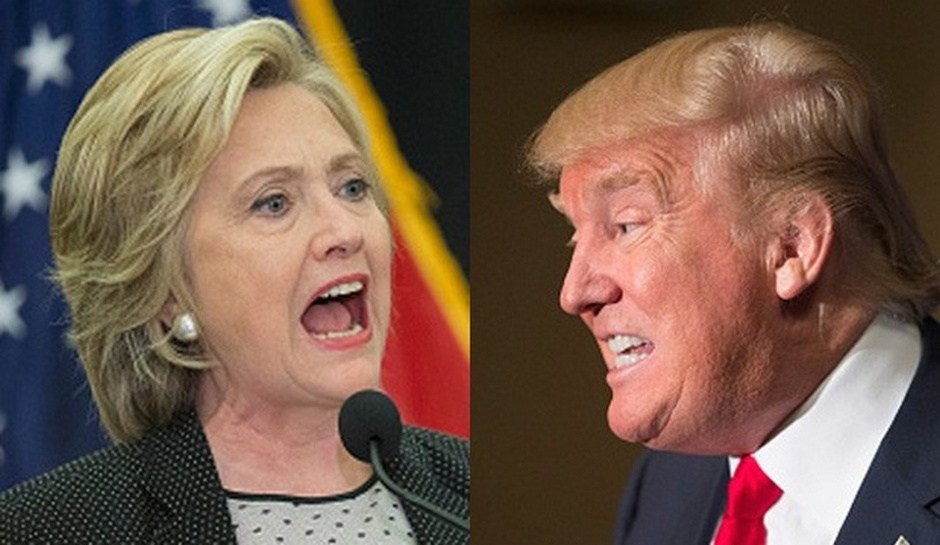
Election Day just 15 days off, Donald Trump is fighting to preserve his narrow path to the presidency in must-win Florida on Monday as Hillary Clinton tries to slam the door on her Republican opponent in battleground New Hampshire. At the same time, Democrats continue to get help from President Barack Obama, whose high job approval numbers have made him a political force in the sprint to Nov. 8. The president lashed out at Trump and praised Clinton as he campaigned Sunday in Nevada, a competitive state in the race for the White House and the Senate. Obama told Nevadans they have a winning hand in Clinton and Senate candidate Catherine Cortez Masto, who is locked in a tight race to fill the seat being vacated by retiring Democratic Sen. Harry Reid. Democrats need to retain the Nevada Senate contest and pick up four new seats elsewhere to claim the Senate majority if Clinton wins. Many Republicans fear that Trump’s struggles could drag down his party’s chances in competitive House and Senate elections across the nation. The president was unsparing Sunday in his criticism of Trump, describing the billionaire businessman as unfit to be president. Obama also railed against Republicans and conservative media outlets for promoting “all kinds of crazy stuff” about him and his party’s leaders. He cited as an example the years-long questions from Trump and others about whether he was born in the U.S. “Is it any wonder that they ended up nominating somebody like Donald Trump?” Obama said. Trump, meanwhile, lashed out at his Democratic opponent on Twitter on Monday, claiming that “Crooked Hillary” wants the United States to accept “as many Syrians as possible” from the war-torn region. Clinton has said Obama’s plan to admit 10,000 Syrian refugees this fiscal year is a good start, but that the nation “needs to do more.” Trump was campaigning Monday in Florida, a state his advisers concede he must win to have any chance at becoming president. The spotlight on Florida shined brighter on Monday also because in-person early voting was beginning across 50 counties, including the state’s largest: Broward, Duval, Hillsborough, Miami-Dade, Orange and Palm Beach. The remaining counties will start in the coming week. Early voting by mail has been underway for weeks. Nearly 1.2 million voters in Florida have already mailed in ballots. The state has nearly 13 million registered voters. Clinton’s running mate, Virginia Gov. Tim Kaine, was set to make two campaign stops in Florida on Monday. Clinton plans to visit the state Tuesday. Clinton’s focus on Monday was New Hampshire, a state that offers just 4 electoral votes compared to Florida’s 29, but marks a key piece to Trump’s increasingly narrow path to the 270 electoral votes needed to win the presidency. The Trump campaign acknowledged its challenge in a Monday fundraising email, conceding that victories in tossup states like Florida, Ohio, Iowa, Nevada and North Carolina wouldn’t be enough to reach 270. “Polls show us close in New Hampshire, Colorado, and Pennsylvania. Winning just any one of those states would lead us to victory,” the campaign wrote. Republished with permission of the Associated Press.
Business owners replace idealists in legal-pot movement

Business owners are replacing idealists in the pot-legalization movement as the nascent marijuana industry creates a broad base of new donors, many of them entrepreneurs willing to spend to change drug policy. Unlike in the past, these supporters are not limited to a few wealthy people seeking change for personal reasons. They constitute a bigger coalition of business interests. And their support provides a significant financial advantage for pro-legalization campaigns. “It’s mainly a social-justice movement. But undoubtedly there are business interests at work, which is new in this movement,” said Kayvan Khalatbari, a one-time pot-shop owner and now head of a Denver marijuana consulting firm. The donors offer a wider foundation of support for the marijuana-related measures on the ballot next month in nine states. The campaigns are still largely funded by national advocacy organizations such as the Drug Policy Alliance, the Marijuana Policy Project and the New Approach PAC. But those groups are less reliant on billionaire activists. On the other side, legalization opponents are attracting new support from businesses as diverse as trucking, pharmaceuticals and even gambling. In 2012, Colorado and Washington became the first states to pass ballot initiatives legalizing recreational marijuana for adults. Oregon, Alaska and Washington, D.C., followed in 2014. The result is a bigger pool of existing businesses that see expansion potential in more states authorizing use of the drug. Take Darren Roberts of Boca Raton, Florida, co-founder of High There!, a social network for fans of pot. He donated $500 this year to a campaign to legalize marijuana for medical purposes in Florida. Roberts is also encouraging his customers to donate to legalization campaigns in their own states. “I would say it’s a combination of both the philanthropic social interest and the potential financial interest,” Roberts said. All five states considering recreational marijuana — Arizona, California, Maine, Massachusetts and Nevada — have seen more money flowing to groups that favor legalization than to those fighting it. The same is true in the four states considering starting or reinstating medical marijuana — Arkansas, Florida, Montana and North Dakota. The donors who contribute to anti-legalization efforts have changed, too. Some deep-pocket donors who drove opposition campaigns in years past are opening their pocketbooks again. Casino owner Sheldon Adelson of Nevada, for example, gave some $5 million in 2014 to oppose a medical-pot measure in Florida. This year, as his home state considers recreational pot and Florida takes a second look at medical marijuana, Adelson has spent $2 million on opposition in Nevada and $1 million to oppose legalization in Massachusetts. Other casinos are donating to Nevada opposition efforts, too, including MGM Resorts International and Atlantis Casino & Resort. Nevada gambling regulators have warned that marijuana violates federal law. Some new opponents have also emerged, moving beyond the typical anti-pot base that includes law enforcement groups, alcohol companies and drug-treatment interests. A pharmaceutical company that is working on a synthetic version of marijuana’s psychoactive ingredient, Insys Therapeutics Inc., has given at least $500,000 to oppose full marijuana legalization in its home state of Arizona. The company did not return a message for comment on the donation. Company officials said in a statement last month that Insys opposes the Arizona ballot measure because marijuana’s safety has not been demonstrated through the federal regulatory process. Other new names popping up in opposition disclosures include U-Haul, which gave $25,000 to oppose legalization in Arizona, and Julie Schauer, a Pennsylvania retiree who gave more than $1 million to a group opposing legalization. Neither returned messages seeking comment on their donations. Smaller donors to opposition campaigns say they are hopelessly outgunned by the young pot industry, but are giving out of a sense of duty. “Everyone’s talking about it like it’s a done deal, but I can’t sit by when I’ve seen firsthand the destruction that marijuana does to people,” said Howard Samuels, a drug-treatment therapist in Los Angeles who donated some $20,000 to oppose recreational legalization in California. Samuels and other marijuana opponents insist that the pot industry cynically hopes to get more people addicted to the drug to line its own pockets, comparing pot providers to tobacco companies. But marijuana-industry donors insist that they are simply carrying on a tradition started by the tie-dye wearing drug activists who pushed legalization long before there was any business model attached to it. They insist they would contribute financially even without any money-making potential. “When a movement becomes an industry, of course the advocacy picture gets shuffled,” said Bob Hoban, a Denver attorney specializing in marijuana law and a $1,000 donor to the Marijuana Policy Project. “It shifts away from activists to more traditional business interests, because the skill sets don’t exactly transfer.” Republished with permission of the Associated Press.
Ben Pollara: Donald Trump, Bernie Sanders and fuzzy math

I am not a big fan of sports metaphors or former Defense Secretary Donald Rumsfeld, but both can be used to demonstrate the inanity and intellectual dishonesty driving the cries of unfairness coming out of the campaigns of Donald Trump and Bernie Sanders. Both are pushing similar messages about their respective parties’ nominating and delegate allocation processes, and those messages are either dishonest or demonstrate ignorance of said processes. Or both, I suppose. So to use the sports metaphor, what would be the public response to a losing basketball team complaining that certain shots are worth three points, while others are worth only one or two? That is essentially what the Sanders and Trump camps are saying about the “unfairness” they perceive in the delegate acquisition game. And it’s a game they both signed up for, ostensibly with some, if not intricate, knowledge of the rules. Well, sorry gentlemen. To quote Rummy, “you go to war with the army you have, not the army you want.” As a Democrat, I should apologize for lumping Sanders in with The Donald. I’m sorry, Bern. Actually, Trump’s case is in some ways more rational than Sanders’. Trump is likely to enter the Republican convention with a clear plurality of his party’s delegates, but perhaps not the majority required to secure the nomination on the first ballot. He will likewise enter the convention with a substantial lead in actual votes. Sanders is virtually certain to have neither. I recently wrote for FloridaPolitics.com inveighing upon the Republican Party to respect Trump’s advantages going into Cleveland and give him the nomination. My case was a political one, and I still believe it. However, the party’s rules are quite clear and have been so since well before Trump entered the primary. The Sanders case is considerably more head-scratching. Yes, he has won a near-sweep of the most recent round of primary and caucus states, but so what? According to an analysis by fivethirtyeight.com from April 8, he has won only 42 percent of Democrats’ raw votes, nearly 2 million fewer primary votes than Hillary Clinton. Yet, his supporters continue to decry the “undemocratic” process by which their party chooses its nominee. Oh, and speaking of undemocratic, Sanders has received roughly 46 percent of pledged delegates, 4 percent higher than his actual share of the vote. But the Bern Bros aren’t bitching about “earned” delegates, where Clinton is dominating. The gripes are about “super delegates,” who Clinton dominates even more thoroughly. I happen to “feel the Bern” here and believe that media outlets should stop including “super delegates” in their delegate counts. When you remove those “Super Delegates,” you remove the illusory notion that Clinton’s lead is built on the backs of party insiders versus the reality of the lead she has earned through actual votes. It’s a lead that looks much smaller, but is in reality essentially insurmountable. Clinton’s earned delegate lead has been consistently north of 200. In 2008, with a popular vote count that Clinton arguably won by a narrow margin, Barack Obama’s earned delegate margin never exceeded much more than 100. I understand the need to occasionally litigate issues in public opinion that you simply cannot win on the facts and the law, but both of these instances seem particularly ripe with hypocrisy and sour grapes. Trump, on the one hand, has benefited significantly from the complex delegate-allocation scheme that he has decried of late. His substantial lead is built largely on “winner take all” states such as Florida and others that have allocated proportionately in such a way that he has captured all or nearly all of a state’s delegates while receiving only a plurality of the raw vote. On the other hand, Sanders has cried foul on the undemocratic nature of the “superdelegate” system, while he has dominated the arguably undemocratic caucus system — the exceptions, of course, being Iowa and Nevada. In Nevada, however, despite losing the state to Clinton by five points, it appears possible that Sanders may ultimately get more delegates because of his dominance in the state party’s multi-step delegate nomination and allocation process. Huh. I understand that facts and logic don’t dictate the rules of political engagement. To quote the rapper El-P, “I might have been born yesterday, sir; but I’ve been up all night.” I’m fond of saying that hypocrisy and hyperbole are the salt and pepper of the kitchen of political campaigning. All that having been said, Trump and Sanders are still full of crap when it comes to their delegate-related complaints. You go to war with the army you have, not the army you want. *** Ben Pollara is a political consultant and a founding partner of LSN Partners, a Miami Beach-based government and public affairs firm. He runs United for Care, the Florida medical marijuana campaign and is a self-described “hyper-partisan” Democrat.
Super PACs dole out cash, whether candidates like it or not
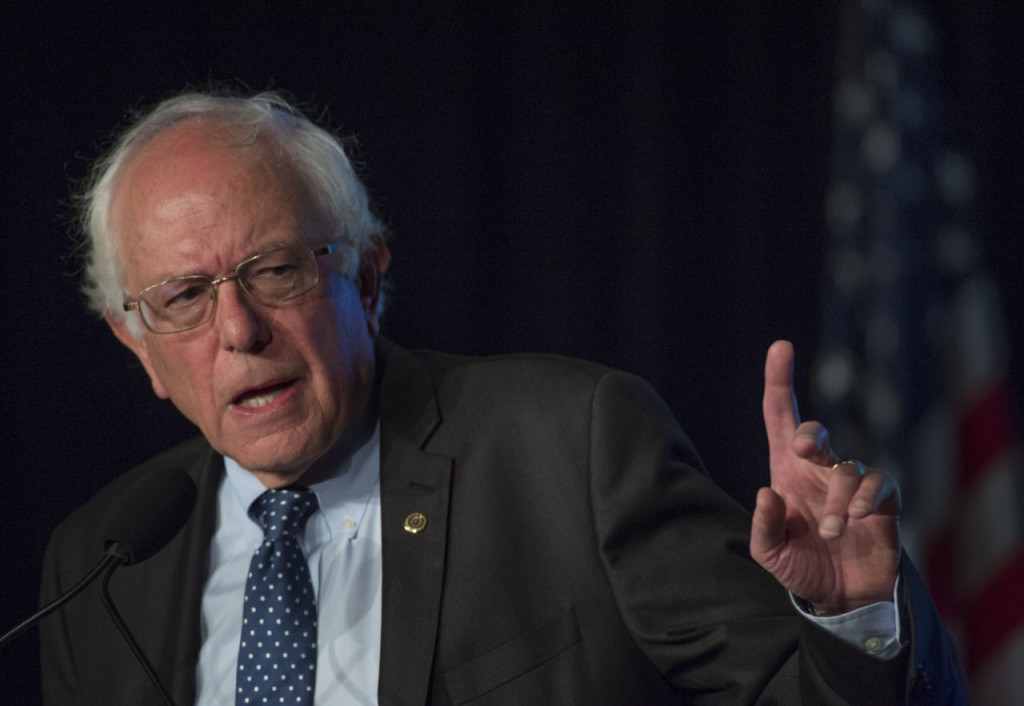
Donald Trump calls them a “crooked business.” Bernie Sanders says they’re “corrupt” organizations “buying elections.” But the barrage of insults hasn’t stopped the political groups known as super PACs and their donors from showing the two presidential candidates some love — no matter how loudly they may rail against their very existence. “I’m not going to be deterred just by that alone,” said Joshua Grossman, president of Progressive Kick, of Sanders’ anti-super PAC message. His liberal super PAC, funded by donors who have written checks as large as $250,000, has endorsed Sanders and is planning to spend money helping to elect him. Unlike formal campaigns for president, super PACs are allowed by law to accept donations of any size. That fact makes them a juicy political target for populist candidates such as Trump and Sanders. Yet already, a super PAC allied with a nurses’ union that endorsed Sanders over Democratic front-runner Hillary Clinton in August has put more than $600,000 into pro-Sanders digital and print ads in the important early primary states of Iowa, New Hampshire, South Carolina and Nevada. Billboards put up by the super PAC, National Nurses United for Patient Protection, proclaim: “Politics As Usual Won’t Guarantee Healthcare For All. Bernie Will.” The union is only able to spend that kind of money because of the 2010 Supreme Court ruling known as Citizens United, a decision that ultimately led to the creation of super PACs. Sanders has decried it as corrosive to democracy. That ruling also enabled unions to start spending member dues on political advertising in federal elections. Since that time, the nurses’ union has moved $3.4 million in dues into its super PAC, according to records filed with the Federal Election Commission. The group hasn’t raised money from anyone else. “Anti-labor folks might say that these unions are extorting money from their dues-paying members to use on politics, whether those members like it or not,” said Paul S. Ryan, senior counsel at the Campaign Legal Center in Washington, which advocates for stricter campaign finance rules. RoseAnn DeMoro, the union’s executive director, said the super PAC has helped other candidates in previous elections and is assisting Sanders’ bid because “we’ve never seen a better messenger” for causes important to the union’s members, citing as an example his plan to expand Medicare. “We are hoping to do as much as we can for him,” she said. “The nurses are extremely happy with what we’ve done with their money. He’s a vehicle for our voice. We laugh quietly among ourselves and say, ‘Bernie stole our issues.’” The nurses’ early endorsement was seen as a political victory for Sanders, who filmed a five-minute video thanking the group’s 185,000 members for their support. Nearly three months later, Sanders and his aides defended the group as “good” big money, drawing a contrast with the wealthy corporate donors he frequently vilifies on the campaign trail. “They are nurses and they are fighting for the health care of their people,” Sanders said in an interview last week on CNN. “They are doing what they think is appropriate. I do not have a super PAC.” Sanders has sought to distinguish himself from Clinton on the issue of big money. While both say they’d like to limit money in politics by rolling back the Citizens United court ruling, Clinton deployed close aides to a super PAC that aims to at least triple the $80 million it raised to support President Barack Obama‘s re-election. That group, Priorities USA, already has a half-dozen $1 million contributors. Sanders has not authorized any similar effort. In fact, in June, Sanders’ campaign attorney sent a cease-and-desist letter to a strategist who set up a “pro-Sanders” super PAC going by several names, including Bet on Bernie and Americans Socially United. Cary Lee Peterson, the man who set up the group, has credit and legal problems in several states, an investigation by the Center for Public Integrity found. A campaign finance report the group filed seven weeks late showed it was $50,000 in debt as of the end of June. The group is continuing to solicit money online. On the other side of the aisle, Trump accuses his opponents of being controlled by the super PACs backing their bids — even calling some “puppets” of their donors. But super PACs can’t seem to quit Trump. At one point his campaign identified nine that appeared to be raising money in the name of helping him. One, called Patriots for Trump, purchased Iowa and New Hampshire voter contact information as recently as late October, FEC records show. Trump himself attended a several events for a group called Make America Great Again — his slogan. In October, The Washington Post reported on ties between the leader of Make America Great Again and Trump’s own aides. Soon after, Trump asked the group to shut down, and they appeared to do so. At the same time, his campaign sent cease-and-desist letters to other supposedly pro-Trump super PACs, and he ramped up his anti-super-PAC rhetoric. Many seem to have stopped raising money. One group, called Let’s Trump Politics, remains operational — at least online. It formed in late September, according to the FEC, and hasn’t yet had to file any fundraising information. The group’s website includes a headline about how “Republicans support political outsiders” — and a disclaimer that its mission is “in no way a direct relation to Donald Trump or his 2016 presidential campaign.” Republished with permission of the Associated Press.
No longer patient, Jeb Bush backers fret about sluggish campaign
For months, Jeb Bush‘s campaign insisted it was too early. Too early to worry about the Republican presidential candidate’s sluggish poll numbers. Too early to fret over the rise of unorthodox candidates Donald Trump and Ben Carson. Too early to question if the one-time front-runner is merely a pedestrian candidate. But with just over three months until primary voting gets underway in Iowa, and Bush still mired in the middle of the crowded GOP field, some supporters fear it could soon be too late. “The moment is now,” said New Hampshire State Rep. Carlos Gonzalez, reflecting the sense of urgency among nearly two dozen Bush supporters interviewed this past week by The Associated Press. On Friday, Bush signaled to supporters he understood the need to make a change. Faced with slower-than-expected fundraising, the campaign announced sweeping spending cuts, including a 40 percent payroll reduction, that will deplete staff at its Miami headquarters and refocus resources in Iowa, New Hampshire, South Carolina and Nevada — the first four states to hold nominating contests. “It means I have the ability to adapt,” Bush said of the changes. “The circumstances when we started the election were different.” But interviews with supporters in early states reveal concerns that extend far beyond the campaign’s allocation of resources. There are fears Bush is failing to distinguish himself from his rivals, despite a month of aggressive television advertising. Many said they were eager to see Bush be more assertive and forceful in debates, in his TV ads and at campaign appearances. They worry he may not be capable of doing so. “God gives us our personalities and our looks and we can’t help that,” said Robert Rowe, another New Hampshire state representative who is switching his allegiance from Bush to Ohio Gov. John Kasich. “We are who we are.” Said Bush supporter Steven Zumbach, an attorney from Des Moines, Iowa: “He’s going to need to take some risk. Unless he does something like that, it’s going to be difficult.” Bush campaign aides say they understand the anxiety, but blame it on an unusual political season that has diverted attention away from more traditional candidates — not a sign of weakness in the former Florida governor. Bush himself has urged voters to stay patient, reminding them that candidates who sit at the top of polls at this stage in the race often fade. “Four years ago Herman Cain was the front-runner. Two weeks prior to that it was Rick Perry,” Bush said Wednesday during a campaign stop in Nevada. “Both are great guys, but they didn’t win the nomination.” Indeed, many voters in Iowa and New Hampshire wait until just before their states’ contests to settle on a candidate. The outcomes in those first two states have ripple effects in South Carolina, Nevada and other states that quickly follow. There are also signs of volatility in the GOP contest. After spending the summer and fall atop the Republican field, Trump appears to be losing ground in Iowa to Carson, an untested politician with a penchant for provocative comments about Muslims and the Holocaust. Bush is still among the candidates viewed as most electable among Republican voters, according to a new Associated Press-GfK poll. Six in 10 registered Republicans say he could possibly win a general election — putting him just below Trump and about tied with Carson atop the field. Most of those interviewed by the AP said they remain loyal to Bush. Even as his campaign fundraising slows, they see his heavily funded super PAC as an advantage that could help him outlast his rivals. They believe his methodical approach to issues and record as Florida governor make him the most qualified Republican to be president. But they wonder if there’s room for a candidate like Bush in a race where voters seem eager to voice their displeasure with Washington and anyone with a history in politics. “Within about a month, he’s going to need to step forth,” said Barbara Smeltzer, a longtime GOP activist from Dubuque, Iowa. “He’s going to have to start to show some muscle.” Added Carroll Duncan, a councilwoman in Dorchester County, South Carolina, “My main concern is that his message is not getting out there. That’s up to his campaign to turn that around.” Bush aides say they’ve been trying to do just that, with both the campaign and Right to Rise super PAC blanketing the airwaves with advertisements. Right to Rise accounted for one of every two 2016 presidential ads last week, according to information collected by Kantar Media’s CMAG advertising tracker. Right to Rise began its media blitz the week of Sept. 15 with a $1.3 million buy in New Hampshire and Iowa, expanding to South Carolina the following week. The super PAC has spent about $2 million each week on ads, CMAG shows. The group’s media plans continue through mid-February — by which time it will have spent $42 million if it follows through on all of its airtime reservations. Bush’s campaign is trying to supplement the ad spending with a large footprint on the ground in early states. The campaign has 12 paid staffers in New Hampshire, 10 in Iowa, eight in Nevada and seven in South Carolina. The overhaul the campaign announced Friday aims to boost those numbers. Supporters hope the changes will be enough to keep Bush afloat through a long, and so far surprising, campaign. “Jeb is not spectacular,” said Lynn Stewart, a state assemblyman from Henderson, Nevada. “But he’s solid and steady.” Republished with permission of the Associated Press.
Hillary Clinton has edge in Nevada, site of Dems’ first debate
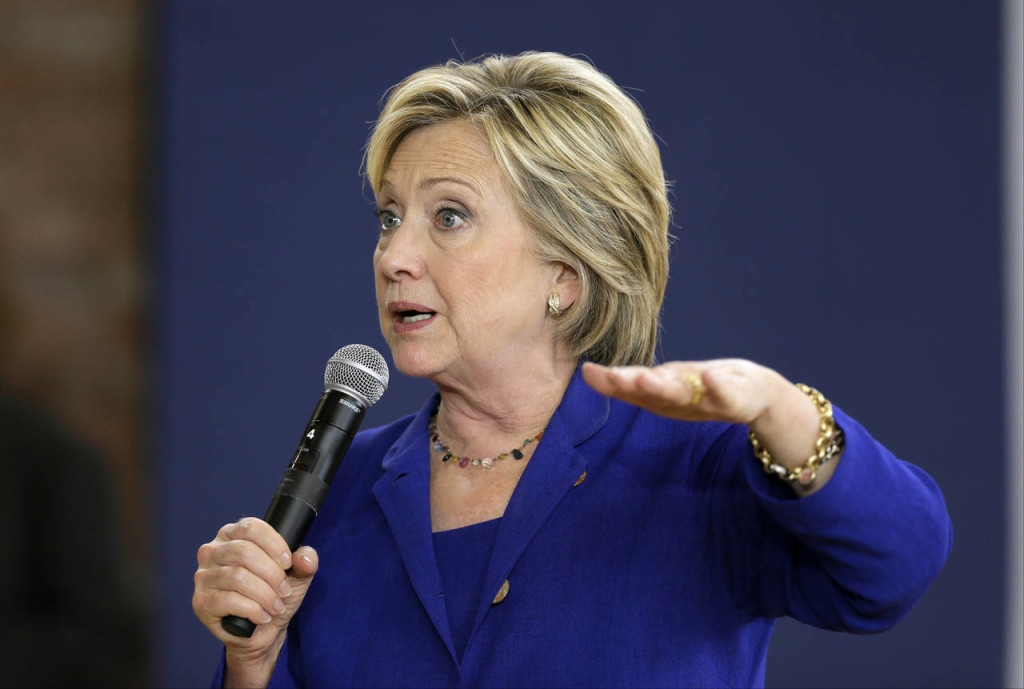
When the Democratic candidates for president take the stage for their first debate this week in Nevada, they’ll do so in a state that serves as a reminder of why Hillary Rodham Clinton is the front-runner for the nomination. One of the first four states to cast ballots in the presidential contest, Nevada is home to large communities of immigrants — many who have only recently arrived in the U.S. When combined with the state’s baroque caucus system, which is so complex that the rules surrounding it run 51 pages, that means winning the state and the largest share of delegates requires a higher degree of organization and effort to get-out-the-vote than in most others. And so for all the excitement generated to date by Vermont independent Sen. Bernie Sanders, and for all the anticipation about whether Vice President Joe Biden will decide to make a late entry into the race, it is Clinton and her campaign that are set up to win when Nevada Democratic caucus next February. Clinton installed staff on the ground in Nevada six months ago, and she now has 22 paid operatives in the state. They have recruited more than 3,000 volunteers, who have already held events in remote desert towns as well as the state’s urban centers. Clinton herself has made wooing immigrants a keystone of her campaign; she announced her immigration policy approach at a Las Vegas high school this spring. “That’s a lot of shoe leather, and they’ve been on the ground for 5-6 months,” Billy Vassiliadis, a veteran Democratic strategist in Nevada who isn’t involved in the current race, said of the Clinton campaign’s efforts. “That’s going to be a challenge that I don’t think a Sanders can overcome, that — God bless his heart — I don’t think Joe can overcome.” Meanwhile, Sanders’ effort in the state has just one paid staffer, who arrived less than two weeks ago. Biden has yet to decide whether to run and does not have any formal campaign operation. None of the other candidates Clinton will debate Tuesday night — former Maryland Gov. Martin O’Malley, former Rhode Island Sen. Lincoln Chaffee and former Virginia Sen. Jim Webb — have a campaign organization that can match Clinton’s. All are largely afterthoughts in early preference polls. The differences in the structural strength of the campaigns were evident this past weekend. While Sanders’ single Nevada staffer had his first meeting with hundreds of Sanders volunteers at a community college on Saturday, Clinton’s campaign flew in Democratic rising star Rep. Joaquin Castro of Texas in Las Vegas and former NBA player Jason Collins in Reno to cheer on volunteers and staffers who had been knocking on doors and making calls for months. “We gave — and we know we have — the best candidate for president of all the candidates for president, Democrat or Republican — Hillary Clinton,” Castro told about two dozen Clinton volunteers who, armed with clipboards filled with computer-generated lists of potential voters, were about to set out for an afternoon of door-knocking in heavily Latino East Las Vegas. Sanders supporters argue they can catch up. “There is a movement here, even in Nevada, for Bernie Sanders,” said Jim Farrell, Sanders’ Nevada state director. “This is not a normal election cycle.” Yet neither was 2008, when Clinton won the Nevada caucus. Her state director then was Robby Mook, who is now her national campaign manager. Her field director that year was Marlon Marshall, now the national campaign’s director of public engagement. Emmy Ruiz, who worked on the Clinton 2008 effort and then ran Obama’s successful 2012 race in Nevada, is now overseeing Clinton’s 2016 effort in the state. Vassiliadis, who worked on the 2008 Obama campaign, said it had staff on the ground in the spring of 2007 and nabbed the coveted endorsement of the Culinary Workers Union, which represents tens of thousands of casino workers in the state. And yet they couldn’t catch up to Mook and the campaign he built for Clinton in Nevada. Clinton’s team is doing it all over again, including targeting the state’s diverse electorate. The campaign hosts Filipino-style potluck dinners and is courting black pastors as well as Nevada’s influential corps of immigrant-rights activists. And what the campaign does in Nevada, Marshall said, will pay off across the country. “The diversity of Nevada and the outreach programs you use there can help us reach out to those communities in other states,” he said. Yet for all her successes in Nevada in 2008, Clinton left the state with one fewer delegate than did Obama. It’s something noted by some Sanders backers, who cite the complex rules that can generously apportion delegates to runners-up as they tout the potential for the enthusiasm for his campaign to ultimately trump Clinton’s structural edge. “We’ll go to the Democratic clubs and see a Hillary person will get up — they’re all very nice people, but it’s like they memorized a speech,” said Tazo Schafer, 67, a retired academic who is volunteering for Sanders, his first involvement in presidential politics since Eugene McCarthy‘s campaign. “Then the Bernie people get up and say, ‘Enough is enough,’ and there’s real passion.” Republished with permission of the Associated Press.
