
Cory Booker ends presidential bid after polling, money struggles
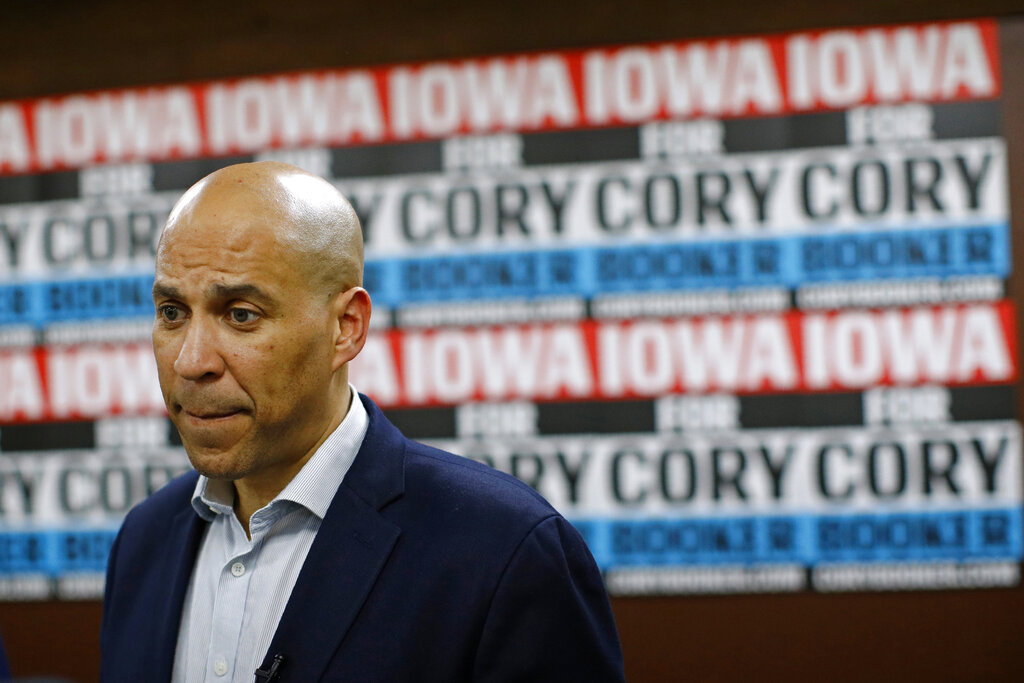
Booker’s campaign struggled from the beginning.
Steve Flowers: Alabama’s bizarre political theatrics would make a great movie

We in the Deep South have a unique history of political theatrics. The only northern states that rival our colorfulness are New Jersey and Illinois. In those two states, you are expected to be corrupt, especially Chicago. Our most colorful southern state has always been Louisiana. The parishes and bayous of the Pelican State gave us Huey Long and other characters. No other states can hold a candle to Louisiana’s brazen corruption. They not only expect their politicians to steal and cavort, they frown on them if they do not. The environment of Louisiana politics is bred toward corruption and debauchery. They not only gave us the glamour of the King Fish, Huey Long, they are proud of their infamous reputation. Well folks if you look at us here in the good old Heart of Dixie over the past few years we are probably giving Louisiana a run for its money. A cursory look at the record reveals that our Speaker of the House of Representatives, Mike Hubbard, was caught and convicted of taking bribes for sponsoring and passing legislation. Our 74-year-old doctor Governor Robert Bentley fell in love with his 44-year-old No. 1 adviser, lost all his wits, and has resigned from office in disgrace. He pleaded guilty to a misdemeanor charge and agreed never to run for office again. The House of Representatives was poised to impeach him had he not resigned. Ole Bentley had become an irrelevant clown and fodder for late night talk shows. The State is better off with Lt. Governor, Kay Ivey, serving out the remaining 20 months of Bentley’s term. Bentley, in a charade promulgated by his desire to not be indicted for his shenanigans, gave the U.S. Senate Seat vacated by Jeff Sessions to the sitting Attorney General Luther Strange to avoid prosecution. Therefore, our new junior U.S. Senator is in Washington with the taint of Bentley’s scandal hovering over his head with the appearance that he is there due to audacious collusion. We have an even richer novel that has transpired in Jefferson County, our most populous and supposedly urbane county. It made national news a year ago when the Mayor and President of the City Council got into a fistfight in the Birmingham City Hall. However, a new development is even more bizarre. During the fall elections, Democrats won all the Jefferson County judgeships. Along with the judgeships, Jefferson County voters elected a Democratic District Attorney. Democrat Charles Henderson beat incumbent Republican Brandon Falls by over 10,000 votes. Get this folks, the sitting DA trumps up a perjury charge against the new DA a few days before he was to take office. Falls convened a grand jury Jan. 12 and returned an indictment the next day Jan. 13. Henderson was to take office the following Monday. As anybody knows, a prosecutor can indict a potato for anything at any time. This scenario proves that point. The loser, Falls, got the winner, Henderson, indicted for perjury. This is so bizarre and corrupt a situation that it makes the aforementioned stories pale in comparison. It makes Jefferson County and Alabama look like a Third World banana republic. There are rampant rumors that the State’s top watchdog, Prosecutor Matt Hart, is camped out in Jefferson County and massive indictments are on the way. It has been over 70 years since Louisiana had a similar scenario. Nobody has been as brash in between. The Louisiana King Fish Huey Long was assassinated on the steps of the capitol in Baton Rouge. Huey Long’s brother, Earl Long, followed his famous older brother as governor. Earl was one colorful character. His opponents decided to seize power from Earl. They took control of the state police and had Earl arrested and put in the state insane asylum. One of the best political movies ever is entitled “Blaze” starring Paul Newman and it illustrates this story of Louisiana political lore. I recommend it for entertainment. These past two years in Alabama politics would make for a good movie. This latest Jefferson County fiasco would have to be a part of the plot. Look out Louisiana; we’ve got some good theater in the Heart of Dixie. See you next week. ___ Steve Flowers is Alabama’s leading political columnist. His weekly column appears in over 60 Alabama newspapers. He served 16 years in the state Legislature. Steve may be reached at www.steveflowers.us.
Lady Gaga hits stage for invite-only show for DNC delegates

Lady Gaga hit the stage at an invitation-only concert Thursday for delegates to the Democratic National Convention, covering classic songs from Woody Guthrie, Neil Young, the Beatles and others. Gaga opened with a jazzy version of Guthrie’s “This Land is Your Land” and then Young’s “Old Man.” She was introduced by Democratic U.S. Sen. Cory Booker, who called her a star who’s not afraid to speak out about sexual violence and mental health. She closed out her set with the Beatles’ “Come Together” and then sang Edith Piaf‘s “La Vie en Rose” as an encore. Lenny Kravitz, who also performed inside the convention on Wednesday night, ended his set Thursday by shouting, “We, the people! We, the people! We, the people!” DJ Jazzy Jeff spun tunes in between their sets. The show gives Camden, one of the country’s most impoverished cities, time in the Democratic convention spotlight. George Norcross and Susan McCue, president of General Majority PAC and a former chief of staff to U.S. Senate Majority Leader Harry Reid, hosted the “Camden Rising” event, held hours before Hillary Clinton formally accepts the Democratic Party’s nomination for president. Norcross is credited with working with Republican Gov. Chris Christie to help in redevelopment efforts in Camden, many partially funded through state grants and tax credits. The insurance executive is a Democratic superdelegate along with his brother, U.S. Rep. Donald Norcross. Both are supporting Clinton. Clinton delegate Suzanne Perkins, 47, of Ann Arbor, Michigan, said she thinks celebrities can help influence delegates and voters. After Kravitz’s set, she said Bernie Sanders supporters in her delegation who like his music and politics heard his support for Clinton and might think, “Maybe I ought to open my mind. Here’s a guy whose politics I agree with and he endorsed her.” Republished with permission of the Associated Press.
Dan Coats says Donald Trump hasn’t made up his mind on VP
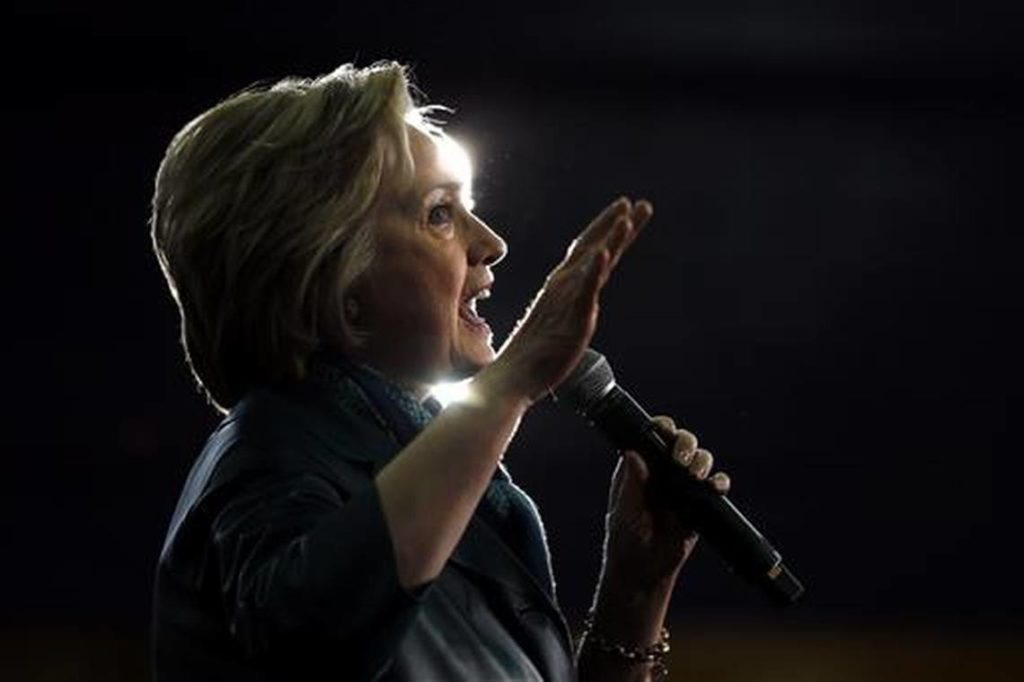
The Latest on the 2016 presidential campaign ahead of the Republican and Democratic national conventions (all times EDT): 1:30 p.m. Indiana Sen. Dan Coats says Donald Trump hasn’t made up his mind about who to select as his running mate. Coats told The Associated Press Wednesday that he spoke with Gov. Mike Pence late Tuesday — one of the names on Trump’s shortlist of potential running mates — and Pence told him there’s still no decision. “I think he’s the front-runner,” Coats said, adding, “I think he ought to be the front-runner.” Coats said Pence is “pretty calm about the whole thing.” He added that Trump is cognizant that he needs to make a decision by Friday given gubernatorial succession rules in Indiana. But he concluded that “reading Donald Trump’s mind is not the easiest thing to do.” ___ 1:20 p.m. Hillary Clinton says the Republican Party of Abraham Lincoln has been transformed into “the party of Trump.” Rattling off a series of attacks against her GOP rival, Clinton says Trump is “dangerous,” ”divisive,” ”fear-mongering” and is “pitting American against American.” Even stalwart Republicans, she says, should be alarmed by Trump’s policies and racist rhetoric. Clinton is casting Trump as ignorant of the Constitution, dismissive of U.S. law and lacking the character to be trusted with American security. “Imagine if he had not just Twitter and cable news to go after his critics and opponents, but also the IRS – or for that matter, our entire military,” she says. “Do any of us think he’d be restrained?” ___ 1:07 p.m. Hillary Clinton is calling on the country — including herself — to “do a better job of listening” rather than fueling political and other divisions after a series of high-profile shootings. Clinton says the country must address both gun violence, criminal justice reform and find ways to better support police departments. “I know that just saying these things together may upset some people,” she says. “But all these things can be true at once.” Clinton is speaking in the Illinois Old State House chamber in Springfield, the site of Abraham Lincoln’s his famous address about the perils of slavery. She is trying to use the symbolic site to contrast her call for civility with what she sees as rival Donald Trump’s polarizing campaign. Clinton said she has work to do, as well. She says that as someone “in the middle of a hotly fought political campaign, I cannot claim that my words and actions haven’t sometimes fueled the partisanship that often stands in the way of our progress.” Clinton adds, “I recognize that I have to do better too.” ___ 12:29 p.m. Donald Trump is meeting with finalists for the job of his vice presidential running mate. Trump met Tuesday with New Jersey Gov. Chris Christie and his family. Early Wednesday, Trump and his children met with Indiana Gov. Mike Pence and his family. Former House Speaker Newt Gingrich also was said to be a finalist. All three have auditioned for the job by opening for Trump at campaign rallies over the past week. Trump was expected to make an announcement on Friday. ___ 10:20 a.m. Republican Donald Trump huddled with Indiana Gov. Mike Pence at the governor’s mansion in Indiana on Wednesday morning amid swirling speculation about Trump’s vice presidential deliberations. Pence and Trump walked out of the residence together just before 10:30 a.m. The pair was joined inside by Pence’s wife, Karen, as well as Trump’s daughter, Ivanka, and his son-in-law Jared Kushner. Trump is said to have narrowed his short list down to a trio of top contenders, including Pence. Pence joined Trump at a fundraiser and a rally on Tuesday where he received a warm reception from the crowd. ___ 10:15 a.m. The lead super PAC backing Democratic presidential candidate Hillary Clinton has begun targeting Spanish-speaking voters in Colorado, Nevada and Florida as part of a $35 million online effort it announced earlier this year. An online ad from Priorities USA features video clips of Trump calling Hispanics “drug dealers” and “criminals” and leading his supporters in the chant: “Build that wall! Build that wall! Build that wall!” In Spanish, an on-screen message declares that “hatred is growing in our country.” The ad campaign also includes a website: unidoscontratrump.org, which means “united against Trump.” The same message will appear in banner ads on social media. The three targeted states all have significant Latino populations. Trump insists he can do better among Hispanics than the less-than-30 percent Republican Mitt Romney drew in 2012 after calling for “self-deportation” for immigrants in the country illegally. ___ 7:35 a.m. Bernie Sanders says he agrees with the harsh remarks that Justice Ruth Bader Ginsburg has made about Republican presidential candidate Donald Trump. The Vermont senator declined to say whether it is appropriate for a sitting Supreme Court justice to openly criticize a White House contender. But he tells ABC’s “Good Morning America” that he agrees Trump is a “total opportunist” and said “the record clear is quite clear that he lies just a whole lot of the time.” Ginsburg in a series of interviews with The Associated Press, The New York Times and CNN has called Trump unqualified to be president and joked that she would move to New Zealand if he won. Trump said in a tweet that Ginsburg should resign. Sanders’s comments came a day after he formally endorsed Hillary Clinton as the Democratic nominee for president. Asked if he is open to being her running mate, Sanders said, “I doubt that will happen.” He said his focus is on helping Clinton win. He says, “We cannot have a man with Trump’s temperament with the nuclear code and running this country.” 5:25 a.m. Hillary Clinton is turning to the symbolism of Abraham Lincoln’s “House Divided” speech to argue that the nation needs to repair its divisions after high-profile shootings in Texas, Louisiana and Minnesota. Clinton’s campaign says the Democratic presidential candidate will talk about the importance of uniting
Chris Christie on Donald Trump appearance: ‘I wasn’t being held hostage’

Anyone worried that Republican Gov. Chris Christie was being held hostage by Donald Trump as he stood, seemingly shell-shocked, behind the GOP presidential front-runner on Super Tuesday can rest easy. “No, I wasn’t being held hostage. No, I wasn’t sitting up there thinking, ‘Oh, my God, what have I done?’” Christie said Thursday back home in New Jersey. “I don’t know what I was supposed to be doing. All these armchair psychiatrists should give it a break.” He said his face was stoic because he was listening as Trump spoke. In “I stood where they asked me to stand. What do I care? Do you think I really care? … I really don’t,” he said. “Next week there will be an Internet freakout about something else.” InChristie also said he won’t heed calls from a handful of newspapers to resign and will continue helping Trump’s campaign. His defense of endorsing the billionaire developer came as two former Republican presidential nominees — including Mitt Romney on Thursday — and 70 national security experts warned that Trump was unfit to be commander in chief. Christie said he doesn’t agree with Trump on everything, though he wasn’t specific. He said he’s told Trump when he disagreed with him and has tried to change his mind. “That’s what a good endorser does,” Christie said. He spoke Thursday at a nearly two-hour news conference in Trenton that was part campaign debriefing, part attempt to refocus on priorities in the state. But he opened the floor up to questions, and reporters had a lot of them. Christie, who ended his own Republican presidential campaign last month, said he will continue helping Trump’s campaign but doesn’t have any more appearances scheduled. Christie added that his 30th wedding anniversary is next week, but he is otherwise focused on state priorities, including a budget due in June. Seven New Jersey newspapers have called on Christie to resign. The Star-Ledger, which endorsed Christie in his 2013 re-election campaign, said in an editorial Thursday that he has since made it clear that governing the state is a “distant second priority” that comes behind his personal ambition. Six newspapers published by Gannett also called for his resignation. Christie said he isn’t surprised by the newspapers’ stance because they haven’t supported him in the past. He said they’re merely trying to find a way to stay relevant as their readerships decline. “The only way to do that is to set themselves on fire,” Christie said. Christie, who spent 261 days out of the state in 2015, also chided the media for counting time he spent either in Philadelphia or New York as somehow not related to state business. “The way you count days is absurd,” he said. He said the Trump campaign financed his recent trips, but state taxpayers, as they always do, will be on the hook for the New Jersey State Police detail that is required to travel with him. Defending his endorsement, Christie said he believes Trump would make the best president out of the remaining candidates and has the best chance to defeat Democrat Hillary Clinton in the general election. He said he and Trump have been friends for 14 years. Christie noted that despite jokes from online commenters, he wasn’t forced into giving any coerced statements on Trump’s behalf. “This is part of the hysteria of the people who opposed my Trump endorsement,” Christie said. Christie said he plans to finish out the nearly two years left in his term and then go into the private sector. He did shoot down one question Thursday. When a reporter asked if he would resign if he were Trump’s pick for vice president, he replied, “Next!” Republished with permission of the Associated Press.
Chris Christie supporters see momentum in New Hampshire
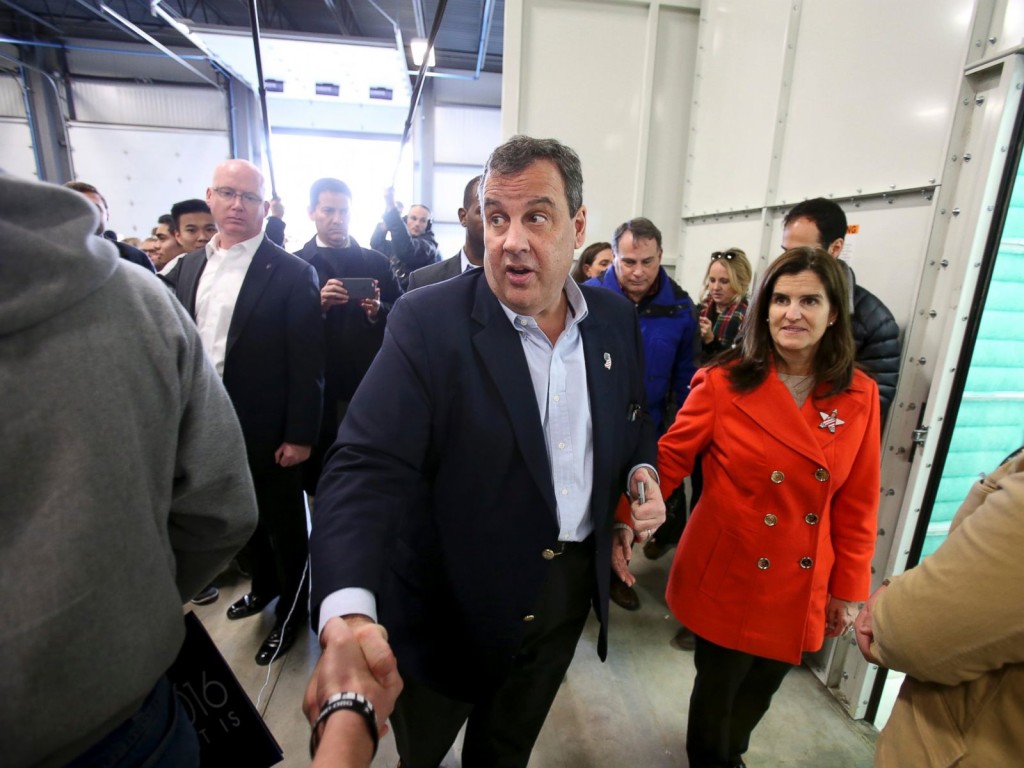
All the marathon town hall meetings, the bar visits, house parties and time invested in New Hampshire finally seem to be paying off for GOP presidential candidate Chris Christie. Poll after poll show the New Jersey governor making gains in the first-in-the-nation primary state. And his supporters say they feel a palpable surge in excitement as the calendar draws nearer to Feb. 9: primary day. “It’s electric,” said Barbara Sheehan, a New Jersey native who now lives in Tuftonboro, after hearing Christie speak. “You can just feel the momentum, it’s in the air.” Christie and his team seemed eager to show off their progress this weekend, when they kicked off a four-day bus tour across the state inside a cavernous automotive garage. After a parade of high-profile endorsers sung Christie’s praises, the governor and his family made a dramatic entrance, pulling into the garage aboard a bus emblazoned with his name and new campaign slogan — “Tell it Like it Is”— as music from “Star Wars” played. Beyond the shiny new wheels, Christie’s team also shipped 120 supporters in from New Jersey to fan across the state, knocking on doors. The move added manpower and helped boost his crowds. But also highlighted that he’s significantly understaffed in the state where he has staked his campaign. “There’s a big difference between paid staff and having to pay people to go door-to-door,” Christie told journalists gathered in the town of Derry. “We’ll do more work than paid staff has done in a month in a weekend, because people are committed to it and we know how to do this.” Christie has been lining up endorsements, but he is lagging many campaigns in fundraising, meaning that now, leading into the primary, he has less than a quarter of the manpower of some of his rivals. While a robust ground game is less important in New Hampshire than in early-voting Iowa, where voters must attend time-consuming caucuses, Christie currently has just four paid staff in the state. That’s far fewer than former Florida Gov. Jeb Bush, who has 20 full-time staff spread across five offices and Ohio Gov. Kasich, who has 11 full-time paid staff and expects to have five offices up and running by the end of the year. Florida Sen. Rubio, meanwhile, has eight paid staff, while poll-leader Donald Trump has 13 working out of four offices. Still, Christie banked on his charm to win votes, traveling the state to meet the people that could make or break his campaign. At Billy’s Sports Bar in Manchester on Sunday, Christie joined customers to chat as they finished their meals. “Nobody’s listening to us in Washington,” complained Manchester’s Joe Rolka, who works in sales. “I’m here to listen,” Christie told him as they spoke. When Christie moved on, Rolka said he was impressed by the governor’s unguarded approach. “After talking to him today, I’m on board. He can have my vote,” said Rolka, who’d been on the fence between Christie and billionaire businessman Donald Trump, who has been leading the state’s opinion polls. Joel Maiola, a Christie supporter from Bedford who managed President George W. Bush‘s campaign in the state in 2000, said that he could feel the buzz growing for Christie’s campaign. He said he made his final decision about a month ago, after taking a serious looks at Kasich, Bush and Rubio, who are all competing for moderate voters. He said he thinks Christie’s time is now. “It’s now to the point where people are making up their minds,” he said as he waiting in the bitter cold for Christie to arrive at a local bar Sunday. “If you were any candidate going into the Christmas break, you’d want to be Chris Christie.” To be sure, Trump remains the dominant force in the state, drawing thousands of people to his events. A recent Franklin Pierce University-Boston Herald poll found Trump to be the favorite of 26 percent of likely Republican voters, more than twice the backing of his closest rival. But Christie is now vying for second place, earning the support of 11 percent of voters in that poll, versus 12 percent for Rubio and 12 percent for Texas Sen. Ted Cruz. Christie’s favorability ratings are also on the rise, with 64 percent of voters now holding a favorable impression of him — up 18 points since October. But the momentum is also attracting new scrutiny for the New Jersey governor, who had been largely ignored by his rivals up until this point. Former Trump adviser Roger Stone, who is now working with a pro-Trump super PAC, told The Associated Press last week that he is looking to run ads highlighting Christie’s record in New Jersey. And Christie, who has been trying to move past the George Washington Bridge scandal that badly damaged his reputation at home, has begun to draw more criticism in debates. There’s also the reality that Christie, who has lagged behind many of his rivals when it comes to fundraising, is badly outgunned when it comes to staff. Still, Christie continues to display his usual swagger. Asked how he would be able to compete in the final stretch and get people out to vote, he appeared unfazed. “Because we’re better,” he told reporters between stops this weekend. “We’re better and we know how to win.” Republished with permission of the Associated Press.
Reporter mocked by Donald Trump says the 2 knew each other well

Donald Trump said he couldn’t have been making fun of a reporter’s disability because he doesn’t know the man. Not so, says the reporter. Serge Kovaleski of The New York Times says he has met Trump repeatedly, interviewing him in his office and talking to him at news conferences, when he worked for the New York Daily News in the late 1980s. “Donald and I were on a first-name basis for years,” he said in a Times story about the Republican presidential candidate’s behavior at a rally in South Carolina last week. Onstage Tuesday, a mocking Trump flailed his arms in an apparent attempt to imitate mannerisms of the “poor guy.” He accused Kovaleski of backing off a story from a week after the 9/11 attacks that said authorities in New Jersey detained and questioned “a number of people who were allegedly seen celebrating the attacks.” Kovaleski then worked for The Washington Post. Trump cites the story as proof of his claim that “thousands” of Muslims in New Jersey celebrated the devastation across the river. But the story did not suggest “thousands” were observed celebrating or that the reports of such a scene were true. Other accounts from that time concluded the allegations were unfounded. Kovaleski has arthrogryposis, a congenital condition that restricts joint movement. In his speech, Trump cited the 2001 story, “written by a nice reporter,” and went on: “Now the poor guy, you oughta see this guy — uh, I don’t know what I said, uh, I don’t remember. He’s going like, I don’t remember.” He made jerking gestures and his voice took on a mocking tone. On Thursday, Trump posted a statement on his Twitter account saying “I have no idea” who Kovaleski is and claiming to have “one of the all-time great memories.” He wrote: “If Mr. Kovaleski is handicapped, I would not know, because I do not know what he looks like. If I did know, I would definitely not say anything about his appearance.” Kovaleski challenged that statement in a Times story posted online Thursday night. “I’ve interviewed him in his office,” he said. “I’ve talked to him at press conferences. All in all, I would say around a dozen times, I’ve interacted with him as a reporter” when he worked for the Daily News. Republished with permission of the Associated Press.
Big spending expected for state legislative races in 2016
While the presidential campaign commands the public’s attention, political parties and financial contributors are quietly preparing for another less glitzy yet significant set of elections a year from now — battles to determine control of dozens of state legislative chambers. National Republican and Democratic groups have set record-high fundraising goals as they try to influence the outcome of 2016 state legislative races. Independent political committees appear likely to join the fray. With Congress frequently paralyzed by partisanship, legislative elections are gaining attention because states are the ones pushing change. In recent years, state legislatures have been addressing gun control, infrastructure, education standards, renewable energy, marijuana and transgender rights. The races also are critical to political parties because legislatures in most states are responsible for drawing the boundaries for congressional and state legislative districts. The party in charge can help ensure favorable districts — and thus potentially remain in power — for a decade to come. In the 2012 elections, for example, Democratic candidates for the U.S. House received about 1.4 million more votes than their Republican opponents, yet the GOP won a 33-seat majority in that chamber, partly because GOP-dominated state legislatures drew political maps to favor their party. While the next round of redistricting in 2021 may seem far away, it often takes several elections for parties to build a majority or chip away at one. That’s why some Democrats have described next year’s state legislative elections as vital if they are to begin reversing recent Republican gains. The GOP controls 69 of the nation’s 99 state legislative chambers, its most ever. “We are definitely looking at all of this in a multicycle way,” said Missouri Democratic Party Chairman Roy Temple. “That’s something that Democrats — not just in Missouri, but nationally — have not been particularly very good at historically.” The Democrats’ attempt to roll back GOP supermajorities in the Missouri Legislature is expected to be countered by heavy Republican spending, after both parties combined to spend more than $6 million on legislative races two years ago. Winning just a handful of seats, Temple said, can make a difference in the redistricting process and, ultimately, in enacting or blocking new laws. Nationally, the Democratic Legislative Campaign Committee hopes to raise $20 million for the 2016 state legislative races, which would set a record for the group. An additional $20 million is expected to be spent by an affiliated super political action committee, Advantage 2020, which is focused on gaining Democratic state legislative majorities ahead of the next round of redistricting. The rival Republican State Leadership Committee has its own record fundraising goal of $40 million. The Republican and Democratic groups each are targeting more than two dozen state legislative chambers, including 19 listed as priorities by both parties. Republicans will be trying to flip Democratic-led House chambers in Colorado, Kentucky and Washington as well as Senate chambers in Iowa, Minnesota and New Mexico. Democrats will be trying to reverse Republican control of 13 chambers, including one-seat Senate margins in such states as Colorado, Nevada and Washington. In Illinois and Massachusetts, Republicans are hoping to cut into Democratic supermajorities that can override the vetoes of Republican governors. The Democrats’ Advantage 2020 PAC is hoping to chip away at Republican legislative majorities in a half-dozen states won at least once by President Barack Obama — Florida, Michigan, North Carolina, Ohio, Pennsylvania and Wisconsin. The parties’ national efforts will be supplemented by state political parties and like-minded groups. Independent expenditures on state legislative races have been on the rise since the U.S. Supreme Court’s 2010 ruling in the Citizens United case, which allowed unions and corporations to spend unlimited amounts on political campaigns. From 2010 to 2012, the total amount of independent expenditures on state legislative races shot up 75 percent to $94 million, according to data compiled by the National Institute on Money in State Politics, a Helena, Montana-based nonprofit. It is still compiling nationwide figures for the 2014 elections. Outside interest groups already were spending big in this fall’s legislative races in New Jersey and Virginia, a potential sign of things to come. The Everytown for Gun Safety Action Fund, backed by former New York Mayor Michael Bloomberg, spent at least $2.2 million to help two Democratic candidates in a battle for control of the closely divided Virginia state Senate. One candidate won while the other lost. The Republican State Leadership Committee also poured more than $1 million into the Virginia Senate races. All told, more than $43 million had been spent on Virginia state Senate races a week before the election, surpassing the high mark set four years earlier, according to the Virginia Public Access Project, which tracks campaign spending. The result was the status quo, with Republicans maintaining the same 21-19 majority they held before Tuesday’s elections. In New Jersey, outside groups spent at least $8.5 million on this year’s state Assembly elections. That was nearly five times what groups spent during the state’s last non-gubernatorial elections in 2011. Most of that money came from two Democratic-leaning groups, the General Majority PAC and Garden State Forward, a political arm of the New Jersey Education Association. Democrats gained several seats in Tuesday’s elections, achieving the party’s largest Assembly majority in almost four decades. Other groups already have been raising money with an eye on 2016. “You have what will be a highly contentious presidential election cycle,” said Matt Walter, president of the Republican State Leadership Committee. So the group set a record-high fundraising goal, he said, “to make sure we cut through the clutter and make sure that these state-level races get the attention that they deserve.”
