
Rex Tillerson’s dismissal may hasten demise of Iran nuclear deal
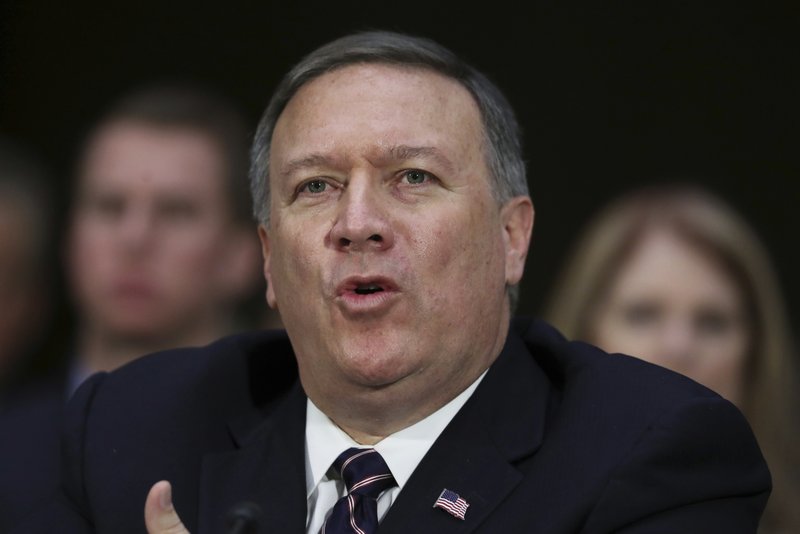
The Iran nuclear deal was in near terminal condition and on life support even before President Donald Trump fired Secretary of State Rex Tillerson. Tillerson’s dismissal this week may hasten its demise. As CIA chief and Iran hawk Mike Pompeo prepares to run the State Department, the Trump administration is weighing a speedier withdrawal from the agreement than even the president has threatened, according to two U.S. officials and two outside advisers briefed on the matter. They were not authorized to discuss the sensitive negotiations publicly and spoke on condition of anonymity. While such a scenario is unlikely, the fact it is being floated as an option may give U.S. officials more leverage in negotiations with European signatories to salvage the accord by toughening it. Two such negotiating sessions have already been held and a third is set for Thursday in Berlin. Trump, who calls the Obama administration’s signature foreign policy achievement the worst deal ever negotiated, has vowed to walk away from the 2015 agreement in mid-May unless Britain, Germany and France join the U.S. in addressing what the president says are its fatal flaws. These include no penalties for Iran’s missile work and support for militant groups in Lebanon, Syria, Yemen and elsewhere. The deal that was negotiated by the Obama administration and six other countries limits Iran’s enrichment and stockpiling of material that could be applied to a nuclear weapons program. In exchange, Tehran was granted widespread relief from international trade, oil and banking sanctions. Trump’s next deadline to extend some of those concessions is May 12, and he has vowed not to do so again unless the Europeans meet his demands. Any U.S. withdrawal would likely crater the agreement. If the U.S. begins threatening fines and other punishments for sanctions violations, countries around the world are likely to curtail commerce with Iran. That could prompt the Iranians to walk away as well, and perhaps even restart nuclear activities banned under the accord. An indication of the Trump administration’s thinking could come Friday, when the U.S., Britain, China, France, Germany, Russia, the European Union and Iran meet for a periodic review at the International Atomic Energy Agency headquarters in Vienna. State Department policy planning chief Brian Hook, who is running the negotiations with Europe, will lead the U.S. delegation to the larger meeting in Austria’s capital. Hook, who Tillerson leaned on heavily for policy advice and direction, could meet separately in Vienna with the Iranian delegation head, Deputy Foreign Minister Abbas Aragchi. For his part, Aragchi sees the writing on the wall. He told a parliamentary committee in Tehran on Wednesday that Tillerson’s ouster was proof that Trump would pull out and promised that Iran would withdraw if the U.S. does. In the U.S., Iran deal supporters braced for what they see as the inevitable. Pompeo “is certain to advise the president to withdraw the United States from our obligations under the nuclear agreement,” said Diplomacy Works, a group of mainly former Obama administration officials that lobbies for staying in the deal. Hook had been tasked by Tillerson with getting the Europeans to agree to as many of Trump’s demands as possible, with an eye toward selling the president on extending the sanctions waivers. Doing so would buy U.S. negotiators time to deal with elements of the agreement Trump has disparaged — such as its expiration dates on key nuclear constraints — and missile and terrorism concerns. With Tillerson gone, the emphasis will likely change. The ex-oilman had waged an often lonely battle within Trump’s Cabinet to save the deal. He succeeded for 13 months. But each time Trump faced another sanctions deadline, Tillerson met increased resistance to keeping the agreement alive. In firing Tillerson on Tuesday, Trump in particular noted his disagreement over the Iran accord. Trump won’t have that problem with Pompeo, who has lambasted the deal on a level similar to Trump, making clear the two men are of the same opinion. Trump said that he and Pompeo “have a very similar thought process” on the deal. As a congressman, Pompeo vociferously denounced the accord when it was struck. “The (deal) can perhaps delay Iran’s nuclear weapons program for a few years,” he wrote at the time. “Conversely, it has virtually guaranteed that Iran will have the freedom to build an arsenal of nuclear weapons at the end of the commitment.” His stance and position with Trump could give Pompeo leverage with the Europeans that Tillerson never enjoyed. U.S. officials said American positions have hardened over the past several weeks, notably on Iranian ballistic missile testing and the deal’s provisions that allow Iran to gradually resume advanced atomic work. Because Iran and the Europeans refuse to renegotiate the nuclear deal, U.S. officials are seeking to create a supplemental agreement with Europe to address these matters. At Thursday’s meeting in Berlin, U.S. and the European officials are hoping to compare draft written proposals and combine points of agreement into a new document that could form the basis of a side deal. U.S. and European diplomats say they’re closer on long-range ballistic missile launches, inspections and new sanctions on Iranian-backed militant groups. Gaps are larger on medium-range missiles that could hit Israel, Saudi Arabia and other Gulf Arab states and on the deal’s particulars for when advanced atomic work can restart. The U.S. focus turned to medium-range missiles after Israeli Prime Minister Benjamin Netanyahu met Trump in Washington earlier this month. Iran maintains that it must have medium-range missiles to defend itself, an argument the Europeans have been sympathetic to. The differences are even more stark on the sunset provisions, which are codified in the nuclear deal and which the Europeans and Iran regard as inviolable, according to the diplomats. One senior negotiator involved in the talks said last week that Europe is prepared to be “creative” in addressing the provisions but would not budge from opposing any measure that would punish Iran for activity that is otherwise permitted under the 2015 agreement. Republished with
Once critical of global deals, Donald Trump slow to pull out of any
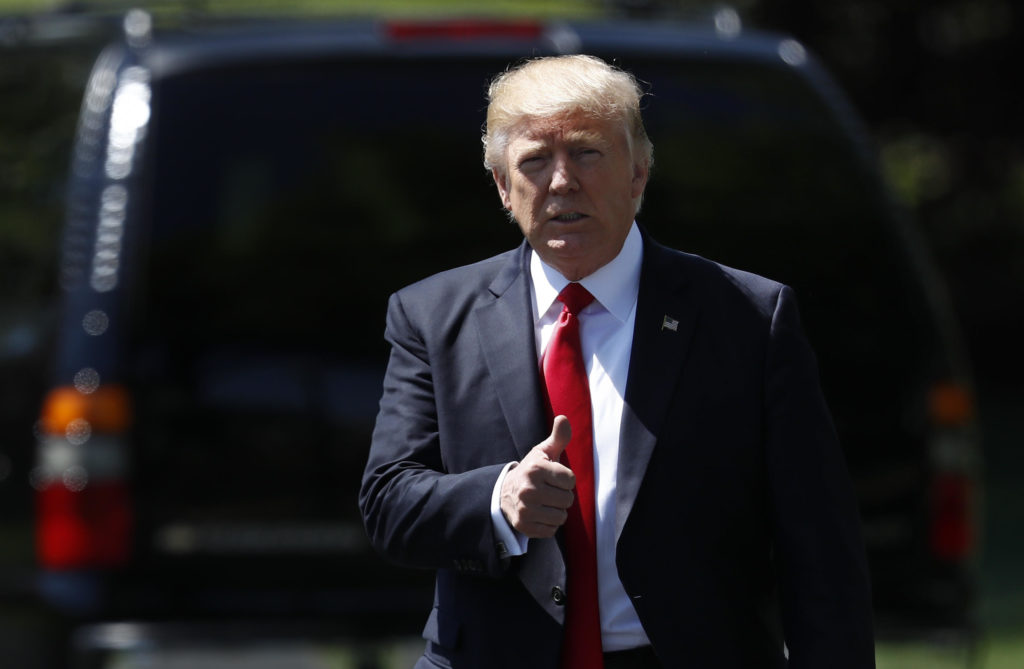
The “America First” president who vowed to extricate America from onerous overseas commitments appears to be warming up to the view that when it comes to global agreements, a deal’s a deal. From NAFTA to the Iran nuclear agreement to the Paris climate accord, President Donald Trump‘s campaign rhetoric is colliding with the reality of governing. Despite repeated pledges to rip up, renegotiate or otherwise alter them, the U.S. has yet to withdraw from any of these economic, environmental or national security deals, as Trump’s past criticism turns to tacit embrace of several key elements of U.S. foreign policy. The administration says it is reviewing these accords and could still pull out of them. A day after certifying Iran’s compliance with the nuclear deal, Secretary of State Rex Tillerson attacked the accord and listed examples of Iran’s bad behavior. His tone suggested that even if Iran is fulfilling the letter of its nuclear commitments, the deal remains on unsure footing. Yet with one exception — an Asia-Pacific trade deal that already had stalled in Congress — Trump’s administration quietly has laid the groundwork to honor the international architecture of deals it has inherited. It’s a sharp shift from the days when Trump was declaring the end of a global-minded America that negotiates away its interests and subsidizes foreigners’ security and prosperity. Trump had called the Iran deal the “worst” ever, and claimed climate change was a hoax. But in place of action, the Trump administration is only reviewing these agreements, as it is doing with much of American foreign policy. Douglas Brinkley, a presidential historian at Rice University, said Trump may be allowing himself to argue in the future that existing deals can be improved without being totally discarded. “That allows him to tell his base that he’s getting a better deal than Bush or Obama got, and yet reassure these institutions that it’s really all being done with a nod and a wink, that Trump doesn’t mean what he says,” Brinkley said. So far, there’s been no major revolt from Trump supporters, despite their expectation he would be an agent of disruption. This week’s reaffirmations of the status quo came via Tillerson’s certification of Iran upholding its nuclear deal obligations and the administration delaying a decision on whether to withdraw from the Paris climate accord. The president had previously spoken about dismantling or withdrawing from both agreements as part of his vision, explained in his inaugural address, that “every decision on trade, on taxes, on immigration, on foreign affairs will be made to benefit American workers and American families.” The Iran certification, made 90 minutes before a midnight Tuesday deadline, means Tehran will continue to enjoy relief from U.S. nuclear sanctions. Among the anti-deal crowd Trump wooed in his presidential bid, the administration’s decision is fueling concerns that Trump may let the 2015 accord stand. Tillerson on Wednesday sought to head off any criticism that the administration was being easy on Iran, describing a broad administration review of Iran policy that includes the nuclear deal and examines if sanctions relief serves U.S. interests. The seven-nation nuclear deal, he said, “fails to achieve the objective of a non-nuclear Iran” and “only delays their goal of becoming a nuclear state.” On the climate agreement, the White House postponed a meeting Tuesday where top aides were to have hashed out differences on what to do about the non-binding international deal forged in Paris in December 2015. The agreement allowed rich and poor countries to set their own goals to reduce carbon dioxide and went into effect last November, after the U.S., China and other countries ratified it. Not all of Trump’s advisers share his skeptical views on climate change — or the Paris pact. Trump’s position on trade deals also has evolved. He had promised to jettison the North American Free Trade Agreement with Mexico and Canada unless he could substantially renegotiate it in America’s favor, blaming NAFTA for devastating the U.S. manufacturing industry by incentivizing the use of cheap labor in Mexico. Now his administration is only focused on marginal changes that would preserve much of the existing agreement, according to draft guidelines that Trump’s trade envoy sent to Congress. The proposal included a controversial provision that lets companies challenge national trade laws through private tribunals. Trump has followed through with a pledge to pull the U.S. out of the Trans-Pacific Partnership, a sweeping free trade deal President Barack Obama negotiated. The agreement was effectively dead before Trump took office after Congress refused to ratify it. Even Trump’s Democratic opponent in the presidential race, Hillary Clinton, opposed the accord. But on NATO, Trump has completely backed off his assertions that the treaty organization is “obsolete.” His Cabinet members have fanned out to foreign capitals to show America’s support for the alliance and his administration now describes the 28-nation body as a pillar of Western security. Republished with permission of The Associated Press.
Gary Palmer dismayed by Senate Dems, calls out Iran’s nuclear deal violation
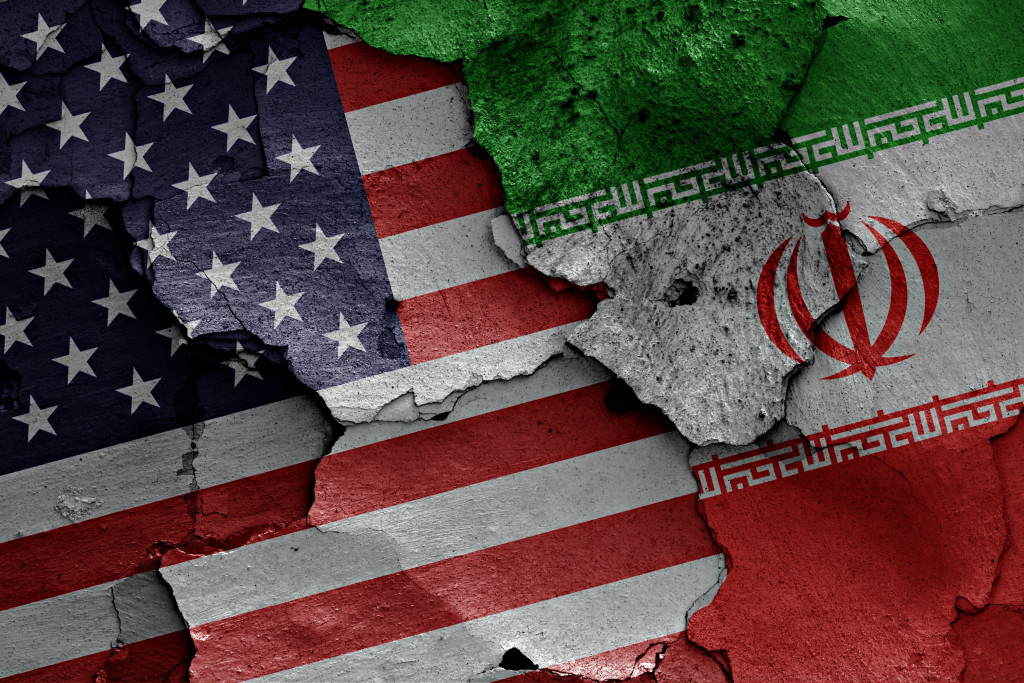
Senate Democrats on Wednesday unexpectedly blocked the chamber from considering the first major spending bill of the year for energy and water programs in effort to prevent a vote on a Republican amendment that would ultimately create friction in the wake of President Barack Obama’s nuclear deal with Iran. The amendment, sponsored by Arkansas Republican Senator Tom Cotton would ban U.S. from spending $8.6 million tax dollars from being used to buy heavy water from Iran in the future. Senate Democrats filibustered the spending bill Wednesday and sustained the filibuster in a second vote Thursday, objecting to what they called a “poison pill”added at the last minute to an otherwise bipartisan $37.5 billion funding bill for the Department of Energy and other agencies Dismayed at the Democrats’ actions, House Republican Gary Palmer (AL-07) spoke out, “Before the ink was dry on the nuclear deal, Iran was already violating it by conducting ballistic missile tests. Instead of holding Iran accountable, this Administration has decided to aid and abet Iran by helping to finance the effort. “Spending tax dollars to subsidize Iran’s efforts to further de-stabilize the region and pursue a nuclear weapon is irresponsible. America has more than one location that produces heavy water. The Obama Administration and Senate Democrats should be held accountable for these irresponsible actions.”
Rick Santorum tells #SunshineSummit U.S. is verging ‘on global war’

Hours after the terrorist attacks in Paris, Republican presidential candidate Rick Santorum told a Sunshine Summit crowd on Saturday that the U.S. was “on the verge of a global war.” “The world is on fire,” he said. “You’re going to be electing a wartime president … We better elect someone with experience, (not) someone who isn’t ready.” Santorum, a former U.S. senator for Pennsylvania, served on the Armed Services committee, supported the Iraq War and backed Iranian sanctions. He blamed the soft foreign policy of President Barack Obama and Democratic presidential candidate Hillary Clinton, formerly Obama’s secretary of state, for abandoning Iraq “against all the generals’ recommendations.” Santorum said of Parisians, “We will stand with them, pray with them and — if we had better leadership — help them.” He angrily mocked Obama’s concern of carbon dioxide, the main cause of global warming, being a greater threat than Islamic extremists. The terror attacks in Paris that claimed over 100 victims were claimed by Islamic State, the Mideast jihadist organization. “Hold your breath, otherwise you’re going to destroy the world,” Santorum said. Islamic State wants to rule under a 7th century form of Islam, he said, and he’d “bomb them back to the 7th century.” He reminded the audience of what he called the other threat in the region, Iran, which he said is still on the path of developing weapons despite a nuclear deal. “Iran with a nuclear weapon is a threat to every man and woman in this country,” he told the audience. The next president needs to be more like Ronald Reagan, someone that “the other side, the enemy, knows who they’re dealing with.” Santorum is at 0.8 percent in the polls, according to the latest average calculated by The Huffington Post. He’s a devout Catholic and social conservative known for his stands against gay marriage and abortion. Santorum also pushed an amendment to the No Child Left Behind Act while in the U.S. Senate that called for the teaching of intelligent design, the view that an “intelligent cause” is responsible for changes in nature, not Darwinian natural selection. The 57-year-old ran for president in 2012, when his rise in popularity peaked with his win of the Iowa caucuses — though by a slim 34 votes. He went on to win several more primaries before taking a dive in the polls and ending his campaign that April.
