
Kanye West delivers jaw-dropping performance in Oval Office
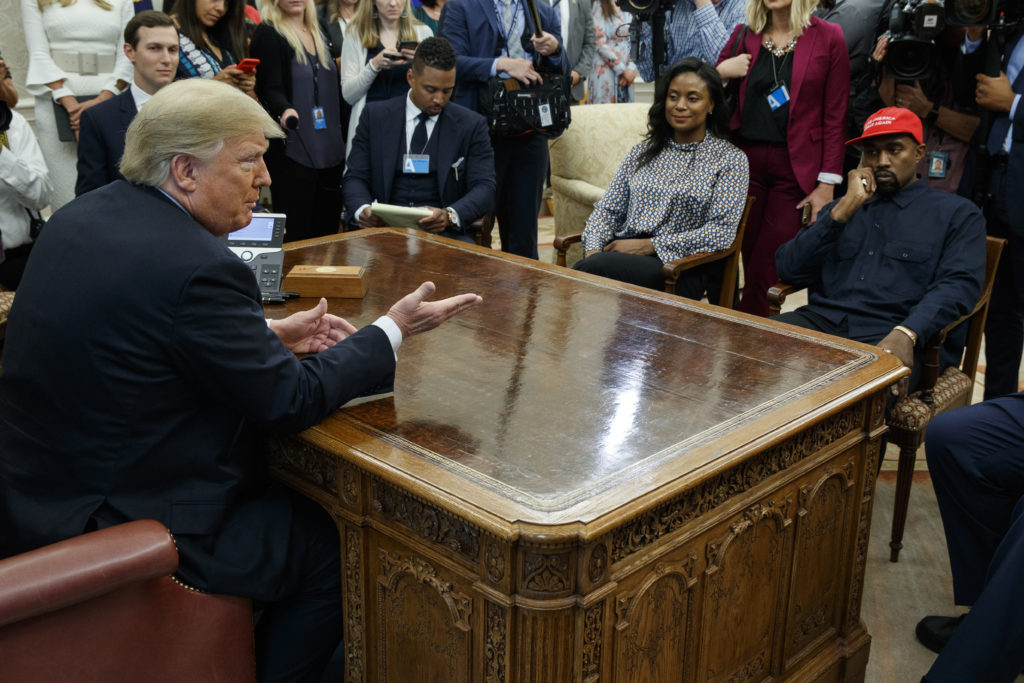
Live from the Oval Office, it’s Kanye West with a jaw-dropping performance. The rapper didn’t rap. But, seated across from President Donald Trump at the Resolute Desk, the musician delivered a rambling, multipart monologue Thursday that touched on social issues, hydrogen planes, mental health, endorsement deals, politics and oh so much more. Seizing the spotlight from the typically center-stage president, West dropped the F-word, floated policy proposals and even went in for a hug. “They tried to scare me to not wear this hat,” West said of his red “Make America Great Again” cap. But, he said, “This hat, it gives me power in a way.” “You made a Superman cape for me,” he told Trump. It was a surreal scene even by the standards of a nonconventional White House. The unlikely allies spoke to reporters before a closed-door lunch that had been billed as a forum to discuss policy issues including manufacturing, gangs, prison reform and violence in Chicago, where West grew up. Spectators at the show included Trump’s son-in-law and top adviser, Jared Kushner, former NFL star Jim Brown, the attorney for a gang leader serving time in federal prison, and a gaggle of reporters. During one pause, Trump seemed to acknowledge the oddness of the moment, saying, “That was quite something.” West’s mental health has been a question of speculation since he was hospitalized in 2016. In a bizarre performance last month on “Saturday Night Live” he delivered an unscripted pro-Trump message after the credits rolled. Addressing the topic Thursday, West said he had at one point been diagnosed with bipolar disorder, but was later told by a neuropsychologist he’d been misdiagnosed. “So he said that I actually wasn’t bipolar; I had sleep deprivation, which could cause dementia 10 to 20 years from now, where I wouldn’t even remember my son’s name,” he said. The conversation began with an exchange on North Korea among Trump, Brown and West. Trump said the region was headed for war before he took over, and West commended him for stopping it. Brown said he liked North Korea; Trump agreed. From there, West discussed prison reform and violence in inner-city Chicago. He brought up Larry Hoover, the leader of the Gangster Disciples who is serving a life sentence for murder, claiming: “The reason why they imprisoned him is because he started doing positive for the community. He started showing that he actually had power, he wasn’t just one of a monolithic voice, that he could wrap people around.” West said he “loved Hillary” Clinton, Trump’s 2016 Democratic rival, because he loves everyone, but said he connected with Trump’s “male energy.” He also criticized the 13th Amendment, which abolished slavery, calling it a “trap door.” Holding out his phone, West showed Trump a picture of a hydrogen-powered plane that he thought should replace Air Force One. “This right here is the iPlane 1,” he said. “This is what our president should be flying.” Added West: “If he don’t look good, we don’t look good. This is our president. He has to be the freshest, the flyest” and have “the flyest planes.” West also had a sartorial suggestion for Trump, proposing a hat that says just “Make America Great” — dropping the “again.” At the end of West’s lengthy, sometimes-hard-to-follow dialogue, even Trump seemed at a loss. “I tell you what: That was pretty impressive,” the president said. “It was from the soul,” West replied. “I just channeled it.” West later told reporters of his verbal stylings: “You are tasting a fine wine that has multiple notes to it. You better play 4D chess with me. … It’s complex.” Taking questions from reporters, the rapper also voiced concern about stop-and-frisk policing. Trump this week called on Chicago to embrace the tactic, which allowed police to detain, question and search civilians without probable cause, though it was deemed unconstitutional in New York City because of its overwhelming impact on minority residents. Trump said they’d discuss the matter and he’d keep an open mind. Asked about his comments in 2005 that President George W. Bush didn’t “care about black people” after Hurricane Katrina, West said that “We need to care about all people” and that he “was programed to think in a victimized mentality.” Trump and West previously appeared together shortly after Trump’s 2016 election in the lobby of Trump Tower in New York. Asked what the two had talked about during their December meeting, West responded briefly that time: “Life. We discussed life.” While Trump has been shunned by much of the Hollywood establishment, he has a fan in West, who tweeted earlier this year that the two share “dragon energy.” “You don’t have to agree with trump but the mob can’t make me not love him. We are both dragon energy. He is my brother,” West wrote. West is married to reality television star Kim Kardashian West, who successfully pushed Trump to grant a pardon to a drug offender earlier this year. West himself has suggested he might be open to wading into politics, including a run for president in 2020. Asked if West could be a future presidential candidate, Trump said, “Could very well be.” West shot back, “Only after 2024.” After all that, the president brought the show to a close by suggesting, “Let’s go have some lunch, OK?” Republished with permission from the Associated Press.
In Donald Trump era, the death of the White House press conference

The presidential news conference, a time-honored tradition going back generations, appears to be no longer. More than a year has passed since President Donald Trump held the only solo news conference of his administration — a rollicking, hastily arranged, 77-minute free-for-all during which he railed against the media, defended his fired national security adviser and insisted nobody who advised his campaign had had contacts with Russia. But there are no signs the White House press shop is interested in a second go-round. Instead, the president engages the press in more informal settings that aides say offer reporters far more access, more often, than past administrations. “President Trump is more accessible than most modern presidents and frequently takes questions from the press,” says White House press secretary Sarah Huckabee Sanders. The president often answers shouted questions at so-called pool sprays, in which a small group of rotating reporters is given access to events such as bill signings and Cabinet lunches. Trump has also taken to answering shouted questions on the White House lawn as he arrives at and departs the White House. The frenzied exchanges — frequently taking place over the roar of Marine One’s rotor — often produce news. But the format also gives the president far more control than he would have during a traditional question-and-answer session. Trump can easily ignore questions he doesn’t like and dodge follow-ups in a way that would be glaring in a traditional news conference. On Friday, for instance, Trump answered several questions in the Oval Office about North Korea and Iran. But when a reporter asked about his threats regarding intervening in the Justice Department, Trump responded with a curt “thank you” that signaled to reporters that he was done with the Q&A session. The president also holds joint news conferences with visiting world leaders, a format reporters call “two and two” because each leader selects two of its country’s reporters to ask questions. While the format looks similar to a solo news conference, the president more often than not calls on friendly reporters from conservative outlets and limits the opportunity for follow-up questions. On Friday, during a joint news conference with German Chancellor Angela Merkel, Trump called on reporters from Fox Business Network and the Christian Broadcasting Network. Fox News correspondent John Roberts has been called on so often that Trump once picked him and then changed his mind. “Actually, we’ll go somebody else this time, John. You’ve been doing enough, John,” he said to laughs. Trump also submits to occasional one-on-one interviews with individual news outlets. Last week, he called in to “Fox & Friends,” his favored format during the campaign. And several times he has held longer, impromptu question-and-answer sessions, including one in the Rose Garden with Senate Majority Leader Mitch McConnell that, for reporters, had the feel of a mosh pit. Margaret Talev, a longtime White House reporter and president of the White House Correspondents Association, said the association welcomes Trump’s “openness to engage on a regular basis, in pool sprays in the Oval Office and less traditional settings such as South Lawn departures.” But, she said, “We have been disappointed at his reluctance to engage in regular full-format news conferences and we will continue to encourage him and his team to return to the practice. Such news conferences help the public to gain a deeper understanding of a president’s thinking on an issue; show transparency and accountability; allow journalists to raise questions the public may be concerned about; and also allow a president to shape his message.” Indeed, during his campaign, Trump often criticized his rival, Democrat Hillary Clinton, for failing to engage more with the press. “Crooked Hillary Clinton has not held a news conference in more than 7 months. Her record is so bad she is unable to answer tough questions!” he tweeted in June 2016. The pattern marks a dramatic departure from historic precedent, according to records kept by The American Presidency Project and dating back to Calvin Coolidge. In their first years alone, President Barack Obama held 11 solo news conferences, George W. Bush held five, and Bill Clinton a dozen. Trump held just one. It’s part of a pattern reflecting Trump’s extraordinarily hostile relationship with a press he loves to hate. “The White House isn’t legally mandated or required to hold press conferences, but it’s a tradition that’s been in place because it serves the public,” said Katie Townsend, the litigation director at Reporters Committee for Freedom of the Press. “And I think the idea that the media is the enemy of the American people and an enemy of the president itself … I think the unwillingness to talk to the members of the media is part of that.” But Ari Fleischer, who served as press secretary for George W. Bush, said there is little benefit for a White House to hold solo new conferences anymore since the president can communicate with the public in other ways. “So long as the president is held accountable as a result of frequent pool sprays, as a result of frequent press conferences with heads of state, one-on-one interviews, the public gets its accountability through other tactics beyond formal long-winded news conferences,” Fleischer said. Bush, he noted, wasn’t a fan of the prime-time news conference, complaining that reporters would “peacock” at those events, making them more about themselves than the president. Trump, however, seems to like the format, which he credited last year for his election win. “Tomorrow, they will say, ‘Donald Trump rants and raves at the press.’ I’m not ranting and raving. I’m just telling you. You know, you’re dishonest people. But I’m not ranting and raving. I love this,” he said during his press conference last year. “I’m having a good time doing it.” Republished with the permission of the Associated Press.
Kellyanne Conway kneels on Oval Office couch, sparks debate
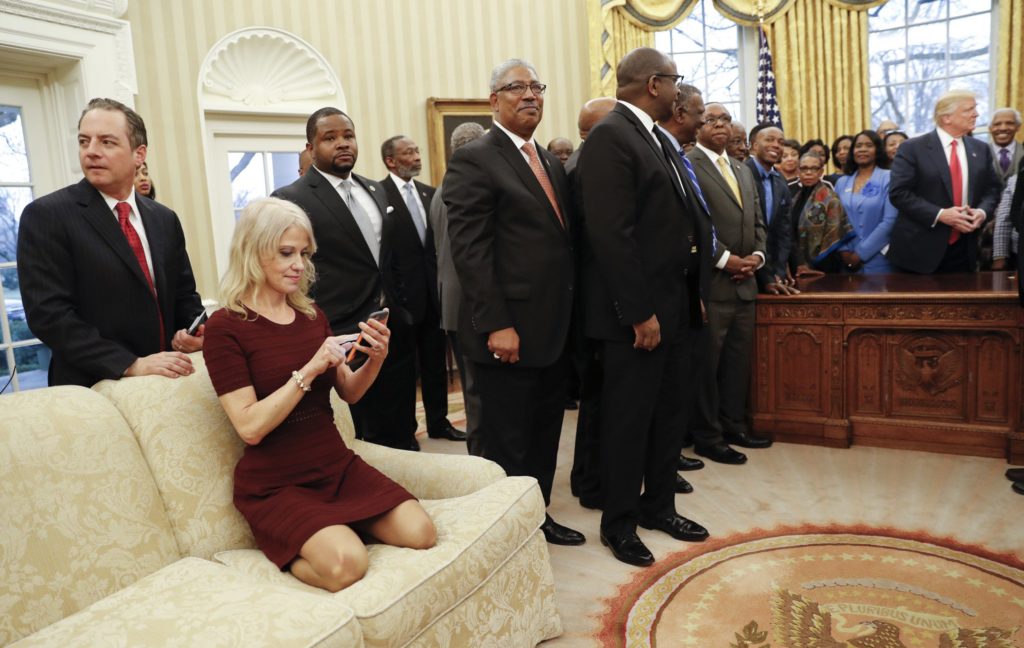
Photos of White House adviser Kellyanne Conway kneeling on an Oval Office couch with her shoes on have sparked an online debate about decorum in the executive mansion. Conway is seen perched on her knees on the couch with her feet behind her in photos taken Monday while President Donald Trump met with leaders of historically black colleges and universities. Some Twitter users were quick to highlight the photos as evidence of a lack of respect for the office from Conway and the Trump administration. Other users have countered with numerous photos of former President Barack Obama resting his feet on the office’s famed Resolute desk at various times during his eight years in office. Conway has yet to weigh in on the criticism. Republished with permission of The Associated Press.
Barack Obama mentoring Donald Trump on world leadering
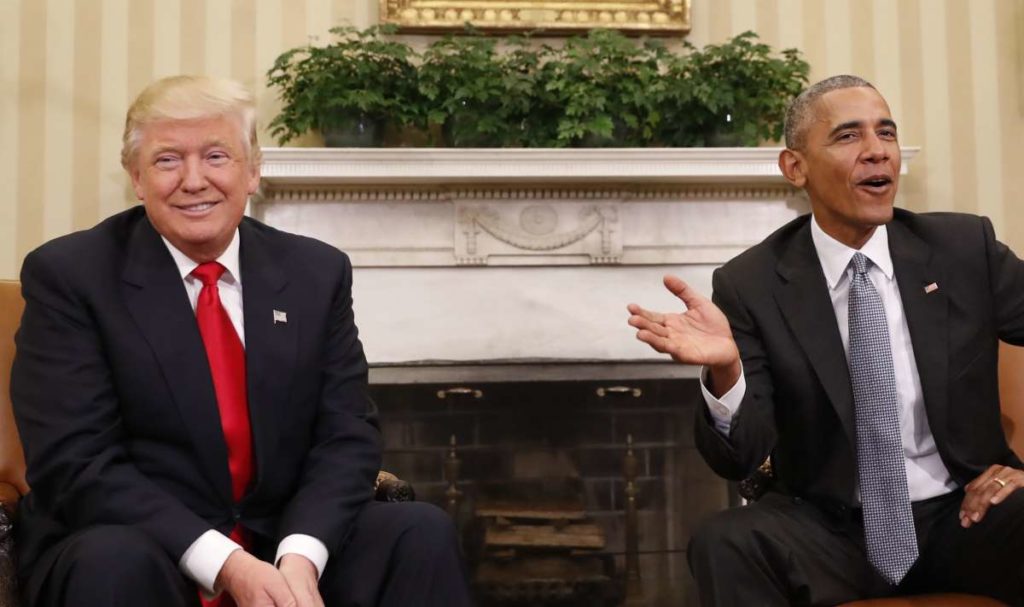
It’s the last thing President Barack Obama ever expected he’d be doing in his final months in office: Coaching Donald Trump on how to be a world leader. As the president-elect holes up in his skyscraper, Obama is giving Trump policy advice, style tips and gentle nudges to let the fervor of the campaign give way to the sobriety of the Oval Office. And as Obama completes his last world tour, he’s been thrust into the unexpected role of Trump translator to anxious U.S. allies. Standing next to German Chancellor Angela Merkel in Berlin, Obama said Trump would quickly see that a president’s responsibilities can’t be treated casually and that diverse countries can only be governed by “listening and reaching out.” “It is my hope that that is what will happen,” Obama said. “And I’m going to do everything I can over the next two months to help assure that that happens.” Though the outgoing president made clear his profound disdain for Trump throughout the campaign, perhaps no one is better positioned than Obama to get him up to speed in a matter of weeks. It’s unclear, though, how much help Trump wants or will accept from Obama. And no one expects that the executive tutoring will substantially change Trump’s vast differences with Obama, who he called the worst president in U.S. history. After meeting with Trump following the election, Obama resolved to spend more time helping prepare Trump than he might under different circumstances — say, if Hillary Clinton had been elected, aides said. Trump, to the surprise of many, seemed game. He said he wanted Obama’s “counsel” and looked forward to “many, many” more meetings. In the run-up to the election, the White House had planned only perfunctory, refresher-style briefings for Clinton, who is no stranger to the White House and whose transition team had prepared extensively for an expected takeover. Soon after Trump’s victory, White House chief of staff Denis McDonough directed that his preparatory materials be thickened and his intelligence briefings expanded to include more basic information, according to U.S. officials, who weren’t authorized to discuss the matter publicly and requested anonymity. Obama and his closest advisers were irritated when it leaked out that Trump, during his White House visit, had displayed a lack of thorough knowledge about key issues while Trump’s aides appeared unfamiliar with the process of staffing up a White House, officials said. They were concerned if Trump felt insulted or aggrieved, he might pull the plug on accepting Obama’s advice and help. After all, Obama’s aides had been pleasantly surprised when Trump, after their Oval Office chat, had agreed to preserve key elements of the “Obamacare” health law, which he’d pledged during the campaign to repeal. If Trump has felt patronized by Obama, so far he hasn’t shown it. Asked why Trump’s meeting this week with Japanese Prime Minister Shinzo Abe was closed to the press, senior transition adviser Kellyanne Conway pointed out that Obama was traveling overseas. “We are very deferential and respectful of the fact that we already have a president of the United States, Barack Obama,” Conway told reporters. “President Obama is still in office for the next two months, and we won’t be making diplomatic agreements today.” Though Trump and Vice President-elect Mike Pence have spoken by phone to more than 30 heads of state since the election, Trump hasn’t been heard from publically, save for one television interview and occasional tweets. From his suite in Trump Tower, he and top aides have been interviewing candidates for the 4,000-odd roles they must fill. Unsure how Trump as president may shake up foreign relations, world leaders have turned to Obama for information about what to expect. Traveling this week to Greece, Germany and Peru, Obama has tried to reassure U.S. partners that Trump, in their Oval Office meeting, expressed a “full commitment” to NATO. “I am encouraged by the president-elect’s insistence that NATO is a commitment that does not change,” Obama said in Germany. During the campaign, Trump said the U.S. didn’t “really need NATO in its current form,” calling it obsolete and threatening not to defend NATO allies unless they pay more into the alliance. Though Trump has since softened those comments, he hasn’t offered the explicit reassurances in public that Obama said he offered in private. But Obama said he was “cautiously optimistic” that transitioning from candidate to president-in-waiting would force Trump to focus and get serious about “gaining the trust even of those who didn’t support him.” “That has to reflect itself not only in the things he says, but also how he fills out his administration,” Obama said. “And my hope is that that’s something he is thinking about.” Republished with permission of the Associated Press.
Donald Trump takes triumphant tour of Washington, has cordial meeting with Barack Obama
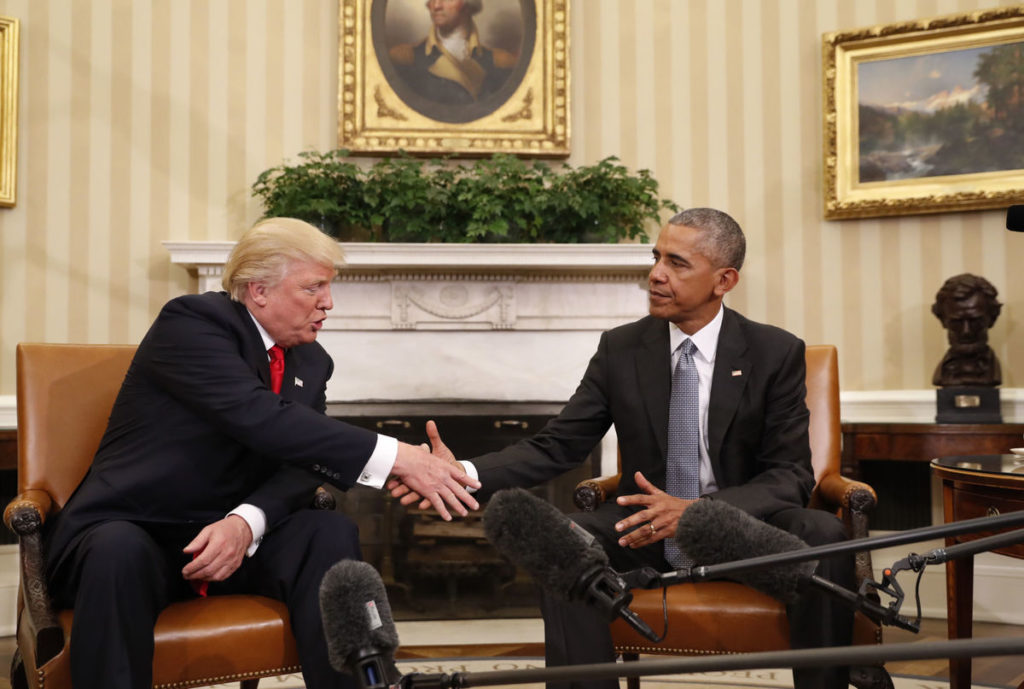
President-elect Donald Trump took a triumphant tour of the nation’s capital Thursday, holding a cordial White House meeting with President Barack Obama, sketching out priorities with Republican congressional leaders and taking in the majestic view from where he’ll be sworn into office. Trump’s meeting with Obama spanned 90 minutes, longer than originally scheduled. Obama said he was “encouraged” by Trump’s willingness to work with his team during the transition of power, and the Republican called the president a “very good man.” “I very much look forward to dealing with the president in the future, including his counsel,” Trump said from the Oval Office. He’ll begin occupying the office on Jan. 20. While Trump noted that he and Obama had never met before, their political histories will forever be linked. Trump spent years perpetrating the lie that Obama was born outside the United States. The president campaigned aggressively against Trump during the 2016 campaign, warning that his election would put the republic at risk. But at least publicly, the two men appeared to put aside their animosity. As the meeting concluded and journalists scrambled out of the Oval Office, Obama smiled at his successor and explained the unfolding scene. “We now are going to want to do everything we can to help you succeed because if you succeed the country succeeds,” Obama said. From the White House, Trump headed to Capitol Hill for meetings with House Speaker Paul Ryan of Wisconsin and Senate Majority Leader Mitch McConnell of Kentucky to discuss the GOP legislative agenda. Ryan, who holds the most powerful post in Congress, was a sometime critic of Trump and never campaigned with the nominee. Emerging from the meetings, Trump sketched out priorities for his presidency. “We’re going to move very strongly on immigration,” he said. “We will move very strongly on health care. And we’re looking at jobs. Big league jobs.” If Trump makes good on his campaign promises, he’ll wipe away much of what Obama has done during his eight years in office. The Republican president-elect, who will govern with Congress fully under GOP control, has vowed to repeal Obama’s signature health care law and dismantle the landmark nuclear accord with Iran. He’s also vowed to build a wall along the U.S.-Mexico border. First lady Michelle Obama met privately in the White House residence with Trump’s wife, Melania, while Vice President Joe Biden was seeing Vice President-elect Mike Pence later Thursday. Obama and Trump met alone, with no st Melania Trump aff present, White House press secretary Josh Earnest told reporters afterward. “The two men did not relitigate their differences in the Oval Office,” Earnest said. “We’re on to the next phase.” Trump traveled to Washington from New York on his private jet, breaking with protocol by not bringing journalists in his motorcade or on his plane to document his historic visit to the White House. Trump was harshly critical of the media during his campaign and for a time banned news organizations whose coverage he disliked from his events. As scores of journalists waited to be admitted to the Oval Office to see Obama and Trump together, they saw White House chief of staff Denis McDonough walking along the South Lawn driveway with Jared Kushner, Trump’s son-in-law. A handful of Trump aides trailed them. The show of civility at 1600 Pennsylvania Avenue contrasted with postelection scenes of protests across a politically divided country. Demonstrators from New England to the heartland and the West Coast vented against the election winner on Wednesday, chanting “Not my president,” burning a papier-mache Trump head, beating a Trump pinata and carrying signs that said “Impeach Trump.” More than 100 protesters held a sit-in outside Trump International Hotel just blocks from the White House. The mostly student protesters held signs saying “Love Trumps Hate,” a phrase Democrat Hillary Clinton often used during the campaign. Trump’s advisers, many of whom were stunned by his unexpected victory over Clinton, plunged into the work of setting up a White House and staffing government agencies. Officials at the Pentagon and State Department said they had not yet been contacted. State Department spokesman Mark Toner said the agency stood ready “to work with the incoming team once that team is designated and arrives here. But we don’t have any firm word as to when that will be.” Trump was expected to consider several loyal supporters for top jobs, including former New York Mayor Rudy Giuliani for attorney general or national security adviser and campaign finance chairman Steve Mnuchin for Treasury secretary. Former House Speaker Newt Gingrich and Tennessee Sen. Bob Corker were also expected to be under consideration for foreign policy posts. As president-elect, Trump is entitled to the same daily intelligence briefing as Obama — one that includes information on U.S. covert operations, information gleaned about world leaders and other data gathered by America’s 17 intelligence agencies. The White House said it would organize two exercises involving multiple agencies to help Trump’s team learn how to respond to major domestic incidents. Republished with permission of the Associated Press.
Facebook hails U.S. presidential race as 2015’s top topic

The U.S. won’t elect a president until next year but the debate over the crowded field of candidates jostling for the Oval Office emerged as the hottest topic on Facebook this year. The race for the Democratic and Republican party nominations eclipsed an outpouring of emotions over deadly attacks, strife, social issues and disasters. The rankings released Wednesday open a window into the cultural mindset by analyzing how frequently specific high-profile events, politicians, entertainers, athletes, movies and TV shows were mentioned in the posts of Facebook’s 1.5 billion users. “This year, the most talked about global topics reflected the serious challenges people are facing all over the world — and how our global community is connecting and coming together in ways we have never seen before,” said Sheryl Sandberg, Facebook Inc.’s chief operating officer. Google, the owner of the Internet’s dominant search engine, will provide another snapshot of what people were thinking and talking about when it releases its annual breakdown of the year’s most frequent requests for more information. Here’s a glimpse at how the world looked on Facebook this year: ___ TOP TOPICS The polarizing candidacy of billionaire former reality-TV star Donald Trump helped drive early interest in who will win next year’s race to succeed President Barack Obama. Facebook says last week’s shootings in San Bernardino didn’t trigger enough discussion to break into the top five. 1. U.S. presidential election 2. Nov. 13 attacks in Paris 3. Syrian civil war and refugee crisis 4. Nepal earthquakes 5. Greek debt crisis ___ TOP ENTERTAINERS British singer Ed Sheeran doesn’t have as many followers as Taylor Swift and other singers on Twitter but the voice behind the Grammy-nominated song “Thinking Out Loud” topped Facebook’s charts this year. All five of the top spots were held by singers. 1. Ed Sheeran 2. Taylor Swift 3. Kanye West 4. Nicky Jam 5. Wiz Khalifa ___ TOP TV SHOWS No surprise here after the HBO series “Game of Thrones” enthralled audiences during its fifth season and won a record 12 times, including the prize for best drama, at the Emmy awards in September. 1. “Game of Thrones” 2. “The Walking Dead” 3. “The Daily Show” 4. “Saturday Night Live” 5. “WWE Raw” ___ TOP MOVIES The anticipation for the Walt Disney Co.’s revival of the “Star Wars” franchise loomed over theaters like the Death Star for most of the year, even though the film won’t be released until next week. 1. “Star Wars: The Force Awakens” 2. “Furious 7” 3. “Jurassic World” 4. “Avengers: Age of Ultron” 5. “American Sniper” ___ TOP ATHLETES The long-awaited May duel between two of the past decade’s best boxers captivated sports fans. Reflecting Facebook’s worldwide reach, none of the most popular pastimes in the U.S. placed an athlete in the top five. New England Patriots quarterback Tom Brady came in sixth place on Facebook’s list, while Golden State Warriors guard Stephen Curry occupied the seventh spot to beat the Cleveland Cavaliers’ LeBron James in the basketball arena. 1. Boxer Floyd Mayweather Jr. 2. Boxer Manny Pacquiao 3. Mixed martial arts fighter Ronda Rousey 4. Soccer star Lionel Messi 5. Soccer star Cristiano Ronaldo ___ TOP POLITICIANS Fascination over who might replace him next year wasn’t enough to overshadow the current U.S. president as he wrapped up in his penultimate year in office. 1. U.S. President Barack Obama 2. Republican presidential candidate Donald Trump 3. Brazil President Dilma Rousseff 4. Democratic presidential candidate Hilary Clinton 5. Democratic presidential candidate Bernie Sanders Republished with permission of the Associated Press.
Donald Trump calls for ‘complete shutdown’ on Muslims entering U.S.

Republican presidential candidate Donald Trump called Monday for a “total and complete shutdown of Muslims entering the United States.” The proposed ban would stand “until our country’s representatives can figure out what is going on,” his campaign said in a statement. The statement added that Trump’s proposal comes in response to the level of hatred among “large segments of the Muslim population” toward Americans. “Until we are able to determine and understand this problem and the dangerous threat it poses, our country cannot be the victims of horrendous attacks by people that believe only in jihad, and have no sense of reason or respect for human life,” Trump said in the statement. He added on Twitter: “Just put out a very important policy statement on the extraordinary influx of hatred & danger coming into our country. We must be vigilant!” Trump campaign manager Corey Lewandowski said Trump’s proposed ban would apply to “everybody,” including Muslims seeking immigration visas as well as tourists seeking to enter the country. He did not respond to questions about whether it would also include Muslims who are U.S. citizens and travel outside of the country, or how a determination of someone’s religion might be made by customs and border officials. In response to a request for additional detail, Trump said via a campaign spokeswoman: “Because I am so politically correct, I would never be the one to say. You figure it out!” Trump’s proposal comes a day after President Barack Obama spoke to the nation from the Oval Office in the wake of the shootings in San Bernardino, California, which Obama said was “an act of terrorism designed to kill innocent people.” The FBI said Monday the Muslim couple who carried out the massacre had been radicalized and had taken target practice at area gun ranges, in one case within days of the attack last week that killed 14 people. Republished with permission of the Associated Press.
