
Bob Dole honored in Kansas as tough but compassionate statesman
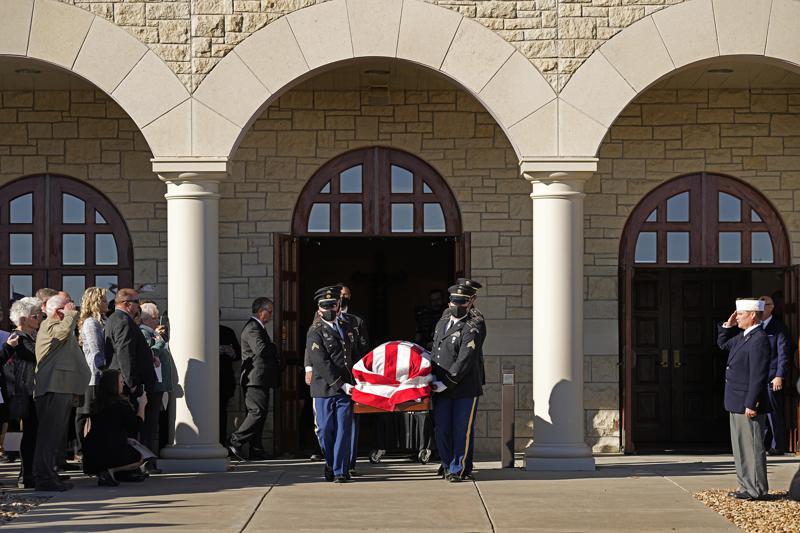
Fellow Kansans on Saturday celebrated Bob Dole as a tough but compassionate patriot shaped by small-town values, a strong partisan leader who could nevertheless work with political opponents, and a war hero who ultimately became “the greatest of the Greatest Generation.” Dole made his last journey to his prairie state for memorial services in his western Kansas hometown of Russell and at the Statehouse in Topeka. He was honored for the military service during World War II that left him severely wounded and the distinguished political career that followed his recovery. Elected officials and former elected officials from both parties said Dole embodied the state’s motto, “To the stars through difficulties,” and never stopped trying to help others. “He did not hide in a time of crisis. He looked for solutions,” former U.S. Rep. Jim Slattery, a Kansas Democrat, said during the Statehouse event. ”I often told Bob he was the toughest man I ever knew, both physically and mentally, but he had a tender heart.” Dole died Sunday at the age of 98 after a lifetime of service that included nearly 36 years in Congress and running as the GOP nominee for president in 1996. U.S. Senate Minority Leader Mitch McConnell, who served more than a decade with Dole in the Senate and later surpassed Dole as the longest-serving GOP leader there, attended both Kansas events as well. Saturday’s events began with a public viewing of his casket and a memorial service at a Roman Catholic church in Russell, the small town some 240 miles (386 kilometers) west of Kansas City where he grew up during the Great Depression. Speakers for the state capital event Saturday afternoon noted that Dole’s career in elective office began in the Kansas House in the early 1950s. The dignitaries at both events included Democratic Gov. Laura Kelly, Kansas’ two Republican U.S. senators, Roger Marshall and Jerry Moran, and former GOP U.S. Sens. Pat Roberts and Nancy Kassebaum Baker. Kelly said in remarks in Dole’s hometown that Russell was “where his roots run deepest.” Dignitaries in dark, formal business attire mixed in the congregation with local residents dressed in less formal farm and work clothes, a KWCH-TV live stream showed. “As we gather here today to come together to salute our state’s most favorite of favorite sons and the greatest of the Greatest Generation, we pause to reflect with immense gratitude on all that Bob Dole’s life meant to Kansas and to Kansans, to our nation and to the world,” Kelly said. Dole — known for a caustic wit that he sometimes turned on himself — also was honored Friday during a service at Washington National Cathedral. President Joe Biden was among the speakers there. Another tribute followed at the World War II Memorial in Washington — a monument to Dole’s generation that he worked to get built. Dole became known as a congressional leader who could bridge partisan divides to pass legislation such as the landmark Americans with Disabilities Act aimed at preventing discrimination on the basis of disability. In Russell, Moran attributed that ability to Dole’s ties to a small town, where people who disagree on politics still mix in their daily lives. Speakers also pleaded for more civility in politics, with Kelly calling on her Statehouse audience to “pledge ourselves to be more like Bob Dole.” Moran added: “Think of all the things he’s been through and how hope had to be so important to his life to get through the day.” Dole will be buried in Arlington National Cemetery, but his casket was flown Friday evening to Salina, Kansas, then transported 70 miles (113 kilometers) west to his boyhood hometown, which now has about 4,400 residents. Oil production allowed Russell to boom when Dole was growing up, even during the Great Depression, with the first local well drilled in 1923, the year he was born. In Russell, Moran quoted Dole’s speech accepting the 1996 presidential nomination, in which Dole said, “the first thing you learn on the prairie is the relative size of a man compared to the lay of the land.” “His family and this community endured the Dust Bowl of the Great Depression,” Moran said. “In Russell, you could feel and see the challenges, the obstacles, the barriers that were put in people’s lives. Nothing was easy.” Republished with the permission of the Associated Press.
Senate leader, presidential candidate Bob Dole dies at 98
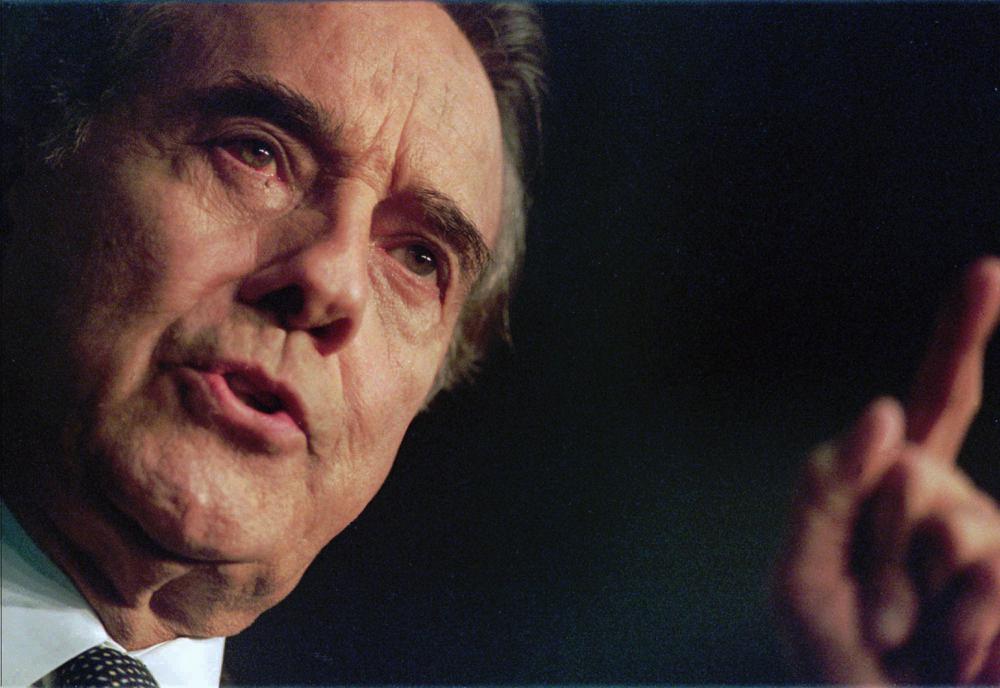
Bob Dole, who overcame disabling war wounds to become a sharp-tongued Senate leader from Kansas, a Republican presidential candidate and then a symbol and celebrant of his dwindling generation of World War II veterans, died Sunday. He was 98. His wife, Elizabeth Dole, said in an announcement posted on social media that he died in his sleep. Dole announced in February 2021 that he’d been diagnosed with stage 4 lung cancer. During his 36-year career on Capitol Hill, Dole became one of the most influential legislators and party leaders in the Senate, combining a talent for compromise with a caustic wit, which he often turned on himself but didn’t hesitate to turn on others, too. He shaped tax policy, foreign policy, farm and nutrition programs, and rights for the disabled, enshrining protections against discrimination in employment, education, and public services in the Americans with Disabilities Act. Today’s accessible government offices and national parks, sidewalk ramps, and the sign-language interpreters at official local events are just some of the more visible hallmarks of his legacy and that of the fellow lawmakers he rounded up for that sweeping civil rights legislation 30 years ago. Dole devoted his later years to the cause of wounded veterans, their fallen comrades at Arlington National Cemetery, and remembrance of the fading generation of World War II vets. Thousands of old soldiers massed on the National Mall in 2004 for what Dole, speaking at the dedication of the World War II Memorial there, called “our final reunion.” He’d been a driving force in its creation. “Our ranks have dwindled,” he said then. “Yet if we gather in the twilight, it is brightened by the knowledge that we have kept faith with our comrades.” Long gone from Kansas, Dole made his life in the capital, at the center of power and then in its shadow upon his retirement, living all the while at the storied Watergate complex. When he left politics and joined a law firm staffed by prominent Democrats, he joked that he brought his dog to work so he would have another Republican to talk to. He tried three times to become president. The last was in 1996 when he won the Republican nomination only to see President Bill Clinton reelected. He sought his party’s presidential nomination in 1980 and 1988 and was the 1976 GOP vice presidential candidate on the losing ticket with President Gerald Ford. Through all of that, he carried the mark of war. Charging a German position in northern Italy in 1945, Dole was hit by a shell fragment that crushed two vertebrae and paralyzed his arms and legs. The young Army platoon leader spent three years recovering in a hospital and never regained use of his right hand. To avoid embarrassing those trying to shake his right hand, Dole always clutched a pen in it and reached out with his left. Dole could be merciless with his rivals, whether Democrat or Republican. When George H.W. Bush defeated him in the 1988 New Hampshire Republican primary, Dole snapped: “Stop lying about my record.” If that pales next to the scorching insults in today’s political arena, it was shocking at the time. But when Bush died in December 2018, old rivalries were forgotten as Dole appeared before Bush’s casket in the Capitol Rotunda. As an aide lifted him from his wheelchair, Dole slowly steadied himself and saluted his one-time nemesis with his left hand, his chin quivering. In a vice presidential debate two decades earlier with Walter Mondale, Dole had famously and audaciously branded all of America’s wars that century “Democrat wars.” Mondale shot back that Dole had just “richly earned his reputation as a hatchet man.” Dole at first denied saying what he had just said on that very public stage, then backed down and eventually acknowledged he’d gone too far. “I was supposed to go for the jugular,” he said, “and I did — my own.” For all of his bare-knuckle ways, he was a deep believer in the Senate as an institution and commanded respect and even affection from many Democrats. Just days after Dole announced his dire cancer diagnosis, President Joe Biden visited him at his home to wish him well. The White House said the two were close friends from their days in the Senate. Biden recalled in a statement Sunday that one of his first meetings outside the White House after being sworn-in as president was with the Doles at their Washington home. “Like all true friendships, regardless of how much time has passed, we picked up right where we left off, as though it were only yesterday that we were sharing a laugh in the Senate dining room or debating the great issues of the day, often against each other, on the Senate floor,” Biden said. “I saw in his eyes the same light, bravery, and determination I’ve seen so many times before.” Biden ordered that U.S. flags be flown at half-staff at the White House and all public buildings and grounds until sunset Thursday. Dole won a seat in Congress in 1960, representing a western Kansas House district. He moved up to the Senate eight years later when Republican incumbent Frank Carlson retired. There, he antagonized his Senate colleagues with fiercely partisan and sarcastic rhetoric, delivered at the behest of President Richard Nixon. The Kansan was rewarded for his loyalty with the chairmanship of the Republican National Committee in 1971 before Nixon’s presidency collapsed in the Watergate scandal. He served as a committee chairman, majority leader, and minority leader in the Senate during the 1980s and ’90s. Altogether, he was the Republicans’ leader in the Senate for nearly 11½ years, a record until Kentucky Sen. Mitch McConnell broke it in 2018. It was during this period that he earned a reputation as a shrewd, pragmatic legislator, tireless in fashioning compromises. After Republicans won Senate control, Dole became chairman of the tax-writing Finance Committee and won acclaim from deficit hawks and others for his handling of a 1982 tax
Donald Trump wants drama, but GOP wants it over
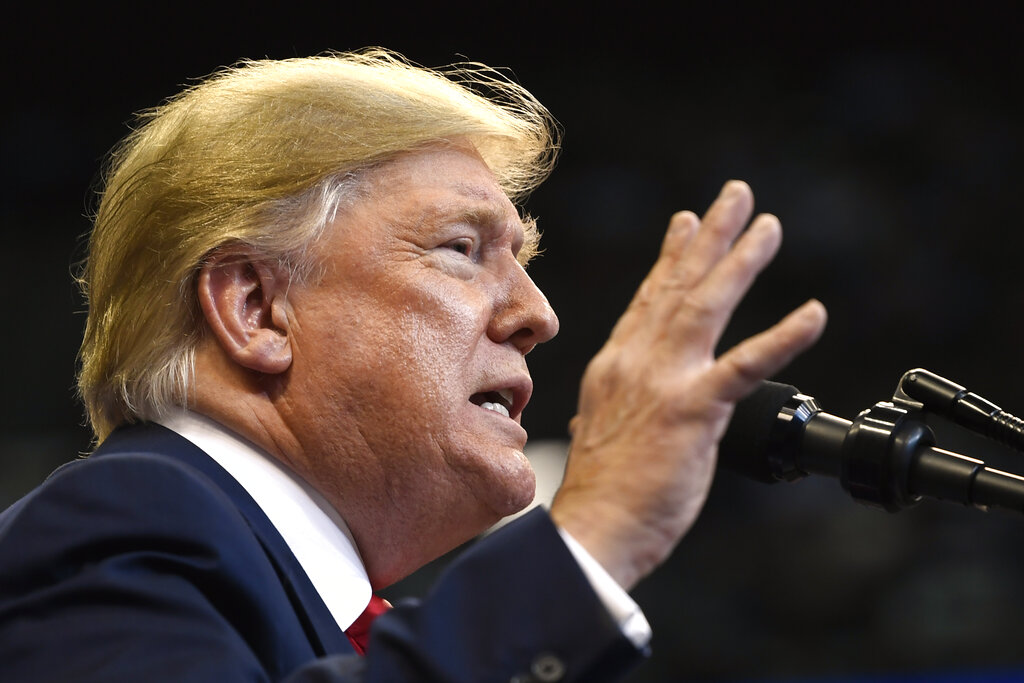
Donald Trump wants more than acquittal. He wants vindication. With impeachment by the House appearing certain, the president has made clear that he views the next step, a trial in the GOP-controlled Senate, as his focus. The president sees the senators not just as a jury deciding his fate, but as partners in a campaign to discredit and punish his Democratic opponents. His Senate allies aren’t so sure that’s a good idea. In recent weeks, Trump has devised a wish list of witnesses for the Senate trial, relishing the opportunity for his lawyers to finally cross-examine his accusers and argue the case that his actions toward Ukraine, including the July 25 call when he asked for a favor, were “perfect.” Trump and his allies have been building up the likely Senate trial, an effort to delegitimize the Democratic-controlled House’s impeachment process by contrast. In the Senate, the Trump team has argued, the president would get the opportunity to challenge witnesses and call some of his own, such as House Intelligence Committee Chairman Adam Schiff, the still-anonymous intelligence community whistleblower, or even Joe Biden and Hunter Biden. He sees that as a chance to embarrass Democrats, including the former vice president and 2020 Democratic rival, and use the friendlier ground to portray himself as the victim of a partisan crusade. “It is pretty clear the president wants a trial,” says Hogan Gidley, the principal deputy White House press secretary. “The president is eager to get his story out.” But it is increasingly clear that Senate Republicans, led by Majority Leader Mitch McConnell, have other ideas. McConnell, who is fiercely protective of his 53-47 Senate majority, has signaled that he wants none of the spectacle Trump desires. Instead he wants a swift trial, potentially with no new witnesses called. “Here’s what I would anticipate: The House managers would come over, make their arguments, the president’s lawyers would then respond. And at that point the Senate has two choices,” McConnell told reporters this week. “It could go down the path of calling witnesses and basically having another trial. Or it could decide — and again 51 members could make that decision — that they’ve heard enough.” In other words, the president, who is almost certain to be found not guilty by the Republican-controlled Senate, can win the hard way or the easy way. Senate Trump allies and advisers inside the White House have in recent days urged the president to temper his expectations and choose the path of least resistance. But Trump, according to three people familiar with the conversations, has responded by repeating his desire for a politically charged trial that drags the Bidens and others into the impeachment spotlight. Still, some aides believe Trump will ultimately relent to McConnell’s advice. Trump’s solicitation of Ukraine for investigations into the Bidens — while withholding military aide from the ally nation facing Russian aggression — forms the core of one article of impeachment against the president. His efforts to block the House investigation forms the second. On Capitol Hill, the emerging GOP consensus is that doing Trump’s defense his way would jeopardize a predictable outcome, test GOP’s fragile loyalties to him and open a Pandora’s Box of unanticipated consequences. “People are beginning to realize that could be a pretty messy and unproductive process,” Sen. Ron Johnson, R-Wis., said Wednesday. “If you start opening up to witnesses, you start opening up to all witnesses. And so I think the president’s got to really decide, to what extent does he want to start going down that road versus just making a strong case.” Democrats would be expected to retaliate by trying to call the president’s senior-most advisers, including acting chief of staff Mick Mulvaney and Secretary of State Mike Pompeo, and his personal attorney, Rudy Giuliani. Under Senate rules, McConnell’s ability to control the proceedings are limited. The Chief Justice of the United States, John Roberts, presides over the trial and any senator may be able to put a motion on witnesses up for a vote. That means defections by just a few GOP senators could thwart McConnell’s plans. With the Republicans slim majority, it’s not at all clear they want to start down the path of a full-blown trial. Should they try to call the whistle-blower or the Bidens to testify, they may not find enough votes of support from their ranks. At the same time, they would have to consider whether to accept or fend off witness requests from Democrats. McConnell also worries that a prolonged impeachment trial would not benefit the handful of GOP senators setting out in the new year on potentially tough reelection bids. Swing state Sens. Susan Collins in Maine, Cory Gardner in Colorado, Joni Ernst in Iowa and Martha McSally in Arizona are among those whose actions will be closely watched. They would much rather be talking about the economy or the pending U.S.-Mexico-Canada trade agreement than engaging in a prolonged, unpredictable impeachment trial. But Republicans also acknowledge they are unlikely to find the 51 votes needed to dismiss the charges against the president outright. Some vulnerable lawmakers and Trump skeptics, such as Sen. Mitt Romney of Utah who has said he is troubled by Trump’s actions, will insist on some semblance of trial. Comparisons are being made to the confirmation of Brett Kavanaugh to the Supreme Court, in which the Senate had to deal at length with allegations of sexual misconduct, though his confirmation by the Republicans was becoming increasingly apparent. “I think the American people are pretty tired of this,” says Sen. Pat Roberts, Republican-Kansas. “I think if we can honor the White House’s concern, OK. But let’s do it in a reasonable time limit. We don’t need six weeks like we did with Clinton.” Around the White House, a divide has emerged between aides and allies embracing the president’s call to use the Senate trial to get back at Democrats and those, particularly in the White House counsel’s office, advising him to heed the warnings of the GOP lawmakers.
Border security bargainers trade offers as deadline nears

Congressional bargainers traded offers and worked toward a border security compromise Friday that would avert a fresh federal shutdown and resolve a clash with President Donald Trump that has dominated the opening weeks of divided government. differences Both sides’ negotiators expressed optimism that an accord could be reached soon on a spending package for physical barriers along the Southwest border and other security measures. Participants said the agreement would all but certainly be well below the $5.7 billion Trump has demanded to build his proposed wall, and much closer to the $1.6 billion that was in a bipartisan Senate bill last year. “That’s what we’re working toward,” said Rep. Lucille Roybal-Allard, Democrat-Calif., one of the bargainers. Besides the dollar figure, talks were focusing on the type and location of barriers, participants said. Also in play were the number of beds the federal Immigration and Customs Enforcement agency could have for detained migrants, and how much aid for natural disaster relief would be included. Money for high-tech surveillance equipment and more personnel was also expected to be included. No one ruled out that last-minute problems could emerge, especially with Trump’s penchant for head-snapping turnabouts. But the momentum was clearly toward clinching an agreement that Congress could pass by next Friday. The next day, government agencies would have to close again for lack of money, if no deal is reached. Negotiator Rep. Chuck Fleischmann, Republican-Tenn., said the latest Democratic offer was “much more reasonable.” And Democratic bargainer Rep. Pete Aguilar of California said, “Each time an offer and a counter is going back and forth the number of open items is reducing. That is progress.” Rep. Mark Meadows, Republican-N.C., who leads the hard-right House Freedom Caucus, said he spoke Thursday night to Trump, who he said was in “wait and see” mode. Meadows said he expects an agreement to provide something closer to $1.6 billion. “I’m not optimistic it’ll be something the president can support,” Meadows said. A conservative House GOP aide said to back a deal, Freedom Caucus members wanted at least $2 billion for barriers and no restrictions on new construction, land acquisition or new types of barriers that could be built. The aide also said the agreement need not contain the term “wall” — a word that was a premier plank of Trump’s presidential campaign, and which Trump has lately alternated between embracing and abandoning. The person would talk only on condition of anonymity to describe private talks. Meadows’ assessment of Trump’s view clashed with one expressed Thursday by Sen. Richard Shelby of Alabama, the chief GOP bargainer. He described the emerging deal to Trump in the Oval Office and told reporters the session was “the most positive meeting I’ve had in a long time.” Shelby said that if the final agreement followed the outline currently under discussion, he believed Trump “would sign it.” Trump has modest leverage in the battle. Besides facing unified Democratic opposition, there is virtually no GOP support in Congress for another shutdown. When congressional talks began, Trump called them a “waste of time.” “They’ve got to come to a solution that actually does what they promised they would do, which is protect the American people,” White House spokesman Hogan Gidley said on Fox News. Trump faces an aggressive, Democratic-led House that is ramping up investigations into Russian involvement in his campaign and businesses and trying to get access to his income tax returns. But ending the border security fight would close one chapter that’s bruised him, including his surrender after a 35-day partial federal shutdown that he started by unsuccessfully demanding taxpayer money to build the border wall. Even with a deal, it was possible Trump might try using claims of executive powers to reach for more wall funding. That could spark votes by Congress to block him, which Trump could veto but would still inflict political damage. Sen. Lindsay Graham, Republican-S.C., said Thursday that an accord could be “a good down payment” and added, “There are other ways to do it and I expect the president to go it alone in some fashion.” Acting White House Chief of Staff Mick Mulvaney said on Fox News Channel’s “Hannity” on Wednesday, “If Congress won’t participate or won’t go along, we’ll figure out a way to do it with executive authority.” Members of both parties have expressed opposition to Trump bypassing Congress by declaring a national emergency at the border, a move that would be certain to produce lawsuits that could block the money. Lawmakers have grown accustomed to expecting the unexpected from Trump. Before Christmas, both parties’ leaders believed he’d support a bipartisan deal that would have prevented the recently ended shutdown, only to reverse himself under criticism from conservative pundits and lawmakers. “There’s a small light at the end of the tunnel,” said Sen. Pat Roberts, Republican-Kan. “We just hope it’s not a train coming the other way.” Republished with permission from the Associated Press
Babies of senators now welcome in Senate chamber
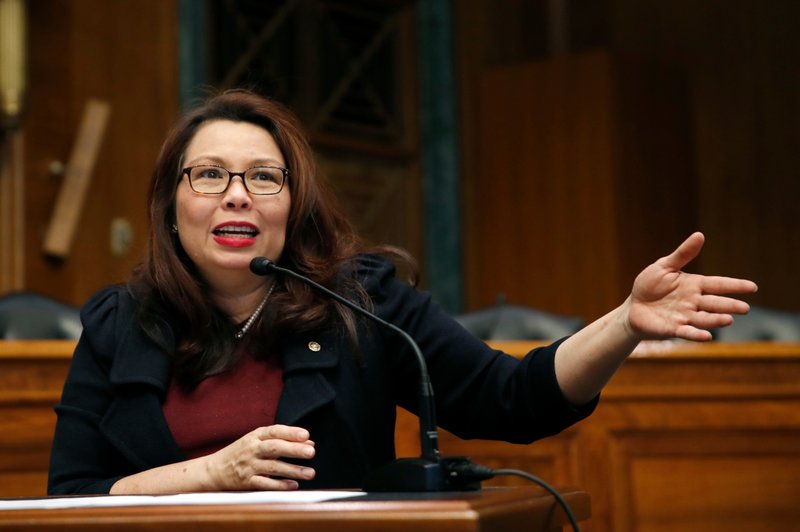
Who doesn’t like babies? No one in the Senate, apparently — at least not enough to block a historic rules change that passed Wednesday allowing the newborns of members into the chamber. Its passage without objection came despite plenty of concern, some privately aired, among senators of both parties about the threat the tiny humans pose to the Senate’s cherished decorum. “I’m not going to object to anything like that, not in this day and age,” said Sen. Pat Roberts, R-Kan., father of three and grandfather of six. He then noted that a person can stand in the door of the cloakroom, a lounge just off the chamber, and vote. “I’ve done it,” he said. Allowing babies on the Senate floor, he said, “I don’t think is necessary.” Sen. Orrin Hatch, the father of six, grandfather of 14 and great-grandfather of 23, said he had “no problem” with such a rules change. “But what if there are 10 babies on the floor of the Senate?” he asked. The inspiration for the new rule is a small bundle named Maile Pearl, born April 9 to Illinois Democrat Tammy Duckworth —the only sitting senator in U.S. history to give birth. In a statement, Duckworth thanked her colleagues for “helping bring the Senate into the 21st Century by recognizing that sometimes new parents also have responsibilities at work.” Their concerns and more were shared by Republicans and Democrats, according to interviews Wednesday. “It is a big change,” Sen. Amy Klobuchar, D-Minn., said in a telephone interview, as leaders of both parties sought to clear the new rule without objection, or public discussion. The private reassurances to members of both parties, she said, have “been going on for weeks.” Teleworking is not an option in the Senate, which requires members to vote in person. So Duckworth raised a rare question that split her colleagues more along generational lines than well-worn partisan ones. Duckworth proposed changing the rules to allow senators with newborns — not just Duckworth, and not just women — to bring their babies onto the floor of the Senate. This, recalled Klobuchar, did not go entirely smoothly for the two months she privately took questions about the idea and its potential consequences — diaper changes, fussing and, notably, nursing. Sen. Tom Cotton, father of two, said he has no problem with the rule change. But the Arkansas Republican acknowledged that some of his colleagues do, “so the cloakroom might be a good compromise.” Klobuchar’s answer to that suggestion noted that Duckworth lost both legs and partial use of an arm in Iraq, and mostly gets around by wheelchair. “Yes, you can vote from the doorway of the cloakroom, but how is she going to get to the cloakroom when it’s not wheelchair accessible?” she asked. Some senators proposed making an exception for Duckworth. But her allies said the Senate should make work easier for new parents. “We believe strongly, and she did, that it should be a permanent rules change.” Having 10 babies on the Senate floor, as Hatch suggested, “would be a delight,” Klobuchar said. “We could only wish we had 10 babies on the floor. That would be a delight,” retorted Klobuchar, noting that such a conflagration would probably mean more young senators had been elected in a body where the average age of members tops 60. There was more, voiced privately, Klobuchar said — including whether Duckworth intended to change Maile’s diaper or nurse her new baby on the Senate floor. Most senators, though, were supportive, Klobuchar said. Majority Leader Mitch McConnell, R-Ky., and Rules Committee Chairman Roy Blunt, R-Mo., both fathers, helped or did not stand in the way. McConnell did not answer a reporter’s question Wednesday about whether he had any concerns about babies on the Senate floor. Several others were happy to voice support for the rules change, and could not resist taking a jab at their colleagues. “Why would I object to it? We have plenty of babies on the floor,” joked Sen. Marco Rubio, R-Fla. But there still was some confusion. Just after the unanimous vote, Sen. Dick Durbin, D-Ill., said it would do the tradition-bound Senate some good to see “a diaper bag next to one of these brass spittoons, which sit on the floor, thank goodness, never used.” Oklahoma Republican James Inhofe took issue with that, saying: “They don’t use diaper bags anymore. They’re disposable diapers.” Diaper bags are generally used to carry clean diapers and other supplies when parents and babies go out. Sometimes, they hold dirty naps until they can be disposed of. Republished with the permission of the Associated Press.
