
Joe Biden decides to keep Space Command in Colorado, rejecting move to Alabama
President Joe Biden has decided to keep U.S. Space Command headquarters in Colorado, overturning a last-ditch decision by the Trump administration to move it to Alabama. The choice ended months of thorny deliberations, but an Alabama lawmaker vowed to fight on. U.S. officials told The Associated Press on Monday that Biden was convinced by the head of Space Command, Gen. James Dickinson, who argued that moving his headquarters now would jeopardize military readiness. Dickinson’s view, however, was in contrast to Air Force leadership, who studied the issue at length and determined that relocating to Huntsville, Alabama, was the right move. The officials spoke on condition of anonymity to provide details of Biden’s rationale for the decision. In announcing the plans, Brig. Gen. Pat Ryder, Pentagon press secretary, said the decision was based on an “objective and deliberate process informed by data and analysis.” He said Defense Secretary Lloyd Austin supported the president’s decision. Reaction to the decision came fast and was sharply divided, as Colorado lawmakers praised it and Alabama officials slammed it as a political maneuver. “This fight is far from over,” warned Rep. Mike Rogers, R-Ala., chairman of the House Armed Services Committee. Biden, said the U.S. officials, believes that keeping the command in Colorado Springs would avoid a disruption in readiness that the move would cause, particularly as the U.S. races to compete with China in space. And they said Biden firmly believes that maintaining stability will help the military be better able to respond in space over the next decade. Those factors, they said, outweighed what the president believed would be any minor benefits of moving to Alabama. Biden’s decision enraged Alabama lawmakers and is sure to fuel accusations that abortion politics played a role in the choice. The location debate has become entangled in the ongoing battle between Alabama Republican Sen. Tommy Tuberville and the Defense Department over the move to provide travel for troops seeking reproductive health care. Tuberville opposed the policy is blocking hundreds of military promotions in protest. The U.S. officials said the abortion issue had no effect at all on Biden’s decision. And they said the president fully expected there would be different views on the matter within the Defense Department. Tuberville, in a statement, said the top three choices for Space Command headquarters were all in Republican-leaning states — Alabama, Nebraska, and Texas — and bypassing them “looks like blatant patronage politics.” Formally created in August 2019, the command was temporarily based in Colorado, and Air Force and Space Force leaders initially recommended it stay there. In the final days of his presidency, Donald Trump decided it should be based in Huntsville. The change triggered a number of reviews. Proponents of keeping the command in Colorado have argued that moving it to Huntsville and creating a new headquarters would set back its progress at a time it needs to move quickly to be positioned to match China’s military space rise. And Colorado Springs is also home to the Air Force Academy, which now graduates Space Force guardians, and more than 24 military space missions, including three Space Force bases. Officials also argued that any new headquarters in Alabama would not be completed until sometime after 2030, forcing a lengthy transition. Huntsville, however, scored higher than Colorado Springs in a Government Accountability Office assessment of potential locations and has long been a home to some of the earliest missiles used in the nation’s space programs, including the Saturn V rocket. It is home to the Army’s Space and Missile Defense Command. According to officials, Air Force Secretary Frank Kendall, who ordered his own review of the matter, leaned toward Huntsville, while Dickinson was staunchly in favor of staying put. The officials said Austin presented both options to Biden. In a statement Monday, Kendall said the service will work to quickly implement Biden’s decision, adding that keeping the command in Colorado will “avoid any disruption to its operational capability.” The decision was hailed as a victory in Colorado lawmakers and condemned in Alabama. “For two and a half years, we’ve known any objective analysis of this basing decision would reach the same conclusion we did, that Peterson Space Force Base is the best home for Space Command,” Sen. John Hickenlooper, D-Colo., said in a statement. “Most importantly, this decision firmly rejects the idea that politics — instead of national security — should determine basing decisions central to our national security.” Sen. Michael Bennet, D-Colo., said the decision “restores integrity to the Pentagon’s basing process and sends a strong message that national security and the readiness of our Armed Forces drive our military decisions.” Rogers, meanwhile, vowed that his committee will continue an investigation into the matter, calling it a “deliberate taxpayer-funded manipulation of the selection process.” He added, “It’s clear that far-left politics, not national security, was the driving force behind this decision.” Republican Alabama Sen. Katie Britt echoed his sentiment, saying it was irresponsible for Biden to “yank a military decision out of the Air Force’s hands in the name of partisan politics.” She said an Air Force evaluation of the potential locations ranked Huntsville first, adding that the decision ”should have remained in the Air Force’s purview.” Republished with the permission of The Associated Press.
Joe Biden sending 1,500 troops for Mexico border migrant surge

The Biden administration will send 1,500 active-duty troops to the U.S.-Mexico border starting next week, ahead of an expected migrant surge following the end of coronavirus pandemic-era restrictions. Military personnel will do data entry, warehouse support, and other administrative tasks so that U.S. Customs and Border Protection can focus on fieldwork, White House spokeswoman Karine Jean-Pierre said Tuesday. The troops “will not be performing law enforcement functions or interacting with immigrants, or migrants,” Jean-Pierre said. “This will free up Border Patrol agents to perform their critical law enforcement duties.” They will be deployed for 90 days and will be pulled from the Army and Marine Corps, and Defense Secretary Lloyd Austin will look to backfill with National Guard or Reserve troops during that period, Pentagon spokesman Air Force Brig. Gen. Pat Ryder said. There are already 2,500 National Guard members at the border. The COVID-19 restrictions have allowed U.S. officials to turn away tens of thousands of migrants crossing the southern border, but those restrictions will lift May 11, and border officials are bracing for a surge. Even amid the restrictions, the administration has seen record numbers of people crossing the border, and President Joe Biden has responded by cracking down on those who cross illegally and by creating new pathways meant to offer alternatives to a dangerous and often deadly journey. For Biden, who announced his Democratic reelection campaign a week ago, the decision signals his administration is taking seriously an effort to tamp down the number of illegal crossings, a potent source of Republican attacks, and sends a message to potential border crossers not to attempt the journey. But it also draws potentially unwelcome comparisons to Biden’s Republican predecessor, whose policies Biden frequently criticized. Congress, meanwhile, has refused to take any substantial immigration-related actions. Then-President Donald Trump deployed active-duty troops to the border to assist border patrol personnel in processing large migrant caravans, on top of National Guard forces that were already working in that capacity. Jean-Pierre downplayed any similarity between Biden’s immigration management and Trump’s use of troops during his term. “DOD personnel have been supporting CBP at the border for almost two decades now,” Jean-Pierre said. “So this is a common practice.” It’s another line of defense in an effort to manage overcrowding and other possible issues that might arise as border officials move away from the COVID-19 restrictions. Last week, administration officials announced they would work to swiftly screen migrants seeking asylum at the border, quickly deport those deemed as not being qualified, and penalize people who cross illegally into the U.S. or illegally through another country on their way to the U.S. border. They will also open centers outside the United States for people fleeing violence and poverty to apply to fly in legally and settle in the United States, Spain, or Canada. The first processing centers will open in Guatemala and Colombia, with others expected to follow. The Pentagon on Tuesday approved the request for troops by Homeland Security, which manages the border. The deployments have a catch: As a condition for Austin’s previous approval of National Guard troops to the border through Oct. 1, Homeland Security had to agree to work with the White House and Congress to develop a plan for longer-term staffing solutions and funding shortfalls, “to maintain border security and the safe, orderly, and humane processing of migrants that do not involve the continued use of DOD personnel and resources,” said Pentagon spokesman Air Force Lt. Col. Devin Robinson. As part of the agreement, the Pentagon has requested quarterly updates from Homeland Security on how it would staff its border mission without servicemembers. It was not immediately clear if those updates have happened or if border officials will be able to meet their terms of the agreement — particularly under the strain of another expected migrant surge. Homeland Security said it was working on it. “U.S. Customs and Border Protection is investing in technology and personnel to reduce its need for DOD support in coming years, and we continue to call on Congress to support us in this task,” the agency said in a statement. Republished with the permission of The Associated Press.
In reversal, U.S. poised to approve Abrams tanks for Ukraine
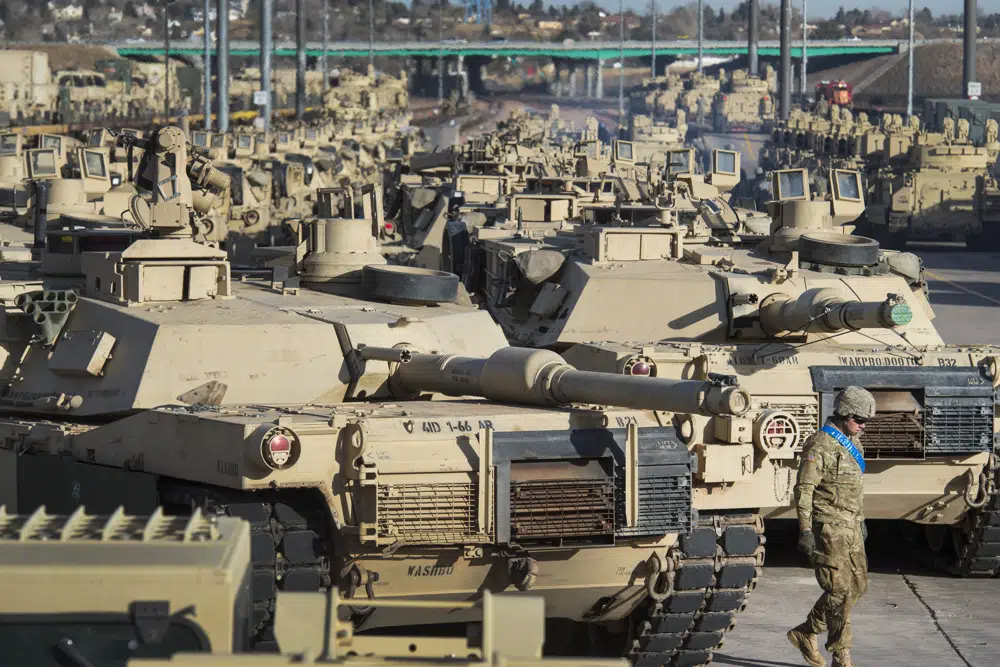
In what would be a reversal, the Biden administration is poised to approve sending M1 Abrams tanks to Ukraine, U.S. officials said Tuesday, as international reluctance to send tanks to the battlefront against the Russians begins to erode. A decision to send a bit more than 30 tanks could be announced as soon as Wednesday, though it could take months for the tanks to be delivered. U.S. officials said details are still being worked out. One official said the tanks would be bought under an upcoming Ukraine Security Assistance Initiative package, which provides longer-range funding for weapons and equipment to be purchased from commercial vendors. The U.S. announcement is expected in coordination with an announcement by Germany that it will approve Poland’s request to transfer German-made Leopard 2 tanks to Ukraine, according to one official. The officials spoke on condition of anonymity because the decision has not yet been made public. By agreeing to send the Abrams at an as-yet unspecified time under the assistance initiative, the administration is able to meet German Chancellor Olaf Scholz’s demand for an American commitment without having to send the tanks immediately. Much of the aid sent so far in the 11-month-old war has been through a separate program drawing on Pentagon stocks to get weapons more quickly to Ukraine. But even under that program, it would take months to get tanks to Ukraine and to get Ukrainian forces trained on them. It wasn’t clear Tuesday how soon the U.S. will start training Ukrainian troops on the Abrams and roughly how soon they can get to the battlefront. Until now, the U.S. has resisted providing its own M1 Abrams tanks to Ukraine, citing extensive and complex maintenance and logistical challenges with the high-tech vehicles. Washington believes it would be more productive to send German Leopards since many allies have them, and Ukrainian troops would need less training than on the more difficult Abrams. Just last week, Under Secretary of Defense for Policy Colin Kahl, told reporters that the Abrams is a complicated, expensive, difficult to maintain, and hard to train on piece of equipment. One thing Defense Secretary Lloyd Austin has been very focused on, he said, “is that we should not be providing the Ukrainians systems they can’t repair, they can’t sustain, and that they, over the long term, can’t afford, because it’s not helpful.” A U.S. official familiar with White House thinking said the administration’s initial hesitancy was based on concerns about the requisite training and the sustainment of the tanks. The official added that the administration believes that such plans are now in place, but it could take time to implement them. At the Pentagon, spokesman Brig. Gen. Pat Ryder said he had nothing to announce on any U.S. decision regarding Abrams tanks. But he said, “anytime that we’ve provided Ukraine with a type of system, we’ve provided the training and sustainment capabilities with that.” The administration’s reversal comes just days after a coalition of more than 50 senior defense officials from Europe and beyond met in Germany to discuss Ukraine’s war needs, and battle tanks were a prime topic. Ukrainian leaders have been urgently requesting tanks, but Germany had resisted mounting pressure either to supply its own tanks or clear the way for other countries, such as Poland, to send the German-made tanks from their own stocks. Kremlin spokesman Dmitry Peskov said the deployment of Western tanks would trigger “unambiguously negative” consequences. Defense leaders from the countries that have Leopard 2 tanks met with the Germans during the Friday conference at Ramstein Air Base in an effort to hammer out an agreement. On Sunday, Berlin indicated it wouldn’t stand in the way if other countries wanted to send the Leopard 2 tanks to Kyiv. Germany needs to agree for the tanks to be given to Ukraine, which is not a member of NATO. U.S. and German officials have given mixed signals about whether the U.S. and German decisions are linked and whether Berlin was hesitant to send its tanks unless the U.S. sent Abrams. Polish Defense Minister Mariusz Błaszczak said Tuesday that Poland has officially requested permission from Germany to transfer its Leopard 2 battle tanks to Ukraine. German officials confirmed to the dpa news agency they had received the application and said it would be assessed “with due urgency.” German Foreign Minister Annalena Baerbock said Sunday that Berlin wouldn’t seek to stop Poland from providing the high-tech armor to Kyiv. German officials declined to comment on the reports of a tank deal. The news weekly Der Spiegel reported Tuesday, without citing a source, that Germany will provide Ukraine with at least one company of Leopard 2 tanks from its own army’s stock. A company comprises 15 tanks. Scholz is due to deliver an address to parliament Wednesday and field questions from lawmakers, many of whom have been pressing the government to join allies in providing the tanks to Ukraine. Lawmakers in Congress have also been pushing the U.S. to beef up its aid to Ukraine. Senate Republican leader Mitch McConnell said Tuesday “it’s time, past time” for the Biden administration and allies to send more military aid to Ukraine and that the U.S. must provide more tanks and weapons to help Ukraine “win this war.” “It’s time, past time, for the Biden administration and our allies to get serious about helping Ukraine finish the job and retake their country.” Republished with the permission of The Associated Press.
