
Jeff Sessions continues to press conservative agenda on immigration
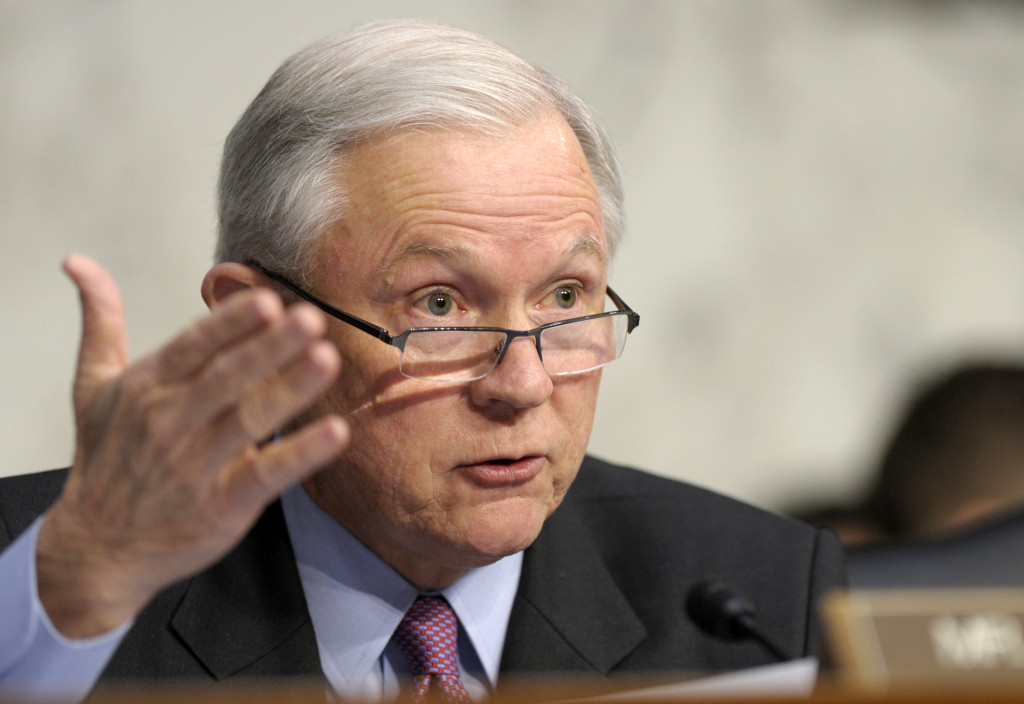
In a letter taking to task Obama administration officials over the release from state custody of more than 100 deportable immigrants who later went on to commit violent crimes, U.S. Sen. Jeff Sessions continued to work with Republican allies to advance a conservative immigration policy in the Senate. Sessions and U.S. Sen. Chuck Grassley — chairman of the Senate Judiciary Committee where Session has taken an active role lately — sent a letter addressed to Secretary of State John Kerry, Homeland Security Secretary Jeh Johnson, and Attorney General Loretta Lynch. Their letter railed against poor execution of deportation protocols by the federal Immigration and Customs Enforcement, formally requesting detailed answers to a list of more than 25 specific inquiries about why 121 suspected killers were allowed to pass through the federal immigration enforcement system and remain in the country. According to information provided by ICE, up to 121 homicides in the U.S. could have been avoided between Fiscal Year 2010 and 2014 had the aliens with criminal convictions been deported instead of released, Grassley and Sessions wrote. “This disturbing fact follows ICE’s admission that, of the 36,007 criminal aliens it released from ICE custody in FY 2013, 1,000 have been re-convicted of additional crimes in the short time since their release.” The senators pointedly asked the Cabinet members, appointed by President Barack Obama, whether their agencies are “fully leveraging existing tools and resources to prevent these dangerous outcomes.” “In the ongoing talks between the U.S. and Cuba, does the administration plan to make repatriation of all of those 30,000+ Cuban nationals, and not just some subset of that group, a condition precedent of granting diplomatic recognition to Cuba?” reads one question. “If not, why not?” The letter is in keeping with a long-term push on immigration on the part of Alabama’s junior senator. Last week, Sessions was vindicated in the conservative press after U.S. Rep. Paul Ryan expressed skepticism about Sessions’ claims that the Trans Pacific Partnership contains loopholes that could lead to a “flood” of new immigration. Ryan had called the language within the proposed TPP that would relax restrictions on the “Movement of Persons,” including professionals operating independently, an “urban legend.” Recent revelations about the trade deal, however, indicate that provisions to forbid mandatory interviews and economic means testing for visa-seekers are indeed part of the proposal, something that Sessions — dubbed by POLITICO as “the Senate’s anti-immigration warrior” — had spoken against. Senate Republican Whip John Cornyn of Texas called Sessions “perhaps the most vocal member of our conference” on immigration after he led the charge in confronting his own caucus in opposition of new H-1B visas for skilled foreign workers, saying it negatively affects domestic job-seekers. “We’ve got to ask — which hasn’t been asked — what does all this do to the ability of a college graduate who’s living at home with his parents because he can’t find a job?” said Sessions, chairman of the Subcommittee on Immigration & the National Interest. That’s a familiar note in his protectionist quest against labor pool distortions because of foreign labor. His approach to the issue evidently has struck a chord in his home state: Sessions was the only incumbent senator who ran unopposed in both primary and general elections in 2014. Sessions and Grassley gave the administration officials addressed in their inquiry a July 6 deadline to respond.
Obama’s trade agenda draws GOP support in U.S. House
Legislation to strengthen President Barack Obama‘s hand for a new round of trade deals advanced Thursday in the U.S. House of Representatives courtesy of Republicans and over the protests of Democrats, a political role reversal that portends a bruising struggle over passage later this spring. The vote was 25-13 in the House Ways and Means Committee as pro-business Republicans outpolled labor-aligned Democrats. It was the second straight day the GOP-controlled Congress voted handed Obama a victory on trade. The Senate Finance Committee approved a nearly identical bill Thursday night that would allow lawmakers to vote yes or no without making changes in trade deals, like the one now taking shape among Pacific Rim trading partners. “They’re waiting for this to put their best offers on the table,” Republican U.S. Rep. Paul Ryan of Wisconsin, the House committee chairman, said of negotiating partners that include Japan, Singapore, Chile and Peru. The president put in a plug for the legislation while speaking dismissively of its critics. “When people say this trade deal is bad for working families, they don’t know what they’re talking about,” Obama told activists and donors with Organizing for Action, a group with roots in his presidential campaigns. Democrats said the legislation didn’t go far enough to assure labor standards and environmental protections strong enough to avoid placing American companies at a disadvantage, and said failure to prohibit currency manipulation abroad would cost U.S. workers their jobs. “Currency manipulation has caused more job loss than anything else connected to trade,” said Rep. Sander Levin of Michigan, the senior Democrat on the panel. But the Democrats’ attempt to substitute their own legislation — weakening Obama’s powers — was ruled out of order by Republicans on grounds that it exceeded the committee’s jurisdiction. As a result, no vote was taken on it. It would have set up a congressional committee with authority to decide if any trade deal had met negotiating objectives, taking the power away from Obama. Unlike the White House-backed measure, it would only have applied to the Trans-Pacific Partnership talks, and not to other possible deals over the next six years. In addition to trade talks involving countries bordering the Pacific, the administration is involved in negotiations toward a TransAtlantic Trade and Investment Partnership with the European Union and a Trade in Services Agreement with dozens of countries. Trade legislation is a perennial political irritant for Democrats, never more than now, given the post-recession political fault lines that have developed on the issue of income disparity. Democratic U.S. Rep. Nancy Pelosi of California, the party’s leader in the House, declined to say whether she supports the legislation. At a news conference, she said: “At the end of the day, you weigh the equities. Is this better than the status quo? How much better? Or is it a wasted opportunity? And right now, I’m disappointed.” She suggested that if the White House and Republicans fail to produce a majority for the measure, it would increase Democratic leverage to seek changes. Former Secretary of State Hillary Rodham Clinton, campaigning for the Democratic presidential nomination this week in New Hampshire, similarly declined to state a position. Some Democrats have been far less reluctant, though. Democratic U.S. Sen. Elizabeth Warren of Massachusetts, a persistent critic of large corporations, has engaged in something of a long-range debate with Obama over the subject in recent days. The House legislation is nearly identical to a bill that cleared the Senate Finance Committee on a bipartisan 20-6 vote. Seven of that panel’s 13 Democrats supported the bill. Sen. Richard Burr of North Carolina was the only Republican to oppose it. In the House committee, all Republicans joined with Democratic Reps. Earl Blumenauer of Oregon and Ron Kind of Wisconsin in supporting the bill. Republished with permission of The Associated Press.
