
Donald Trump tax cut: Huge, vague and likely mild boost for economy

President Donald Trump‘s team boasted Wednesday that its tax-cut plan would lighten Americans’ financial burdens, ignite economic growth and vastly simplify tax filing. Yet the proposal so far remains short of vital details, including how it would be paid for. And based on the few specifics spelled out so far, most experts suggest that it would add little to growth while swelling the budget deficit and potentially handing large windfalls to wealthier taxpayers. Trump’s plan would replace the current seven income tax brackets with three, and the top bracket would drop from 39.6 percent to 35 percent. It would also slash the corporate rate from 35 percent all the way to 15 percent, a boon to most companies even though many don’t pay the full tax now. With tax credits and other loopholes, most corporations pay closer to 20 percent, according to calculations by JPMorgan. Perhaps the most contentious plank would enable taxpayers with business income — including those wealthy enough to pay the top tax rate — to instead pay the new 15 percent corporate rate. That’s because Trump would apply the corporate rate to “pass through” businesses. Pass-throughs include partnerships such as law firms and hedge funds as well as most small businesses — from the local florist to the family-owned restaurant on Main Street. What’s more, some privately held large companies — including Trump’s own real estate empire — are structured as pass-throughs and would benefit, too. Here’s a closer look at Trump’s proposal and its likely impact: ___ WHO BENEFITS? It’s hard to say because the administration has released so few details. The three new income tax rates would be 10 percent, 25 percent and 35 percent. But Trump’s top economic adviser, Gary Cohn, and Treasury Secretary Steven Mnuchin, weren’t ready Wednesday to say at what income levels these new rates would kick in. Tax experts said far more details were needed to determine how average Americans would be affected. “The impact on Joe Taxpayer is unknown,” said Marc Gerson, vice chair of the tax department of law firm Miller & Chevalier in Washington. “There’s not enough specificity. It’s hard for taxpayers to determine where they’ll come out.” Cohn asserted that the plan would cut taxes “especially for low and middle income families.” It purports to do so in part by doubling the standard deduction, which is used by taxpayers who don’t itemize their tax deductions. At the same time, the Trump plan would eliminate the estate tax and the alternative minimum tax, thereby benefiting some of the richest taxpayers. And that’s on top of shrinking the corporate tax rate that many affluent individuals could likely capitalize on. ___ WHY CUT CORPORATE TAXES? By making corporations more profitable, the Trump administration hopes to encourage more business spending on equipment — from computers to factories and machinery. Doing so, in turn, could make the economy more efficient and accelerate growth and hiring. Economic growth has been stuck at about 2 percent a year since the recession ended in 2009. Mnuchin says the administration wants to accelerate it above 3 percent, a pace it hasn’t touched since 2005. The corporate tax cuts are also intended to encourage more businesses to stay in the United States, which now has the highest corporate rate among advanced economies. Many large corporations are enthusiastic about lower rates and say they support the elimination of loopholes, which both reduce revenue and make taxes more complicated. ___ WHO’D BENEFIT FROM THE CORPORATE RATE CUT? Aside from most large companies, many partnerships and small businesses would benefit because they’re structured as pass-throughs, which derives from the fact that they pass on their profits to their owners. Those owners now pay individual income tax rates, which top out at 39.6 percent. With the pass-through rate dropped to 15 percent, those taxpayers could enjoy an enormous tax cut. The Trump team stressed the benefits that might flow to small businesses. But the richest windfalls would flow to the wealthy — lawyers, hedge fund managers, consultants and other big earners. Nearly 75 percent of pass-through income flows to the 10 percent wealthiest taxpayers, according to the liberal Center on Budget and Policy Priorities. “It would tremendously help high earners,” says Brian Thompson, a certified public accountant in Chicago. In Kansas, Gov. Sam Brownback eliminated state taxes on pass-throughs, which turned out to be a boon for Bill Self, the coach of the University of Kansas’ men’s basketball team. He had previously set up his own company, according to state media reports. As a result, he paid little state income tax despite earning nearly $3 million a year. Many people, particularly wealthy Americans, could set up companies and reclassify their paychecks as “business income” and have it taxed at 15 percent, experts say. In Kansas, the number of pass-through businesses jumped to more than double the level the state expected, according to the nonpartisan Tax Policy Center. That cost the state revenue without spurring more job creation. Mnuchin said the Treasury would issue rules to prevent wealthy people from capitalizing on the lower rate. But many experts are skeptical. “Good luck with that,” said Mark Mazur, director of the nonpartisan Tax Policy Center and a former Treasury official under President Barack Obama. “The tax agencies tend to be at least a couple of steps behind the businesses.” ___ HOW ELSE WOULD BIG BUSINESSES BENEFIT? The administration is also proposing to tax only corporate income earned in the United States. This is known as a “territorial” system. It would replace the current worldwide system, under which corporations pay tax on income earned in the U.S. and overseas. Yet companies can avoid the tax if they keep their foreign earnings overseas. Many businesses have kept hundreds of billions of dollars outside the United States. Mnuchin said Trump’s plan would encourage corporations to return the money to the United States and invest it in plants and equipment. Some analysts counter that corporations might instead use the money to pay dividends to
Updates from the 1st presidential debate

The Latest on the first of three presidential debates between Democrat Hillary Clinton and Republican Donald Trump (all times EDT): 10:45 p.m. Both candidates concluded the first presidential debate by saying they will accept the outcome if the other wins. Hillary Clinton spoke directly to viewers and said, “It’s not about us, it’s about you.” Donald Trump initially dodged the same question, saying he would make a “seriously troubled” America “great again.” He added: “I’m going to be able to do it. I don’t believe Hillary Clinton will.” But Trump finished his answer by saying that if Clinton wins, “I will absolutely support her.” ___ 10:43 p.m. Hillary Clinton is punching back at Donald Trump’s assertions that she doesn’t have the “stamina” to be president. Trump has questioned whether Clinton has the physical fitness to be president and he repeated the criticism to her directly during the debate. Clinton’s response? Trump shouldn’t talk about stamina until he’s tried out the busy schedule she kept up as secretary of state. Trump didn’t answer moderator Lester Holt’s original question about his past comments that Clinton doesn’t have the “presidential look.” Clinton suggested the remarks were about gender, and she reminded the crowd of Trump’s past comments calling women “pigs” and other derogatory names. ___ 10:42 p.m. Donald Trump says NATO needs to “go into the Middle East with us” to combat the Islamic State group. And he is taking credit for NATO focusing resources on combating terrorism. In fact, the alliance agreed in July to contribute aircraft and conduct training in Iraq and has increased intelligence coordination there. And NATO set up an anti-terrorism program in 2004 — years before Trump criticized them as a presidential candidate. Earlier this year, Trump criticized NATO for not focusing on terrorism. He said that afterward, he saw an article reporting that NATO was opening a new, major anti-terrorism division. He said Tuesday that NATO’s action was “largely because of what I was saying, and my criticism of NATO.” ___ 10:40 p.m. Donald Trump is avoiding a specific declaration on how he would use nuclear weapons if he’s elected president. The Republican nominee said during the first presidential debate that he “would not do first strike” because “once the nuclear alternative happens, it’s over.” That statement suggests he would not authorize a nuclear attack unless the U.S. was struck first. But in the same answer Trump said he “can’t take anything off the table.” He mentioned adversary nations such as North Korea and Iran. President Barack Obama has considered changing existing policy to state clearly that the United States would not deploy nuclear weapons without first being attacked by nuclear weapons. But he met resistance and has elected not to make such a shift. ___ 10:38 p.m. Hillary Clinton is accusing Donald Trump of being too easily provoked to keep the United States from going to war — perhaps even one involving nuclear weapons. Trump says: “I have much better judgment than she does. I have much better temperament.” That drew laughs from some in the debate crowd, and prompted Clinton to exclaim: “Woo! OK!” Clinton then pivoted to policy, defending the U.S.-led war in Afghanistan. Clinton said Iran was “weeks away” from a nuclear bomb when she became secretary of state — and says the Obama administration thwarted that progress. She continued that Trump didn’t have “good judgment or the right temperament” because he could take the country to war over small issues, like being mocked on Twitter. ___ 10:35 p.m. Donald Trump is continuing to insist he opposed the Iraq War before the U.S. invasion despite evidence to the contrary. Trump says during the debate that he “did not support the war in Iraq,” calling that charge “mainstream media nonsense.” But there is no evidence Trump expressed public opposition to the war before the U.S. invaded. Trump was asked in September 2002 whether he supported a potential Iraq invasion in an interview with Howard Stern. Trump briefly hesitated, then responded: “Yeah, I guess so.” Presented with the comment during the debate, Trump responds: “I said very lightly, I don’t know, maybe, who knows.” He’s also telling reporters to call Fox News host Sean Hannity to confirm private conversations he said they had about the war. Hannity is a top Trump supporter. Clinton voted in favor of the invasion in 2002 while she was a New York senator. She has since said it was a mistake. ___ 10:27 p.m. Donald Trump is interrupting the moderator of the first presidential debate to insist he has the best temperament for the office. Trump repeatedly made the assertion after clashing with moderator Lester Holt over his early support for the Iraq War. Then he segued to his temperament. “I think my strongest asset by far is my temperament,” Trump said. “I know how to win.” Clinton and her allies have repeatedly hit Trump over his temper and inability to take criticism. ___ 10:23 p.m. Hillary Clinton says one key to fighting terrorism in the United States is working closely with Muslims living here. Clinton says Donald Trump has “consistently insulted Muslims abroad, Muslims at home.” She says Muslim people can provide information that law enforcement may not be able to obtain anyplace else. Both candidates were asked to explain how they would combat terrorism in the U.S. Clinton says her plan includes an intelligence surge to obtain “every scrap of information” and to “do everything we can to vacuum up intelligence from Europe, from the Middle East.” ___ 10:20 p.m. Hillary Clinton says defeating the Islamic State group and taking out its leaders would be a top priority as president. Clinton says she’s hopeful the Islamic State group would be pushed out of Iraq by the end of the year. She says the U.S. could then help its allies “squeeze” the terrorist group in Syria. Clinton says she would do everything possible to take out the group’s leaders, and make that one of her administration’s organizing principles
Hillary Clinton aide says Bernie Sanders backers to come around
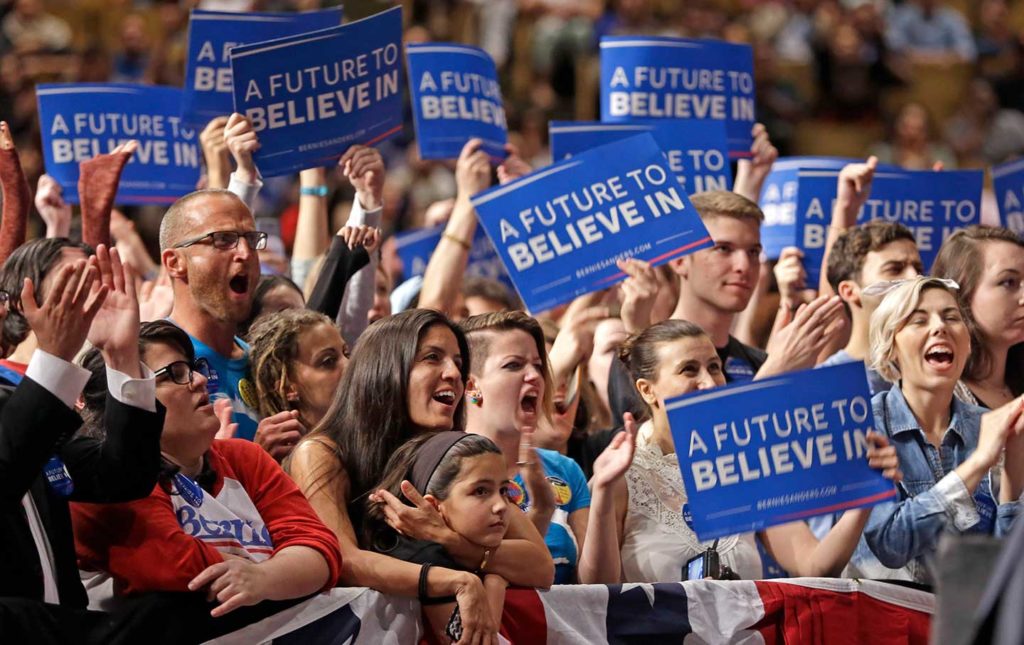
The Latest on the Democratic National Convention and 2016 presidential campaign. (all times EDT): 7:10 p.m. A Hillary Clinton campaign adviser says he’s not worried about winning over Bernie Sanders’ supporters. “Most of them are going to come around.” That’s what John Podesta thinks. Podesta says he knows there are some in the Sanders camp who are still “emotional” and wish Clinton didn’t win more votes than the Vermont senator in the race for the Democratic presidential nomination. But Podesta says most of Sanders’ supporters are looking at the election as a choice between Clinton and Republican Donald Trump. Podesta spoke after some Sanders delegates at the party’s convention wore neon yellow shirts to protest Clinton’s nomination. 6:50 p.m. Some Bernie Sanders supporters are wearing glow-in-the-dark shirts on the final night of Democrats convention in Philadelphia. They say it’s a way to remind presidential nominee Hillary Clinton that she hasn’t brought them all on board yet. For Clinton, the silent protest probably is preferable to the heckling and booing from that marked the early days of the convention. Sanders delegate Davena Norris says her bright shirt is meant to send a message that more needs to be done to curb the influence of money in politics. 6:45 p.m. Donald Trump is campaigning in Iowa and largely avoiding the topic that earned him lots of criticism this week. Only a day ago Trump encouraged Russia to find and make public missing emails deleted by his Democratic presidential opponent, former Secretary of State Hillary Clinton. Trump’s comments raised the question of whether he was condoning foreign government hacking of U.S. computers and the public release of information stolen from political adversaries. Trump was condemned by Clinton and even some of his fellow Republicans. Running mate Mike Pence warned of “serious consequences” if Russia interfered in the election. Trump has since insisted he was being sarcastic. At the Iowa rally, he did say he wanted better relations with Russia and joked that writing letters was more secure than “putting something on a computer.” 5:40 p.m. Donald Trump says “a lot of lies are being told” about him in the speeches at the Democratic National Convention this week. The Republican presidential nominee is joking about it during a campaign rally in Davenport, Iowa. “Boy, I’m getting hit” by Democrats – he says. “I guess they have to do their thing.” Trump is criticizing Democrats for not talking about terrorism or laying out a plan to aid the economy. 4:25 p.m. Die-hard Bernie Sanders supporters from Oregon’s delegation say they’re demanding a nationally televised apology at the Democratic National Convention before Hillary Clinton takes the stage Thursday night to accept the presidential nomination. The matter involves leaked emails from the Democratic National Committee that indicated party officials were biased against the Vermont senator. The DNC has apologized and the party’s leader, Debbie Wasserman Schultz, is resigning her post. But Melissa Pancurak tells The Associated Press that those steps don’t go far enough. She says the Oregon delegates are part of a coalition of Sanders supporters working to get their demand to appropriate DNC officials before Clinton’s speech. 4:20 p.m. Donald Trump’s stand on abortion has been inconsistent, but his running says Trump would be a “pro-life president.” Mike Pence is campaigning in Grand Rapids, Michigan, and he makes clear he opposes abortion. And the Indiana governor tells a town hall rally, “I don’t apologize for it.” Pence drew the ire of abortion rights advocates in March after he signed a law banning abortions that were being sought because of fetal genetic defects. That law has since been blocked pending the outcome of a court challenge. Pence says Trump would appoint conservatives to the Supreme Court who would send the Roe v. Wade abortion ruling to the “ash heap of history.” 4 p.m. “Disrespectful.” That’s what Elijah Cummings thinks of liberal supporters of Bernie Sanders who chanted an anti-trade slogan during the Maryland congressman’s speech at the Democratic National Convention. But Cummings says he’s not upset about it because he’s a veteran of civil rights protests and understands the passion that drove the mostly young delegates to shout over his speech Monday. Cummings says in an interview that most of those who were shouting probably didn’t know he worked with Sanders to draft the Democratic platform and he’s “never voted for a trade bill in 20 years in Congress.” He says more than 100 people have apologized to him for the outbursts. 2:37 p.m. President Barack Obama‘s mention of “fascists” and “homegrown demagogues” in his convention speech wasn’t aimed at Republican presidential nominee Donald Trump. That’s what White House press secretary Josh Earnest is telling reporters the day after Obama argued for Democrat Hillary Clinton’s election over Trump. Obama said “anyone who threatens our values, whether fascists or communists or jihadists or homegrown demagogues, will always fail in the end.” Obama had criticized Trump several times before arriving at that particular line in the speech, including saying that American power “doesn’t come from a self-declared savior promising that he alone can restore order as long as we do things his way.” Trump said in his acceptance speech at last week’s GOP convention that “I alone can fix” a political system he says is rigged. 2:19 p.m. Former New York Mayor Rudolph Giuliani is giving Hillary Clinton credit for her work on behalf of victims of the Sept. 11, 2001, terrorist attacks. Giuliani was asked at a Republican Party briefing Thursday in Philadelphia whether he took issue with the Democratic convention speakers who’d been praising Clinton. Giuliani said she was “enormously supportive and helpful.” Clinton was a U.S. senator from New York at the time. He says Clinton “has a right to tell people that she worked hard on behalf of the 9/11 families.” He adds that, “She did.” But Giuliani adds that “on all other aspects she fails the test.” Clinton and Democrats, he says, have “not done anything to prevent another attack.” 1:50 p.m.
Democratic donors, allies offer reward for Donald Trump tax returns
The wealthy Democratic donors, many of them executives who run complex businesses, know firsthand how revealing tax returns can be. Perhaps that’s why they can’t stop talking about Republican nominee Donald Trump‘s refusal to release his. In their suites at the Ritz Carlton hotel, where many are staying during this week’s Democratic convention, and at its auxiliary swanky parties, the supporters of Hillary Clinton are sounding the alarm about Trump’s break with decades of presidential campaign tradition. Clinton put out eight years of recent tax filings last summer, and they lament that voters don’t seem to understand why Trump’s refusal to do the same matters. Democratic talk of the taxes spilled onto the convention stage Wednesday night. Vice presidential candidate Tim Kaine, mocking Trump, said, “Believe me, there’s nothing suspicious in my tax returns. Believe me!” The crowd laughed. There’s even a literally a bounty for the Trump documents. Moishe Mana, a top fundraiser for Clinton, has offered to give $1 million to the charity of Trump’s choice if he makes them public. He joins an unnamed Republican donor working with Clinton ally David Brock who has made a similar offer of $5 million. “Through his financial documents, we are trying to break into the image that he’s portraying to the American people,” said Mana, a real estate developer in Miami. “He says he’s a successful businessman who wants to do for the country what he did for his company. Well, go ahead, show me the money.” Trump is unmoved. The billionaire owner of the Trump Organization, an international development company, says the Internal Revenue Service is reviewing his most recent returns and that he’ll release them once that audit is complete. He reiterated that plan at a news conference Wednesday in Doral, Florida. Asked when he would put out the documents, he said: “I don’t know. Depends on the audit.” There’s no telling whether that would happen before Election Day, but the IRS says there’s no legal reason Trump can’t make the tax returns public even as they are under review. The issue has flared up in recent days, in the wake of the hack of emails at the Democratic National Committee that the Obama administration said Wednesday was almost certainly the work of Russia. The group WikiLeaks released the emails on the eve of the convention, a leak its leader Julian Assange has said was timed to inflict political damage on Clinton. Trump said Wednesday that he has no ties to Russia whatsoever, but that hasn’t stopped Democratic donors in Philadelphia from saying that in the absence of Trump’s tax returns, voters are left to wonder whether there are undisclosed financial ties between Trump and foreign entities. “Think of what’s gone on just this week and connect the dotted lines,” said top Clinton donor J.B. Pritzker, a billionaire venture capitalist in Chicago. “I’m not sure what’s going on, but it sure doesn’t look good. The question is who his investors are, and whether there are any in China or Russia that are affecting his personal income.” Mana also wants that answered. If Trump’s elected president, he said, “how much in debt would we be to other countries? This is about the security of the United States. We have the right to make sure he’s not in debt to other countries.” While information about Trump’s debts has been made public in personal financial disclosures filed with federal election regulators, the Democratic donors say access to his taxes might shed light on previously unknown business arrangements. The returns would also detail for the first time how much he pays in income tax and how much he gives to charity. “He is obfuscating in order to avoid being discovered as a liar,” Pritzker said. The 2012 GOP nominee, Mitt Romney, resisted putting out his 2011 tax return until the September just before the election, after being pressed for months about doing so. The documents showed he paid an effective tax rate of 14.1 percent, far lower than the average person, spawning days of bad headlines. Other presidential candidates, including Republican Texas Sen. Ted Cruz, have been dinged for not giving much to charity. Bill and Hillary Clinton paid an overall federal tax rate of 31.6 percent between 2007 and 2014, her returns showed. In 2014, they donated almost 11 percent of their income to charity. In addition to blaming the IRS audit, Trump has said in interviews that it might not make political sense for him to put out his returns. Romney’s returns were “a tiny peanut compared to mine,” Trump said on “Meet the Press” in an interview that aired last Sunday. There was little controversial in the Romney documents, he said. Yet the media “made him look bad,” Trump said. “In fact, I think he lost his election because of that.” Republished with permission of the Associated Press.
