
Cuba’s Fidel Castro, who defied U.S. for 50 years, dies at 90

Former President Fidel Castro, who led a rebel army to improbable victory in Cuba, embraced Soviet-style communism and defied the power of 10 U.S. presidents during his half-century rule, has died at age 90. With a shaking voice, President Raul Castro said on state television that his older brother died at 10:29 p.m. Friday. He ended the announcement by shouting the revolutionary slogan: “Toward victory, always!” Castro’s reign over the island-nation 90 miles (145 kilometers) from Florida was marked by the U.S.-backed Bay of Pigs invasion in 1961 and the Cuban Missile Crisis a year later that brought the world to the brink of nuclear war. The bearded revolutionary, who survived a crippling U.S. trade embargo as well as dozens, possibly hundreds, of assassination plots, died 10 years after ill health forced him to hand power over to Raul. Castro overcame imprisonment at the hands of dictator Fulgencio Batista, exile in Mexico and a disastrous start to his rebellion before triumphantly riding into Havana in January 1959 to become, at age 32, the youngest leader in Latin America. For decades, he served as an inspiration and source of support to revolutionaries from Latin America to Africa. His commitment to socialism was unwavering, though his power finally began to fade in mid-2006 when a gastrointestinal ailment forced him to hand over the presidency to Raul in 2008, provisionally at first and then permanently. His defiant image lingered long after he gave up his trademark Cohiba cigars for health reasons and his tall frame grew stooped. “Socialism or death” remained Castro’s rallying cry even as Western-style democracy swept the globe and other communist regimes in China and Vietnam embraced capitalism, leaving this island of 11 million people an economically crippled Marxist curiosity. He survived long enough to see Raul Castro negotiate an opening with U.S. President Barack Obama on Dec. 17, 2014, when Washington and Havana announced they would move to restore diplomatic ties for the first time since they were severed in 1961. He cautiously blessed the historic deal with his lifelong enemy in a letter published after a month-long silence. Obama made a historic visit to Havana in March 2016. Carlos Rodriguez, 15, was sitting in Havana’s Miramar neighborhood when he heard that Fidel Castro had died. “Fidel? Fidel?” he said, slapping his head in shock. “That’s not what I was expecting. One always thought that he would last forever. It doesn’t seem true.” “It’s a tragedy,” said 22-year-old nurse Dayan Montalvo. “We all grew up with him. I feel really hurt by the news that we just heard.” Fidel Castro Ruz was born Aug. 13, 1926, in eastern Cuba’s sugar country, where his Spanish immigrant father worked first recruiting labor for U.S. sugar companies and later built up a prosperous plantation of his own. Castro attended Jesuit schools, then the University of Havana, where he received law and social science degrees. His life as a rebel began in 1953 with a reckless attack on the Moncada military barracks in the eastern city of Santiago. Most of his comrades were killed and Fidel and his brother Raul went to prison. Fidel turned his trial defense into a manifesto that he smuggled out of jail, famously declaring, “History will absolve me.” Freed under a pardon, Castro fled to Mexico and organized a rebel band that returned in 1956, sailing across the Gulf of Mexico to Cuba on a yacht named Granma. After losing most of his group in a bungled landing, he rallied support in Cuba’s eastern Sierra Maestra mountains. Three years later, tens of thousands spilled into the streets of Havana to celebrate Batista’s downfall and catch a glimpse of Castro as his rebel caravan arrived in the capital on Jan. 8, 1959. The U.S. was among the first to formally recognize his government, cautiously trusting Castro’s early assurances he merely wanted to restore democracy, not install socialism. Within months, Castro was imposing radical economic reforms. Members of the old government went before summary courts, and at least 582 were shot by firing squads over two years. Independent newspapers were closed and in the early years, homosexuals were herded into camps for “re-education.” In 1964, Castro acknowledged holding 15,000 political prisoners. Hundreds of thousands of Cubans fled, including Castro’s daughter Alina Fernandez Revuelta and his younger sister Juana. Still, the revolution thrilled millions in Cuba and across Latin America who saw it as an example of how the seemingly arrogant Yankees could be defied. And many on the island were happy to see the seizure of property of the landed class, the expulsion of American gangsters and the closure of their casinos. Castro’s speeches, lasting up to six hours, became the soundtrack of Cuban life and his 269-minute speech to the U.N. General Assembly in 1960 set the world body’s record for length that still stood more than five decades later. As Castro moved into the Soviet bloc, Washington began working to oust him, cutting U.S. purchases of sugar, the island’s economic mainstay. Castro, in turn, confiscated $1 billion in U.S. assets. The American government imposed a trade embargo, banning virtually all U.S. exports to the island except for food and medicine, and it severed diplomatic ties on Jan. 3, 1961. On April 16 of that year, Castro declared his revolution to be socialist, and the next day, about 1,400 Cuban exiles stormed the beach at the Bay of Pigs on Cuba’s south coast. But the CIA-backed invasion failed. The debacle forced the U.S. to give up on the idea of invading Cuba, but that didn’t stop Washington and Castro’s exiled enemies from trying to do him in. By Cuban count, he was the target of more than 630 assassination plots by militant Cuban exiles or the U.S. government. The biggest crisis of the Cold War between Washington and Moscow exploded on Oct. 22, 1962, when President John F. Kennedy announced there were Soviet nuclear missiles in Cuba and imposed a naval blockade of the island. Humankind held its
Updates from the 1st presidential debate

The Latest on the first of three presidential debates between Democrat Hillary Clinton and Republican Donald Trump (all times EDT): 10:45 p.m. Both candidates concluded the first presidential debate by saying they will accept the outcome if the other wins. Hillary Clinton spoke directly to viewers and said, “It’s not about us, it’s about you.” Donald Trump initially dodged the same question, saying he would make a “seriously troubled” America “great again.” He added: “I’m going to be able to do it. I don’t believe Hillary Clinton will.” But Trump finished his answer by saying that if Clinton wins, “I will absolutely support her.” ___ 10:43 p.m. Hillary Clinton is punching back at Donald Trump’s assertions that she doesn’t have the “stamina” to be president. Trump has questioned whether Clinton has the physical fitness to be president and he repeated the criticism to her directly during the debate. Clinton’s response? Trump shouldn’t talk about stamina until he’s tried out the busy schedule she kept up as secretary of state. Trump didn’t answer moderator Lester Holt’s original question about his past comments that Clinton doesn’t have the “presidential look.” Clinton suggested the remarks were about gender, and she reminded the crowd of Trump’s past comments calling women “pigs” and other derogatory names. ___ 10:42 p.m. Donald Trump says NATO needs to “go into the Middle East with us” to combat the Islamic State group. And he is taking credit for NATO focusing resources on combating terrorism. In fact, the alliance agreed in July to contribute aircraft and conduct training in Iraq and has increased intelligence coordination there. And NATO set up an anti-terrorism program in 2004 — years before Trump criticized them as a presidential candidate. Earlier this year, Trump criticized NATO for not focusing on terrorism. He said that afterward, he saw an article reporting that NATO was opening a new, major anti-terrorism division. He said Tuesday that NATO’s action was “largely because of what I was saying, and my criticism of NATO.” ___ 10:40 p.m. Donald Trump is avoiding a specific declaration on how he would use nuclear weapons if he’s elected president. The Republican nominee said during the first presidential debate that he “would not do first strike” because “once the nuclear alternative happens, it’s over.” That statement suggests he would not authorize a nuclear attack unless the U.S. was struck first. But in the same answer Trump said he “can’t take anything off the table.” He mentioned adversary nations such as North Korea and Iran. President Barack Obama has considered changing existing policy to state clearly that the United States would not deploy nuclear weapons without first being attacked by nuclear weapons. But he met resistance and has elected not to make such a shift. ___ 10:38 p.m. Hillary Clinton is accusing Donald Trump of being too easily provoked to keep the United States from going to war — perhaps even one involving nuclear weapons. Trump says: “I have much better judgment than she does. I have much better temperament.” That drew laughs from some in the debate crowd, and prompted Clinton to exclaim: “Woo! OK!” Clinton then pivoted to policy, defending the U.S.-led war in Afghanistan. Clinton said Iran was “weeks away” from a nuclear bomb when she became secretary of state — and says the Obama administration thwarted that progress. She continued that Trump didn’t have “good judgment or the right temperament” because he could take the country to war over small issues, like being mocked on Twitter. ___ 10:35 p.m. Donald Trump is continuing to insist he opposed the Iraq War before the U.S. invasion despite evidence to the contrary. Trump says during the debate that he “did not support the war in Iraq,” calling that charge “mainstream media nonsense.” But there is no evidence Trump expressed public opposition to the war before the U.S. invaded. Trump was asked in September 2002 whether he supported a potential Iraq invasion in an interview with Howard Stern. Trump briefly hesitated, then responded: “Yeah, I guess so.” Presented with the comment during the debate, Trump responds: “I said very lightly, I don’t know, maybe, who knows.” He’s also telling reporters to call Fox News host Sean Hannity to confirm private conversations he said they had about the war. Hannity is a top Trump supporter. Clinton voted in favor of the invasion in 2002 while she was a New York senator. She has since said it was a mistake. ___ 10:27 p.m. Donald Trump is interrupting the moderator of the first presidential debate to insist he has the best temperament for the office. Trump repeatedly made the assertion after clashing with moderator Lester Holt over his early support for the Iraq War. Then he segued to his temperament. “I think my strongest asset by far is my temperament,” Trump said. “I know how to win.” Clinton and her allies have repeatedly hit Trump over his temper and inability to take criticism. ___ 10:23 p.m. Hillary Clinton says one key to fighting terrorism in the United States is working closely with Muslims living here. Clinton says Donald Trump has “consistently insulted Muslims abroad, Muslims at home.” She says Muslim people can provide information that law enforcement may not be able to obtain anyplace else. Both candidates were asked to explain how they would combat terrorism in the U.S. Clinton says her plan includes an intelligence surge to obtain “every scrap of information” and to “do everything we can to vacuum up intelligence from Europe, from the Middle East.” ___ 10:20 p.m. Hillary Clinton says defeating the Islamic State group and taking out its leaders would be a top priority as president. Clinton says she’s hopeful the Islamic State group would be pushed out of Iraq by the end of the year. She says the U.S. could then help its allies “squeeze” the terrorist group in Syria. Clinton says she would do everything possible to take out the group’s leaders, and make that one of her administration’s organizing principles
Gold cards and red hats: A Trumpian approach to fundraising
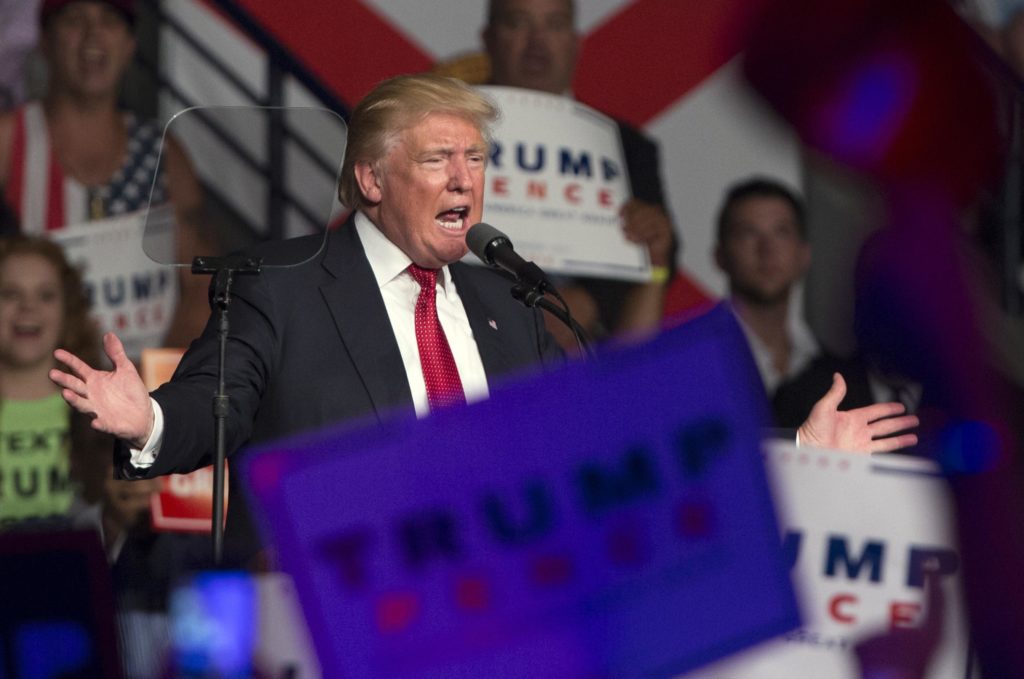
Donald Trump is underwriting his presidential bid by selling the Donald Trump lifestyle — and campaign finance records show it is working. For the low price of $25, you can snag a Trump Gold Card emblazoned with your name or join a campaign “Board of Directors” that comes with a personalized certificate. For $30, grab one of Trump’s signature red hats — billed as “the most popular product in America.” Supporters can elevate themselves to “big league” by ponying up $184 for a signed, “now out of print” copy of Trump’s book, “The Art of the Deal.” There’s a catch to some of these merchandising claims. There is no evidence the board of directors exists. “The Art of the Deal” is still in print, available for $9.34 in paperback. And the new campaign edition of the book is signed by an autopen, not Trump, as noted in the solicitation’s fine print. Regardless, the appeals have paid off. Through the end of July, people giving $200 or less made up about half of his campaign funds, according to fundraising reports through July. For Democratic nominee Hillary Clinton, those small gifts accounted for about 19 percent. The two candidates each claim over 2 million donors, but Trump has been fundraising in earnest for only about three months, compared to Clinton’s 17-month operation. Both are expected to report the details of their August fundraising to federal regulators on Tuesday. “His brand appeals to quite a number of people,” said John Thompson, digital fundraising director for Ted Cruz‘s Republican presidential campaign. “It’s smart for him to use it for fundraising. The celebrity factor builds a natural donor community on its own, without him having to do too much.” Hyperbolic campaign marketing is a natural fit for Trump, who has puffed up the value of what he sold throughout his business career. At times, Trump has offered golf memberships or Trump University seminars at a “discount” from an imaginary, inflated price; and he has declared condo projects close to selling out when in reality they were struggling. “You want to say it in the most positive way possible,” Trump once told attorneys who asked him whether he had ever lied about his properties to sell them. “I’m no different from a politician running for office.” Perhaps it is no surprise, then, that his campaign has adopted that same approach, outspending Clinton on campaign merchandise while running a brisk retail operation that helps him raise the money for, among other things, crucial get-out-the-vote efforts and advertising to spread his message. Trump’s appeals for smaller contributions are reminiscent of Bernie Sanders, whose signature line in the Democratic primary this year was that his campaign was paid for by $27 donations. Sanders’ digital fundraiser, Michael Whitney, questioned whether Trump’s small donor haul would continue since it does not appear the campaign has done much to get email addresses that could be turned into fresh batches of new potential donors. “This feels more like a battering ram than a well-thought-out digital program,” Whitney said. One of Trump’s most frequent fundraising offers has been a “gold card” that identifies the holder as an Executive Member for a “one-time induction fee.” “In the past, I have asked supporters for a one-time induction fee of $100. But because of your outstanding generosity to date, I am only asking you to make a $35 contribution,” the email asks. The Associated Press found no evidence of an online solicitation in which the card was sold for the undiscounted price of $100. The gold card offer is reminiscent of a Trump Visa card that became available in 2004. In a press release for it, Trump pitched it as “the best deal” and warned declining it “could get you fired.” Trump also seeks to make would-be donors feel like part of the campaign. Several emails have sought “campaign advice,” asked for help with debate preparation and even offered people the chance to join a campaign “board of directors.” There’s no evidence such a board exists, and the campaign did not respond to questions about it. But the gold card and executive board membership gimmicks are getting results, said Tom Sather, senior director of research at the email data solutions firm Return Path. The firm measures emails much the way Nielsen measures television viewership, by extrapolating from a large panel of study participants. Emails from the Trump campaign and Trump joint committees with the Republican Party have an average open rate of 11 percent, Sather said. The 10 gold card-related emails had a far higher open rate of 18 percent, and executive board emails had an open rate of 19 percent, he said. “These kinds of offers intrigue people and make them feel exclusive and special,” he said. Ever the marketer, Trump has also dominated the campaign swag front. In April, May and June, Trump spent about $3 million on merchandise that’s then sold to donors, an AP review of campaign finance reports found. Clinton’s operation spent about $2 million in the same time period. Republished with permission of the Associated Press.
