
U.S. approves updated COVID-19 vaccines
The U.S. approved updated COVID-19 vaccines on Monday on an emergency basis. The U.S. Food and Drug Administration took action Monday to approve and authorize updated COVID-19 vaccines for emergency use. The agency approved updated mRNA vaccines for 2023-2024 made by ModernaTX Inc. and Pfizer Inc. The vaccines were “formulated to more closely target currently circulating variants and to provide better protection against serious consequences of COVID-19, including hospitalization and death,” according to the FDA. “Vaccination remains critical to public health and continued protection against serious consequences of COVID-19, including hospitalization and death,” said Dr. Peter Marks, director of the FDA’s Center for Biologics Evaluation and Research. “The public can be assured that these updated vaccines have met the agency’s rigorous scientific standards for safety, effectiveness, and manufacturing quality.” The updated mRNA vaccines were each approved for people 12 years of age and older and were authorized under emergency use for people 6 months through 11 years of age. The FDA said the bivalent Moderna and Pfizer-BioNTech COVID-19 vaccines were no longer authorized for use in the United States. Republished with the permission of The Center Square.
U.S. opens second COVID boosters to 50 and up, others at risk
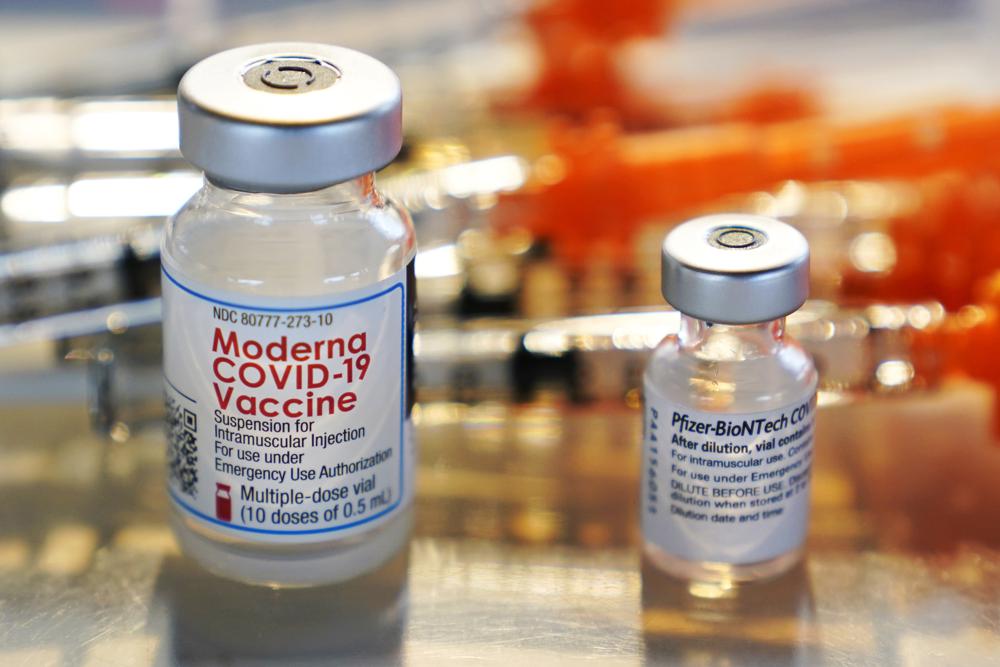
Americans 50 and older can get a second COVID-19 booster if it’s been at least four months since their last vaccination, a chance at extra protection for the most vulnerable in case the coronavirus rebounds. The Food and Drug Administration on Tuesday authorized an extra dose of the Pfizer or Moderna vaccine for that age group and for certain younger people with severely weakened immune systems. The Centers for Disease Control and Prevention later recommended the extra shot as an option but stopped short of urging that those eligible rush out and get it right away. That decision expands the additional booster to millions more Americans. Dr. Rochelle Walensky, CDC’s director, said it was especially important for older Americans — those 65 and older — and the 50-somethings with chronic illnesses such as heart disease or diabetes to consider another shot. “They are the most likely to benefit from receiving an additional booster dose at this time,” Walensky said. There’s evidence protection can wane, particularly in higher-risk groups, and for them, another booster “will help save lives,” FDA vaccine chief Dr. Peter Marks said. For all the attention on who should get a fourth dose of the Pfizer and Moderna vaccines, only about half of Americans eligible for a third shot have gotten one — and the government urged them to get up to date. Two shots plus a booster still offer strong protection against severe illness and death, even during the winter surge of the super-contagious omicron variant. The move toward additional boosters comes at a time of great uncertainty, with limited evidence to tell how much benefit an extra dose right now could offer. COVID-19 cases have dropped to low levels in the U.S., but all vaccines are less powerful against newer mutants than earlier versions of the virus — and health officials are warily watching an omicron sibling that’s causing worrisome jumps in infections in other countries. Pfizer had asked the FDA to clear a fourth shot for people 65 and older, while Moderna requested another dose for all adults “to provide flexibility” for the government to decide who really needs one. FDA’s Marks said regulators set the age at 50 because that’s when chronic conditions that increase the risks from COVID-19 become more common. Until now, the FDA had allowed a fourth vaccine dose only for the immune-compromised as young as 12. Vaccines have a harder time revving up severely weak immune systems, and Marks said their protection also tends to wane sooner. Tuesday’s decision allows them another booster, too — a fifth dose. Only the Pfizer vaccine can be used in those as young as 12; Moderna’s is for adults. What about people who got Johnson & Johnson’s single-dose shot? They already were eligible for one booster of any kind. Of the 1.3 million who got a second J&J shot, the CDC said now they may choose a third dose — either Moderna or Pfizer. For the more than 4 million who got Moderna or Pfizer as their second shot, the CDC says an additional booster is only necessary if they meet the newest criteria — a severely weakened immune system or are 50 or older. That’s because a CDC study that tracked which boosters J&J recipients initially chose concluded a Moderna or Pfizer second shot was superior to a second J&J dose. If the new recommendations sound confusing, outside experts say it makes sense to consider extra protection for the most vulnerable. “There might be a reason to top off the tanks a little bit” for older people and those with other health conditions said University of Pennsylvania immunologist E. John Wherry, who wasn’t involved in the government’s decision. But while he encourages older friends and relatives to follow the advice, the 50-year-old Wherry — who is healthy, vaccinated, and boosted — doesn’t plan on getting a fourth shot right away. With protection against severe illness still strong, “I’m going to wait until it seems like there’s a need.” While protection against milder infections naturally wanes over time, the immune system builds multiple layers of defense, and the type that prevents severe illness and death is holding up. During the U.S. omicron wave, two doses were nearly 80% effective against needing a ventilator or death — and a booster pushed that protection to 94%, the CDC recently reported. Vaccine effectiveness was lowest — 74% — in immune-compromised people, the vast majority of whom hadn’t gotten a third dose. To evaluate an extra booster, U.S. officials looked to Israel, which opened a fourth dose to people 60 and older during the omicron surge. The FDA said no new safety concerns emerged in a review of 700,000 fourth doses administered. Preliminary data posted online last week suggested some benefit: Israeli researchers counted 92 deaths among more than 328,000 people who got the extra shot, compared to 232 deaths among 234,000 people who skipped the fourth dose. What’s far from clear is how long any extra benefit from another booster would last, and thus when to get it. “The ‘when’ is a really difficult part. Ideally, we would time booster doses right before surges but we don’t always know when that’s going to be,” said Dr. William Moss, a vaccine expert at the Johns Hopkins Bloomberg School of Public Health. Plus, a longer interval between shots helps the immune system mount a stronger, more cross-reactive defense. “If you get a booster too close together, it’s not doing any harm — you’re just not going to get much benefit from it,” said Wherry. The newest booster expansion may not be the last: Next week, the government will hold a public meeting to debate if everyone eventually needs a fourth dose, possibly in the fall, of the original vaccine or an updated shot. Even if higher-risk Americans get boosted now, Marks said they may need yet another dose in the fall if regulators decide to tweak the vaccine. For that effort, studies in people — of omicron-targeted shots alone or in
FDA OKs mixing COVID vaccines; backs Moderna, J&J boosters

U.S. regulators on Wednesday signed off on extending COVID-19 boosters to Americans who got the Moderna or Johnson & Johnson vaccine and said anyone eligible for an extra dose can get a brand different from the one they received initially. The Food and Drug Administration’s decisions mark a big step toward expanding the U.S. booster campaign, which began with extra doses of the Pfizer vaccine last month. But before more people roll up their sleeves, the Centers for Disease Control and Prevention will consult an expert panel Thursday before finalizing official recommendations for who should get boosters and when. The latest moves would expand by tens of millions the number of Americans eligible for boosters and formally allow “mixing and matching” of shots — making it simpler to get another dose, especially for people who had a side effect from one brand but still want the proven protection of vaccination. Specifically, the FDA authorized a third Moderna shot for seniors and others at high risk from COVID-19 because of their health problems, jobs, or living conditions — six months after their last shot. One big change: Moderna’s booster will be half the dose that’s used for the first two shots, based on company data showing that was plenty to rev up immunity again. For J&J’s single-shot vaccine, the FDA said all U.S. recipients, no matter their age, could get a second dose at least two months following their initial vaccination. The FDA rulings differ because the vaccines are made differently, with different dosing schedules — and the J&J vaccine has consistently shown a lower level of effectiveness than either of the two-shot Moderna and Pfizer vaccines. As for mixing and matching, the FDA said it’s OK to use any brand for the booster regardless of which vaccination people got first. The interchangeability of the shots is expected to speed the booster campaign, particularly in nursing homes and other institutional settings where residents have received different shots over time. FDA’s acting commissioner Dr. Janet Woodcock said the agency wanted to make its booster guidance as flexible as possible, given that many people don’t remember which brand they first received. In other cases, some people may want to try a different vaccine if they previously experienced common side effects like muscle ache or chills. Still, regulators said it’s likely many people will stick with the same vaccine brand. The decision was based on preliminary results from a government study of different booster combinations that showed an extra dose of any type revs up levels of virus-fighting antibodies. That study also showed recipients of the single-dose J&J vaccination had a far bigger response if they got a full-strength Moderna booster or a Pfizer booster rather than a second J&J shot. The study didn’t test the half-dose Moderna booster. Health authorities stress that the priority still is getting first shots to about 65 million eligible Americans who remain unvaccinated. But the booster campaign is meant to shore up protection against the virus amid signs that vaccine effectiveness is waning against mild infections, even though all three brands continue to protect against hospitalization and death. “Today the currently available data suggest waning immunity in some populations of fully vaccinated people,” Woodcock told reporters. “The availability of these authorized boosters is important for continued protection against COVID-19 disease.” The Moderna booster decision essentially matches FDA’s ruling that high-risk groups are eligible for the Pfizer vaccine, which is made with the same technology. FDA recommended that everyone who’d gotten the single-shot J&J vaccine get a booster since it has consistently shown lower protection than its two-shot rivals. And several independent FDA advisers who backed the booster decision suggested J&J’s vaccine should have originally been designed to require two doses. Experts continue to debate the rationale of the booster campaign. Some warn that the U.S. government hasn’t clearly articulated the goals of boosters given that the shots continue to head off the worst effects of COVID-19, and wonder if the aim is to tamp down on virus spread by curbing, at least temporarily, milder infections. FDA’s top vaccine official suggested regulators would move quickly to expand boosters to lower age groups, such as people in their 40s and 50s, if warranted. “We are watching this very closely and will take action as appropriate to make sure that the maximum protection is provided to the population,” said FDA’s Dr. Peter Marks. In August, the Biden administration announced plans for an across-the-board booster campaign aimed at all U.S. adults, but outside experts have repeatedly argued against such a sweeping effort. On Thursday an influential panel convened by the CDC is expected to offer more specifics on who should get boosters and when. Their recommendations are subject to approval by the CDC director. The vast majority of the nearly 190 million Americans who are fully vaccinated against COVID-19 have received the Pfizer or Moderna options, while about 15 million have received the J&J vaccine. Republished with the permission of the Associated Press.
Pfizer COVID-19 shot expanded to U.S. children as young as 12
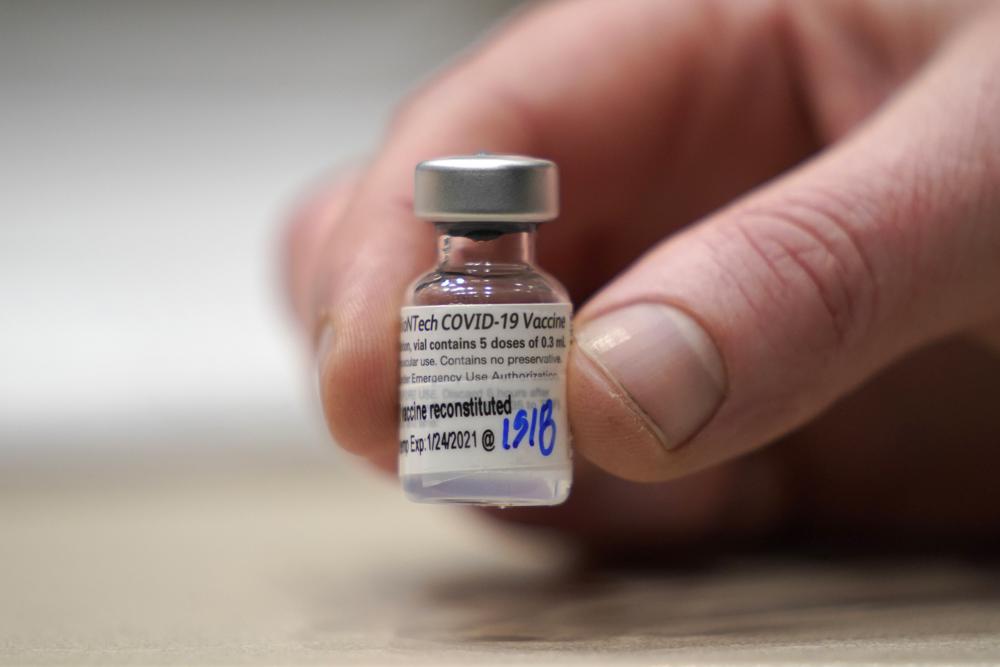
U.S. regulators on Monday expanded the use of Pfizer’s COVID-19 vaccine to children as young as 12, offering a way to protect the nation’s adolescents before they head back to school in the fall and paving the way for them to return to more normal activities. Shots could begin as soon as Thursday, after a federal vaccine advisory committee issues recommendations for using the two-dose vaccine in 12- to 15-year-olds. An announcement is expected Wednesday. Most COVID-19 vaccines worldwide have been authorized for adults. Pfizer’s vaccine is being used in multiple countries for teens as young as 16, and Canada recently became the first to expand use to 12 and up. Parents, school administrators, and public health officials elsewhere have eagerly awaited approval for the shot to be made available to more kids. “This is a watershed moment in our ability to fight back the COVID-19 pandemic,” Dr. Bill Gruber, a Pfizer senior vice president who’s also a pediatrician, told The Associated Press. The Food and Drug Administration declared that the Pfizer vaccine is safe and offers strong protection for younger teens based on testing of more than 2,000 U.S. volunteers ages 12 to 15. The agency noted there were no cases of COVID-19 among fully vaccinated adolescents compared with 16 among kids given dummy shots. More intriguing, researchers found the kids developed higher levels of virus-fighting antibodies than earlier studies measured in young adults. The younger teens received the same vaccine dosage as adults and had the same side effects, mostly sore arms and flu-like fever, chills or aches that signal a revved-up immune system, especially after the second dose. Pfizer’s testing in adolescents “met our rigorous standards,” FDA vaccine chief Dr. Peter Marks said. “Having a vaccine authorized for a younger population is a critical step in continuing to lessen the immense public health burden caused by the COVID-19 pandemic.” Pfizer and its German partner BioNTech recently requested similar authorization in the European Union, with other countries to follow. The latest news is welcome for U.S. families struggling to decide what activities are safe to resume when the youngest family members remain unvaccinated. “I can’t feel totally comfortable because my boys aren’t vaccinated,” said Carrie Vittitoe, a substitute teacher and freelance writer in Louisville, Kentucky, who is fully vaccinated, as are her husband and 17-year-old daughter. The FDA decision means her 13-year-old son soon could be eligible, leaving only her 11-year-old son unvaccinated. The family has not yet resumed going to church, and summer vacation will be a road trip so they do not have to get on a plane. “We can’t really go back to normal because two-fifths of our family don’t have protection,” Vittitoe said. President Joe Biden said Monday’s decision marked another important step in the nation’s march back to regular life. “The light at the end of the tunnel is growing, and today it got a little brighter,” Biden said in a statement. Pfizer is not the only company seeking to lower the age limit for its vaccine. Moderna recently said preliminary results from its study in 12- to 17-year-olds show strong protection and no serious side effects. Another U.S. company, Novavax, has a COVID-19 vaccine in late-stage development and just began a study in 12- to 17-year-olds. Next up is testing whether the vaccine works for even younger children. Both Pfizer and Moderna have begun U.S. studies in children ages 6 months to 11 years. Those studies explore whether babies, preschoolers, and elementary-age kids will need different doses than teens and adults. Gruber said Pfizer expects its first results in the fall. Outside of the U.S., AstraZeneca is studying its vaccine among 6- to 17-year-olds in Britain. And in China, Sinovac recently announced that it has submitted preliminary data to Chinese regulators showing its vaccine is safe in children as young as 3. Children are far less likely than adults to get seriously ill from COVID-19, yet they represent nearly 14% of the nation’s coronavirus cases. At least 296 have died from COVID-19 in the U.S. alone, and more than 15,000 have been hospitalized, according to a tally by the American Academy of Pediatrics. That’s not counting the toll of family members becoming ill or dying — or the disruption to school, sports and other activities so crucial to children’s overall well-being. The AAP welcomed the FDA’s decision. “Our youngest generations have shouldered heavy burdens over the past year, and the vaccine is a hopeful sign that they will be able to begin to experience all the activities that are so important for their health and development,” said AAP President Dr. Lee Savio Beers in a statement. Experts say children must get the shots if the country is to vaccinate the 70% to 85% of the population necessary to reach what’s called herd immunity. In the meantime, the Centers for Disease Control and Prevention says unvaccinated people — including children — should continue taking precautions such as wearing masks indoors and keeping their distance from other unvaccinated people outside of their households. Republished with the permission of the Associated Press.
U.S. panel endorses widespread use of Pfizer COVID-19 vaccine
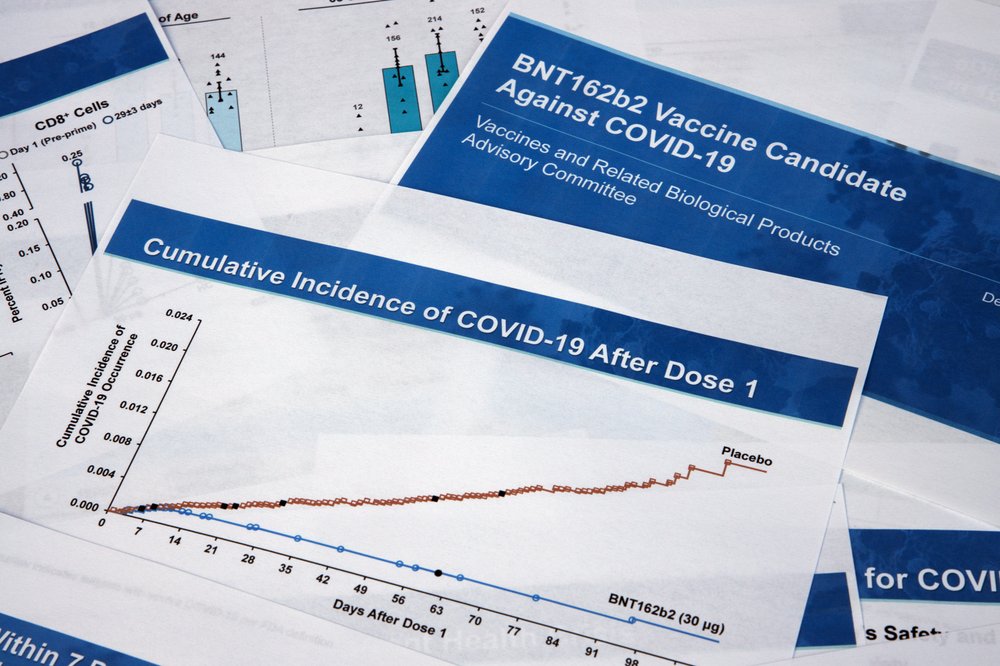
A U.S. government advisory panel endorsed widespread use of Pfizer’s coronavirus vaccine Thursday, putting the country just one step away from launching an epic vaccination campaign against the outbreak that has killed close to 300,000 Americans. Shots could begin within days, depending on how quickly the Food and Drug Administration signs off, as expected, on the expert committee’s recommendation. In a 17-4 vote with one abstention, the government advisers concluded that the vaccine from Pfizer and its German partner BioNTech appears safe and effective for emergency use in adults and teenagers 16 and older. That endorsement came despite questions about allergic reactions in two people who received the vaccine earlier this week when Britain became the first country to begin dispensing the Pfizer-BioNTech shot. Despite all the remaining unknowns, in an emergency, “the question is whether you know enough,” said panel member Dr. Paul Offit of Children’s Hospital of Philadelphia, who concluded that the shot’s potential benefits outweigh its risks. The independent review by non-government experts in vaccine development, infectious diseases, and medical statistics was considered critical to boosting Americans’ confidence in the safety of the shot, which was developed at breakneck speed less than a year after the virus was identified. The decision came as COVID-19 cases surge to ever-higher levels across the U.S., with deaths hitting an all-time, one-day high of more than 3,100 on Wednesday. Pfizer has said it will have about 25 million doses of the two-shot vaccine for the U.S. by the end of December. But initial supplies will be limited and reserved primarily for health care workers and nursing home residents, with other vulnerable groups next in line until the shots become widely available on-demand, something that will probably not happen until the spring. Experts estimate at least 70% of the U.S. population will have to be vaccinated to achieve herd immunity, the point at which the virus can be held in check. That means it could be several months before things start getting back to normal and Americans can put away their masks. The FDA next week will review a second vaccine, from Moderna and the National Institutes of Health, that appears about as protective as Pfizer-BioNTech’s shot. A third candidate, from Johnson & Johnson, which would require just one dose, is working its way through the pipeline. Behind that is a candidate from AstraZeneca and Oxford University All eyes now turn to the FDA staff scientists who will make the final decision on whether to greenlight use of the Pfizer-BioNTech vaccine. Regulators not only in Britain but in Canada have already approved it for use in their countries, and President Donald Trump and White House officials have complained for weeks about the pace of FDA’s careful review. FDA’s vaccine director Dr. Peter Marks said ahead of the expert meeting that a decision would come within “days to a week.” “Americans want us to do a scientific review, but I think they also want us to make sure we’re not wasting time on paperwork as opposed to going forward with the decision,” FDA Commissioner Stephen Hahn said before the meeting. A positive vote for the vaccine was virtually assured after FDA scientists issued a glowing review of the vaccine earlier in the week. Agency staffers said data from Pfizer’s ongoing study of 44,000 people showed strong protection across different age groups, races, and health conditions with no major, unexpected safety problems. The Pfizer-BioNTech shot remains experimental because that final-stage study isn’t complete. As a result, the expert panel wrestled with a list of questions that have yet to be answered. For example, while the vaccine is more than 90% effective in blocking the symptoms of COVID-19, the FDA’s advisers stressed it is not yet clear if it can stop the silent, symptomless spread that accounts for up to half of cases. “Even though the individual efficacy of this vaccine is very, very, very high, you really as of right now do not have any evidence” that it will lower transmission, said Dr. Patrick Moore of the University of Pittsburgh. He urged Pfizer to take additional steps to answer that question. And the advisers are worried that Pfizer will lose its opportunity to answer critical questions as it begins offering the real vaccine to study participants who had been getting dummy shots. The company proposed gradually moving those patients to the vaccine group, with priority based on age, health conditions, and other factors. Under that plan, 70-year-old participants would cross over before healthy 30-year-olds. Pfizer must still show whether the vaccine works in children younger than 16 and in pregnant women. On the safety front, as widespread vaccinations begin, the first recipients will be closely tracked by government health authorities since studies in tens of thousands of people can’t detect rare risks that strike 1 in a million. Hanging over the meeting were the British allergic reactions and a warning from authorities there that people with a history of serious reactions shouldn’t get the vaccine for now. Pfizer representatives said they have seen no signs of allergic reactions in their trial. But some of the FDA advisers fear the British warning will deter millions of Americans with allergies who might benefit from the COVID-19 vaccine from giving it a try and urged additional studies to try to settle the issue. “This issue is not going to die until we have better data,” Offit said. Republished with the permission of the Associated Press.
