
Donald Trump returns to Arizona – and a chaotic political landscape
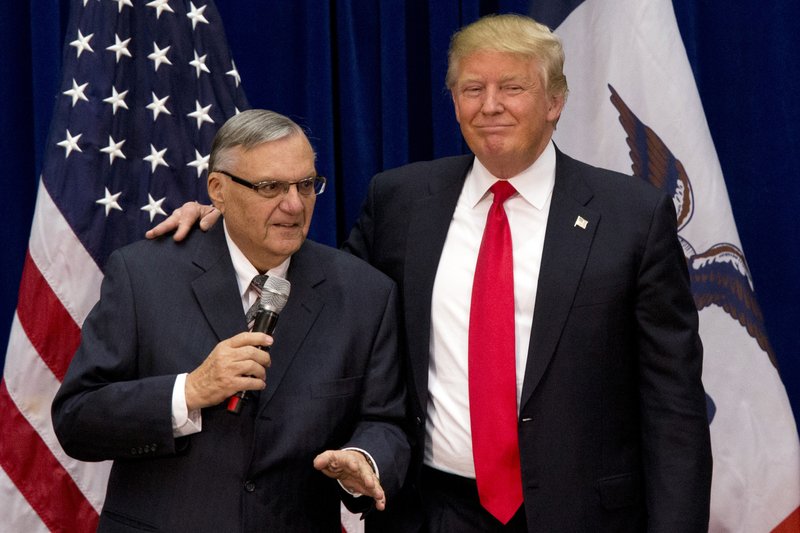
Donald Trump was just a few weeks into his candidacy in 2015 when he came to Phoenix for a speech that ended up being a bigger moment in his campaign than most people realized at the time. Trump savaged his critics and the media, vowed to fine Mexico $100,000 for each immigrant entering the country illegally, talked tough on trade, promised to return America to its winning ways and borrowed a line from Richard Nixon in declaring, “The silent majority is back.” The packed crowd ate it up — the raucous enthusiasm an early sign of the overwhelming support among Trump’s base that would help carry him to the presidency. As Trump returns to Arizona Tuesday in need of another big moment, he will find a place where his agenda and unconventional leadership style have consumed the political landscape and elevated the state’s status in the national fight for control of power in Washington in 2018. It was Arizona senator John McCain who cast the vote that derailed Trump’s effort to repeal the health care law. The other Arizona senator, Jeff Flake, has become the poster child for Republicans who buck the president’s agenda and feel his wrath on Twitter. The president is almost certain to back a GOP challenger to Flake in 2018, complicating Republican efforts to maintain control of the Senate. Trump has also revived the immigration debate and infuriated Latinos here with his talk of pardoning former Sheriff Joe Arpaio over his recent conviction for breaking the law with his signature immigration patrols. The controversy over Civil War monuments has even spilled into Arizona, where the governor has faced repeated calls to take down a handful of Confederate memorials in the state. And an overlooked item in Trump’s agenda, school choice, has made education a hot campaign issue in Arizona. With the strong support of Education Secretary Besty DeVos, Arizona passed the nation’s most ambitious expansion of vouchers this year, and public-school advocates recently submitted more than 100,000 signatures in a petition drive to get the law wiped out on the 2018 ballot. If that isn’t enough fuel for a political bonfire, Trump’s visit to Arizona will be his first political event since the race-driven violence in Virginia and his divisive comments in the aftermath of the protests. That created a dilemma for Republicans like Gov. Doug Ducey on whether to take the stage at the Trump rally while running for re-election. Doing so would subject him to attacks from moderates and the left by appearing with the president so soon after Charlottesville and possibly at the same time as the president pardons Arpaio and throws his endorsement behind Flake’s challenger. But avoiding the stage could hurt him with the base. Ducey’s plan is to greet the president on the airport tarmac and skip the rally, saying he wants to oversee the law enforcement response to protests. The governor supported Trump and appeared on stage at one of his rallies last year in Arizona. Trump would be hard-pressed to find a state where his Republican base is as faithful and vocal as in Arizona, which is a big reason why he came to the state seven times during his campaign and refers to the “special place” it holds for him. The fierce, non-conformist political spirit evident at Trump rallies here traces its roots to the frontier days and allows hard-fisted politicians like him and Arpaio to thrive. “The Republican primary base in Arizona is highly partisan, semi-libertarian in the sense that it’s against the swamp,” said longtime Republican political strategist Chuck Coughlin. “We’re the 48th state to join. We’re still acting like a juvenile. We still act like we’re the last one invited to the party which is sort of what Donald Trump is.” The biggest consequence of Trump’s unorthodox governing style may be seen in Flake’s re-election effort. Flake has been outspoken in his criticism of Trump, taking him to task in pointed jabs in a recent book. Trump has been sending out Tweets signaling his support for far-right former state Sen. Kelli Ward, who is running against Flake in the primary. Other Republicans with less baggage than Ward could also enter the race and complicate things further, making it harder for Republicans to keep the seat in the general election. Rep. Kyrsten Sinema is considered the top threat on the Democratic side. “If the president himself is supporting a challenger to Jeff, it’s a serious problem,” said Coughlin, who has been polling voters about the intraparty turmoil that has unsettled the race. Voters like Julie Brown are indicative of the GOP struggle in the Trump administration between the base and establishment. She attended a Trump rally last year and remains steadfast in her support of the president, even after Charlottesville. “He’s not totally polished and everyone tears apart his words, but you’ll never have to guess what he’s thinking and I like that much better than a politician who just gets up there and buoyantly lies and is bought by lobbyists,” Brown said. “He’s just straightforward, and like I said, it rocks the boat but we need it.” Republished with permission of The Associated Press.
Donald Trump to visit Marine base in Yuma before Phoenix rally
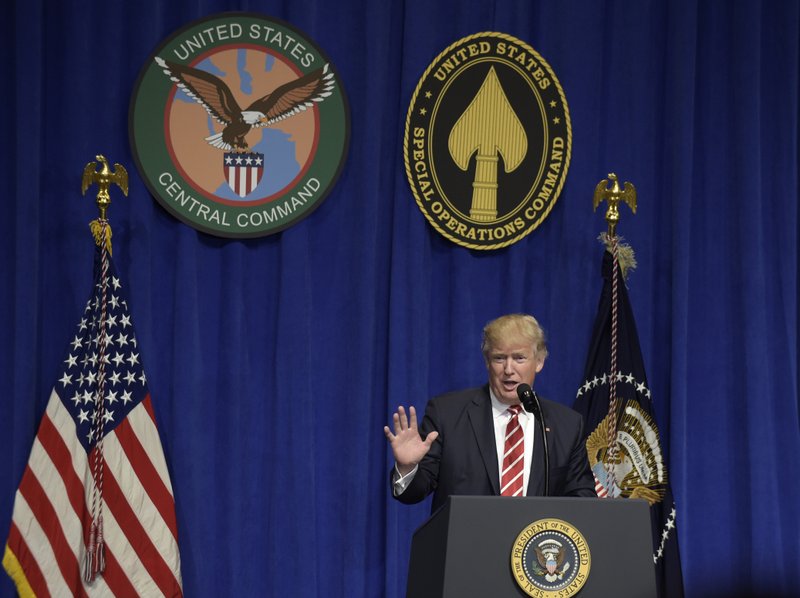
The White House says President Donald Trump is scheduled to visit a Marine Corps base in Arizona along the U.S.-Mexico border. Trump is set to visit Marine Air Station Yuma on Tuesday afternoon before he travels to Phoenix to hold a rally. Yuma’s location along the U.S.-Mexico border touches on one of Trump’s signature issues: his call for putting up a border wall to stem illegal immigration from Mexico. The rally in Phoenix will take place at the city’s convention center. Trump tweeted about the event last week with a link for ticket availability. The president has been holding campaign-style events in Trump-friendly areas since he took office. The rally will be his first in the West. Republished with permission of The Associated Press.
For Hillary Clinton, struggle to change public perception persists
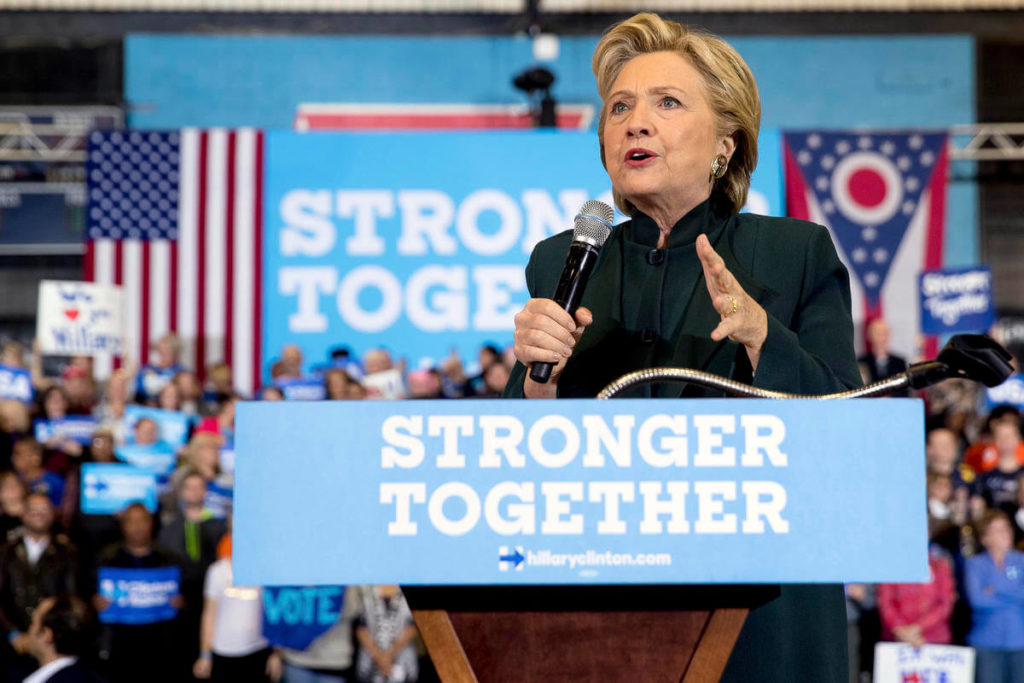
Hillary Clinton bested Donald Trump in three debates. She leads in many preference polls of the most competitive states. Barring a significant shift in the next two weeks, she is in a strong position to become the first woman elected U.S. president. But Clinton will end the campaign still struggling to change the minds of millions of voters who don’t think well of her, a glaring liability should the Democratic nominee move on to the White House. While many see her as better prepared to be commander in chief than Trump, she is consistently viewed unfavorably by more than half of the country. Most voters also consider her dishonest. Clinton’s advisers have spent months trying to erase that perception. They’ve set up small events where she had more intimate conversations with voters. They’ve tested a seemingly endless stream of messages aimed at assuring the public that the former secretary of state was in the race to do more than fulfill her own political ambitions. As Clinton starts making her closing argument to voters, her team appears to have come to terms that the mission remains unfulfilled. “Honest and trustworthy has become our most talked about metric because it’s not great,” said Jennifer Palmieri, Clinton’s communications director. “But we’ve never thought it’s the metric people make a decision on.” If Clinton wins, that theory may be proven true. Just 36 percent of voters believe Clinton is honest and trustworthy, according to a recent Washington Post/ABC News poll. That’s compared with about 60 percent who believe she has the qualifications and temperament to be commander in chief. The public’s perception of Clinton has bounced up and down throughout her time in public life. Her favorability rating fell below 50 percent at times during her years as first lady, but rose to its high water mark then and while she was as secretary of state under President Barack Obama. Democrats blame some of the current negative personal perceptions of Clinton on the hard-charging tactics she’s used to try to discredit Trump, though they believe her sustained assault on Trump’s character and temperament has been crucial. Party operatives also say Trump’s personal attacks on Clinton have made it all but impossible for more positive messages to break through. He’s called her a “liar,” a “nasty woman” and pledged to put her in jail. “When you’re under relentless assault from a reality TV star, it’s hard to come out of that with anybody feeling good about anyone,” said Bill Burton, a former Obama aide. Still, Clinton’s advisers acknowledge that some of her troubles have been of her own making, including her penchant for privacy. She’s spent nearly the entire campaign struggling to explain why she used a private email server in the basement of her home while she led the State Department. She hid a pneumonia diagnosis this fall from nearly all of her senior staff, then left the public unaware of her condition and whereabouts for 90 minutes after the illness caused her to rush out of a public event in New York. “She is a politician that does not seek to be the center of attention and is inherently more private than most politicians, certainly presidential candidates,” Palmieri said. “That doesn’t always serve you great in a campaign for president.” Clinton frequently shoots down questions about the public’s negative perceptions by saying she’s viewed more positively when she’s doing a job rather than running for one. There’s some evidence to back that up. When she ran for re-election to the Senate from New York in 2006, she won with 67 percent of the vote, a big jump from the 55 percent share from her first race in 2000. Her approval rating when she left the State Department, where her job kept her out of day-to-day politics, sat at an enviable 65 percent, according to the Pew Research Center. But if Clinton is elected president, she won’t have the luxury she had as secretary of state to stay away from the political fray — with Republicans in Washington in the opposition, and possibly Trump, too. The businessman keeps flirting with the idea he could contest the election results if he loses. There are also persistent rumors that, if he loses, he might try to harness the enthusiasm of his millions of supporters into some type of media venture. “The notion that Trump is going to go quietly into the night and wish her Godspeed is highly unlikely,” said David Axelrod, another former Obama adviser. “She’s going to have to contend with that and whatever it is he chooses to make his vehicle.” Clinton has begun acknowledging the challenge that could await her in the White House, if she wins, centering her closing argument to voters on a call for unity after a bitter campaign. “My name may be on the ballot, but the question really is who are we as a country, what are our values, what kind of a future do we want to create together,” she said Friday at a rally in Ohio. Some Democrats see the transition — the two-month-plus stretch between the Nov. 8 election and the Jan. 20 inauguration — as a crucial opportunity for her to signal, if she wins, that a Clinton White House would be different from a Clinton campaign. In a nod to bipartisanship, she could nominate a Republican for her Cabinet. Clinton could start moving on some of her more broadly popular policy proposals as a way of boosting her appeal, assuming no crisis demands immediate action. Still, Axelrod said changing the public’s view of Clinton will be a “long-term project.” “There’s no silver bullet to turn around years of wear and tear on her image,” he said. Republished with permission of the Associated Press.
Possible Election Day problems worry civil rights advocates
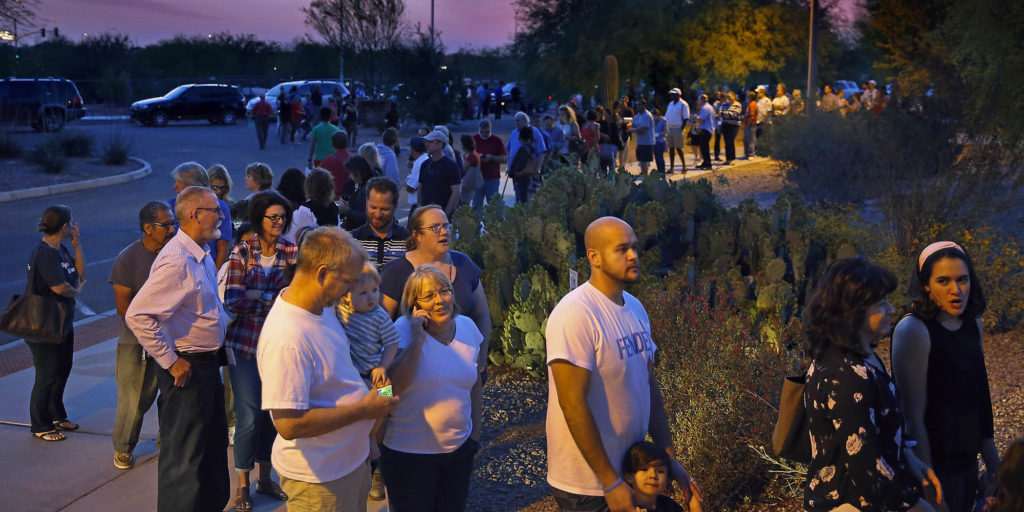
New ID requirements. Unfamiliar or distant polling places. Names missing from the voter rolls. Those are just some of the challenges that could disrupt voting across the country through Election Day. While most elections have their share of glitches, experts worry conditions are ripe this year for trouble at the nation’s polling places. This is the first presidential election year without a key enforcement provision of the federal Voting Rights Act, and 14 states have enacted new registration or voting restrictions. Adding to the uncertainty is a call by Republican presidential candidate Donald Trump for supporters to monitor the polls for voter fraud and concerns by the federal government that hackers could try to disrupt the voting process. All this has civil rights advocates on guard. “There is going to be a lot going on in this election that we are going to have to watch out for,” said Penda Hair, a civil rights lawyer who represented the North Carolina NAACP in its bid to overturn that state’s voter ID law. With no national standards for voting, rules vary widely across states and even counties. Voting experts and civil rights groups are encouraging voters to do their research before heading to the polls. That includes checking to ensure they are registered and finding their voting location, as well as understanding their rights if they face any problems. “People should not leave without casting a ballot,” said Wendy Weiser, head of the democracy program at the Brennan Center for Justice at NYU’s School of Law. “If you are an eligible voter, you should be able to have your vote counted no matter what anyone is saying.” Adding to the potential for confusion are new voter ID laws in nine states as well as reduced hours for early voting and changes to polling locations in some states. In North Carolina, at least two counties no longer offer Sunday voting. Deborah Dicks Maxwell, 60, said she is worried that — along with early voting hours largely limited to between 9 a.m. and 5 p.m. — will make it harder for people to cast ballots in her home county of New Hanover. She said Sunday voting was popular during North Carolina’s primary in March. “With the short hours we have and the high turnout that generally occurs in a presidential election year, someone is going to be in line,” said Dicks Maxwell, president of the New Hanover County branch of the NAACP. “Why penalize the citizens when you could have extended the hours and made it easier for them?” State officials have said the county didn’t offer Sunday voting in 2012 and that the current plan represents an increase in evening hours available during early voting. Long lines led to frustration during Arizona’s March primary, when some voters in the Phoenix area waited hours to cast ballots after county election officials opened 60 polling stations — fewer than half what is typical. Melissa Dunmore, a 26-year-old social worker from Phoenix, still doesn’t know if her primary ballot was counted. She waited an hour to vote, only to be told she wasn’t registered despite checking her status before heading to her polling place. She said she won’t be deterred and plans to vote early this time. “If we stop voting every time it was hard or it was denied, women wouldn’t have the right to vote, black people wouldn’t have the right to vote,” Dunmore said. Meanwhile, some 33 states have accepted an offer from the federal government to check their voter databases and reporting systems for vulnerabilities after hackers attempted to breach systems in two states over the summer. Trump’s warning that the election might be rigged along with his call for supporters to monitor polling places has alarmed some advocacy groups who say such comments threaten to undermine voter confidence in the election. “We are deeply concerned about the chilling effect this call might have on the electorate and minority voters in particular,” said Kristen Clarke, president of the Lawyers’ Committee for Civil Rights Under Law. “And we are concerned about the disruption this will cause for election workers.” Clarke and others say Trump supporters at the polls could lead to intimidation at a time when the U.S. Department of Justice has had to make substantial changes to its federal election monitoring program following the 2013 Supreme Court decision that struck down a portion of the Voting Rights Act. For the 2012 election, more than 780 federal observers and Justice Department staff were sent to 51 jurisdictions in 23 states. Now federal election observers can be sent only to those locations where there is a court order, which exists for only a small number of places in five states. With fewer federal election observers on hand, Attorney General Loretta Lynch said last week that Justice Department employees will be sent instead to at least as many states as 2012. But she did not say how many officials will go and how much access they will have. Republished with permission of the Associated Press.
Man arrested for punching anti-Donald Trump protester is an Air Force member
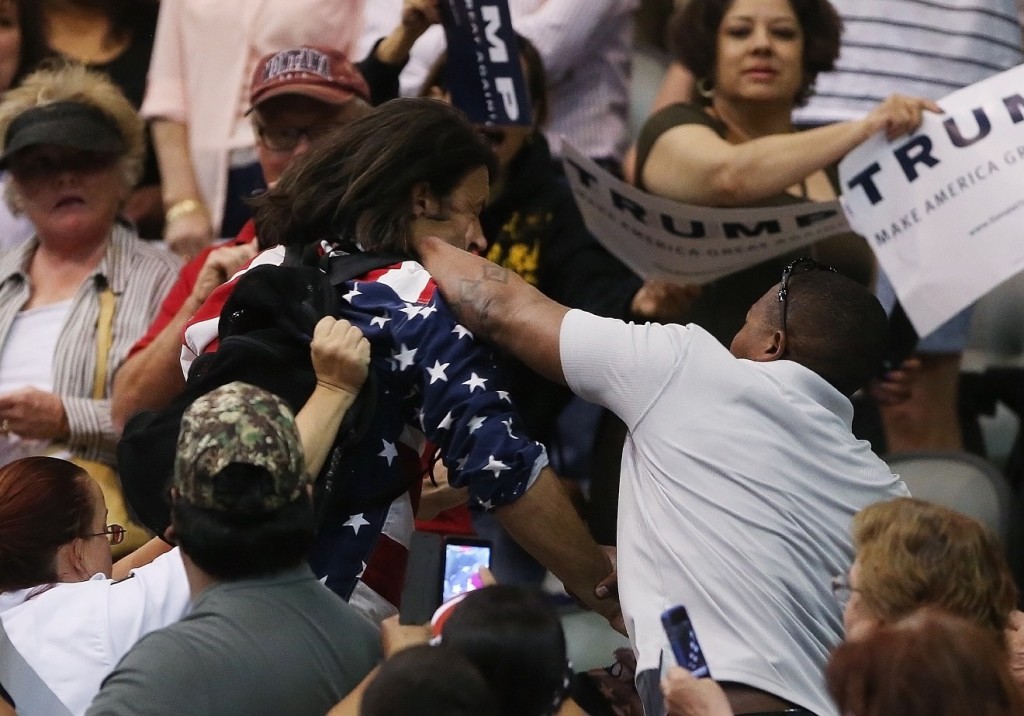
A man captured on video kicking and punching an anti-Donald Trump protester at the presidential candidate’s rally in Tucson on Saturday is a member of the Air Force. Staff Sgt. Tony Pettway, a response force leader, is assigned to the Davis-Monthan Air Force Base in Tucson and was arrested on Saturday on a misdemeanor charge of assault with injury. He works in security forces. The event in Tucson turned ugly when two protesters displayed offensive imagery in an attempt to make a statement against the divisiveness of the Trump campaign. Pettway was one of several people arrested at two Trump rallies in Arizona this weekend. The anti-Trump protester carried a sign with a Confederate flag over an image of Trump and was being escorted out of the building when Pettway punched and kicked him. The incident was caught on video. People can be heard cheering as Trump denounces another protester who was wearing a KKK-style sheet. “There’s a disgusting guy. Puts a Ku Klux Klan hat on. Thinks he’s cute. He’s a disgusting guy,” Trump said. “I’m going to tell you folks, that’s a disgrace. They are taking away our First Amendment rights.” Davis-Monthan is reviewing the situation and will take appropriate action, said 2nd Lt. Sydney Smith of the 355th Fighter Wing public affairs office. Airmen are allowed to participate in political events on their own time, Smith said. “We believe wholeheartedly in our fellow Americans’ rights to express their views on political issues, and we strongly condemn any attempt to silence those views through force or violence,” Smith said. Pettway was released without being booked into jail. It is unclear if he has an attorney. Pettway, 32, began active duty in the Air Force in August 2002 and completed his basic training at Lackland Air Force Base in Texas, Air Force Personnel Center spokesman Mike Dickerson said. He was stationed in South Korea twice and in New Mexico before moving to Davis-Monthan in December 2012. Dickerson said Pettway has received a commendation medal on three occasions but didn’t know what they were for. Tucson police also arrested 67-year-old Linda Rothman on a misdemeanor count of assault without injury. They haven’t said why she was arrested. Authorities in Phoenix, where Trump held a rally earlier in the day, also arrested several protesters. Maricopa County Sheriff’s deputies identified three protesters who were arrested while helping block the only major highway leading to a Trump rally in metropolitan Phoenix. Steffany Laughlin, Jacinta Gonzalez and Michael Cassidy were all booked on one count of obstructing a public thoroughfare, deputies said. Republished with permission of the Associated Press.
Advocacy group for disabled honors U.S. Rep. Mo Brooks as “Congressional Champion”
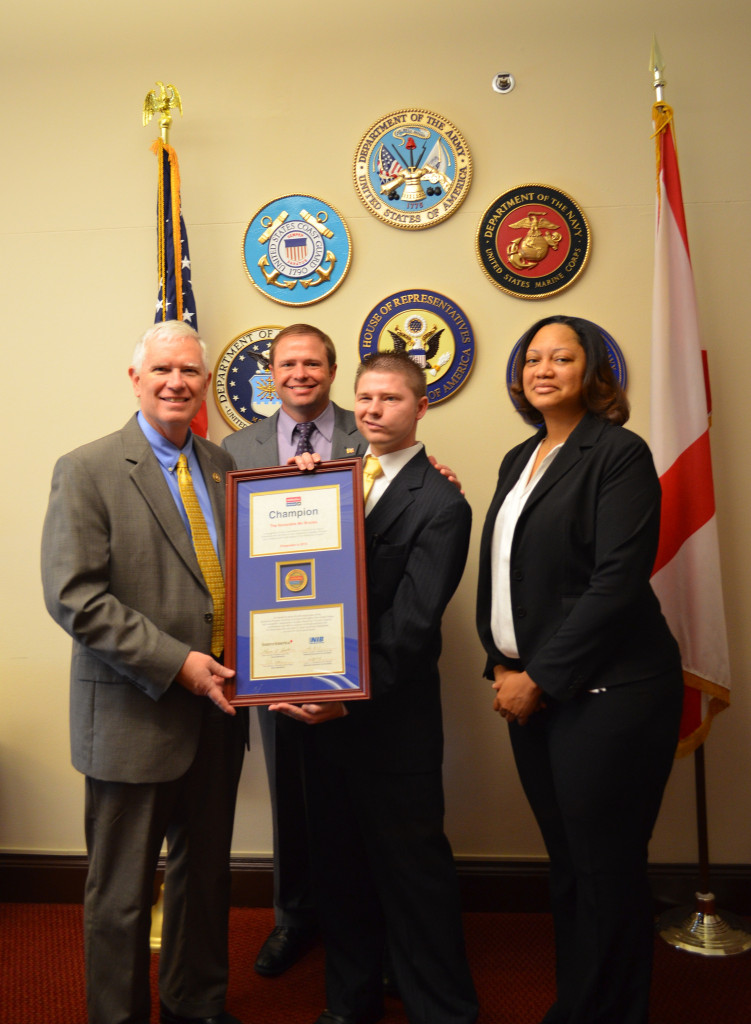
AbilityOne, a federally administered program to encourage private-sector employers to hire Americans with physical and mental disabilities, recently honored U.S. Rep. Mo Brooks with its “Congressional Champion” award. Brooks, who represents Alabama’s 5th Congressional District, said in a news release Tuesday he was humbled to receive the recognition for his work as a lawmaker, in particular with Phoenix, a Huntsville-based nonprofit company that employs more than 450 workers with disabilities in the manufacturing sector. “An important part of Phoenix’s success in providing employment opportunities is the AbilityOne program, a public-private partnership that provides meaningful benefits to our community and our country,” said Brooks on the occasion of his recognition. Of the many rewarding jobs accomplished by workers in the AbilityOne program, hundreds of American flags are produced on a daily basis in Alabama by our fellow citizens at Phoenix.” “It was a pleasure to meet with AbilityOne representatives at my office in Washington, and to hear from Phoenix employee Brian Sarkisian how the program has given him fulfillment and the freedom to live an independent life. I’m extremely proud of the work done through this program to further the job prospects for many hardworking individuals across North Alabama.” Phoenix CEO Bryan Dodson, in turn, was effusive in his praise of Brooks, a third-term Republican originally from Charleston. “Phoenix commends Congressman Brooks for recognizing the many benefits to society and people with disabilities that the AbilityOne program provides,” said Dodson. “We thank him for his continued support and commitment to helping people with disabilities increase their independence through employment.” Despite years of efforts on the part of state and private agencies like AbilityOne — who has helped place more than 40,000 disabled workers with employers — unemployment remains endemic among the disabled. According the U.S. Bureau of Labor Statistics, almost 83 percent of Americans with a mild to severe disability is out of work. Among those who do work, the disabled are about twice as likely to be employed only part-time.
