
Port of Mobile adding automotive terminal
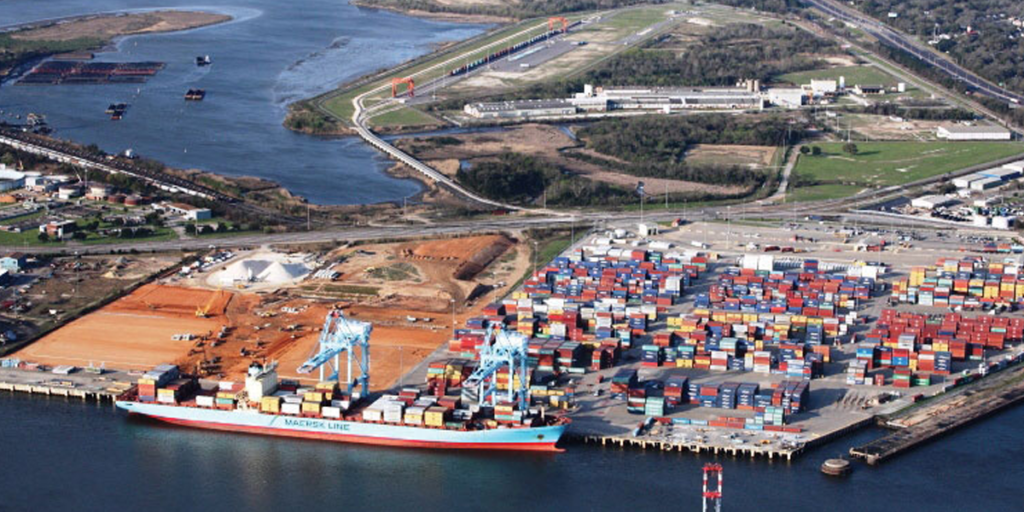
The terminal will cost $60 million.
Kay Ivey touts Rebuild Alabama Act at Montgomery Chamber meeting

Alabama Gov. Kay Ivey touted the Rebuild Alabama Act, with its gasoline tax increases to fund infrastructure, as one of her major accomplishments that will address a longtime need in the state. Ivey delivered her “State of the State” address to members of the Montgomery Area Chamber of Commerce, emphasizing the Rebuild Alabama funding passed in a special session of the Legislature last month. “Since I took office two years ago tonight, we have seen 25,000 new jobs created here in Alabama,” Ivey said. “We have seen several coveted economic development projects announced. And we have seen strides taken to improve education. More recently, we saw the strength of teamwork in the effort to pass my Rebuild Alabama Act. It absolutely took a strong team effort to get that key piece of legislation passed.” The new law raises Alabama’s gasoline tax by 10 cents per gallon over the next three years to fund improvements to roads, bridges and the Port of Mobile, along with other transportation infrastructure improvements. “To expect a prosperous future for the great state of Alabama, it was just time for us to address once and for all the lingering issue of our crumbling infrastructure,” Ivey said. After delivering her address, Ivey told reporters the state is playing catch-up with others in addressing these problems. “Alabama is way behind our sister states in doing this,” she said. “We’ve got a lot of catching up to do. I’m just proud that the people of Alabama supported this and we’re moving forward to rebuild Alabama.” The governor said when business prospects are looking to locate in a state or area, infrastructure needs are essential. Anna Buckalew, president and CEO of the Montgomery Area Chamber of Commerce, agreed and praised the governor for pushing for the gasoline tax increase. “We took a little time and celebrated the passing of the gas tax,” Buckalew said. “That took tremendous leadership on her part. She led the way. We had great support with the Legislature and other leaders, but it took the governor to get that done. We’re so grateful. The gas tax gives us infrastructure that was critically needed. You can’t do economic development without good infrastructure.” Ivey said “the state’s economy is booming” and economic development will continue to be a key issue. She also acknowledged the need to address other problems. “So, as we move forward we will face our challenges, like improving infrastructure, like addressing the understaffing in our prisons, like improving the education system,” she said. “And we will continue to build on our strengths. And when we do all of this, working together, we will have a future that is filled with growth and opportunity. Remember that Alabama’s best days are still ahead of us.” Buckalew said that’s music to the ears of organizations like the Montgomery chamber. “The governor is a strong advocate of economic development,” she said. “We heard that this morning. The chamber is all about job creation and she was singing our song this morning. She talked about the thousands of jobs that have been created in the state. She is a pro-business governor.” Ivey said workforce development and its ties to education at every level will be a priority. “Looking forward, we’ve got to start preparing our people for jobs of the future,” Ivey said. “So, we’re trying to build that pipeline starting with pre-K and all the way through the workforce, two-year colleges and beyond. It’s important to keep the pipeline current and relative to the needs of industry.” Buckalew said a quality workforce tops the list of needs for companies looking to locate or expand in the state. “The governor has a tremendous agenda on workforce development (starting with) pre-K,” Buckalew said. “She understands the realities of what we need to have a trained workforce in this state. A trained workforce means that those people have opportunities, that our kids can have opportunities and jobs.”, with its gasoline tax increases to fund infrastructure, as one of her major accomplishments that will address a longtime need in the state. Republished with permission of Alabama News Center. For video of speech and additional photos please check out their site.
Alabama delegation throws support behind Port of Mobile improvements
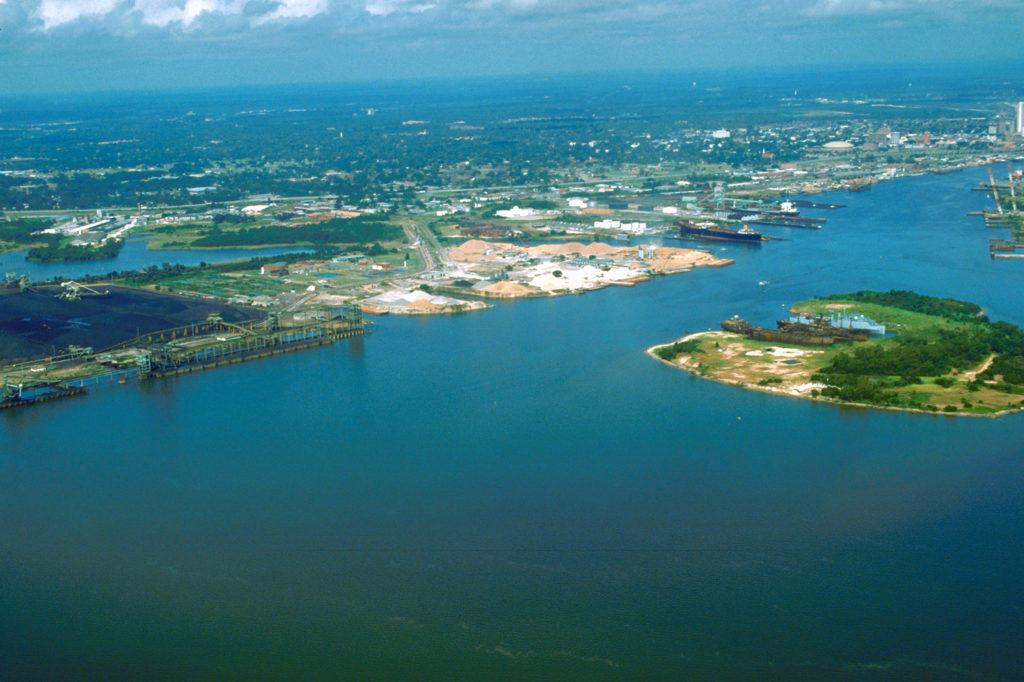
The Port of Mobile is Alabama’s only deep-water port. It moves around 54 million tons of cargo per year — a volume that consistently ranks the port within the top dozen or so ports in the nation. On Monday, the Alabama congressional delegation, as part of a bipartisan and bicameral effort, endorsed the modernization of the port’s navigation channel. U.S. Senator Richard Shelby led the delegation letter. In addition to Shelby, the letter was signed by the entirety of the Alabama delegation: U.S. Senator Doug Jones (D-Ala.), as well as U.S. Reps. Robert Aderholt, Mike Rogers, Mo Brooks, Martha Roby, Terri Sewell, Bradley Byrne and Gary Palmer. The Alabama lawmakers submitted comments to the Mobile District of the U.S. Army Corps of Engineers (Corps) in support of the Tentatively Selected Plan (TSP) identified in the Draft Mobile Harbor, Mobile, Ala. Integrated General Reevaluation Report (GRR) with Supplemental Environmental Impact Statement (SEIS). Due to increased vessel size and channel transit inefficiencies issues, the federal Mobile Harbor Channel is currently undergoing a GRR by the Corps to deepen and widen its navigation channel. The TSP identified in the Draft GRR/SEIS recommends deepening the existing channels by 5 feet, incorporating bend easings in the Bar Channel, widening the Bay Channel from 400 feet to 500 feet for 3 nautical miles, and expanding the Choctaw Pass Turning Basin to better accommodate the safe turning of large vessels. The GRR is currently on schedule to conclude in November 2019. The letter reads in part, “Modernizing the capabilities of one of the nation’s largest seaports will spur exponential economic investment by allowing larger ships and more goods to be shipped and sold, facilitating and expanding commerce. We believe that the TSP accomplishes these goals in a manner that is economically and environmentally responsible, and encourage the Corps to move forward to attain the Agency Decision Milestone and to expeditiously deepen and widen the federal channel.” “The deepening and widening of the Port of Mobile will provide economic development opportunities throughout the entire state of Alabama,” said Shelby. “This project will create an avenue for exponential growth by facilitating and expanding commerce in the state. I look forward to continuing our work with the Corps as we strive to improve the safety and efficiency of the Port in an increasingly global marketplace.” “Alabama is a trade state and the modernization of the Port of Mobile is key to our economic future,” said Jones. “I’m proud to join Senator Shelby and my colleagues in fighting for Alabama farmers and businesses and supporting their efforts to secure new opportunities brought by a wider, deeper port. This is an important step forward in our efforts to maximize the competitive advantage of Alabama’s farmers, shippers, and manufacturers.” “While the Port of Mobile might seem like a long way from the 4th Congressional District in North Alabama, it is vitally important to the area I serve. Two large rivers in the 4th District, the Coosa and the Black Warrior, both flow into Mobile Bay, making the bay and these two rivers critically important for the economy of my district and our entire state,” said Aderholt. “I support the Port of Mobile and was pleased to sign on to Senator Shelby’s letter to the Army Corps. In my congressional district, both the agriculture and automobile industries will greatly benefit from the modernization,” said Rogers. “I appreciate Senator Shelby’s leadership on this important issue, and am always pleased to work with the Alabama delegation,” said Brooks. “As the 10th largest seaport in the United States, the Port of Mobile is a huge economic driver for our state, and I fully support efforts to modernize and improve the capabilities of this vital port.” “The Port of Mobile is vitally important to economic growth throughout the State of Alabama and the surrounding region,” said Roby. “I am pleased to support this effort to make more resources available as we work to expand the capabilities of this seaport. I am proud to work alongside Senator Shelby and the rest of Alabama’s congressional delegation to invest in and support our growing economy and its future needs.” “Investments in Alabama’s trade infrastructure give our state a competitive advantage in today’s global marketplace,” added Sewell. “I am proud to work with my colleagues on both sides of the aisle to invest in infrastructure projects that bring better jobs and better wages to our state. The Port of Mobile is an economic engine in Alabama, and the plan drafted by the Army Corps of Engineers would modernize its facilities, expand commerce, and secure our port’s future.” “The Port of Mobile is critical to Southwest Alabama, but it plays just as important a role throughout the rest of our state. The deepening and widening project will greatly expand the capabilities at the Port and the overall economic potential – meaning a win for all of us. I appreciate the work Senator Shelby and our Alabama delegation has put in to move the project forward, and I will continue working with stakeholders at all levels to ensure the project remains on track,” said Byrne. “I have long supported the expansion of the Port of Mobile and think transportation will be greatly improved as a result of it,” said Palmer. The full text of the letter is as follows: Dear Colonel Joly, We write to offer our comments in support of the Tentatively Selected Plan (TSP) identified in the Draft Mobile Harbor, Mobile, Alabama Integrated General Reevaluation Report with Supplemental Environmental Impact Statement. The Port of Mobile (Port), operated by the Alabama State Port Authority (Authority), is currently the 10th largest seaport in the United States and has been identified as the fastest growth container terminal in North America. In any given year, between 52-67 million tons of cargo moves through the Port. The Authority’s container, general cargo and bulk facilities have immediate access to two interstate systems, five Class 1 railroads, and 15,000 miles of inland waterway connections. To keep up with demand,
$315 million to fund projects in Mobile and Baldwin counties
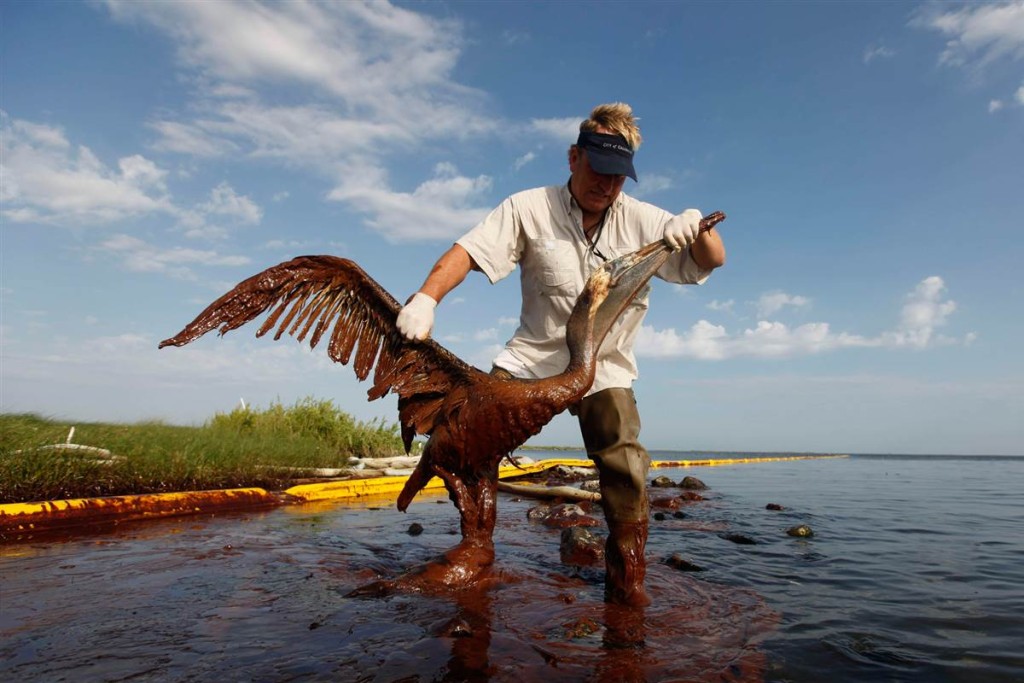
A $315 million from the RESTORE Act and the Alabama Gulf Coast Recovery Council will help fund projects in southwestern areas of the state. Fifty projects will be given funding for infrastructure, environmental restoration and economic development, AL.com reported. The biggest include $56 million for five major road expansion projects in Baldwin County, $28 million for a new facility at the Port of Mobile, $27 million for projects affecting Dauphin Island’s Aloe Bay and $21 million to redevelop the docks in Bayou La Batre. Funds will also help improve water-sewer systems and eliminate sewage overflows. The money comes from penalties paid by companies involved in the 2010 Deepwater Horizon oil disaster in the Gulf of Mexico. The RESTORE Act established a trust fund to hold much of that money aside for “programs, projects, and activities that restore and protect the environment and economy of the Gulf Coast region.” Eliska Morgan, the council’s executive director, said more than 400 projects were submitted by various organizations and government entities. Some that didn’t make the cut will be considered in the future. “There are some really great ones,” Morgan said. “We’ve been working toward this end for some time.” Mobile County had more requests, totaling nearly twice the money as Baldwin County requests. Republished with the permission of the Associated Press.
Wal-Mart to invest $135M in Alabama import distribution center
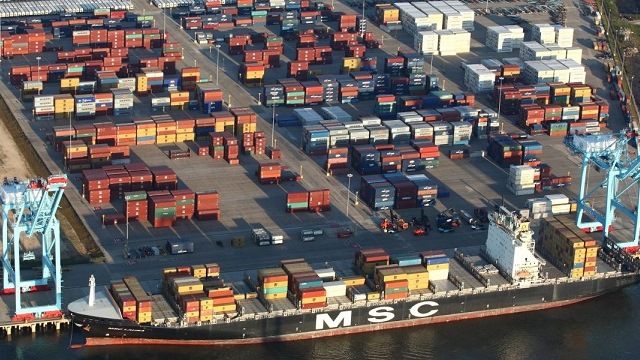
Retail giant Wal-Mart Stores Inc. plans to invest at least $135 million to open a massive import distribution facility in Mobile County, creating 550 jobs and providing a major boost to the Port of Mobile. Wal-Mart’s new 2.5 million-square-foot facility will service about 800 stores with products primarily shipped through the Alabama port’s container terminal. The company’s plans were announced today at a groundbreaking ceremony at APM Terminals. “As you know, there’s been a tremendous competition for the distribution center that Wal-Mart is going to build here in Mobile,” Glen Wilkins, public affairs director for the retailer, said at the ceremony. He added, “I think we did a great job choosing Mobile. I think that was a fantastic idea.” ‘Powerful catalyst’ The Alabama facility will be Walmart’s sixth import distribution center in the nation as the retailer expands its logistics network. The Port of Mobile is one of the nation’s busiest deep-water ports. (Contributed) “Wal-Mart’s decision to locate an import distribution center in Mobile County is a clear signal that Alabama is serious about creating jobs for its citizens and expanding the potential of the Port of Mobile,” Gov. Robert Bentley said. “Wal-Mart is making a substantial investment in Alabama, and we look forward to expanding our valuable partnership with the company through this project,” he added. The Wal-Mart distribution center will become an important player in the Port of Mobile’s container business. The facility is expected to generate cargo volume of approximately 50,000 TEUs, or twenty-foot equivalents, a standard unit of measure in container transportation. “Wal-Mart’s distribution and logistics center in Mobile County will enhance Alabama’s connection to the global economy and provide a major boost in cargo volume to the Port of Mobile,” said Greg Canfield, secretary of the Alabama Department of Commerce, who spoke at today’s ceremony. “The Wal-Mart hub will act as a powerful catalyst for job creation and significantly increase the operations of the world’s largest retailer in the state.” Port credit Canfield added that the Wal-Mart distribution center project is the first to qualify for a “port credit” incentive adopted in 2016 by the Legislature as part of the Alabama Renewal Act. Denson White of APM Terminals checks on the unloading and loading of containers. APM will be the site of a $135 million Wal-Mart import distribution center, officials announced today. (Mike Kittrell/Alabama NewsCenter) The port credit is meant to stimulate cargo traffic and job growth at facilities such as the Port of Mobile. The 4,000-acre seaport is one of the nation’s busiest deep-water ports, handling more than 50 million tons of cargo annually. Wal-Mart qualified for a port credit totaling $3 million. Bentonville, Arkansas-based Wal-Mart already has more than 38,000 workers in Alabama. The 550 full-time jobs being created at the import distribution center in Mobile will have an average annual wage of $35,000, plus benefits. Some salaried workers will earn more than $50,000, Wal-Mart said. The Alabama State Port Authority and APM Terminals joined the state and local economic development team that worked on “Project Beverly,” as it was code-named during the recruitment. “We are excited about how this facility will help us serve customers from Alabama to the Great Lakes and the economic impact it will have through local job creation and future economic development in the Mobile area,” said Jeff Breazeale, Wal-Mart’s vice president of Direct Import Logistics. “We are grateful to the State of Alabama, Mobile County, the City of Mobile and the Alabama State Port Authority for the support we have received throughout this process, and we look forward to a strong relationship with the community for years to come.” This story originally appeared on the Alabama Department of Commerce’s Made in Alabama website. Republished with permission of Alabama NewsCenter.
Florida ports drop trade with Cuba, Port of Mobile to pick up slack
Alabama officials were in Tampa Thursday to ink a trade agreement with Cuba, one that Florida ports cannot. Seaports in Mobile and Havana are agreeing to do business in the future in a deal similar to one that had been between three ports in Florida. That is until last week, when Gov. Rick Scott threatened to pull funding to ports shipping to Cuba. John Kavulich, president of the New York-based U.S.-Cuba Trade and Economic Council, told the Tampa Bay Times: “This feels like Cuba’s way of saying if Florida doesn’t want our business, Alabama does … And they are coming onto your turf to do it.” Representatives for Alabama and Cuba were attending “Planning for Shifting Trade,” an international conference sponsored by the American Association of Port Authorities, held at the Tampa Marriott Waterside Hotel & Marina. So far, the U.S. allows only a limited number of exports to Cuba, which is still under a trade embargo imposed half a century ago after Cuban leader Fidel Castro established communism on the island nation. A 2000 law allows some exceptions, such as agricultural goods and food. Castro died in November 2016. Mobile has the fifth highest number of exports to Cuba among U.S. ports, Kavulich told the Times. Currently, Tampa ports send no shipments to Cuba.
Robert Bentley signs Alabama Renewal Act into law
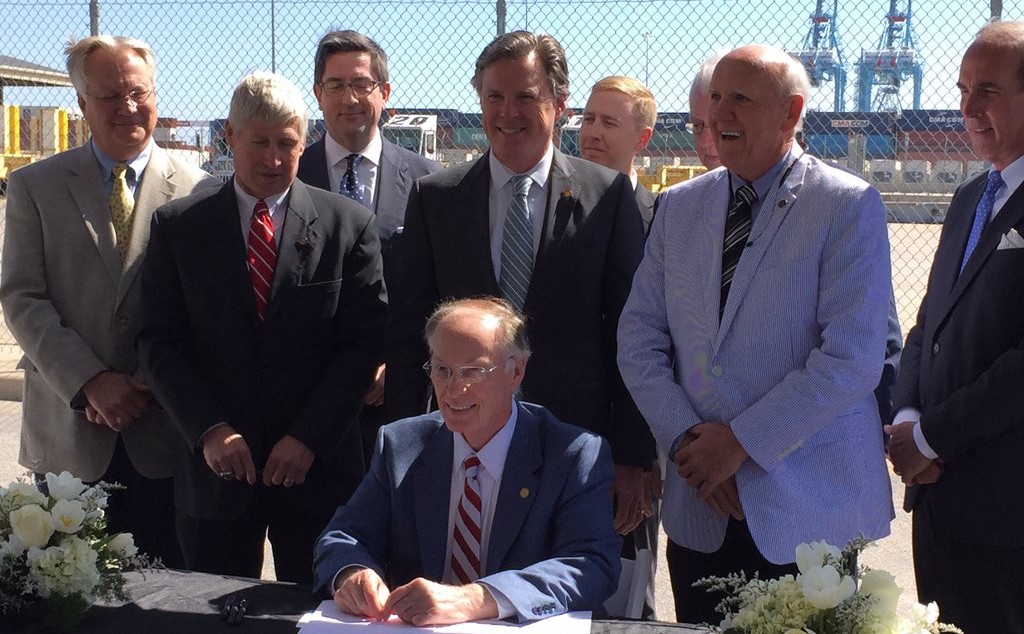
Joined by other state and local leaders at the Port of Mobile, Gov. Robert Bentley on Friday signed the Alabama Renewal Act into law. As part of the state’s continued commitment to job creation the legislation creates two new tools for increasing economic development: it will “increase the availability of shovel-ready land sites for job creation” and “stimulate cargo traffic at the state’s port facilities and connect Alabama businesses to new opportunities around the world via a new Port Credit.” Because most states already offer such incentives, the new legislation will make Alabama more competitive by providing more options for luring in large companies and new jobs. “The Port of Mobile is a critical and valuable asset for industrial transportation of goods on the global market,” Bentley said at the event. “The signing of the Alabama Renewal Act is another clear signal that Alabama is serious about economic development and remains competitive nationwide. We have made great strides in how we recruit and retain companies in our state, and I am pleased to sign the Alabama Renewal Act to continue our efforts of job creation and promotion of our ’Made In Alabama’ brand.” The legislation was sponsored by state Rep. Mac McCutcheon (R-Huntsville) and state Sen. Greg Reed (R-Jasper), who both joined Bentley at Friday’s event. “I would like to thank Governor Bentley and the members of the Legislature for supporting this bill,” McCutcheon said. “This measure will not only stimulate economic growth in our state but also promote the use of our state docks, which are second to none in the world.” “Our economy is improving, and I am committed to doing everything possible to create more jobs, especially in rural Alabama,” said Reed. “The Alabama Renewal Act will help us achieve that goal while being fiscally responsible to taxpayers.”
Terminal management company expanding in Mobile
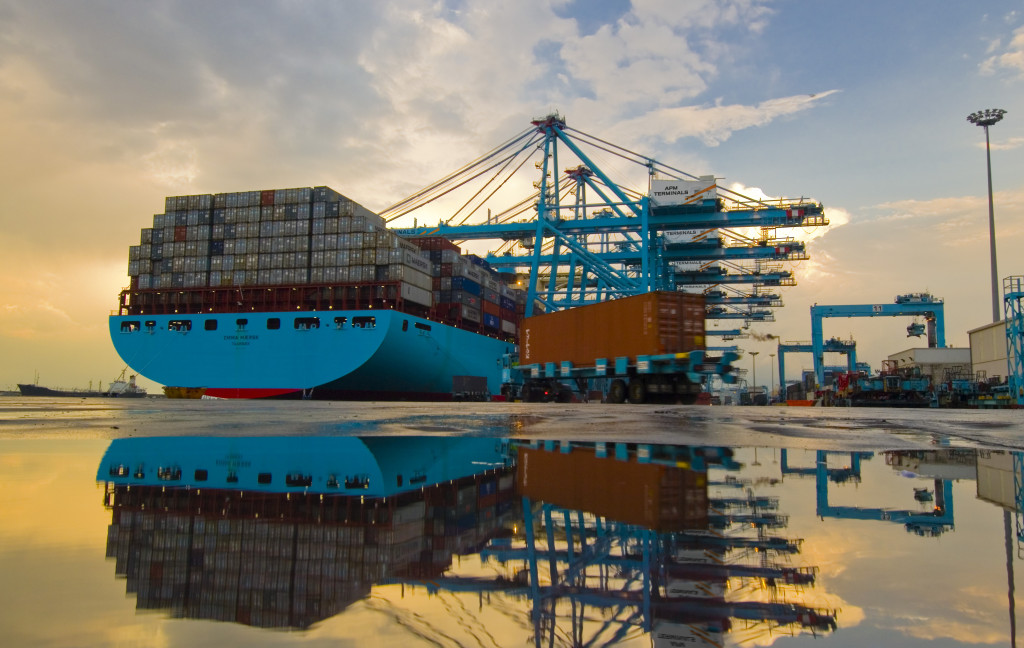
State port authority officials say a terminal management company is planning to expand operations at the Port of Mobile. Officials said in a statement Tuesday that APM Terminals is planning to add two new cranes and expand the container facility at Choctaw Point. Port officials say the company is investing $40 million in the 20-acre expansion. Officials say the state has invested $50 million to build an intermodal transfer facility that offers access to five railroads. The intermodal transfer facility is expected to be finished in the first quarter of 2016. Republished with permission of The Associated Press.
Bradley Byrne: What is Trade Promotion Authority and why does it matter?
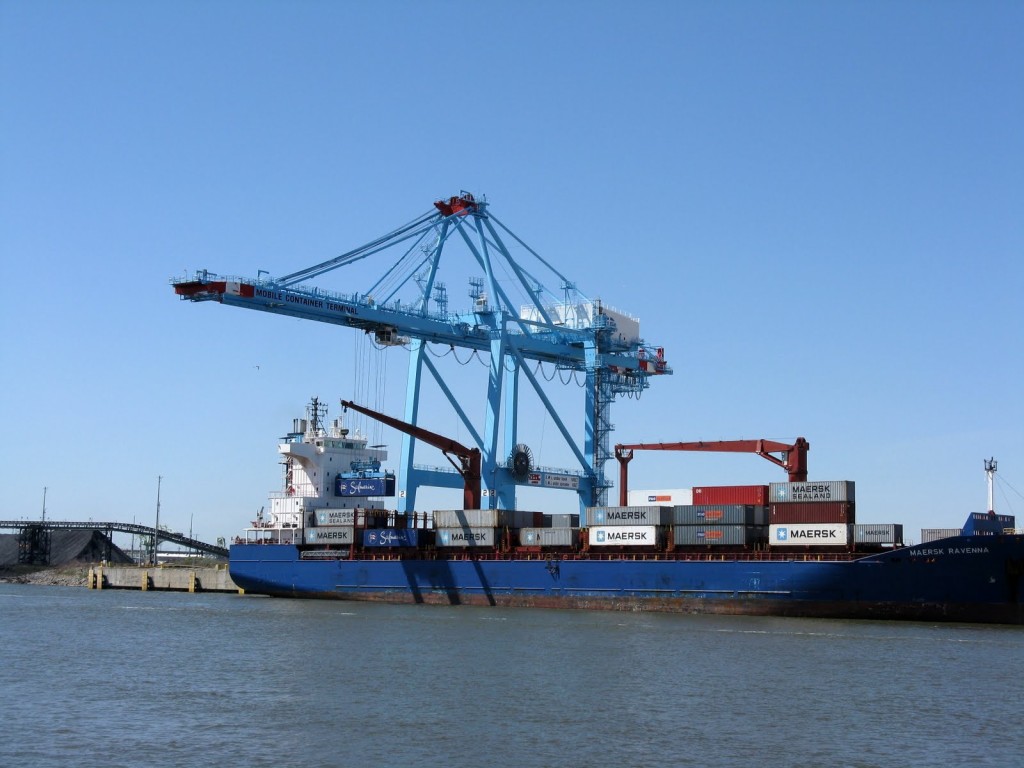
The world’s economy is now more interconnected than ever before, with 96% of customers located outside of the United States. If we are going to stay competitive on the world stage and grow our economy, then we must look for new ways to engage in trade. That’s why the United States is currently in negotiations with a number of Pacific Rim and South American countries located on the Pacific regarding a new free trade agreement. Similar talks are ongoing with our allies in Europe. To simplify the process, Congress is using a tool called Trade Promotion Authority, or TPA. This process has been used for decades. TPA is not a trade deal itself, but instead, a way for Congress to set the negotiating guidelines which the President must adhere to in any final agreement. To date, no trade deal has been completed without a TPA procedure in place. I have heard from constituents and groups right here in Alabama and all across the country who believe Congress should pass TPA. Groups like the Mobile Area Chamber of Commerce, the South Baldwin Chamber of Commerce, the Alabama State Port Authority, the Alabama Farmers Federation, the steel industry, and Manufacture Alabama have all asked me to support TPA. Liberal labor unions claim that free trade doesn’t benefit American workers, but that is simply not true. Over 558,384 jobs in Alabama alone are directly supported by trade. Nationwide more than one in five jobs – over 38 million – are related to trade. Specific to Southwest Alabama, the Port of Mobile is among the top United States ports serving manufacturing, mining, and agribusiness exports. I’ve also heard from our nation’s military and foreign policy leaders who believe passing TPA is important for our national security. If the United States doesn’t engage in trade with our allies in the Pacific and Europe, nations like China and Russia will fill the void and expand their influence in the region. We simply cannot allow that to happen. That’s why 17 former Secretaries of Defense and senior military officials, as well as former Secretary of State Condoleezza Rice, have called on Congress to move forward with new free trade agreements, which are a key foreign policy tool. Most importantly, many conservative organizations and leaders like Ted Cruz, Paul Ryan, and Macro Rubio, have urged passage of TPA in order to restrict President Barack Obama’s authority and hold the President accountable. In fact, Senator Cruz wrote that “trade promotion authority will hold the administration accountable both to Congress and to the American people.” Every President already has the Constitutional authority to negotiate trade deals with foreign nations, but TPA would allow Congress to set guidelines, restrictions, and requirements for the negotiations. TPA puts Congress, not President Obama, in the driver’s seat when it comes to trade agreements. TPA also makes some significant transparency requirements that will force the President to keep the American people informed about the negotiations. Under TPA, any potential trade agreement will have to be made publicly available for 60 days before Congress can vote on it. Most importantly, TPA ensures that Congress has the final say in approving any trade agreements. If a deal doesn’t meet the high standard that is required, then Congress would simply reject it. I came to Washington to focus on solutions that grow the economy, advance a strong national defense, and fight back against an out of control executive. Passing TPA fulfills each of those goals, and that’s why it earned my support. If you still have questions about TPA or any other issue related to trade, I invite you to visit my website at Byrne.House.Gov where I have posted some more information about this important legislation. Bradley Byrne is a member of the U.S. Congress representing Alabama’s 1st Congressional District.
Bradley Byrne: Recapping my trip to Cuba
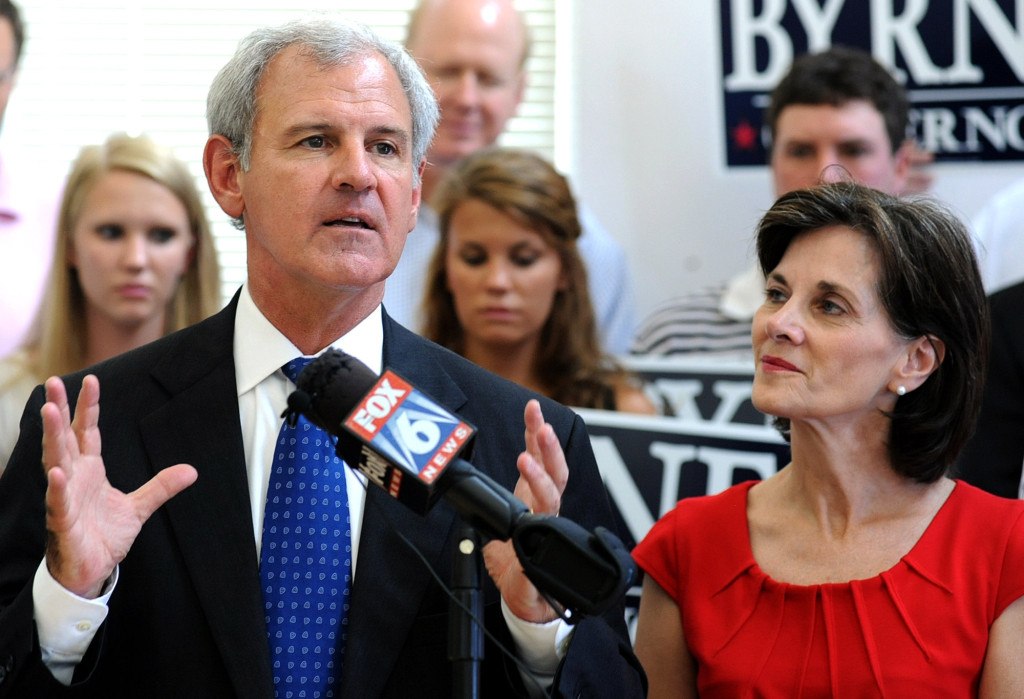
I recently traveled to Cuba as part of a Congressional Delegation to learn more about the Cuban government, visit with the Cuban people, and discuss everything from the economy to education to trade. This visit came at a particularly interesting time as the United States remains in negotiations with Cuba about restoring diplomatic and economic relations. You may remember that late last year President Barack Obama announced that he had decided unilaterally to normalize relations with Cuba for the first time in over 50 years. I was immediately concerned by this announcement because the President had once again decided to act alone without any consultation with Congress. This pattern of executive overreach has been far too common from the Obama administration. I also had serious concerns about normalizing relations with Cuba while the Castro regime was still in power. Despite these reservations, I do want to see the United States and Cuba reach the point where diplomatic relations can be fully restored and the Congressionally imposed trade embargo can be lifted. I also realize that the city of Mobile and all of Southwest Alabama is uniquely suited to potentially benefit from improved relations with Cuba. That’s why I accepted an opportunity to travel to Cuba and see the progress for myself. I was joined on the trip by four other Members of Congress, two of whom represent southern port cities like I do. Upon arrival, we immediately met with the Cuban Foreign Minister and his staff. We had a very serious conversation about the ongoing negotiations, and I expressed my concerns about the need for mutual assurances on security matters and human rights. I also made clear that it isn’t the responsibility or intention of the United States to change the way Cuba runs their country. That is a decision that the Cubans must reach on their own. The next day we traveled out to the Port of Mariel, which is west of Havana. The port is well positioned and has a lot of room for expansion. It is only two years old and still under construction. It has a capacity for 800,000 containers, but they are only handling around 260,000 containers at present. I talked with the Port officials about ways the United States can slowly open up trade opportunities instead of lifting the trade embargo all at once. We talked extensively about transshipments, which would allow goods from the larger Post-Panamax ships soon to be passing through the Panama Canal to be moved onto smaller ships that could then dock at ports along the Gulf Coast, like the Port of Mobile. That is, at least until our port is dredged to the appropriate depth to support these new vessels. During the trip we also had the opportunity to visit with officials from the Catholic Church, small business owners, scholars, medical students, and many ordinary Cubans. Each group faces some pretty significant challenges, but they all expressed optimism. At each stop, it became clear that Cuba is a beautiful country full of remarkable people. I believe there is legitimate potential for strong ties between our two countries. Unfortunately, they have a long way to go to achieve their legitimate desire to participate in the world economy. Cuba must continue to make improvements in their infrastructure, as well as progress in the treatment of its citizens. Cuba must also build trust with the United States by no longer allowing known U.S. adversaries like Russia to operate militarily in Cuban airspace and waters. I know that one day the trade embargo will be repealed, the Cuban people will engage in economic activities with the United States, and Americans will be able to freely travel to Cuba. While that day is not yet here, I look forward to continuing to be a positive, proactive participant in the negotiations. Bradley Byrne is a member of the U.S. Congress representing Alabama’s 1st Congressional District.
