
Pete Buttigieg enters race for 2020 Democrat presidential nomination
Democrat Pete Buttigieg, the 37-year-old mayor of South Bend, Indiana, says he’s forming an exploratory committee for a 2020 presidential bid. “The reality is there’s no going back, and there’s no such thing as ‘again’ in the real world. We can’t look for greatness in the past,” Buttigieg says in a video that includes before-and-after footage of South Bend, a Rust Belt city once described as “dying.” “Right now our country needs a fresh start,” he says. Buttigieg has touted his work to improve his city of 100,000 residents as he’s prepared for a jump from local politics to a presidential campaign. He’s also said Democrats could benefit from a new generation of leaders as they try to unseat President Donald Trump in 2020. He’s expected to travel to Iowa next week to meet with voters in the nation’s first caucus state, followed by stops in New Hampshire. Buttigieg is a Rhodes scholar who was first elected mayor of his hometown in 2011 at age 29, making him the youngest mayor of a U.S. city with at least 100,000 residents. A lieutenant in the Navy Reserve, he served a tour in Afghanistan in 2014. Buttigieg raised his national profile with an unsuccessful 2017 run for Democratic National Committee chairman, saying the party needed a new start. He withdrew from the race before a vote when it became clear he didn’t have the support to win. Buttigieg has spent time in Iowa and other battleground states in recent years as he tried to build financial support and name recognition. He cracks that those who do know his name still aren’t sure how to pronounce it. (It’s BOO’-tah-juhj.) Most of the time he goes by “Mayor Pete.” Amid his campaign for a second term, Buttigieg came out as gay in a column in the local newspaper. He went on to win re-election with 80 percent of the vote. In 2018, three years to the day after the column ran, he married his husband, middle school teacher Chasten Glezman. If he were to win the Democratic nomination, Buttigieg would be the first openly gay presidential nominee from a major political party. Buttigieg announced in December that he wouldn’t seek a third term as mayor, stoking speculation he would join a field of roughly two dozen candidates who may seek the Democratic nomination for president — most of them better known and with experience in higher office, and all of them older. “I belong to a generation that is stepping forward right now,” he says in the video released Wednesday. “We’re the generation that lived through school shootings, that served in the wars after 9/11, and we’re the generation that stands to be the first to make less than our parents unless we do something different. We can’t just polish off a system so broken. It is a season for boldness and a focus on the future.” Buttigieg is releasing in February a book about his life and his tenure leading South Bend. Republished with permission from the Associated Press.
Primary takeaways: Establishment loses, diversity grows
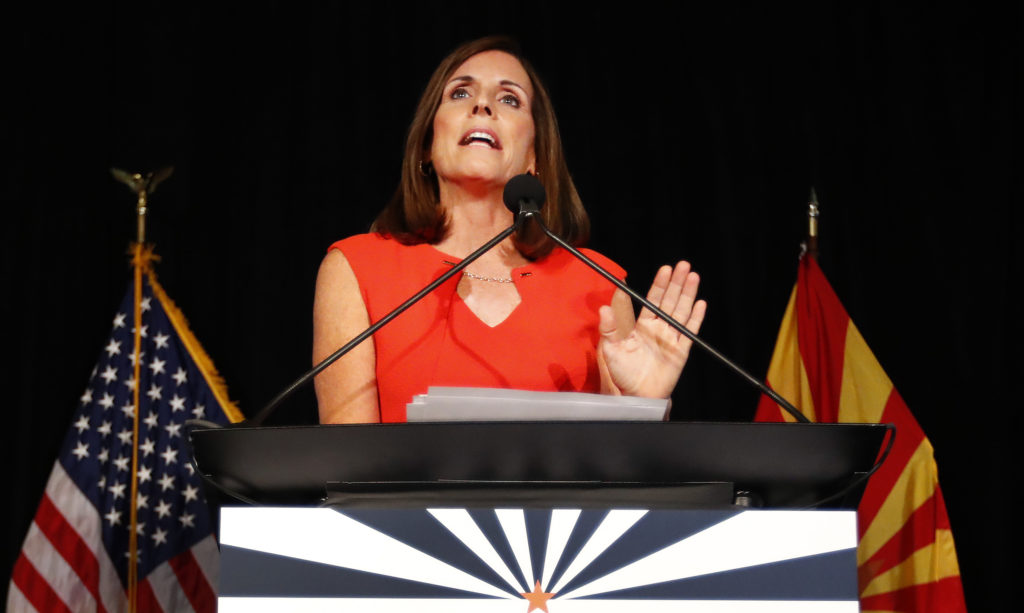
President Donald Trump got his man in battleground Florida, but he watched a prominent immigration ally fall in Arizona in what was another eventful night in the 2018 midterm season. Arizona and Florida held primaries Tuesday, both of which tested Trump’s influence. There were also new signs of diversity on the Democratic side. Takeaways from one of the final rounds of voting ahead of midterm elections: FLORIDA ESTABLISHMENT FAIL The political establishment in both parties had a bad night in Florida’s high-profile race for governor. On the Republican side, Trump got his man, Republican congressman Ron DeSantis, who beat out the establishment favorite, state Agriculture Commissioner Adam Putnam. Despite Trump’s support, DeSantis was not the strongest general election candidate in the race, operatives in both parties suggest. The three-term Republican congressman who makes frequent Fox News appearances is known as an immigration hard-liner in a state where Hispanic voters hold outsized sway. And lest there be any question about his allegiance to Trump’s divisive immigration policies, DeSantis encourages his toddler to “build the wall” with blocks in one campaign ad. That’s a message that may play well among a general electorate in West Virginia, where Trump won by more than 40 percentage points in 2016, but Trump carried Florida by only a single percentage point. On the Democratic side, liberal champion Andrew Gillum, the mayor of Tallahassee, bested a crowded field that included establishment favorite Gwen Graham, the former congresswoman and daughter of Florida political icon Bob Graham. Graham, who was considered a centrist, was viewed as a more attractive general election candidate in the purple state. Gillum is more liberal, having earned the backing of Vermont Sen. Bernie Sanders and billionaire Tom Steyer. To win the governor’s office for the first time since 1999, Democrats will have to come together quickly. The results on both sides underscore the outsized influence of each party’s most passionate voters in lower-turnout off-year elections. McSALLY’S CHALLENGE Martha McSally won the GOP nomination for Arizona Senate, but the results show how divided the party is and the challenge that lies ahead. A significant number of Republicans backed former Maricopa County Sheriff Joe Arpaio and fellow immigration hard-liner Kelli Ward. Now McSally has to bring together the party — including some of Trump’s most devoted supporters — going into the fall against Democrat Krysten Sinema, who is widely considered well-positioned. The race gives Democrats one of their best pickup opportunities in the nation. Meanwhile, it would be wrong to assume that McSally’s win is a repudiation of the tough rhetoric of her challengers, who essentially split the conservative vote. The 86-year-old man known nationwide as Sheriff Joe, who personifies the tough immigration policies that define the modern-day Republican Party, may never serve in public office again after his loss Tuesday. (For those who forget, Arpaio was convicted of criminal contempt last year for ignoring a judge’s order to stop detaining immigrants in the country illegally. Trump later pardoned him.) MISSING: BLUE WAVE IN FLORIDA If a Democratic wave is coming to Florida, it may have to be supplied by independents. With just a handful of precincts left to count, Republicans cast more than 1.6 million Florida ballots, while registered Democrats were on track to fall just below 1.5 million. Beyond the raw vote totals, the GOP count also was a larger share of its last presidential election turnout. That measure is a useful way to assess which party is more excited about a midterm election, and it’s particularly useful in Florida because the state limits primaries only to voters registered by party. The GOP total came to almost 35 percent of what Trump won in Florida in 2016. The Democrats’ total was about 33 percent of Hillary Clinton‘s 2016 turnout. Of course, it doesn’t mean Republicans are guaranteed big wins in Florida this fall. But it does show the GOP base in Florida is anything but depressed, turning out in solid numbers to nominate DeSantis after he was endorsed by Trump. The scenario cuts against the grain of a midterm election cycle that’s been defined by energy on the left in other states, and it puts an added burden on Florida Democratic candidates to attract voters who didn’t participate in Tuesday’s primaries. FLORIDA MONEY PIT There was less drama on the Senate side in battleground Florida, but the stage is now set for what will likely be the nation’s most expensive midterm contest. Florida Gov. Rick Scott easily captured the Republican nomination in the GOP’s bid to unseat Democratic incumbent Sen. Bill Nelson. At 75 and seeking his fourth term, Nelson is considered particularly vulnerable as voters continue to show disdain for candidates with deep ties to the establishment. Scott, an independently wealthy businessman, has already spent more than $27 million on the race compared to Nelson’s $6 million. The conservative Koch network has identified the Senate seat as a top target, and outside groups on both sides are expected to dump millions more in the contest. The extraordinary price tag of running a statewide campaign in Florida, which features 10 media markets, will test each side’s resolve and resources — particularly on the Democratic side. Republicans know Scott can and will dump millions more of his own personal wealth into his campaign. Democrats aren’t so lucky. National Democrats are already weighing how best to invest their limited dollars considering their challenges in other states where their incumbents are on the defensive. Yet if Democrats lose Nelson’s seat in Florida, their already narrow path to the Senate majority becomes virtually nonexistent. DIVERSITY WAVE GROWS In his upset victory, Gillum joins two other African-American gubernatorial nominees on the November ballot, Georgia Democrat Stacey Abrams and Maryland Democrat Ben Jealous, in what may be the party’s most diverse midterm class in history. No state is currently represented by a black governor. The nominations, of course, do not mean the candidates will continue to re-write history. Republicans have cast Gillum, like the other black nominees, as part
Mike Ball proposes legislation to scrap partisan primaries
One Alabama lawmaker wants to scrap partisan primaries in favor of open elections that would send the two top vote-getters, regardless of party affiliation, on to the general election. Madison-Republican State Rep. Mike Ball introduced HB214 on Tuesday, which would replace the state’s current primary system, which advances the top vote-getting Republican and top vote-getting Democrat, when both parties offer a candidate, to the general election. Under Ball’s bill, all Alabamians would receive the same ballot and be able to vote for any candidate, regardless of party affiliation. The two highest vote-getters, regardless of party, would advance to the general election, thus eliminating the need for run-off elections. Consequently, it would be possible for two candidates belonging to the same political party to win in the proposed system and face off in the general election. Ball’s idea isn’t unheard of. Called a “top two,” “nonpartisan blanket” or “jungle” primary system, states like Washington, California and Louisiana all use similar electoral systems. The plan is also used in Texas and some other states in special elections but not primaries. HB214 would be used in all elections, except that of the Presidential election. According to the text of the bill: This bill would create a primary election system for all offices other than the office of President where all qualified candidates, including party candidates and independent candidates, would have their names on the primary election ballot and all qualified electors would vote the same ballot. This bill would provide that the two candidates that receive the highest number of votes in a primary election, regardless of their party affiliation or lack thereof, would be placed on the ballot in the general election. If passed, Ball’s bill would go into effect after the state elections in 2019.
Polls open for Alabama’s U.S. Senate special primary election
Polls have opened for voters casting their ballots in Alabama’s U.S. Senate special primary election for the U.S. Senate seat previously held by Attorney General Jeff Sessions. Polls opened at 7 a.m. Tuesday for both the Republican and Democratic primaries. Republican Sen. Luther Strange, who was appointed in February to fill the post temporarily by former Gov. Robert Bentley, is seeking to stave off a bevy of GOP challengers including former Alabama Chief Justice Roy Moore, Alabama 5th District U.S. Rep. Mo Brooks, and Christian Coalition of Alabama leader Dr. Randy Brinson. Other Republican candidates include Dr. James Beretta, Joseph Breault, Mary Maxwell and Bryan Peeples. As for Democrats, polling gives Robert Kennedy, Jr. a lead in the 7-person field with former U.S. Attorney Doug Jones following behind. The remaining field took only single digits. Alabama Secretary of State John Merrill last week said he’s expecting a low voter turnout for the primary. On Monday he said he’s projecting only 20-25 percent of voters will go to the polls. Merrill said a primary typically brings out 30-32 percent of voters. Unless one of the candidates can secure a 50 percent plus one majority of the vote in the Aug. 15 primary, Alabama voters will have to decide between the top two vote-getters in a Sept. 26 runoff. The general election is scheduled for Dec. 12. Polling closes statewide at 7:00 p.m.
New polling shows tight race for Roy Moore, Luther Strange in GOP Senate primary
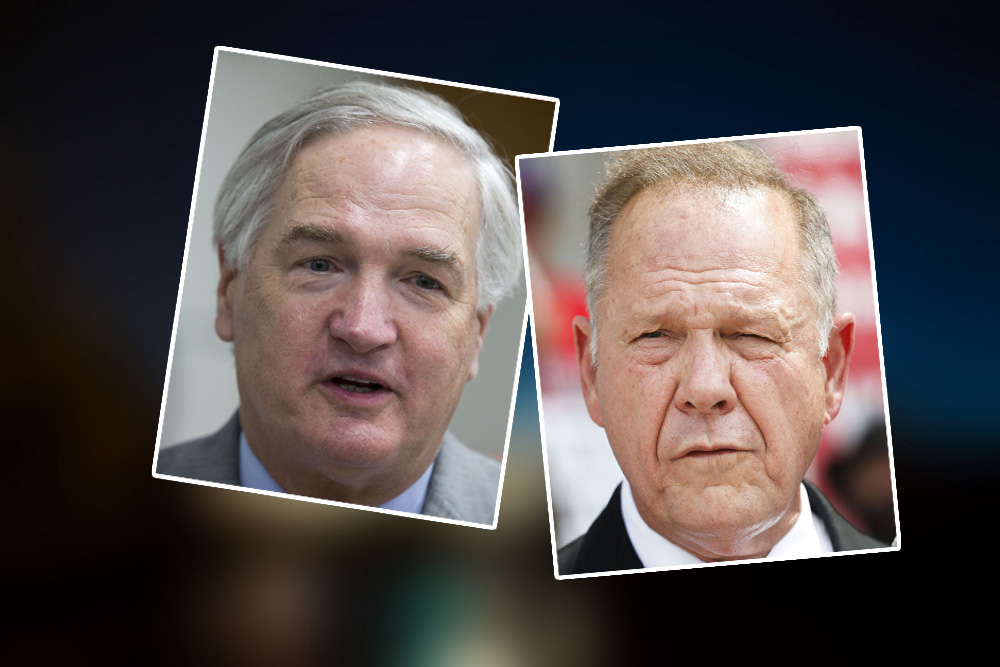
As the contentious Alabama U.S. Senate race heats up, new polling shows a tight contest between former Alabama Supreme Court Chief Justice Roy Moore and sitting U.S. Sen. Luther Strange. The Montgomery Advertiser reports on a new poll of 426 likely Republican voters showing Moore holding a narrow lead over Strange, 31 percent to 29 percent. The numbers were within the poll’s 5 percent margin of error. Huntsville Republican Congressman Mo Brooks comes in third at 18 percent, with state Sen. Trip Pittman of Baldwin County gets 8 percent and Alabama Christian Coalition president Randy Brinson with 2 percent. Eleven percent are undecided. Other Republican candidates on the ballot include Dr. James Beretta, Joseph Breault, Mary Maxwell and Bryan Peeples Meanwhile, SuperPAC’s are preparing ahead of the Aug. 15 Republican special primary. Senate Leadership Fund, the committee linked to Majority Leader Mitch McConnell, has banked over $1.5 million in 26 days in July. SLF has been spending heavily to back Strange, appointed to the Senate seat in February after Jeff Sessions stepped down to become Donald Trump’s Attorney General. According to Federal Election Commission reports, mostly through a $1 million check from hedge fund manager Steven A. Cohen and $250,000 from Phil Ruffin, owner of the Treasure Island Hotel and Casino in Las Vegas. Most of SuperPAC’s attention in the race has been focused on Brooks, attacking him for lack of fidelity to then-candidate Donald Trump, who later carried Alabama easily in the 2016 presidential race. Recently, the group opened up a second front with some new attack ads targeting Moore, a popular far-right social conservative. The National Rifle Association of America Political Victory Fund also reported spending $43,117 on radio ads to boost Strange, according to a newly filed independent expenditure report dated Aug. 2. The race will most likely result in a Sept. 26 runoff between the two top vote getters, since it appears that no single candidate will receive a majority. The last day to apply for an absentee ballot for the primary is Thursday, Aug. 10.
No longer patient, Jeb Bush backers fret about sluggish campaign
For months, Jeb Bush‘s campaign insisted it was too early. Too early to worry about the Republican presidential candidate’s sluggish poll numbers. Too early to fret over the rise of unorthodox candidates Donald Trump and Ben Carson. Too early to question if the one-time front-runner is merely a pedestrian candidate. But with just over three months until primary voting gets underway in Iowa, and Bush still mired in the middle of the crowded GOP field, some supporters fear it could soon be too late. “The moment is now,” said New Hampshire State Rep. Carlos Gonzalez, reflecting the sense of urgency among nearly two dozen Bush supporters interviewed this past week by The Associated Press. On Friday, Bush signaled to supporters he understood the need to make a change. Faced with slower-than-expected fundraising, the campaign announced sweeping spending cuts, including a 40 percent payroll reduction, that will deplete staff at its Miami headquarters and refocus resources in Iowa, New Hampshire, South Carolina and Nevada — the first four states to hold nominating contests. “It means I have the ability to adapt,” Bush said of the changes. “The circumstances when we started the election were different.” But interviews with supporters in early states reveal concerns that extend far beyond the campaign’s allocation of resources. There are fears Bush is failing to distinguish himself from his rivals, despite a month of aggressive television advertising. Many said they were eager to see Bush be more assertive and forceful in debates, in his TV ads and at campaign appearances. They worry he may not be capable of doing so. “God gives us our personalities and our looks and we can’t help that,” said Robert Rowe, another New Hampshire state representative who is switching his allegiance from Bush to Ohio Gov. John Kasich. “We are who we are.” Said Bush supporter Steven Zumbach, an attorney from Des Moines, Iowa: “He’s going to need to take some risk. Unless he does something like that, it’s going to be difficult.” Bush campaign aides say they understand the anxiety, but blame it on an unusual political season that has diverted attention away from more traditional candidates — not a sign of weakness in the former Florida governor. Bush himself has urged voters to stay patient, reminding them that candidates who sit at the top of polls at this stage in the race often fade. “Four years ago Herman Cain was the front-runner. Two weeks prior to that it was Rick Perry,” Bush said Wednesday during a campaign stop in Nevada. “Both are great guys, but they didn’t win the nomination.” Indeed, many voters in Iowa and New Hampshire wait until just before their states’ contests to settle on a candidate. The outcomes in those first two states have ripple effects in South Carolina, Nevada and other states that quickly follow. There are also signs of volatility in the GOP contest. After spending the summer and fall atop the Republican field, Trump appears to be losing ground in Iowa to Carson, an untested politician with a penchant for provocative comments about Muslims and the Holocaust. Bush is still among the candidates viewed as most electable among Republican voters, according to a new Associated Press-GfK poll. Six in 10 registered Republicans say he could possibly win a general election — putting him just below Trump and about tied with Carson atop the field. Most of those interviewed by the AP said they remain loyal to Bush. Even as his campaign fundraising slows, they see his heavily funded super PAC as an advantage that could help him outlast his rivals. They believe his methodical approach to issues and record as Florida governor make him the most qualified Republican to be president. But they wonder if there’s room for a candidate like Bush in a race where voters seem eager to voice their displeasure with Washington and anyone with a history in politics. “Within about a month, he’s going to need to step forth,” said Barbara Smeltzer, a longtime GOP activist from Dubuque, Iowa. “He’s going to have to start to show some muscle.” Added Carroll Duncan, a councilwoman in Dorchester County, South Carolina, “My main concern is that his message is not getting out there. That’s up to his campaign to turn that around.” Bush aides say they’ve been trying to do just that, with both the campaign and Right to Rise super PAC blanketing the airwaves with advertisements. Right to Rise accounted for one of every two 2016 presidential ads last week, according to information collected by Kantar Media’s CMAG advertising tracker. Right to Rise began its media blitz the week of Sept. 15 with a $1.3 million buy in New Hampshire and Iowa, expanding to South Carolina the following week. The super PAC has spent about $2 million each week on ads, CMAG shows. The group’s media plans continue through mid-February — by which time it will have spent $42 million if it follows through on all of its airtime reservations. Bush’s campaign is trying to supplement the ad spending with a large footprint on the ground in early states. The campaign has 12 paid staffers in New Hampshire, 10 in Iowa, eight in Nevada and seven in South Carolina. The overhaul the campaign announced Friday aims to boost those numbers. Supporters hope the changes will be enough to keep Bush afloat through a long, and so far surprising, campaign. “Jeb is not spectacular,” said Lynn Stewart, a state assemblyman from Henderson, Nevada. “But he’s solid and steady.” Republished with permission of the Associated Press.
