
How today’s loudest progressives are nothing like those who fought for civil rights

“Unlike the civil rights movement of the 1950s and ’60s, when protesters wore their Sunday best and carried themselves with heroic dignity, today’s liberal marches are marked by incoherence and downright lunacy — hats designed to evoke sexual organs, poems that scream in anger yet have no point to make, and an hysterical anti-Americanism.” That quote came from a Wall Street Journal op-ed by Shelby Steele an author and current Stanford University fellow titled “The Exhaustion of American Liberalism: White guilt gave us a mock politics based on the pretense of moral authority.” Steele’s post pulls no punches as he addresses, head on, the fallacy of “white guilt,” and I appreciate that. An acquaintance of mine, Javacia Bowser — a teacher, blogger and all around boss lady — frequently ask questions of the day (QOTD) to her loyal tribe of fellow writers, bloggers on See Jane Write. On February 13 she queried: Is there a topic you completely avoid writing about? If so, what is it and why? I didn’t answer her question online that day but I haven’t stopped thinking about it. The truth is there is a topic I’ve started and stopped writing about too many times to count — it’s race and the idea of “white privilege.” The most recent instance included me starting and stopping, writing and revising a blog when Senator Doug Jones named his chief of staff and all the headlines blared that he hired a black man (including calling my own Managing Editor to complain, just to find out she wrote the very same story). Why didn’t they blare that he hired a highly qualified man? Why did leaders within the black community write letters emphasizing that Jones should hire black senior staffers rather than saying that he needed to hire the best and most qualified staff who would work to make Alabama better for everyone? I called friends black and white and even a former colleague I hadn’t talked to in years (a young successful black male who I hired to replace me when I left my job on the Hill) about my strong feelings but at the end of the day I couldn’t get it right. I don’t know that it wasn’t that I wasn’t articulating my strong thoughts and feelings so much as I could just envision all the ways things could go wrong if it were misinterpreted and I was labeled “racist”. I’ve researched this, whites writing or talking about subjects ranging from the Black Lives Matters movement, to crime and poverty, and of course white privilege. It seems that nearly every time even the most middle of the road approaches add opposing views are met with cries of not getting it because they’re racist and out of touch. I feel Steele nails the way I feel nearly every time I see someone talk about privilege without addressing actual solutions. I mean tangible action items, as in they plan to put their money where their mouths are in accomplishing what they’re talking about. Here’s what he wrote, White guilt is not angst over injustices suffered by others; it is the terror of being stigmatized with America’s old bigotries—racism, sexism, homophobia and xenophobia. To be stigmatized as a fellow traveler with any of these bigotries is to be utterly stripped of moral authority and made into a pariah. The terror of this, of having “no name in the street” as the Bible puts it, pressures whites to act guiltily even when they feel no actual guilt. White guilt is a mock guilt, a pretense of real guilt, a shallow etiquette of empathy, pity and regret. I’ve said multiple times that the differences between the civil rights movement and many of the liberal movements happening today is huge. The biggest difference is that the former was about peace and equality, and the latter about hate and division. During the civil rights movement leaders were fighting the “us vs. them” mentality; today the leaders of liberal movements emphasis the “us vs. them.” The best those of in the “us” category can do is apologize loudly and often for their/our us-ness whether that be race, wealth, education, backgrounds, beliefs, the list goes on. In the civil rights movement, it was about doing the right thing with clear goals in mind that would move our nation forward. Today’s liberal movement it’s about screaming how conservatives or independents who don’t share their view are evil, wrong and just mean-spirited with no end in sight. If the fight is being led by blacks – you join or agree or you’re racist. If the fight is being led by women – you join or agree or you’re sexist. Don’t believe me, look at how pro-life women were welcomed at the “Women’s March.” Steel closes his post with thoughts I’ve expressed in the past. So long as there’s no real conversations that can be had by progressives and conservatives on race, inequality and poverty without name calling, blame and fear we can’t solve the problems that really matter. No one wins when we can’t talk and there’s so many who want to talk but won’t because of the way the conversation is currently being framed. Today’s liberalism is an anachronism. It has no understanding, really, of what poverty is and how it has to be overcome. It has no grip whatever on what American exceptionalism is and what it means at home and especially abroad. Instead it remains defined by an America of 1965—an America newly opening itself to its sins, an America of genuine goodwill, yet lacking in self-knowledge. This liberalism came into being not as an ideology but as an identity. It offered Americans moral esteem against the specter of American shame. This made for a liberalism devoted to the idea of American shamefulness. Without an ugly America to loathe, there is no automatic esteem to receive. Thus liberalism’s unrelenting current of anti-Americanism. Let’s stipulate that, given our history, this liberalism is understandable. But American liberalism never acknowledged that
Bill Clinton opening fundraising spree for wife’s campaign
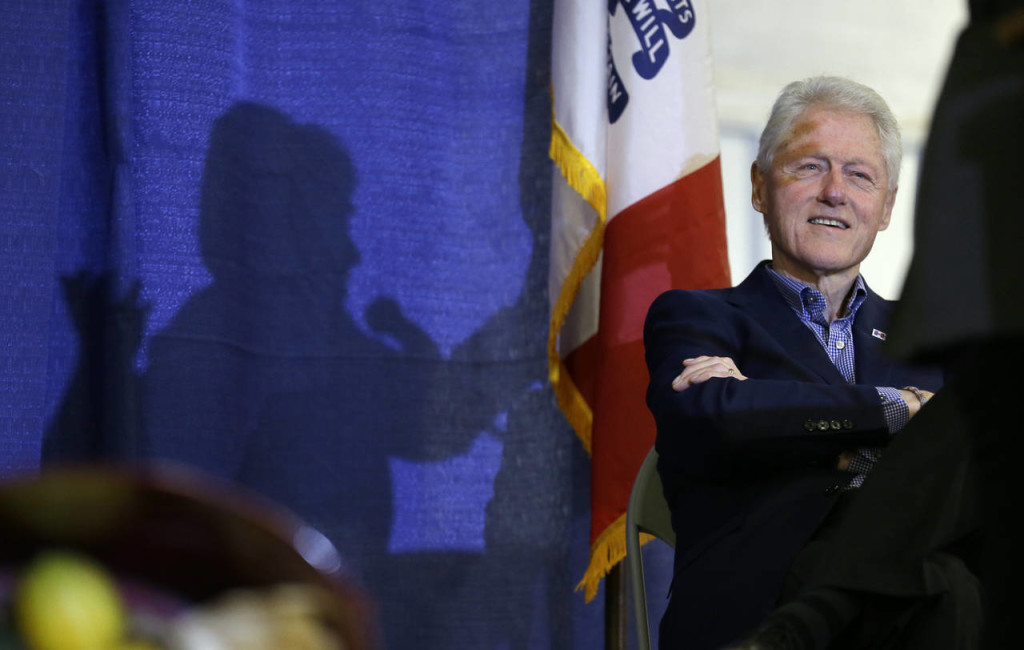
Former President Bill Clinton is going on a fundraising swing reminiscent of his presidential campaigns of the 1990s. But this time he’s doing it for his wife. Hillary Rodham Clinton‘s presidential campaign has scheduled more than a dozen December events featuring the former president as her team prepares for an end-of-year finance deadline ahead of the first contests in Iowa and New Hampshire. The fundraising blitz, Bill Clinton’s most aggressive stretch of the year, shows how Hillary Clinton’s campaign can multiply her money largesse with the help of her husband, one of the Democratic party’s most prolific rainmakers. Working together, the couple will hold at least five fundraising events on some single days in December. After staying behind the scenes for much of the year, Bill Clinton has slowly begun taking a larger public role in the campaign. And it isn’t just with fundraising. He introduced pop singer Katy Perry at a concert before the Iowa Democratic Party’s Jefferson-Jackson dinner last month and appeared with his wife at a party barbecue in Ames, Iowa, last week. “No one knows her better than him and no one knows the process better, so it’s a natural fit,” said Ira Leesfield, a Miami attorney and longtime Clinton donor. “It’s like Derek Jeter taking the field when he was 38.” The fundraising push comes as Vermont Sen. Bernie Sanders, Hillary Clinton’s main Democratic challenger, makes campaign finance reform a central part of his message. Hillary Clinton’s ties to Wall Street and financial industry donors will influence her agenda, Sanders has said. Bill Clinton kicks off December with fundraisers in Seattle, Los Angeles, the Phoenix area and in Laredo, Texas, where he will join with Rep. Henry Cuellar, a Texas congressman who represents the state’s Rio Grande Valley. The former president then raises money on Dec. 7 in Rhode Island with the state’s Democratic governor, Gina Raimondo, and Rhode Island’s congressional delegation. He headlines events in North Carolina later that same day. Later that week, the couple will show how they can spread their fundraising clout around the country. On Dec. 10, Hillary Clinton raises money in New York City while her husband meets with donors in Pennsylvania with stops in Pittsburgh, Bethlehem and Scranton. The next day, the former secretary of state will fundraise in Tulsa, Oklahoma, and St. Louis while her husband appears at events in the Chicago area and Munster, Indiana. In mid-December, the ex-president will raise money in Washington, D.C., including an event at the home of longtime Democratic powerbrokers Vernon and Ann Jordan. He will travel to Richmond later that day for a fundraiser with Virginia Gov. Terry McAuliffe, a friend and fundraiser for the Clintons. The Clintons will head into the holidays with a New York City dinner concert with musician Sting on Dec. 17. The event will benefit a new joint fundraising committee called the Hillary Victory Fund and will range from $33,400 per person to $100,000 for couples who serve as event chairs. David Brock, a Clinton supporter who runs several progressive groups aiding her candidacy, said Bill Clinton is a “gifted orator who has the ability to move people.” Brock recalled how in the spring of 2013 the former president spoke at a donor conference for two of his projects, American Bridge 21st Century and Media Matters. It was no standard stump speech, Brock said. “Rather, off the cuff, he wove an intricate tapestry for probably 45 minutes about the history of news and its relation to democracy,” he said. The 150 donors in the New York hotel ballroom were “in a trance,” Brock said. “There’s no one else at his level who is that good,” Brock said. “He says things about you that you can’t say about yourself, making him quite an effective endorser and validator.” Republished with permission of the Associated Press.
