
Anti-Donald Trump protests have shrunk. What’s it mean for 2020?

The decline follows countless protests that took place after Donald Trump’s victory in 2016.
From protests to ‘pussy hats,’ Donald Trump resistance brews online
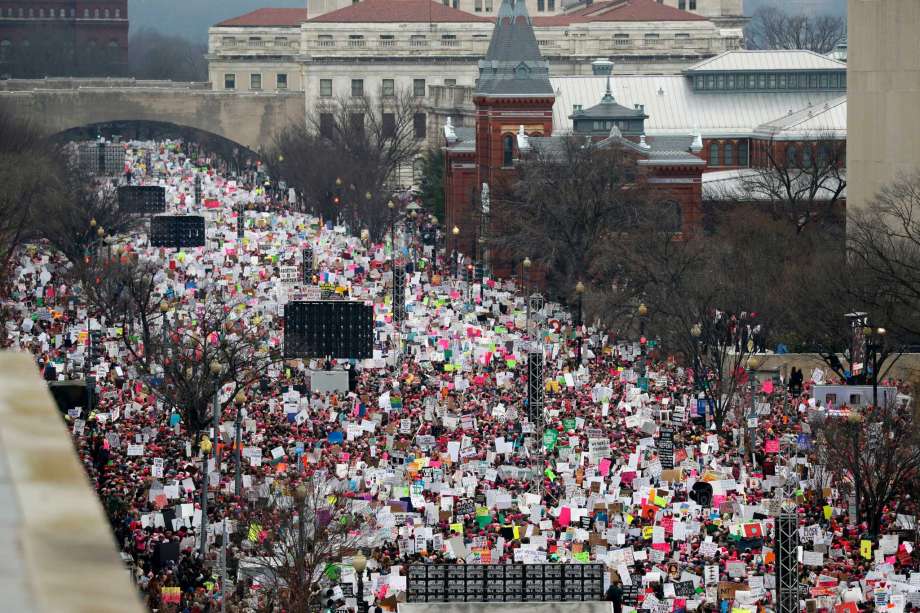
The revolution may not be televised — but it apparently will be tweeted. And Facebooked. And Instagrammed. Not long after President Donald Trump temporarily barred most people from seven majority-Muslim countries from entering the U.S., social activist Dex Torricke-Barton took to Facebook. “I’m thinking of organizing a rally,” he posted. Within a few hours, more than 1,000 people expressed interest. The resulting protest a week later, in front of San Francisco’s City Hall, drew thousands more. Torricke-Barton is far from alone. From organizing protests on the fly to raising money for refugee and immigrant rights groups, people have been using social media to fuel the resistance against Trump in ways their organizing predecessors from the 1960s could have hardly imagined. ROOTS OF PROTEST In Queens, New York, for instance, a group of 27 women met up to write postcards to their state and local representatives during a “Postcard-Writing Happy Hour” organized through Facebook. And on Ravelry, the social network for knitters and crocheters, members have been trading advice and knitting patterns for the pink “pussy hats” that emerged as a symbol during the Women’s March on Washington and similar protests elsewhere after Trump’s inauguration. “This is an incredible project because it’s mixed between digital and physical,” says Jayna Zweiman, one of the founders of the Pussyhat Project. “We harnessed social media for good.” In 1969, activists planned massive marches around the U.S. to protests the war in Vietnam. The protests, called the Moratorium, drew millions of people around the world. But “it took months, a lot of effort, a national office of the organization to get it off the ground,” says Christopher Huff, a Beacon College professor focused on social movements of the 1960s. “The women’s march was achieved at a much larger scale at a fraction of the time.” This immediacy is both an asset and a disadvantage. While online networks help people rally quickly around a cause, Huff says, they don’t necessarily help people grasp the “long-term effort” required to sustain a movement. ONLINE, THEN OFF In Silicon Valley and across the tech world, Trump’s travel ban created a stir that went well beyond the industry’s usual calls for deregulation and more coding classes for kids. Between aggregating donations, issuing fiery statements, and walking out of work in protest, tech company executives and employees took up the anti-Trump cause at a scale not seen in other industries. New York-based Meetup, for instance, broke with nearly 15 years of helping people form and join interest groups on a non-partisan basis. “We’re vital plumbing for democracy,” the company wrote in a Medium post this week. “But after Donald Trump’s order to block people on the basis of nationality and religion, a line had been crossed.” So Meetup held a company-wide “resist-a-thon” — a riff on the hackathons tech companies hold to devise new technologies — to help people get involved in the anti-Trump movement known as “the resistance.” It then unveiled more than 1,000 new “#resist” Meetup groups that people can join for free (it’s normally $15 a month to run a group). As of Wednesday, some 35,000 people had joined the #resist Meetup groups, and scheduled 625 events around the world. Torricke-Barton, who in earlier incarnations wrote speeches for Facebook CEO Mark Zuckerberg and Alphabet Chairman Eric Schmidt, said he and two sisters of Iranian descent organized their last-minute protest using Facebook groups and Messenger. That’s quite a contrast with Torricke-Barton’s earlier experience protesting violence in Darfur more than a decade ago. Back then, “lawyers, marketers, communications people would help you get (the protests) off the ground … networks had to be created in advance,” he said. “Now, protests can start without any kind of infrastructure.” FOLLOW THE MONEY Shortly after Trump’s order, the venture capitalist Bijan Sabet tweeted a link to the fundraising platform Crowdrise alongside an explanation of his support for the American Civil Liberties Union— and then asked his followers to do the same. Sabet figured it might take as long as two months to reach his $50,000 goal. It took three days. That weekend, the ACLU raised $24 million, far more than the $4 million it receives in a typical year. Sabet, whose father is from Iran, says he’s seeing civic involvement “level up,” and that social media is pushing that along. Previously, he said, people would maybe say, “yeah, I’m a bit frustrated, but I don’t have all the information, I don’t know how to get involved.” Now, there’s no excuse. LITTLE THINGS The effects of social media aren’t limited to huge efforts. A week or so after the election, Marisa Frantz, an art director in Cerrillos, New Mexico, created a private Facebook group called “America is Watching.” To join, all people had to do was comment “yes.” If they then posted their zip code in comments, Frantz would send them contact information for their senators and representative, Frantz’s sister-in-law, Sarah Bailey Hogarty, explained in an email. “Like many of us, I was floundering around feeling terrible and afraid,” said Hogarty, a digital producer for the San Francisco Museum of Modern Art. “I wanted to do something, but I had no idea where to start.” Hogarty called the group her “foothold to resistance.” Now, the group has more than 1,000 members across the U.S. and organizes weekly “calls to action,” such as contacting senators and representatives about a particular issue determined by a poll of the group. Groups like this demonstrate how social media has helped “lower the barrier to entry” into social activism, in the words of Tarun Banerjee, a sociology professor at the University of Pittsburgh. “What social media can do really well is spread awareness,” Banerjee said. “Can people make President Trump back down because of social media? Probably not. But it can shine the light.” Republished with permission of the Associated Press.
After mass turnout, can protests turn into political impact?
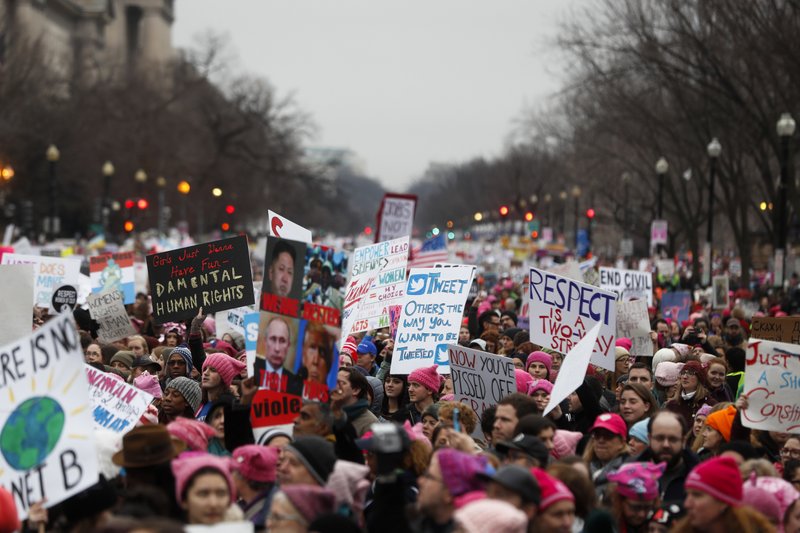
Deb Szeman, a self-described “homebody,” had never participated in a demonstration before hopping on an overnight bus from her home in Charlotte, North Carolina, to attend the women’s march on Washington. She returned on another bus that pulled in at 4 a.m. Sunday, full of people buzzing about what might come next and quipping that they would see each other at the next march. “I wouldn’t have spent 18 hours in Washington, D.C., and taken the bus for seven hours both ways if I didn’t believe there was going to be a part two, and three and four and five,” said Szeman, 25, who works at a nonprofit and joined the National Organization for Women after Trump won the White House. “I feel like there’s been an awakening,” she said. More than a million people turned out Saturday to nationwide demonstrations opposing President Donald Trump’s agenda, a forceful showing that raised liberals’ hopes after the election denied them control of all branches of federal government. Now, the question is whether that energy can be sustained and turned into political impact. From marches against the Iraq War in 2003 to Occupy Wall Street, several big demonstrations have not directly translated into real-world results. In Wisconsin, for example, tens of thousands stormed the state Capitol in 2011 to protest Gov. Scott Walker‘s moves to weaken unions. Walker has since been re-elected. Trump also won the state in November as Republicans increased their hold on the statehouse, part of the GOP’s domination of state-level elections in recent years. Organizers of Saturday’s marches are promising 10 additional actions to take during the first 100 days of Trump’s presidency. So far, the first and only is for supporters to write to their senators or representatives. Groups scrambled so fast to arrange the massive demonstrations in only a few weeks that they have had limited time to determine how to channel the energy into additional action. But, they promise, it’s coming. “The left has really woken up and said, ‘My gosh, we’ve been fighting the symbolic fight, but we haven’t been fighting the institutional fight,’” said Yong Jung-Cho of the activist group All of Us, which organized protests at the inauguration as well as the women’s march. There’s still value in symbolism. Saturday’s immense crowds ruffled the new president as his press secretary falsely contended that Trump had broken a record on inauguration attendance. Jamie Henn of the climate action group 350.org said that reaction is a hint on how to build the movement. “Size matters to this guy,” Henn said. “It’s like dealing with a schoolyard bully and some of us need to go back to middle school and revisit what that’s like” as they think up new tactics. Saudi Garcia, a 24-year-old anthropology student at New York University, is a veteran of Black Lives Matter protests in New York. She rode to Washington with longtime, largely minority activists to block checkpoints to the inauguration. She was heartened to find herself in a very different crowd Saturday, which she described as largely white women, many of whom brought young children to the women’s march. Garcia hopes those women stay involved in fighting Trump. “We need to be like the tea party was in 2009,” Garcia said. “Those people were relentless — showing up at town council meetings, everywhere.” Stan A. Veuger of the American Enterprise Institute, a conservative think tank, co-authored a study of how the nationwide demonstrations that launched the tea party movement led to increased conservative political clout. Higher attendance at individual demonstrations correlated with more conservative voting by congressional members and a greater share of Republican votes in the 2010 election, when the GOP won back the House, he said. But, Veuger cautioned, it wasn’t automatic. The tea party activists also went home and volunteered in local organizations that helped change the electoral results. “Political protests can have an effect,” he said. “But there’s nothing guaranteed.” One positive sign for the left, he added, was that the women’s marches seemed to draw an older crowd not deeply rooted in demonstrating — people who are more likely to volunteer, donate and vote. Beth Andre is one of them. Before the election, the 29-year-old who works in crisis services at a college had bought a ticket from her home in Austin, Texas, to Washington to watch what she thought would be Hillary Clinton‘s inauguration. After Trump won, she canceled the trip. She was heartbroken again when she realized that meant she could not attend the women’s march. But a friend invited her to a meeting to plan a women’s march in Austin instead. Andre has never been involved in a protest movement before. Still excited after Saturday’s demonstration, she’s planning to attend lobbying workshops by her local Democratic Party and is thinking of running for office. “We want to be able to harness that energy and anger that we have right now and turn it into something good,” she said. Republished with permission of the Associated Press.
Donald Trump drives teens to demonstrate though they can’t vote
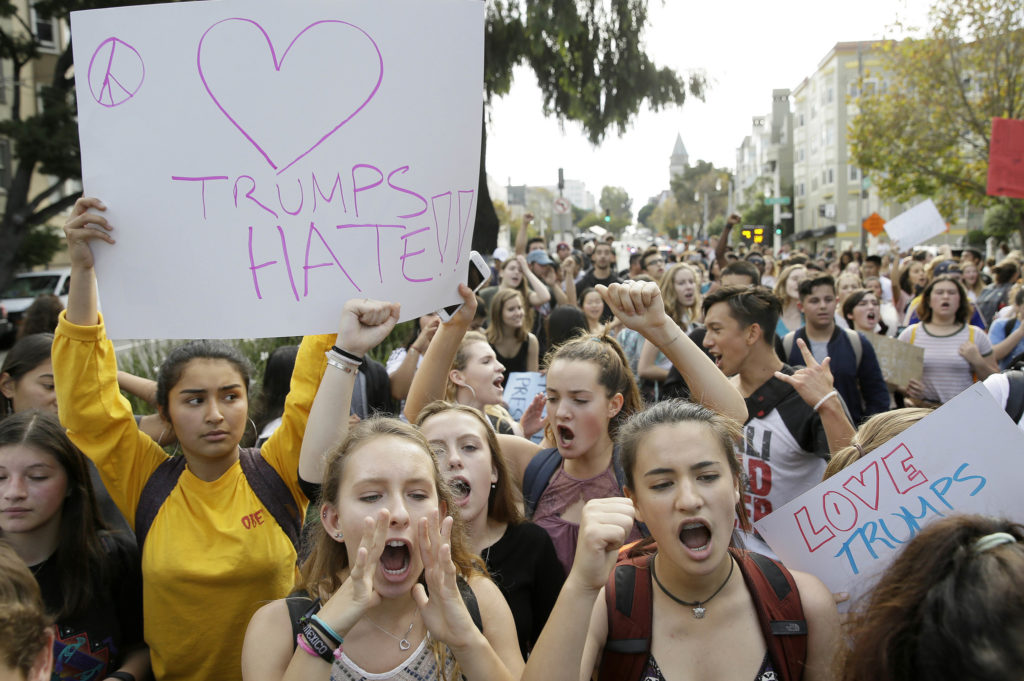
A high school senior, Yaocihuatl Reyes didn’t pay much attention to the presidential race until she found her teacher sobbing and her east Los Angeles classmates terrified that the election of Donald Trump would lead to the deportation of their families. At that moment, the 17-year-old daughter of a nurse and security guard with little political upbringing said she felt driven to act. She and a friend asked students from nearby high schools in the predominantly Latino neighborhood to meet at a park, where they decided to lead a walkout. They made signs, wrote chants and mapped routes for the march to City Hall days later. Hundreds took part. “We just wanted to go and tell our community that we’re here for them, we’re scared, too, but we’re not going to give up,” said Reyes, whose family is in the U.S. legally. “This walkout was kind of for unity, to unify each other.” Though too young to vote, thousands of high school students from Seattle to Silver Spring, Maryland, have taken to the streets since Trump’s election to protest his proposed crackdown on illegal immigration and his rude comments about women. It is an unusual show of political involvement on the part of young people. And experts say that kind of engagement can lead to increased activism when they are adults. “The election has really promoted a feeling on the part of many people that just staying silent is being complicit, and so we’re seeing a huge uptick in engagement,” said Jennifer Earl, a professor of sociology at the University of Arizona who researches the internet and social movements. On the other side of the political divide, students have also rallied in support of Trump, though in smaller numbers. The so-called millennial generation – the youngest adult generation – is the most racially and ethnically diverse in the country now, according to the Washington-based Pew Research Center. Nearly half of millennials identify themselves as political independents, more than in prior generations, according to Pew. Young people who are politically active and concerned about issues are more likely to vote once they turn 18, said Joseph Kahne, professor of educational policy and politics at the University of California, Riverside. Many teens are using social media to spread the word about demonstrations. The best predictor of whether a young person attends a protest is whether he or she is asked to go, Kahne said. Reyes said she had never even attended a political event until earlier this year, when she asked her mother to take her to a rally for Democratic Sen. Bernie Sanders. Oregon teen Cole Sandlin said he, too, had never attended a political rally before organizing one at his high school. He and a friend ordered flags online to support Trump, affixed them to their trucks and gathered in the parking lot before class on Election Day. The rally drew about 30 students. “We thought, this is basically our first election that we’re involved in, that we ought to do something to show our political views,” said Sandlin, who turned 18 shortly after the election and likes Trump’s promises to revamp health care and trade. Sandlin said he has long been interested in politics and grew up watching the news with his father, a farmer in Silverton, Oregon. He said he plans to work on the farm after graduation but will keep up on political issues. “If there was something I felt compelled to share my opinion, I wouldn’t have a problem doing that,” he said. Nor would Reyes, who plans to attend college next year and major in political science, inspired by Sanders’ campaign. She said also wants to organize a community rally in east Los Angeles with speakers on topics such as criminal justice reform. “It was kind of bizarre. I didn’t think people would come,” she said of the walkout. “I just kept telling my friends, ‘Wow, we actually did this. People actually came. It worked.’” Republished with permission of the Associated Press.
