
Hillary Clinton trails Donald Trump by three points in Florida, new Q polling shows
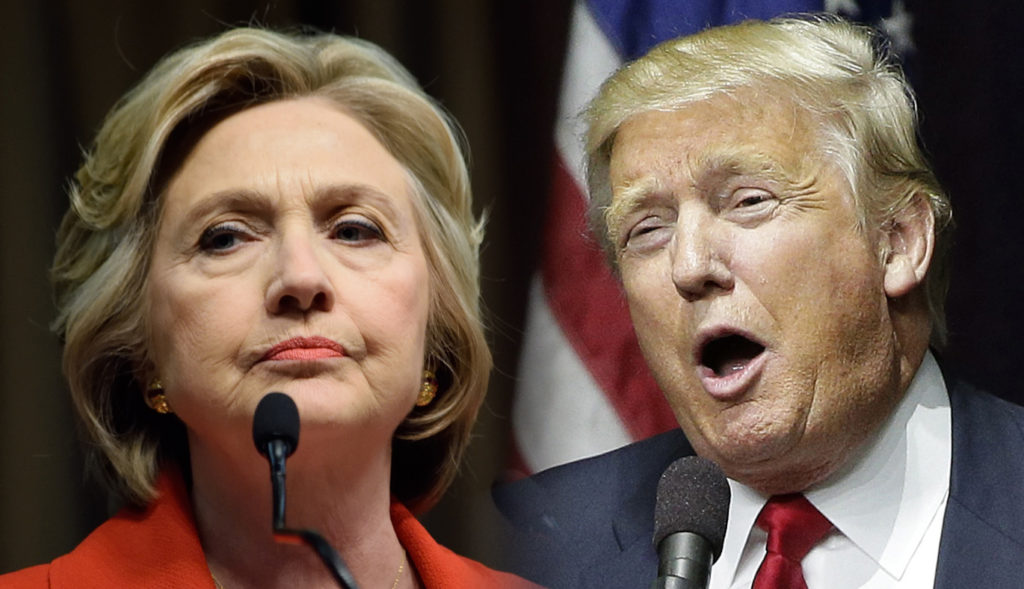
Hillary Clinton trails Donald Trump by three points in a head-to-head matchup in the Sunshine State, according to a poll released Wednesday by Quinnipiac University. The new Swing State Poll also showed a 2-point lead for Trump in Pennsylvania and a tie in Ohio, but the numbers became less favorable for Clinton when pollsters included Jill Stein of the Green Party and Gary Johnson of the Libertarian Party as potential options. In the four-way race, Trump leads Clinton 41-to-36 in Florida, with Johnson taking 7 percent and Stein taking 4 percent. Another 5 percent said they would vote for someone else or stay home on Election Day. By comparison, Trump also took a 1-point lead in Ohio and a 6-point lead in Pennsylvania when Stein and Johnson were included. On the whole, Trump leads among Florida men 50-29, while Florida women back Clinton 48-36, down from 52-34 last month. Trump’s lead among white voters remains strong at 54-30, though nonwhite voters favor Clinton 56-21. “In Florida, Donald Trump is getting only 21 percent of the nonwhite vote. Although he is winning among white voters, who are mainly Republican, victory in Florida will be a very difficult lift for him if he can’t do better among nonwhite voters,” said Peter Brown, assistant director of the Q Poll. When asked which candidate would be more effective against ISIS, creating jobs and solving immigration problems, Florida voters said Trump. Despite his victories in each of those policy areas, the poll shows voters see Clinton as more prepared to be president and as more intelligent than Trump by double-digit margins.
54 percent of voters say they won’t vote for Donald Trump
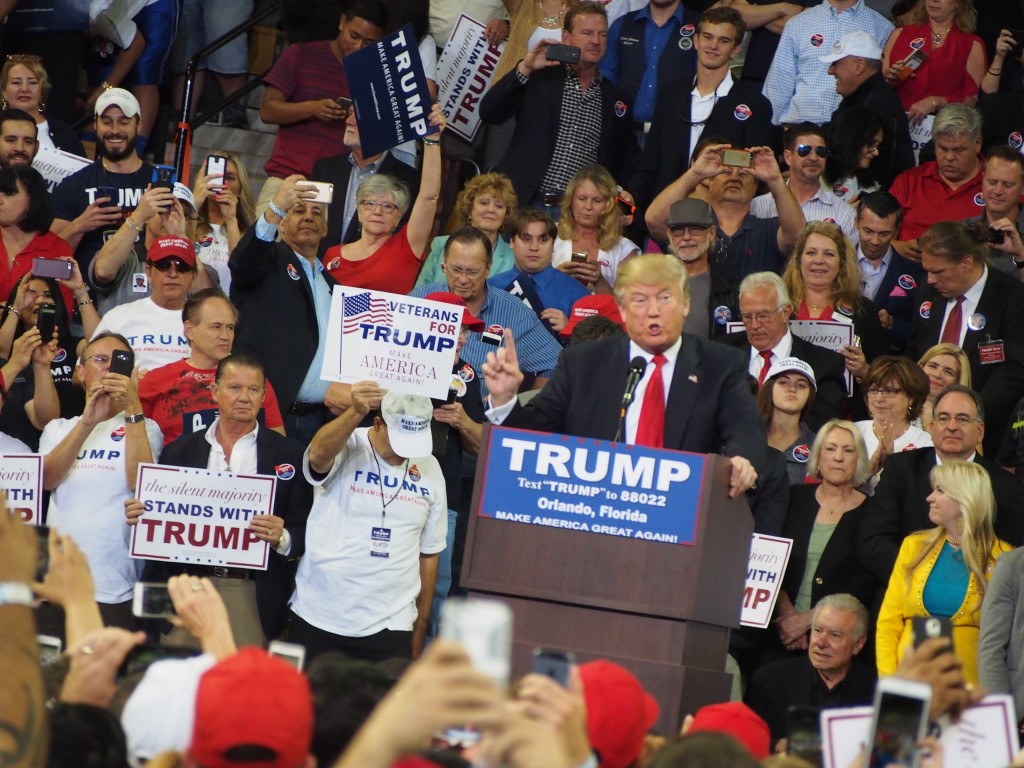
Donald Trump may be the leading in the polls, but more than 50 percent of voters said they wouldn’t vote for him in November. According to a Quinnipiac University Poll, 54 percent of registered voters surveyed said they wouldn’t vote for the New York Republican in the general election. Forty-three percent of respondents stated that they wouldn’t support Democratic front-runner Hillary Clinton. But voters might not have any other options. The survey found that Trump leads the GOP field with 43 percent, followed by Ted Cruz at 29 percent. John Kasich is in third with 16 percent. Trump leads the field among every cross section of respondents, except those who self-identify as very conservative. Among those Republican and Republican-leaning voters, 47 percent said they supported Cruz. On the Democratic side, Clinton leads Bernie Sanders 50 percent to 38 percent. Sanders, the poll found, does better among people between 18 and 44 years old and those who self-identify as very liberal. “Donald Trump and Hillary Clinton may have the overall leads among primary voters, but there is not a love in the room as a big percentage of Americans say of the front runners they could take ‘em or leave ‘em,” said Tim Malloy, assistant director of the Quinnipiac University Poll, in a statement Wednesday. The Quinnipiac University Poll was conducted from March 16 through March 21. The survey polled 1,451 registered voters and had an overall margin of error of 2.6 percent. The survey includes 652 Republicans with a margin of error of 3.8 percent; and 635 Democrats with a margin of error of 3.9 percent.
Poll: Donald Trump, Ted Cruz neck and neck in Iowa

With less than a week before the Iowa caucuses, the Republican race appears too close to call, according to a Quinnipiac University poll released Tuesday. Donald Trump leads the pack among likely Republican caucus goes with 31 percent, followed by Ted Cruz at 29 percent. Marco Rubio, who has held that third place spot for weeks, is at 13 percent. No other Republican candidate cracked double digits in the Quinnipiac survey. “Despite Sarah Palin’s endorsement of Donald Trump and Gov. Terry Branstad’s criticism of Sen. Ted Cruz and despite — or because of Sen. Cruz’ ‘New York values’ comments, the Iowa Republican Caucus remains too close to call,” said Peter A. Brown, assistant director of the Quinnipiac University Poll, in a statement. The poll found Cruz leads Trump among white, born-again Evangelical Christians, voters who describe themselves as “very conservative” and voters who identify as members of the tea party. Trump, however, leads Cruz among voters who self-identify as “somewhat conservative,” “moderate” or “liberal.” “One week before the caucuses gather, the question is which candidate has the best field organization. If the events of the last two weeks haven’t moved the needle, one wonders what would change it in the next six days,” said Brown in a statement. While Trump appears to have significant support among likely Republican caucus-goers, respondents aren’t so sure they would back him if he were the nominee. When asked which candidate respondents would “definitely not support for the Republican nomination for president,” Trump and Jeb Bush were tied at 24 percent. The Quinnipiac University poll was conducted from Jan. 18 through Jan. 24. It surveyed 651 likely Republican caucus participants and had a margin of error of 3.8 percent Trump, Cruz Go Down To The Wire In GOP #Iowa Caucus Poll https://t.co/OjrPo806Vt #Election2016 #IAcaucus pic.twitter.com/FXLBflwNOw — Quinnipiac Poll (@QuinnipiacPoll) January 26, 2016
Jac VerSteeg: Poll accuracy might be worse than you thought
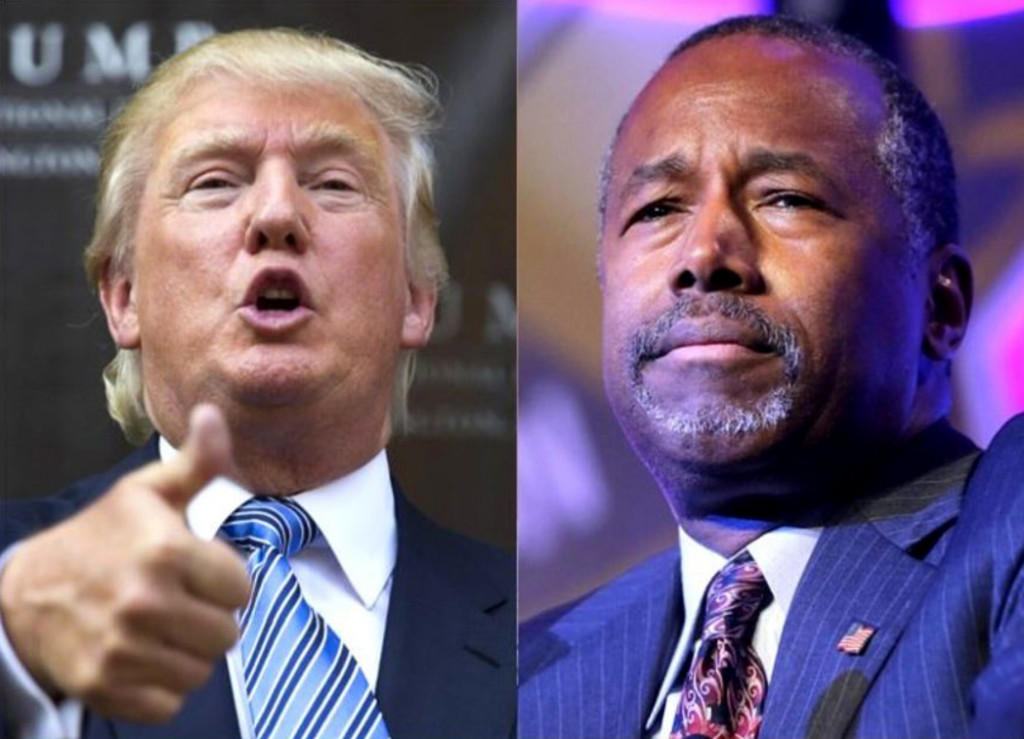
Way back in 1984, the late, great Chicago newspaperman Mike Royko wrote a column in which he urged readers to lie to pollsters. “Be polite. Talk to them,” Royko coached. “But lie. Don’t give them an honest answer.” Royko wrote that pollsters would collect the results and “feed them into a computer, which will chew on them, digest them and finally burp a sheet of paper” allowing the network’s “high priest of politics” to project the winner. “But if enough of you lie,” Royko encouraged, “the entire nation will be treated to one of the finest evenings of television viewing since the tube was unleashed.” Here we are more than 30 years later and it is becoming increasingly clear that people don’t need to lie to pollsters to screw up the results. Because of changes in the way human beings communicate – and I’m talking here primarily about smart phones – it might be impossible to conduct a valid poll. In which case the pollsters, some completely unwittingly, are lying to us. Certainly there have been a lot of incorrect predictions recently. Results in Kentucky, where pollsters overwhelmingly and erroneously predicted a Democrat would be the next governor, are just the latest high-profile example. Bob Sparks explained in his recent column for Context Florida that poor methodology can be partly to blame. And Sparks cited an analysis by Steve Vancore, also for Context Florida, that bolstered the point. Both of those columns are must reading for anyone trying to figure out how two polls – each supposedly the result of scientific research – can come to different conclusions or get election results so wrong. And polls do often disagree. As reported in the Nov. 8 South Florida Sun Sentinel, the NBC News/Wall Street Journal survey of Republican voters found Ben Carson on top with 29 percent to Donald Trump’s 23 percent, while the Quinnipiac University poll put Donald Trump on top with 24 percent and Ben Carson second with 23 percent. The discrepancy might be a simple matter of timing. Those two polls overlapped slightly on the calendar but were not conducted on identical days. They also differed in sample size, which slightly affects the margin of error. However, voices are emerging from the world of polling that sound a more serious alarm. In a story in September, Bloomberg News reported that “doubts are intensifying (about the accuracy of polling) after a series of high-profile misfires around the world in the past year, notably in Greece, Israel and Britain.” The key problem – which some also blame for the flawed polling that convinced Mitt Romney he would defeat Barack Obama in 2012 – is a decline in participation traced to the rise of cell phones. People increasingly do not have land lines and do not answer their cell phones unless they recognize the caller. Even then, they are as likely to text as call. Or they could be at the mall or the grocery store and decline to talk. Further, mobile phones are, well, mobile, which could have an effect on local or regional polling. In my own family, three people whose phone numbers have Florida area codes no longer reside in the Sunshine State. The Bloomberg piece quotes Kirby Goidel, editor of “Political Polling in the Digital Age”: “There isn’t a pollster out there who thinks about this seriously who isn’t a little bit uneasy.” Bloomberg is far from the only source reporting the concern. U.S. News & World Report, in a story from September, quotes Geoffrey Skelley of the University of Virginia’s Center for Politics: “The science of public surveying is in something of a crisis right now.” All the uncertainty leads to the inevitable questions. Are Trump’s and Carson’s numbers really that good? Are Jeb Bush’s numbers really that bad? There is no definitive answer since political polls, by their very nature, cannot be tested until there is an actual election. Even when we get to the caucuses and primaries – starting in early February of next year – we never will know whether the polls from this fall were correct. Because polling is “in crisis,” 2016’s elections will be the most important test for polling since public opinion surveys began. Not only will voters decide which candidates will hold office, they will learn which polling firms to trust – if any. In the meantime, when considering polls, remember that they might reflect built-in lies that make Royko’s suggestion seem quaint. Jac Wilder VerSteeg is a columnist for The South Florida Sun Sentinel, former deputy editorial page editor for The Palm Beach Post and former editor of Context Florida.
Presidential primary brief: 470 days until Election Day
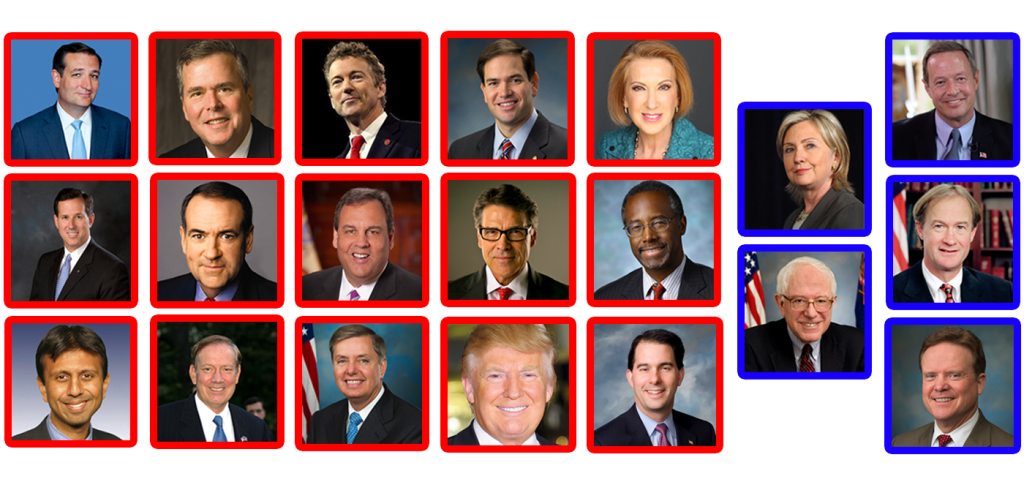
216 days until AL Presidential Primary 470 days until Election Day Convention Dates: Republican July 18-21 2016, Democratic July 25-28 2016 Weekly Headlines: John Kasich becomes 16th Republican to announce presidential bid Donald Trump surging in New Hampshire, Iowa AFL-CIO may delay endorsement of Clinton as 2016 presidential candidate Press Clips Clinton in trouble in Colorado, Iowa, and Virginia (Quinnipiac University Poll 7/22/15) Former Secretary of State Hillary Clinton is behind or on the wrong side of a too-‐close-‐to-‐ call result in match-ups with three leading Republican contenders, U.S. Sen. Marco Rubio of Florida, former Florida Gov. Jeb Bush and Wisconsin Gov. Scott Walker in Colorado, Iowa and Virginia, according to a Quinnipiac University Swing State Poll released today. Perhaps the biggest loser, however, is Donald Trump, who has negative favorability ratings of almost 2-‐1 in each state, the independent Quinnipiac University Poll Ninds. The Swing State Poll focuses on key states in the presidential election. In several matchups in Iowa and Colorado, another Democratic contender, U.S. Sen. Bernie Sanders of Vermont, runs as well as, or better than Clinton against Rubio, Bush and Walker. Vice President Joseph Biden does not do as well. C-‐SPAN scoops Fox News for First GOP candidates encounter (Latin Post 7/20/15) Three days before 10 Republican presidential hopefuls are scheduled to debate on Fox News, many of them will participate in a nationally televised forum hosted by C-‐SPAN. Steve Scully, C-‐SPAN’s politics executive producer, was not shy about touting his network’s scoop, AdWeek noted. “This event is significant” Scully said, “because it will afford the public its first opportunity to hear all of the Republican presidential candidates answer questions on one stage.” So far, the Washington-‐based network has received confirmations from New Jersey Gov. Chris Christie, former neurosurgeon Ben Carson, Ohio Gov. John Kasich, former Hewlett‐Packard Chief Executive Carly Fiorina, South Carolina Sen. Lindsey Graham and former New York Gov. George Pataki. 126 things to know about the 21 candidates running in 2016 (USA Today 7/20/15) With John Kasich’s campaign launch on Tuesday, that’s a whopping 21 candidates who have formally entered the 2016 race. (Still to come? An early August announcement by Republican Jim Gilmore, and a decision by Vice President Biden on the Democratic side.) The parade of contenders into the White House race began in March, when Texas Sen. Ted Cruz announced his bid. Since then, USA TODAY has been compiling facts and tidbits about the large presidential field to help you get to know the men and women seeking the nation’s highest office. Here are the 126 things you should know about 21 presidential candidates: #BlackLivesMatter is winning the 2016 Democratic primary (Time 7/23/15) When Black Lives Matter protestors stormed a room at a meeting in Phoenix and demanded that the 2016 presidential candidates say the names of black people killed by the police, the response was swift: Bernie Sanders did it the next day. “I wish that in the year 2015, I could tell you we have eliminated racism in this country, but you all know that is not true,” said Sanders, to a crowd of more than 11,000 in Houston on Sunday, and then listed the names: “Sandra Bland, Eric Garner, Tamir Rice, Freddie Gray and many, many others.” Donald Trump’s cash will only take him so far in 2016 (Politico 7/23/15) Donald Trump made a bold pledge during his rambling presidential announcement inside the brass-‐laden, marble-‐filled lobby of Trump Tower. “I’m using my own money. I’m not using the lobbyists. I’m not using donors. I don’t care. I’m really rich,” he said. While it’s true that Trump is really rich, the real estate mogul’s Financial disclosure made public this week casts doubt on the idea that he has access to enough cash right now to spend the $1.5 billion or more it’s expected to cost to reach the White House in 2016. Brace yourself, the presidential election is going to be all about anger (NPR 7/26/15) Hillary Clinton laid out some lofty goals for her presidency in a speech on Friday. “My mission from my Nirst day as president to the last will be to raise the incomes of hardworking Americans so they can once again afford a middle-‐class life,” she said. “This is the defining economic challenge not only of this election but our time.” So, she has her work cut out for her. But interestingly, that line came not from a populist barn burner of a speech, but from a policy-‐focused address about ending “quarterly capitalism” — the tendency for businesses to focus on short-‐term shareholder gains over long-‐term investment.
Marco Rubio tops in GOP presidential pack, best against Hillary Clinton, Q-poll finds
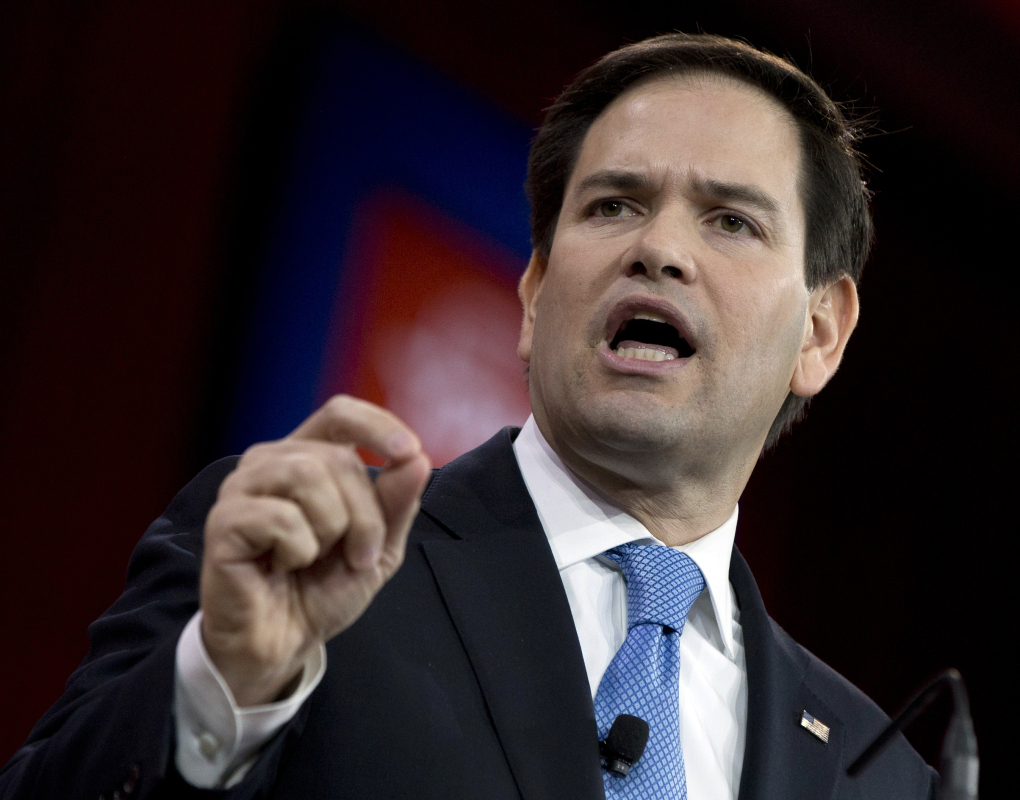
U.S. Sen. Marco Rubio wins the support of 15 percent of Republican primary voters and runs best against Democrat Hillary Clinton, according to a Quinnipiac University National poll released Thursday. The former secretary of state tops the Democratic field with 60 percent and leads top Republican contenders, except Rubio, in head-to-head matchups, the Quinnipiac University Poll finds. The Republican primary field shows Rubio with 15 percent, former Gov. Jeb Bush with 13 percent and Wisconsin Gov. Scott Walker with 11 percent. No other candidate tops 9 percent and 14 percent remain undecided. Bush tops the “no way” list as 17 percent of Republican voters say they would definitely not support him. New Jersey Gov. Chris Christie is next with 16 percent who give him a definite thumbs down, with 10 percent for U.S. Sen. Rand Paul of Kentucky. Clinton owns the Democratic nod with 60 percent, followed by Vice President Joseph Biden with 10 percent and U.S. Sen. Bernie Sanders of Vermont with 8 percent. Former Maryland Gov. Martin O’Malley has 3 percent and 14 percent are undecided. Clinton and Biden each get 7 percent on the “no way” list. “The youngest member of the GOP presidential posse moves to the front of the pack to challenge Hillary Clinton whose position in her own party appears rock solid,” said Tim Malloy, assistant director of the Quinnipiac University Poll. “This is the kind of survey that shoots adrenalin into a campaign. Marco Rubio gets strong enough numbers and favorability ratings to look like a legit threat to Hillary Clinton.” In a general election matchup, Clinton gets 45 percent of American voters to 43 percent for Rubio. She leads other top Republicans: •45-40 percent over Christie; •46-42 percent over Paul; •47-42 percent over former Arkansas Gov. Mike Huckabee; •46-39 percent over Bush; •46-41 percent over Walker; •48-41 percent over U.S. Sen. Ted Cruz of Texas. American voters say 54-38 percent that Clinton is not honest and trustworthy, a lower score than top Republicans. Voters say 62-34 percent that she has strong leadership qualities, besting Republican men by margins of 10 percentage points or higher. Voters are divided 47-47 percent on whether she cares about their needs and problems. Paul cares, voters say 43-35 percent, the best score on this point among Republicans. Voters approve 50-45 percent of the job Clinton did as Secretary of State. They support 53-43 percent a Congressional investigation into her e-mail use, but say 51-44 percent that such an investigation would be politically motivated rather than justified. American voters give Clinton a split 46-47 percent favorability rating. Rubio’s favorability score is 35-25 percent. Other Republicans get negative or divided scores: •29-42 percent for Christie; •33-33 percent for Paul; •33-33 percent of Huckabee; •30-43 percent for Bush; •24-21 percent for Walker, with 54 percent who don’t know enough about him to form an opinion; •25-30 percent for Cruz. “Yes she is a leader, but can she be trusted? Mixed reviews for Hillary Clinton on key character traits,” Malloy said. From April 16-21, Quinnipiac University surveyed 1,353 registered voters nationwide with a margin of error of +/- 2.7 percentage points. Live interviewers call land lines and cell phones. The survey includes 567 Republicans with a margin of error of +/- 4.1 percentage points and 569 Democrats with a margin of error of +/- 4.1 percentage points
