
Black Americans weep for the Obama era and uncertain future

On the night in 2008 when Barack Obama was elected the country’s first black president, many black Americans wept. Eight years later, they weep again for the end of an era some thought they would never live to see — and for the uncertain future they face without him. In Obama, many African-Americans felt they had a leader who celebrated their culture and confronted their concerns. In his wife, Michelle, they saw a national role model who epitomized style and grace with brown skin. Now some regard the election of his successor as the price of black progress and the culmination of years of racist rhetoric directed at the Obamas — at times stoked by President-elect Donald Trump himself. “There’s a great deal of melancholy and fear and despair,” said Lester Spence, professor of political science and Africana studies at Johns Hopkins University. “This is a dynamic that the vast majority of black America has only read about or seen in movies. They don’t understand the potential of what’s coming.” Not all African-Americans are sad to see Obama leaving the White House. But blacks overwhelmingly voted for the president in 2008 and 2012, and fewer than 1 in 10 black voters supported Trump. For many, the events of the final days of Obama’s presidency added to the sense of gloom. With his inauguration fast approaching, Trump took to Twitter last week to bash Rep. John Lewis, a civil rights legend who was nearly killed marching for voting rights in Selma, Alabama in 1965. Trump said Lewis was “all talk, talk, talk — no action or results.” On Monday, the president marked his last Martin Luther King Jr. holiday before he himself enters the annals of history. On Friday, he will be replaced by a chief executive who questioned Obama’s birthplace and offended many blacks during his campaign by describing dangerous “inner cities” in need of “law and order.” Perhaps nowhere was the surreal moment more evident than at the Smithsonian National Museum of African-American History and Culture, where a sea of black faces gathered to say goodbye and to celebrate a history of struggle and progress. “This year marks the most significant, most poignant and really the most important Martin Luther King Jr. celebration of my lifetime,” said James Peterson, professor of English and Africana studies at Lehigh University. “There’s never been a clearer case, in terms of presidential politics and the general direction of the country, where King’s edicts are more pertinent than they are now.” Some in the crowd were descendants of slaves. Some survived segregation. Others were too young to have known anything other than a black president. Many made a deliberate decision to be there on this holiday at the end of a historic presidency. For black Americans, the museum offers “proximity to black culture, black history and the power of black social movements. You can steel yourself,” Peterson said. “There’s a reason folks will find solace in just being there.” Throughout the museum are milestones of black suffering and achievement. Watching a video of the 1963 March on Washington, Charles Phillips of Philadelphia worried about whether dark days lay ahead. “I think we’re going to be in for some bad things,” said Phillips, who wore an Obama T-shirt he bought during the president’s first term. “To come to a place like this, it touches you, to see what we went through — and are hopefully not going to go through in the next four years.” Looking at an exhibit with photos of a smiling, waving Obama family during the 2008 inauguration, Kim Taylor became emotional. Though she had visited the museum five times since it opened in September, she cried for the first time as she reflected on the progress of the civil rights movement and Obama’s historic presidency. “I don’t know if we’ll ever have another black president,” said Taylor, of Capitol Heights, Maryland. “I made a point to be here. I just wanted to be a part of history, to have that closeness with other black people.” Jerrod Lemmons and his wife, Dee, were in town from Waxahachie, Texas, for the weekend, taking their daughter on a college tour of Howard University. But stopping by the museum was also important. Being there during Obama’s last days in the White House was humbling and bittersweet, Jerrod Lemmons said. His head dropped at the thought of Trump taking office at the end of a week that began with King’s birthday. “I don’t believe he supports us,” Lemmons said of the president-elect. “He doesn’t see value in who we are as a people.” Sitting outside of the exhibit on sports, he reflected on African-Americans’ sacrifices, failures and victories. “It all comes down to: What are we going to do?” Lemmons said. “We all have a responsibility to each other. This museum reminds us exactly of that.” Jewelle Mason, also visiting from Philadelphia, came to the museum hoping, just maybe, that Obama might show up. He didn’t. But she let out a contented sigh that she was able to be there on King Day, savoring the final days of Obama’s presidency. “It’s nice to know that now he’s a part of the history,” Mason said. “That’s something they can never take away from us.” Republished with permission of The Associated press.
Possible Election Day problems worry civil rights advocates
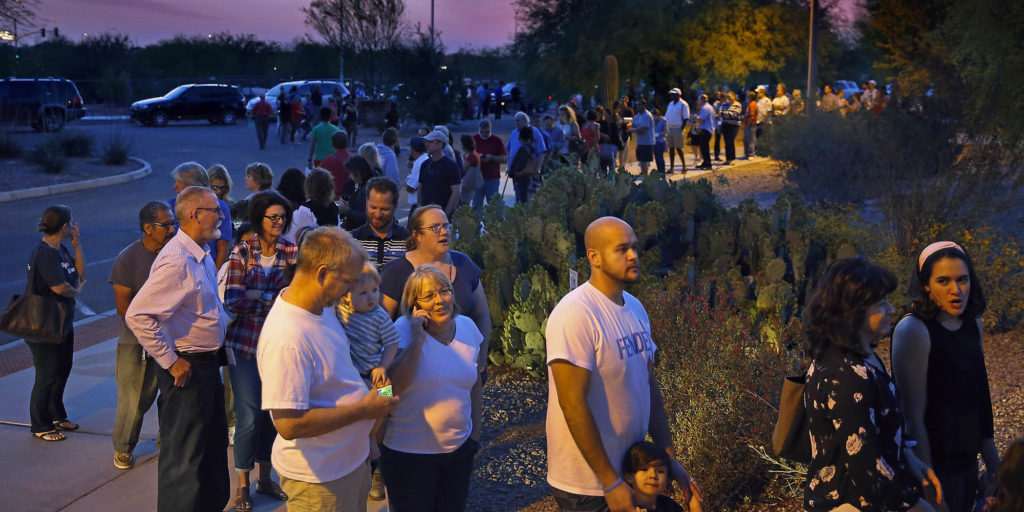
New ID requirements. Unfamiliar or distant polling places. Names missing from the voter rolls. Those are just some of the challenges that could disrupt voting across the country through Election Day. While most elections have their share of glitches, experts worry conditions are ripe this year for trouble at the nation’s polling places. This is the first presidential election year without a key enforcement provision of the federal Voting Rights Act, and 14 states have enacted new registration or voting restrictions. Adding to the uncertainty is a call by Republican presidential candidate Donald Trump for supporters to monitor the polls for voter fraud and concerns by the federal government that hackers could try to disrupt the voting process. All this has civil rights advocates on guard. “There is going to be a lot going on in this election that we are going to have to watch out for,” said Penda Hair, a civil rights lawyer who represented the North Carolina NAACP in its bid to overturn that state’s voter ID law. With no national standards for voting, rules vary widely across states and even counties. Voting experts and civil rights groups are encouraging voters to do their research before heading to the polls. That includes checking to ensure they are registered and finding their voting location, as well as understanding their rights if they face any problems. “People should not leave without casting a ballot,” said Wendy Weiser, head of the democracy program at the Brennan Center for Justice at NYU’s School of Law. “If you are an eligible voter, you should be able to have your vote counted no matter what anyone is saying.” Adding to the potential for confusion are new voter ID laws in nine states as well as reduced hours for early voting and changes to polling locations in some states. In North Carolina, at least two counties no longer offer Sunday voting. Deborah Dicks Maxwell, 60, said she is worried that — along with early voting hours largely limited to between 9 a.m. and 5 p.m. — will make it harder for people to cast ballots in her home county of New Hanover. She said Sunday voting was popular during North Carolina’s primary in March. “With the short hours we have and the high turnout that generally occurs in a presidential election year, someone is going to be in line,” said Dicks Maxwell, president of the New Hanover County branch of the NAACP. “Why penalize the citizens when you could have extended the hours and made it easier for them?” State officials have said the county didn’t offer Sunday voting in 2012 and that the current plan represents an increase in evening hours available during early voting. Long lines led to frustration during Arizona’s March primary, when some voters in the Phoenix area waited hours to cast ballots after county election officials opened 60 polling stations — fewer than half what is typical. Melissa Dunmore, a 26-year-old social worker from Phoenix, still doesn’t know if her primary ballot was counted. She waited an hour to vote, only to be told she wasn’t registered despite checking her status before heading to her polling place. She said she won’t be deterred and plans to vote early this time. “If we stop voting every time it was hard or it was denied, women wouldn’t have the right to vote, black people wouldn’t have the right to vote,” Dunmore said. Meanwhile, some 33 states have accepted an offer from the federal government to check their voter databases and reporting systems for vulnerabilities after hackers attempted to breach systems in two states over the summer. Trump’s warning that the election might be rigged along with his call for supporters to monitor polling places has alarmed some advocacy groups who say such comments threaten to undermine voter confidence in the election. “We are deeply concerned about the chilling effect this call might have on the electorate and minority voters in particular,” said Kristen Clarke, president of the Lawyers’ Committee for Civil Rights Under Law. “And we are concerned about the disruption this will cause for election workers.” Clarke and others say Trump supporters at the polls could lead to intimidation at a time when the U.S. Department of Justice has had to make substantial changes to its federal election monitoring program following the 2013 Supreme Court decision that struck down a portion of the Voting Rights Act. For the 2012 election, more than 780 federal observers and Justice Department staff were sent to 51 jurisdictions in 23 states. Now federal election observers can be sent only to those locations where there is a court order, which exists for only a small number of places in five states. With fewer federal election observers on hand, Attorney General Loretta Lynch said last week that Justice Department employees will be sent instead to at least as many states as 2012. But she did not say how many officials will go and how much access they will have. Republished with permission of the Associated Press.
Updates from the 1st presidential debate

The Latest on the first of three presidential debates between Democrat Hillary Clinton and Republican Donald Trump (all times EDT): 10:45 p.m. Both candidates concluded the first presidential debate by saying they will accept the outcome if the other wins. Hillary Clinton spoke directly to viewers and said, “It’s not about us, it’s about you.” Donald Trump initially dodged the same question, saying he would make a “seriously troubled” America “great again.” He added: “I’m going to be able to do it. I don’t believe Hillary Clinton will.” But Trump finished his answer by saying that if Clinton wins, “I will absolutely support her.” ___ 10:43 p.m. Hillary Clinton is punching back at Donald Trump’s assertions that she doesn’t have the “stamina” to be president. Trump has questioned whether Clinton has the physical fitness to be president and he repeated the criticism to her directly during the debate. Clinton’s response? Trump shouldn’t talk about stamina until he’s tried out the busy schedule she kept up as secretary of state. Trump didn’t answer moderator Lester Holt’s original question about his past comments that Clinton doesn’t have the “presidential look.” Clinton suggested the remarks were about gender, and she reminded the crowd of Trump’s past comments calling women “pigs” and other derogatory names. ___ 10:42 p.m. Donald Trump says NATO needs to “go into the Middle East with us” to combat the Islamic State group. And he is taking credit for NATO focusing resources on combating terrorism. In fact, the alliance agreed in July to contribute aircraft and conduct training in Iraq and has increased intelligence coordination there. And NATO set up an anti-terrorism program in 2004 — years before Trump criticized them as a presidential candidate. Earlier this year, Trump criticized NATO for not focusing on terrorism. He said that afterward, he saw an article reporting that NATO was opening a new, major anti-terrorism division. He said Tuesday that NATO’s action was “largely because of what I was saying, and my criticism of NATO.” ___ 10:40 p.m. Donald Trump is avoiding a specific declaration on how he would use nuclear weapons if he’s elected president. The Republican nominee said during the first presidential debate that he “would not do first strike” because “once the nuclear alternative happens, it’s over.” That statement suggests he would not authorize a nuclear attack unless the U.S. was struck first. But in the same answer Trump said he “can’t take anything off the table.” He mentioned adversary nations such as North Korea and Iran. President Barack Obama has considered changing existing policy to state clearly that the United States would not deploy nuclear weapons without first being attacked by nuclear weapons. But he met resistance and has elected not to make such a shift. ___ 10:38 p.m. Hillary Clinton is accusing Donald Trump of being too easily provoked to keep the United States from going to war — perhaps even one involving nuclear weapons. Trump says: “I have much better judgment than she does. I have much better temperament.” That drew laughs from some in the debate crowd, and prompted Clinton to exclaim: “Woo! OK!” Clinton then pivoted to policy, defending the U.S.-led war in Afghanistan. Clinton said Iran was “weeks away” from a nuclear bomb when she became secretary of state — and says the Obama administration thwarted that progress. She continued that Trump didn’t have “good judgment or the right temperament” because he could take the country to war over small issues, like being mocked on Twitter. ___ 10:35 p.m. Donald Trump is continuing to insist he opposed the Iraq War before the U.S. invasion despite evidence to the contrary. Trump says during the debate that he “did not support the war in Iraq,” calling that charge “mainstream media nonsense.” But there is no evidence Trump expressed public opposition to the war before the U.S. invaded. Trump was asked in September 2002 whether he supported a potential Iraq invasion in an interview with Howard Stern. Trump briefly hesitated, then responded: “Yeah, I guess so.” Presented with the comment during the debate, Trump responds: “I said very lightly, I don’t know, maybe, who knows.” He’s also telling reporters to call Fox News host Sean Hannity to confirm private conversations he said they had about the war. Hannity is a top Trump supporter. Clinton voted in favor of the invasion in 2002 while she was a New York senator. She has since said it was a mistake. ___ 10:27 p.m. Donald Trump is interrupting the moderator of the first presidential debate to insist he has the best temperament for the office. Trump repeatedly made the assertion after clashing with moderator Lester Holt over his early support for the Iraq War. Then he segued to his temperament. “I think my strongest asset by far is my temperament,” Trump said. “I know how to win.” Clinton and her allies have repeatedly hit Trump over his temper and inability to take criticism. ___ 10:23 p.m. Hillary Clinton says one key to fighting terrorism in the United States is working closely with Muslims living here. Clinton says Donald Trump has “consistently insulted Muslims abroad, Muslims at home.” She says Muslim people can provide information that law enforcement may not be able to obtain anyplace else. Both candidates were asked to explain how they would combat terrorism in the U.S. Clinton says her plan includes an intelligence surge to obtain “every scrap of information” and to “do everything we can to vacuum up intelligence from Europe, from the Middle East.” ___ 10:20 p.m. Hillary Clinton says defeating the Islamic State group and taking out its leaders would be a top priority as president. Clinton says she’s hopeful the Islamic State group would be pushed out of Iraq by the end of the year. She says the U.S. could then help its allies “squeeze” the terrorist group in Syria. Clinton says she would do everything possible to take out the group’s leaders, and make that one of her administration’s organizing principles
