
Gov. Kay Ivey says Alabama is making progress on expanding digital infrastructure
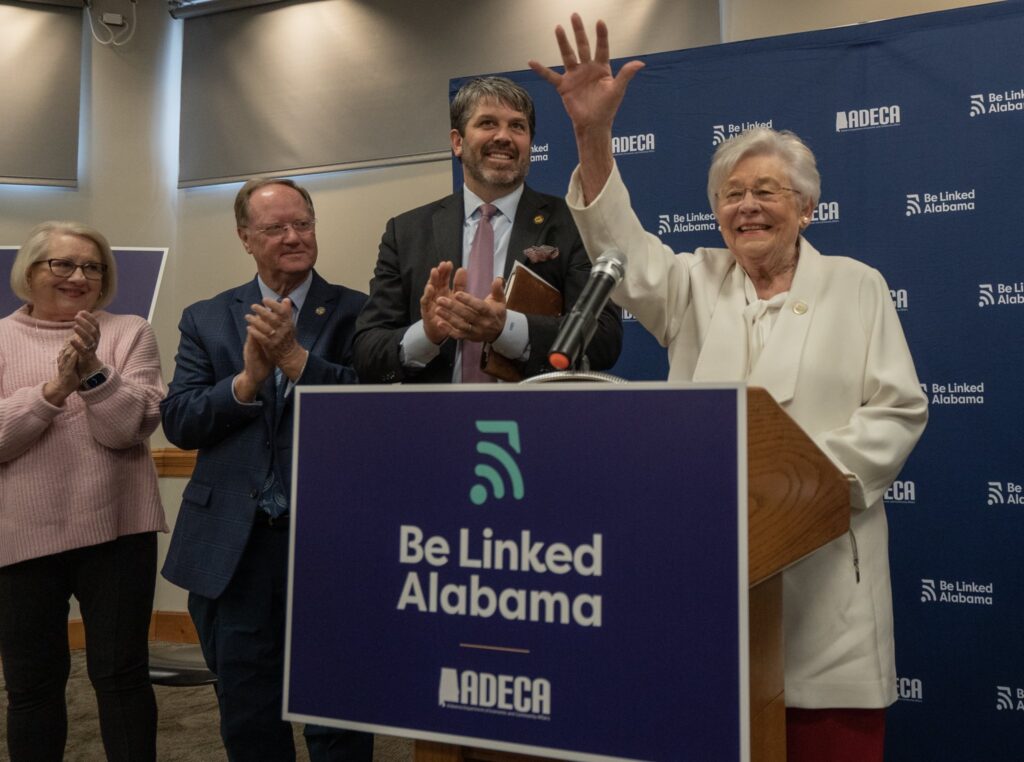
Alabama Governor Kay Ivey (R) on Monday continued her broadband tour with an event at Cullman Electric Cooperative in Cullman County. Ivey discussed upcoming broadband projects in Cullman and Winston counties. “Our presence in Cullman County today underscores our commitment to providing access to high-speed internet for every Alabamian,” said Gov. Ivey. “The remarkable strides made here, supported by the Alabama Broadband Accessibility Fund and Cullman Electric Cooperative, signify our dedication to connecting unserved residents. This milestone represents our journey towards statewide connectivity, demonstrating that when one community gains access, we all move closer to a more connected and prosperous Alabama.” Ivey was joined by Alabama Department of Economic and Community Affairs (ADECA) Director Kenneth Boswell, Cullman Electric Cooperative CEO Tim Culpepper, state Sen. Garlan Gudger (R-Cullman), and state Reps. Randall Shedd (R-Cullman) as well as Tim Wadsworth (R-Arley). The speakers addressed the nearly $7 million in grant and matching funds committed for broadband projects in the area. The broadband expansion will give over 1,300 currently unserved addresses the ability to be connected in Cullman and Winston counties. Ivey and Boswell also discussed the overall success of the Alabama Broadband Accessibility Fund (ABAF). ABAF is funded by the Alabama Legislature. It supports targeted projects in communities in need of high-speed internet access. These funds, awarded by Governor Ivey and managed by ADECA, give internet service providers the ability to execute projects that connect individual households, businesses, community anchor institutions such as libraries and schools, and others to broadband infrastructure. “A primary mission of mine in the Alabama Legislature is to ensure that every single Alabamian will have access to high-speed internet,” said Rep. Shedd. “I was proud to discuss the progress we have made so far in my district, and I look forward to continuing our work to make sure that all Alabamians can take advantage of the 21st-century technology that is critical to everyday life. These investments we have made through programs like the Alabama Broadband Accessibility Fund have already brought high-speed internet access to tens of thousands of households and businesses, with tens of thousands more on the way.” “Our continued progress in expanding high-speed internet access would not be possible without a unified team working hard every day to accomplish our state broadband goals,” said Director Boswell. “This team includes Governor Ivey, the Alabama Legislature, internet service providers, and others too many to name working together to make sure Alabama residents and Alabama communities have the tools needed to thrive.” Since 2018, Alabama has invested approximately $82 million in state dollars through grant awards supporting more than 100 projects through the Alabama Broadband Accessibility Fund. Once all Alabama Broadband Accessibility Fund projects awarded to date have been completed, access to broadband service will be available to more than 72,000 Alabama households, businesses and community institutions that currently have no option to subscribe. Following the program, Governor Ivey, speakers, and residents of Cullman and Winston counties participated in a ceremonial groundbreaking. Alabamians interested in learning more about what the state is doing to expand high-speed internet access are encouraged to visit the Be Linked Alabama website, a hub of internet expansion information and news. It includes the Alabama Broadband Map, county profiles and dashboards, and statewide broadband news. Be Linked Alabama represents the state’s united effort to expand access to affordable, reliable high-speed internet. As Alabama works toward achieving the goal of high-speed internet access for all, the statewide initiative is coordinated by ADECA and brings together partners from across the state, including Governor Ivey, the Alabama Legislature, internet service providers, research institutions, utility companies, community leaders, and the public. The state has received hundreds of millions of dollars through the American Rescue Plan Act and the infrastructure bill to spend on rural broadband projects. Broadband expansion combined with road and bridge infrastructure improvements, aggressive economic development efforts, and improving the state’s education system is all a part of Gov. Ivey’s broader plan to reverse the decades-long decline in rural Alabama counties. To connect with the author of this story or to comment, email brandonmreporter@gmail.com.
Kay Ivey breaks ground at second broadband stop, signaling digital infrastructure progress
On Monday, Gov. Kay Ivey made a second stop on her broadband tour at Cullman Electric Cooperative in Cullman County, discussing upcoming broadband projects in Cullman and Winston counties. Following the program, Governor Ivey, speakers, and residents of Cullman and Winston counties participated in a ceremonial groundbreaking. “Our presence in Cullman County today underscores our commitment to providing access to high-speed internet for every Alabamian. The remarkable strides made here, supported by the Alabama Broadband Accessibility Fund (ABAF) and Cullman Electric Cooperative, signify our dedication to connecting unserved residents,” said Governor Ivey. “This milestone represents our journey towards statewide connectivity, demonstrating that when one community gains access, we all move closer to a more connected and prosperous Alabama.” Made the second stop on my broadband tour this morning. For Alabamians in Cullman and Winston counties, there are projects underway to expand access to high-speed internet. I was proud to ceremonially break ground on them today. ⬇️ #alpolitics (1/2) pic.twitter.com/pGCfCfS9cR — Governor Kay Ivey (@GovernorKayIvey) December 4, 2023 Ivey was joined by Alabama Department of Economic and Community Affairs (ADECA) Director Kenneth Boswell, Cullman Electric Cooperative CEO Tim Culpepper, state Sen. Garlan Gudger (R-Cullman), and state Reps. Randall Shedd (R-Cullman) and Tim Wadsworth (R-Arley). The $7 million in grant and matching funds committed for broadband projects will give over 1,300 currently unserved addresses the ability to be connected in Cullman and Winston counties. ABAF, which is funded by the Alabama Legislature, supports targeted projects in communities in need of high-speed internet access. These funds, awarded by Governor Ivey and managed by ADECA, give internet service providers the ability to execute projects that connect individual households, businesses, community anchor institutions such as libraries and schools, and others to broadband infrastructure. “A primary mission of mine in the Alabama Legislature is to ensure that every single Alabamian will have access to high-speed internet,” said Rep. Shedd. “I was proud to discuss the progress we have made so far in my district, and I look forward to continuing our work to make sure that all Alabamians can take advantage of the 21st-century technology that is critical to everyday life. These investments we have made through programs like the Alabama Broadband Accessibility Fund have already brought high-speed internet access to tens of thousands of households and businesses, with tens of thousands more on the way.” Since 2018, Alabama has invested approximately $82 million in state dollars through grant awards supporting more than 100 projects through the Alabama Broadband Accessibility Fund. Once all Alabama Broadband Accessibility Fund projects awarded to date have been completed, access to broadband service will be available to more than 72,000 Alabama households, businesses, and community institutions that currently have no option to subscribe. “Our continued progress in expanding high-speed internet access would not be possible without a unified team working hard every day to accomplish our state’s broadband goals,” said Director Boswell. “This team includes Governor Ivey, the Alabama Legislature, internet service providers, and others too many to name working together to make sure Alabama residents and Alabama communities have the tools needed to thrive.” Be Linked Alabama represents the state’s united effort to expand access to affordable, reliable high-speed internet. The statewide initiative is coordinated by ADECA and brings together partners from across the state, including Governor Ivey, the Alabama Legislature, internet service providers, research institutions, utility companies, community leaders, and the public.
Wallace State Community College holds ribbon cutting at new Workforce Training Center
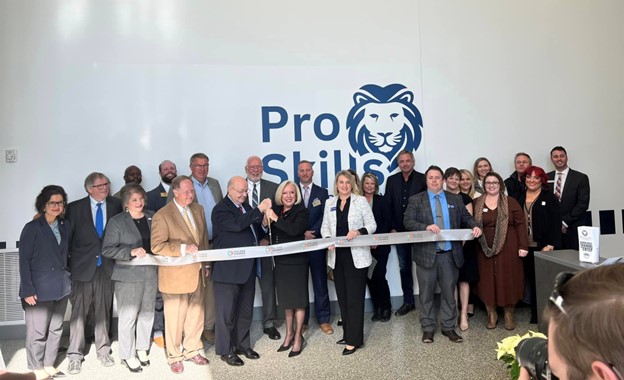
Wallace State Community College (WSCC) held a ribbon cutting on Wednesday for its new Workforce Training Center, which is located on the grounds of Rehau. The Workforce Training Center will provide facilities for training programs and services offered by the college’s Center for Career and Workforce Development. Initially, classes for phlebotomy, computer office training, fiber optics training, some manufacturing training, and a Skills for Success lab will be offered at the site. WSCC plans to offer classes for Certified Nursing Assistants and Medication Assistant Certification at the center soon. Alabama Community College System Chancellor Jimmy Baker, State Rep. Randall Shedd, Cullman Mayor Woody Jacobs, and Cullman Economic Development Agency Director Dale Greer were in attendance, as well as WSCC President Dr. Vicki Karolewics, Vice President for Advancement and Innovation Suzanne Harbin and industry partners Jeremy Sturdivant of the Jimmie Hale Mission, and Tracy Rushing of R.E. Garrison Trucking. Space will also be available for use by area businesses and industries that need facilities for employee training. Hardin said that the facility provides them with a central location to host classes and store materials and supplies for their programs. Through its Pro Skills Pathways program, the Center for Career and Workforce Development offers short-term training to earn credentials students can use to get a job, advance in their current job, or use as credit to articulate into a credit-bearing program at Wallace State. Economic developer Dr. Nicole Jones Wadsworth told Alabama Today, “Wallace State’s newest workforce training center at the Rehau campus will transform the lives of the people in Cullman and the surrounding area. Courses offered will equip graduates with in-demand skills that translate into jobs within a variety of trades. We applaud Wallace State for its continuous communication with industry partners and willingness to go the extra mile to serve our communities.” Registration for the Spring 2024 semester is underway, with classes beginning January 8 for regular and Mini Term I and March 6 for Mini Term II. Registration for Flex Start I courses will be held Jan. 13-19, with classes starting January 15, and registration for Flex Start II courses will be held Jan. 20-26, with classes beginning January 22. To register for classes, visit their website. The two-year college system has an enormously important role in training Alabama’s workforce. This expansion with the Workforce Training Center will help Wallace State perform in that role. To connect with the author of this story or to comment, email brandonmreporter@gmail.com.
Gov. Kay Ivey announces new statewide brand for high-speed internet expansion
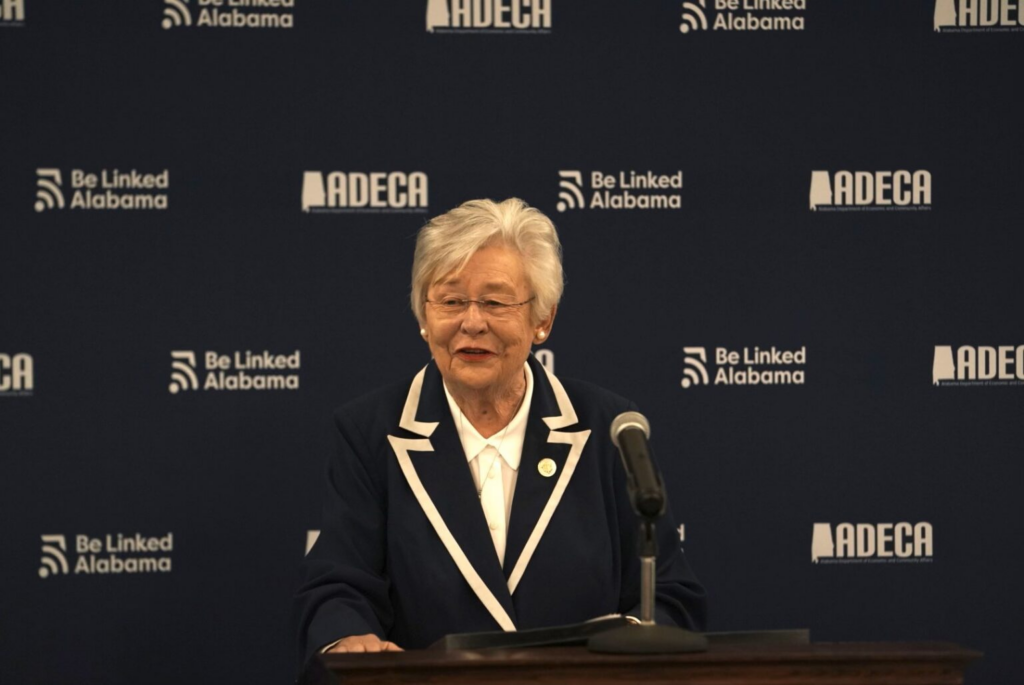
Governor Kay Ivey on Tuesday announced how more than $400 million in federal funding and over $1.4 billion from the U.S. Department of Commerce Broadband Equity, Access and Deployment Program (BEAD) will be allocated to expand access to high-speed internet across Alabama. At Tuesday’s event in Dothan, Governor Ivey also unveiled Be Linked Alabama as the name and hub representing the state’s continued efforts to expand access to high-speed internet. “Providing broadband connectivity to every Alabamian, whether it be in our largest metros or most rural areas, has been a top priority of the Ivey Administration since day one,” said Gov. Ivey. “As we launch Be Linked Alabama today, we are furthering our commitment to fully connecting our state. Offering the ability to connect to high-speed internet in all 67 counties is a journey, not a short trip, but Alabama is certainly well positioned to finish this race in the near future.” The new brand comes alongside massive investments by the federal government into broadband expansion in Alabama. The American Rescue Plan Act funds were allocated by the Alabama Legislature in 2022 and 2023 special sessions to support expansion of high-speed internet to unserved areas of the state. Gov. Ivey announced the upcoming opening of grant applications for the $182 million from the Capital Projects Fund to support “last-mile” projects that provide the actual connections to homes, businesses, and community anchor institutions. The application period is expected to open on August 14 and close in October. The state’s new Anchor Institution/Middle Mile (AIMM) program will be funded with the second round of American Rescue Plan Act funds allocated earlier this year. More than $200 million will support this effort, which will potentially serve 500 anchor facilities – including institutions such as colleges and universities, rural hospitals, and government facilities that are inadequately served, along with “middle-mile” deployment that will provide the infrastructure to help facilitate last-mile deployment by internet service providers. The application dates for AIMM program will be announced at a workshop on Friday, August 11. Be Linked Alabama represents the state’s united effort to expand access to affordable, reliable high-speed internet to all Alabamians. The statewide initiative is coordinated by the Alabama Department of Economic and Community Affairs (ADECA) and brings together partners from across the state, including but not limited to Governor Ivey, the Alabama Legislature, internet service providers, research institutions, utility companies, community leaders and the public as Alabama works toward achieving the goal of high-speed internet access for all. The Governor introduced that Be Linked Alabama website, a hub of internet expansion information and news. It includes the Alabama Broadband Map, county profiles and dashboards, and statewide broadband news. Kenneth Boswell is the Director of ADECA. “We have a great team in Alabama that includes public officials such as our governor and members of the Legislature, private sector companies, citizens, local leaders, and communities all joining together with a common goal – to give every Alabamian the ability to be connected,” said Director Boswell. “Our state has already made tremendous progress on our journey to expand high-speed internet availability by providers, but we still have a long way to go. Be Linked Alabama represents the progress that we have made and the continued progress still to come.” “The funding announced today will have a lasting impact on Alabama’s future, and I am proud to have the opportunity to administer the deployment of these funds in a manner that will give our state the maximum benefit,” said Boswell. “Every dollar counts, and we are going to deploy these dollars efficiently to help make Governor Ivey’s goal of giving all Alabamians access to high-speed internet a reality.” Along with the massive influx of federal funds, since 2018, the state of Alabama has invested $88.6 million in state dollars through grant awards supporting 109 projects through the Alabama Broadband Accessibility Fund. Once all the projects awarded to date have been completed, internet service will be available to more than 82,000 Alabama households, businesses, and community institutions that do not have access to high-speed internet. In September 2022, Governor Ivey announced a grant to support broadband “middle-mile” network infrastructure to improve access for last-mile projects. In June, Governor Ivey announced that Alabama would receive an additional $1.4 billion from the federal BEAD Program to boost ongoing efforts to expand access to unserved areas. ADECA will complete and submit Alabama’s required plan for using those funds to the National Telecommunications and Information Administration. Tuesday’s announcement included a demonstration from students trained at the Wallace Community College campus on how to deploy the fiber optic cables needed for high-speed internet delivery. This training was developed through the Alabama Community College System’s Innovation Center. The Innovation Center brings together the state’s community colleges, industries, and community partners to deliver training offered at no cost to participants thanks to funding provided by Ivey and the Alabama Legislature. Ivey has made broadband expansion a priority of her administration. State Senator Clay Scofield (R-Guntersville) and State Representative Randall Shedd (R) have carried her rural broadband package of bills in the Alabama Legislature. To connect with the author of this story or to comment, email brandonmreporter@gmail.com.
Senator Clay Scofield and Rep. Randall Shedd: Broadband ‘critically important investment’ for Alabama
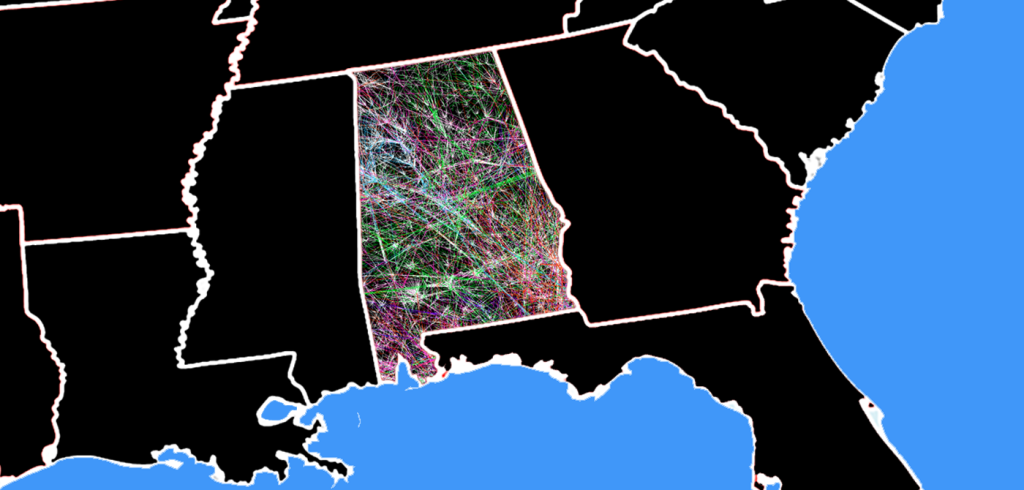
Alabama has made significant investments over the past five years to expand broadband access across the state. As a result, we are making great progress towards bringing high-speed internet to unserved communities throughout Alabama. The Governor and Legislature are focused on building upon this success, so during the recent Special Session of the Legislature, we allocated $260 million of federal American Rescue Plan Act (ARPA) dollars to help the state continue building its broadband infrastructure for the benefit of all Alabama residents and businesses. This important bill, which has now been passed by the legislature and signed by the Governor, is one of many investments the state has made to improve broadband accessibility. In 2018, the Alabama legislature enacted the Alabama Broadband Accessibility Act, through which our state has awarded $88.6 million in grants for the expansion of broadband services through the Alabama Department of Economic and Community Affairs (ADECA). These investments have already brought high-speed internet access to tens of thousands of households and businesses, with tens of thousands more on the way. The legislature also passed the Connect Alabama Act in 2021, which created the Alabama Digital Expansion Authority (ADEA) to advise, review, and approve Alabama’s statewide connectivity plan and to analyze data and mapping that will provide the information needed to make the best decisions for broadband in our state. This has been a great success and paid huge dividends thanks to ADEA’s efficient stewardship of our state’s broadband dollars, as funds have been utilized to efficiently support projects where Alabama needs them most. Before passing these important legislative priorities, our state ranked near the bottom of the chart nationally in broadband connectivity. Those days are long behind us, and now other states are looking at Alabama as a model of how to get broadband expansion done. In 2022, the state of Alabama allocated $192 million of ARPA funds for last-mile expansion and another $85 million of ARPA funds for the creation of a statewide middle mile network. You can think of “middle mile” as the road you take to get to a certain address, and the “last mile” as your destination’s driveway. Through Governor Kay Ivey’s leadership in supporting this middle mile network, which will touch almost all of Alabama’s 67 counties, we are “paving” the way for our state to have more robust and cost-efficient broadband access once additional state and federal dollars become available in the coming years. This is a critically important investment into our state as we are implementing the bold vision set forth by ADEA in the Alabama Connectivity Plan. Without access to high-speed internet, a community simply can’t meet its full potential in a modern, 21st Century economy. Alabamians depend on high-speed internet for work, education, healthcare, and countless other needs. We need to make sure that every Alabamian has access to high-speed internet, and with the passage of this spending bill, we are well on our way. ADEA will continue to oversee these efforts to ensure that the funds are being spent efficiently and effectively on projects that will have the highest possible impact for our state. We are committed to bringing broadband access to all of Alabama, and this is one more step in that direction.
House committee advances bill to overhaul Alabama’s adoption laws

On Wednesday, the Alabama House Children and Seniors Advocacy Committee gave a favorable report to a bill to replace Alabama’s existing adoption statutes with new code language that sponsors claim will make the adoption process faster, less burdensome, and more affordable. House Bill 101 (HB101) is sponsored by State Representative Ginny Shaver, who Chairs the committee. “This a Law Institute (ALI) bill,” Shaver said. “I started working on a bill and found out that they already had a committee working on rewriting the state’s adoption code.” “The committee has worked for over four years,” Shaver explained, “The Committee has brought in stakeholders from all over the adoption field.” “I started working with the committee in 2021, not to write the bill, but to learn,” Shaver said. “Alabama’s adoption law has not been touched in 30 years.” Shaver said the rewritten 80-page bill “is very comprehensive and detailed.” “The goal was to update the language and streamline the process and protect the confidentiality of the parties,” said Shaver. “To put it as simply as I can, this bill repeals that current adoption code and replaces it.” Shaver said that the new legislation divided minor adoptions versus adult adoptions. It also clarifies which court is the proper court, allows courts handling adoptions to work together and communicate, allows for electronic communication, provides rules for a contest of adoptions in certain situations, and clarifies procedures about relatives and stepparents who adopt a minor. “My concern about adoption is to make it simpler and also to save time and money,” Shaver said. “We want to do everything possible to get a child into a permanent home as soon as possible.” “This streamlines the process and provides clarity to make it better going forward,” Shaver said. State Rep. Barbara Boyd said, “When you are changing codes, you really don’t know what we are voting on unless you are an attorney. I read the whole bill, but I still don’t understand it. In my opinion, it is not a good job.” “We did have a summary, and the Law Institute did provide answers to questions after each section,” Shaver said. State Rep. Randall Shedd, “I want to thank you for your work. A lot of people worked hard on this bill. It may not be a perfect bill, but it is real close to it.” State Rep. Barbara Drummond told reporters at a minority caucus press event afterward, “This bill is a Law Institute bill that overhauls the whole code on adoption.” The committee voted to give HB101 bill a favorable report as amended. The committee also voted to give a favorable report to House Bill 103 (HB103), which is sponsored by State Rep. Allen Baker. “This is an adoption-related bill,” Baker said. “This bill would authorize sick leave for state employees to deal with issues related to adoption.” Boyd asked, “How does this bill differ from current law?” “This clarifies more than changes,” Baker said. “This adds clarity. To this point, this has been up to the discretion of the agency.” Drummond asked, “Is higher ed in there?” Baker said the community college system and four-year higher education institutions were included. Two technical amendments were approved by the committee. HB103 received a favorable report from the Committee in a unanimous vote. Both HB101 and HB103 could be considered by the full House of Representatives as early as Thursday. Thursday will be day four of the 2023 Alabama Regular Legislative Session. Regular sessions are limited to no more than thirty legislative days. To connect with the author of this story or to comment, email brandonmreporter@gmail.com.
Steve Flowers: Alabama making strides in broadband expansion
If you took a nighttime plane ride across much of the rural South in the early 1900s, you would see nothing but darkness on the ground below because electricity at the time was centered mainly around highly populated areas. But through federal, state, and private sector partnerships, electricity was brought to rural America to light up homes and power the products many of us today take for granted. Life without access to electricity is tough for most of us to even imagine, but there was a time not too long ago when many simply did not have it. The same is true today of high-speed internet access. Unfortunately, many homes, businesses, and communities in Alabama and across the country do not have access to this essential 21st-century necessity due to a lack of broadband infrastructure – which you can think of as the highway that connects individuals and businesses to internet providers. But there’s good news for Alabama. While states across the country are scrambling to build out the infrastructure needed to provide their residences with access to high-speed internet, Alabama is serving as an example of how to do it the right way. Over the past few years, Alabama has been ambitious – and innovative – in the way that it has set the state up to deal with the buildout of broadband infrastructure. Governor Kay Ivey, the state legislature, and groups such as the Alabama Rural Broadband Coalition, which includes organizations ranging from Alabama Power to the Alabama Hospital Association, deserve a lot of credit for the success the state is currently seeing on broadband. Along with Governor Ivey, State Senator Clay Schofield of Marshall County and State Representative Randall Shedd of Blount/Cullman Counties deserve accolades for their involvement with this expansion of broadband in our state. To name a few steps the state has taken, in 2017, Governor Ivey issued an executive order establishing the Alabama Department of Economic and Community Affairs (ADECA) as the state agency to oversee broadband planning and expansion. Since 2018, Alabama has invested $64.1 million in state funding through grant awards supporting 100 projects through the Alabama Broadband Accessibility Fund. The state has committed to over $300 million more in state and federal funding for broadband expansion. In November 2021, ADECA established a new Alabama Digital Expansion Division, which was created through the Connect Alabama Act of 2021. This act also created the Alabama Digital Expansion Authority to work with ADECA to oversee broadband expansion in the state. In December 2021, ADECA released the Alabama Broadband Map and Alabama Connectivity Plan to guide the state’s efforts and recommend strategies to expand broadband. The map included months of collaborative work and the participation of 57 internet service providers to give a clear and accurate picture of broadband availability in the state down to the address level. Recently, Governor Ivey awarded a multi-million dollar grant to fund a “middle-mile” broadband network to make statewide broadband service availability a more attainable goal throughout Alabama. The grantee – Fiber Utility Network – will use existing fiber infrastructure and new infrastructure to create a middle mile network that includes almost 3,000 miles of fiber – including approximately 1,089 miles from electric co-ops, more than 1,000 miles leased from Alabama Power, and more than 500 miles that will need to be constructed. This is a big deal for the state, as more than 300 Alabama cities and towns with populations of less than 10,000 are within 10 miles of the planned path. As late as last week, a crowning coup to our broadband expansion occurred when it was announced that the U.S. Treasury has approved $191.8 million to go toward expanding broadband in the state. This grant will connect 55,000 households and businesses to broadband. Expanding broadband infrastructure so that all Alabamians have access to essential, high-speed internet is no easy task. It takes time, effort, financial investment, and the collaboration of both state and local elected officials, private sector groups, and others to successfully build out the infrastructure needed to get Alabamians connected. I believe that our state leaders and business community have been able to do that and have set up Alabama as a model for how to get it right when delivering broadband access to its citizens. See you next week. Steve Flowers is Alabama’s leading political columnist. His weekly column is seen in over 60 Alabama newspapers. Steve served 16 years in the state legislature. Steve may be reached at: www.steveflowers.us.
Nathaniel Ledbetter announces a second round of House committee chairs
State Rep. Nathaniel Ledbetter announced his second round of committee chairs on Monday. Ledbetter is the Alabama House Republican Caucus choice to be the next Speaker of the House in the Alabama House of Representatives, and under the rules of the Legislature, the Speaker appoints most of the committee chairs. Ledbetter announced the appointment of Rep. Jim Carns to serve as Chair of the House Commerce and Small Business Committee, a role he previously held under outgoing Speaker Mac McCutcheon. Carns served in the state legislature from 1990 to 2006. From 2006 to 2010, he served on the Jefferson County Commission. He returned to the House in 2011. Carns is a businessman with experience in manufacturing. Ledbetter announced the appointment of State Rep. Margie Wilcox to chair the Boards, Agencies, and Commissions Committee. Wilcox returns for her third consecutive term in the Legislature. During the last quadrennium, Wilcox chaired the Alabama Legislature’s Joint Transportation Committee and the Joint License Plate Oversight Committee. Wilcox owns and operates a taxicab company in Mobile. She has previously served as vice chair of the House County and Municipal Government Committee. Rep. Danny Crawford returns as the Agriculture and Forestry Committee chair. Crawford was elected to the Alabama House in a 2016 special election. He served on the Athens City Council from 1993-2005 and was employed with the Farm Service Agency for 33 years. He was appointed state director by President George W. Bush in 2001. State Rep. Reed Ingram will return as the chair of the County and Municipal Government Committee. Ingram served in the House since 2014 and was the chair of the County and Municipal Government Committee since 2018. Ingram is a well-known businessman and restauranter from Montgomery. He previously served on the Montgomery County Commission from 2004 to 2014. Ledbetter is appointing State Rep. Randall Shedd to chair the Transportation, Utilities, and Infrastructure Committee. Shedd has served in the House since 2013. He previously served as the chairman of the Cullman County Commission and as the mayor of Fairview. He worked as the director of the Cullman County Commission on Aging. Shedd previously chaired the House Urban and Rural Development Committee and was vice chair of the House Children and Senior Advocacy Committee. “From rural to urban areas, from employers to employees, and from tradesmen to consumers, the collective decisions made by these committees affect every Alabamian in some manner,” Ledbetter said. “All of these individuals have my full faith and confidence, and I am certain they will always work on behalf of the citizens each of us seek to serve.” Ledbetter has previously announced his first round of appointments. All of these appointments are conditional on Ledbetter being selected as Speaker in the organizational session of the House of Representatives in January. Since Republicans hold a 77-member supermajority in the 105-member Alabama House, it is highly likely that Ledbetter will be selected as Speaker, so will then be able to make these appointments officially. Ledbetter has served in the House since 2014. He previously was the Mayor of Rainsville and has served on the town council. He has worked for the Sand Mountain Electric Cooperative as accounts manager. To connect with the author of this story, or to comment, email brandonmreporter@gmail.com.
Kay Ivey awards $82.45 million in broadband grants to Middle-Mile project

On Tuesday, Gov. Kay Ivey awarded an $82.45 million grant to help make statewide broadband service availability more attainable for more people across Alabama. Ivey made the announcement at the Central Alabama Electric Cooperative headquarters building just North of Prattville. “Achieving full broadband coverage is a journey, not a short trip, and today is an important step toward completing that journey,” Gov. Ivey stated. “The Alabama Middle-Mile project – the infrastructure setting part of this journey – is going to lead our state to be the model for the nation when it comes to providing broadband capabilities. In 2022, being able to be connected at home, work, or on the go is absolutely necessary, and this is certainly key to making that a reality.” Gov. Ivey explained that the funds will be used by Fiber Utility Network, a corporation formed by eight rural electric cooperatives to fund a “middle-mile” broadband network that will have a statewide impact. The eight co-ops include Central Alabama, Coosa Valley, Covington, Cullman, Joe Wheeler, North Alabama, PowerSouth, and Tombigbee. Ivey was joined at the event by state leaders, including Speaker of the House Mac McCutcheon (R-Monrovia), President Pro Tem of the Alabama Senate Greg Reed (R-Jasper), State Senate Majority Leader Clay Scofield (R-Guntersville), Senate Minority Leader Bobby Singleton (D-Greensboro), State Rep. Randall Shedd (R-Baileytown), and Alabama Department of Economic and Community Affairs (ADECA) Director Kenneth Boswell. “The project is the springboard to supplying broadband services for rural residents, businesses, educational facilities, and other community anchors,” said Director Boswell. “I commend the Fiber Utility Network for their willingness to undertake this necessary step to ensure more Alabamians have access to these services.” ADECA is administering the award through its Alabama Digital Expansion Division, which the Legislature created in order to identify projects that will expand broadband access in Alabama. “In terms of broadband, this is a great leap forward,” said Sen. Scofield, chairman of the Alabama Digital Expansion Authority board. “Governor, you really are America’s broadband governor, and we can’t thank you enough.” “Connectivity is really the great equalizer,” Scofield continued. “This will really put us at the forefront of broadband in Alabama, and it will help us expand much quicker and at a more economical cost.” “This project is probably the most significant step we’ve taken to get high-speed internet access to everyone in Alabama,” said Rep. Shedd, who serves as co-chairman of the Alabama Digital Expansion Authority board. “I could not be any more excited,” Sen. Reed told reporters. “I would like to congratulate the Governor, Sen. Scofield, and Director Boswell. This is the largest thing we could do for our infrastructure.” “This is a tremendous step in the right direction to digitally connect all of Alabama, especially the Black Belt,” said Sen. Singleton. “I am proud to stand with Governor Ivey to award these needed funds to elevate these communities and provide a service that will have an impact on the entire state.” “Thank you, Governor, for always including rural Alabama in your vision for the state,” Singleton said. “This is a game changer.” The Alabama Middle-Mile Network project involves filling in gaps in broadband expansion which will hopefully result in more cost-effective and feasible ways to provide broadband service availability to residents in rural areas. Tom Stackhouse is the president of the Fiber Utility Network. “The eight electric cooperatives that make up the Fiber Utility Network are honored to be a part of building a middle mile network to bring internet service closer to those Alabamians,” said Stackhouse. “We want to thank Governor Ivey and the staff at ADECA for the vision, leadership, and assistance to make this a reality.” Chris Rush is the President of Marshall Medical Center – a hospital in North Alabama. “There are two crucial elements to health care. The first is having quality care, top-quality doctors, nurses, staff, and technology, and also the ability to access that care. In a lot of places and areas, that is not possible,” Rush said. “It is easier to connect through telemedicine with a specialist in a network located at a central urban hospital like we are with the Huntsville Hospital system. I would like to express my gratitude to Governor Ivey, Senator Scofield, and others.” The Fiber Utility Network will create a middle-mile network connecting almost 3,000 miles of existing and new fiber infrastructure within three years. When complete, the network will provide improved access to unserved areas for the last-mile projects that provide actual broadband availability to homes, businesses, and schools. Once connected, residents will have the ability to become a customer of the last-mile broadband providers. Funds for the project are being provided through the American Rescue Plan Act. The use of those funds was approved earlier this year by the Alabama Legislature. Alabama still has over a billion dollars in ARPA funds yet to appropriate. Reed said that the Legislature will address further funding for broadband, “As quickly as the legislature can address this issue.” “I told a reporter that we should spend all of it on this,” Shedd said. “That’s what it is going to take.” To connect with the author of this story, or to comment, email brandonmreporter@gmail.com.
Alabama lawmakers introduce bills aimed at expanding broadband in underserved areas of the state
Federal funds and other revenue sources could be tapped to address ongoing deficiencies in broadband infrastructure, based on a pair of duplicate bills working through both chambers of the Alabama legislature. As the 2022 legislative session is underway, state Rep. Randall Shedd, R-Fairview, and state Sen. Clay Scofield, R-Guntersville, have introduced the mirroring HB2 and SB3, respectively. The pair of bills in their draft state call for a constitutional amendment that, if ratified, would give each unit of government – the state, counties or municipalities – the authority to allocate financial resources toward broadband expansion under a mixture of different scenarios. The proposed constitutional amendment includes a clause, “The state, a county or a municipality is authorized to grant federal award funds or any other source of funding designated for broadband infrastructure by state law to any public or private entity for the purpose of providing or expanding broadband infrastructure.” Another passage within the amendment adds, “The granting of funds by a county or a municipality to a private entity pursuant to this section must be approved at a public meeting held by the appropriate county or municipality.” Deficiencies in broadband infrastructure – particularly in Alabama’s rural areas – has been an ongoing topic of discussion during the pandemic, where more adults and students have been taking classes and working virtually. Scofield and Shedd have been discussing broadband expansion this past year, in advance of introducing the legislation. Last summer, Scofield shared his views on the issue in a news release detailing his chairmanship of the Alabama Digital Expansion Authority. “Providing high-speed Internet to rural and unserved communities in Alabama has been one of my top priorities since I was first elected to the Senate over a decade ago,” Scofield said in a statement. He added, “We have witnessed our state transform into an economic powerhouse over the years, cultivating industrial expansion, job growth, technological advancements and much more.” In a radio interview in early December, Shedd shared his hope for allocating some of the federal COVID-19 relief funding toward broadband expansion. The goal, he said, “is to identify how we can remove some of the barriers and streamline some of the process. We’re not going to get it all out of the way, but if we can identify what those barriers are, and streamline the process and get it to people faster, it’s something we’d like to do.” With supply chain interruptions and labor shortages ongoing issues, Shedd conceded a full rollout of the expansion plan could take time. “We’ve got some challenges to try and deal with,” he said. “But we also have the opportunity of a lifetime.” HB2 currently is in the House Urban and Rural Development Committee. SB3 is under review in the Senate Finance and Taxation General Fund Committee. The bills were introduced on January 19. By Dave Fidlin | The Center Square contributor Republished with the permission of The Center Square.
Steve Flowers: Incumbency prevails in 2022 State House races
Folks, believe it or not, we are closing in on six months before next year’s election year. The primary election is set for May 24, 2022. In Alabama, all our major constitutional officers are on the ballot next year. The governor’s office is the premier race in the state, and that coveted and powerful post is set for its four-year quadrennial run. Therefore, this big political year is referred to as the gubernatorial year. Those of us who follow Alabama politics have been salivating with anticipation for a cavalcade of great races. However, the power of incumbency has devasted the big year into a yawn. All the major state offices are held by popular incumbents, who are either running unopposed or have minimal opposition. The consolation prize was that there would be the legislative races. After all, this is where the real power in the state rests. You can simply look at where the special interest and PAC money is spent to verify that fact. However, the omnipotent power of incumbency has also encroached on those races. The Alabama House of Representatives has 105 members. There are 77 Republicans and 28 Democrats. The large majority of incumbents are running for reelection – both Republicans and Democrats. The overwhelming majority of these incumbents will have no opposition. However, in the House, there will be some major changes in leadership because of retirement or moving on to new posts. Speaker of the House Mac McCutcheon is not running for reelection. This has created an interesting and spirited race within the Republican Caucus ranks for Speaker. In addition, Victor Gaston of Mobile, who is Speaker Pro Tem, is also retiring. Bill Poole of Tuscaloosa, who chaired the powerful House Ways and Means Education Budget Committee, has left the House to be the State Finance Director. House Rules Committee Chairman Mike Jones of Andalusia is running for the open Senate seat of retiring Senator Jimmy Holley. Two of the freshman House members are running for statewide office. Wes Allen of Troy is running for Secretary of State, and Andrew Sorrell of Tuscumbia is running for State Auditor. In addition, Connie Rowe of Jasper is leaving the House to become an administrative assistant to Lt. Gov. Will Ainsworth. Some of the veteran House members who are choosing to hang up their legislative cleats include Howard Sanderford of Huntsville, Mike Ball of Huntsville, K.L. Brown of Jacksonville, Kerry Rich of Marshall, Allen Farley of Jefferson, Harry Shiver of Baldwin, Mike Holmes of Elmore, and Becky Nordgren of Etowah. The most noteworthy retiree may be Representative Steve McMillan of Baldwin County, who is retiring after serving close to 43 years in the House. Steve has been a quiet yet very effective voice for the people of Baldwin County. They all will be missed. Some of the high profile and powerful members of the House, who will return for another four years with no or token opposition, are Steve Clouse of Ozark, Nathaniel Ledbetter of Dekalb County, and Danny Garrett, Jim Carns, David Wheeler, and David Faulkner of Jefferson. Danny Garrett has ascended to Chairman of the House Ways and Means Education. Other leaders returning are Chris Pringle, Reed Ingram, Randall Shedd, Tracy Estes, Chris Sells, David Standridge, Ginny Shaver, Jim Hill, Alan Baker, Joe Lovvorn, Chris Blackshear, Kyle South, Paul Lee, Jeff Sorrells, Rhett Marques, Steve Hurst, Joe Faust, and Margie Wilcox. The Democratic leadership will remain intact. There is an illustrious array of House Democratic leaders, including Anthony Daniels, Chris England, Laura Hall, Peb Warren, Barbara Boyd, A.J. McCampbell, Berry Forte, Dexter Grimsley, Thomas Jackson, Kevin Lawrence, Mary Moore, Juandalynn Givan, and veteran John Rogers. Two of the Democratic House veterans from Jefferson County, Louise Alexander and Merika Coleman, are both running for an open Jefferson County Senate Seat, leaving both their House seats up for grabs. There may be an increase in the number of females in the House of Representatives. It has already begun with the election of Cynthia Almond of Tuscaloosa, who was elected without opposition to replace Bill Poole. In addition, Patrice Penni McClammy won the Montgomery District 76 seat of her late father, Thad McClammy. She won with no opposition. See you next week. Steve Flowers is Alabama’s leading political columnist. His weekly column appears in over 60 Alabama papers. He served 16 years in the state legislature. Steve may be reached at www.steveflowers.us.
Randall Shedd: Rural broadband expansion requires continued focus from Alabama lawmakers
Consider for a moment the number of times each day that you access the Internet for business, school, and leisure. Many families and businesses have abandoned check-writing altogether in order to utilize quick and easy online bill pay and payroll services. At the height of the COVID-19 pandemic, schools across the state, both public and private, converted to virtual classrooms that required teachers and students to have fast and dependable Internet access in order to teach and learn. Many senior citizens and others with chronic conditions have increasingly relied upon telemedicine, which uses the Internet to link doctors and patients in “virtual office visits” that provide needed medical care without having to leave home. Now imagine that the high-speed, broadband Internet that makes all of this technology available to you was suddenly replaced with the beeps, blips, and dings of the telephone modem, dial-up service that was commonplace more than 25 years ago. For many Alabamians residing in rural and remote areas of the state, the archaic, temperamental, and frustratingly slow dial-up access is all they have ever known. The lack of broadband access and other infrastructure discourages industrial recruitment and economic development from taking place in areas of our state with the highest unemployment rates and the biggest needs. Businesses, industries, and manufacturing concerns simply cannot locate in areas that have not yet implemented 21st Century Internet technology. Recognizing the significant quality-of-life improvements that broadband access can bring and understanding that it is not economically feasible for service providers to build infrastructure and create fiber-optic networks in low-population areas that cannot realize a return on investment, the Alabama Legislature began focusing its attention on rural Internet needs a few years ago. In 2017, the Legislature took a firm first step toward addressing the issue by passing a measure that ensures every public school classroom in Alabama – whether urban or rural, rich, poor, or middle-class – has wireless broadband service. While that was significant, students need the same access at home in order to complete their assignments and continue their education on their own time. We continued our commitment the following year by creating a $20 million grant program designed to leverage federal funds and expand high-speed broadband Internet service in unserved and underserved portions of the state. The program, known as the Alabama Broadband Accessibility Fund, is administered by the Alabama Department of Economic and Community Affairs. It has since been amended to increase the minimum speeds supported by the program and to expand eligibility so that the funds can be used more effectively. Even more progress was made in 2019 when the Legislature passed a bill that I sponsored in the House, which allows broadband carriers to partner with electricity providers in rural areas by using their easements and existing infrastructure. Most recently, the Legislature created the Alabama Digital Expansion Authority, which is developing a statewide connectivity plan to expand high-speed Internet and determining which parts of the state may qualify as rural, underserved, or unserved. The authority also provides oversight of ongoing upgrades to networks, technological equipment, and end-user devices necessary to expand access, and it is seeking the most cost-effective way to expand fiber networks throughout the state. As the 2022 Regular Legislative Session approaches, lawmakers must be prepared to move quickly to appropriate funding that will enhance the successful public/private partnership that is helping expand broadband access in Alabama. The current grant program provides 35% public funding when 65% private funding is proposed for eligible broadband expansion projects. Under the current public/private partnership scenario, if private Internet providers spent $2 billion on expansion projects, $1 billion in public matching funds would be added for a total outlay of $3 billion. Current cost estimates for providing high-speed broadband to all Alabamians range from $4 billion to $6 billion. In order to keep Alabama economically stable and provide its citizens with the basic needs and comforts that are expected today, rural broadband expansion must remain a high priority. Without access to modern technology, our children and grandchildren upon graduation will continue abandoning their rural homes for more inviting, attractive, and promising areas to live. State Rep. Randall Shedd, who represents portions of Blount, Cullman, Morgan, and Marshall counties, serves as chairman of the House Urban and Rural Development Committee, co-chairs the Legislative Oversight Committee on Rural Broadband, and is vice-chair of the new Alabama Digital Expansion Authority.
