
Speaker Nathaniel Ledbetter appoints House Members to serve on a study commission evaluating Alabama’s labor force participation

Alabama has the lowest unemployment rate in state history. There are job openings all over the state that businesses and governments cannot fill, yet the state has one of the country’s worst labor force participation rates. That Alabamians are choosing to stay home rather than join the booming economy has increasingly perplexed state leaders. “Despite having one of the lowest unemployment rates in the country and a record number of Alabamians working, the percentage of Alabamians participating in the labor force is lower than almost any other state,” Governor Kay Ivey wrote recently. “While we are increasing that by the tens of thousands, we have to change this statistic. Getting folks off the sidelines and into the labor force is my next priority.” On Monday, Speaker of the House Nathaniel Ledbetter announced members of the Alabama House of Representatives that will serve on an ad hoc committee studying Alabama’s labor force participation rates and identifying barriers to workforce entry. “Alabama is witnessing record-breaking economic growth and historically low unemployment rates,” Ledbetter said. “Despite these numbers, in Alabama, there are roughly 140,000 job openings and, at the same time, 48,834 unemployed workers across our state. That means we are lacking nearly 100,000 workers over 16 years old, which puts our labor force participation rate at a mere 57 percent—one of the lowest rates in the entire country.” The House members appointed to serve on the study commission will be Rep. Reed Ingram (R–Pike Road), who will serve as the Chairman of the Committee. Rep. Danny Garrett (R–Trussville); Rep. Donna Givens (R–Robersdale); House Minority Leader Anthony Daniels (D–Huntsville); Rep. James Lomax (R–Huntsville); Rep. Barbara Drummond (D–Mobile); Rep. Mike Kirkland (R–Scottsboro); Rep. Bill Lamb (R–Tuscaloosa); Rep. Kelvin Lawrence (D–Hayneville); Rep. Curtis Travis (D–Tuscaloosa); Rep. Chris Pringle (R–Mobile); Rep. Matt Woods (R–Jasper); Rep. Wes Kitchens (R–Guntersville); Rep. Jim Carns (R–Birmingham); and House Majority Leader Scott Stadthagen (R–Hartselle). “Over the coming months, it will be imperative for this group to build on the progress of, and collaborate with, existing entities such as the Lt. Governor’s Commission on 21st Century Workforce, the Alabama Community College System, Alabama higher-education institutions, and essential stakeholders across the private sector,” Ledbetter said. The study commission is expected to address areas including extending adequate childcare to families, examining the correlation between productivity growth and labor output, ensuring wages and salaries are competitive, addressing workforce housing concerns, and offering improved and more expansive mental health programs and services to citizens. “An insufficiency of resources such as these creates barriers to workforce entry as much as an absence of quality education,” Ledbetter postulated. The study commission is slated to host their first meeting on Thursday, October 5, at 10:00 a.m. in room 617 of the Alabama State House. To connect with the author of this story or to comment, email brandonmreporter@gmail.com.
Nathaniel Ledbetter announces House members who will serve on labor force participation study
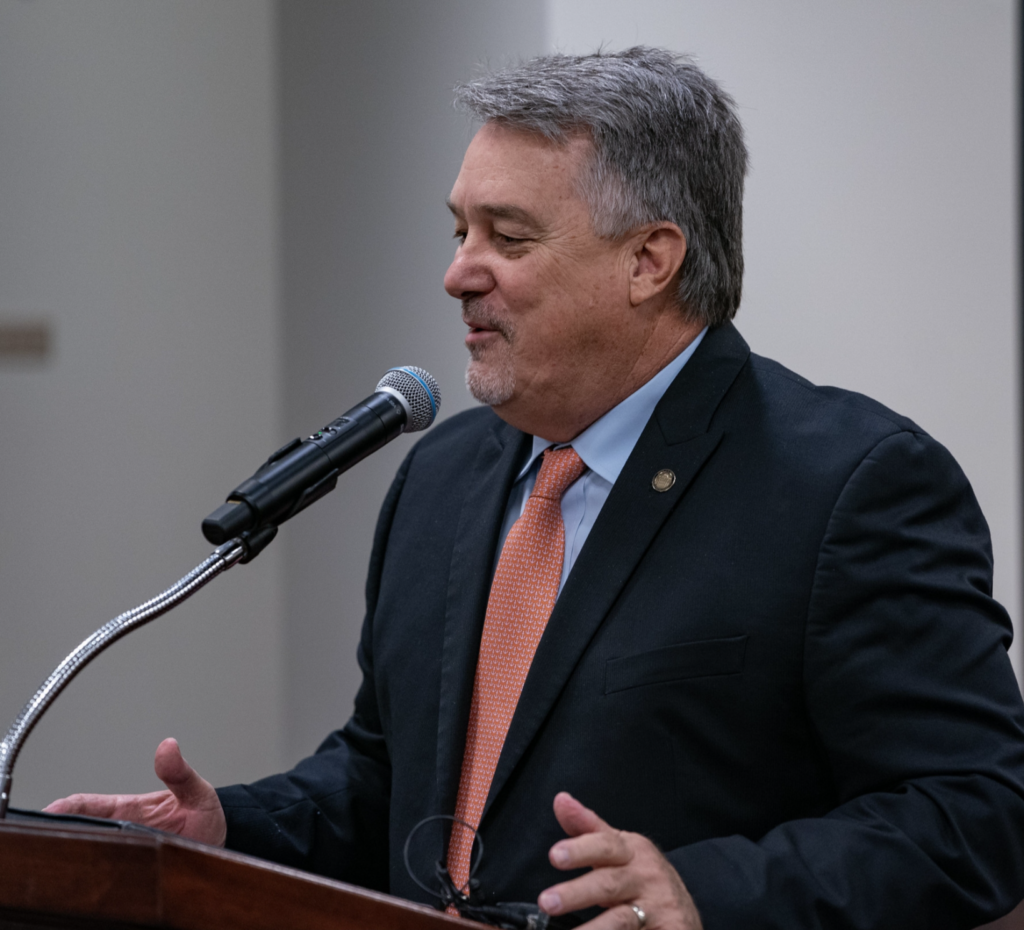
With unemployment still sitting at a record low of 2.1%, the state is looking for ways to increase the number of Alabamians in the workforce. Speaker of the House Nathaniel Ledbetter announced on Monday key House members that will serve on an ad hoc committee studying Alabama’s labor force participation rates and identifying barriers to workforce entry. In July, Gov. Kay Ivey said labor force participation was a top priority. “Despite having one of the lowest unemployment rates in the country and a record number of Alabamians working, the percentage of Alabamians participating in the labor force is lower than almost any other state,” Gov. Ivey wrote in an op-ed. “While we are increasing that by the tens of thousands, we have to change this statistic. Getting folks off the sidelines and into the labor force is my next priority.” In September, Alabama Department of Labor Secretary Fitzgerald Washington announced that Alabama’s Labor Force Participation Rate (LFPR) rose only slightly in August to 57.0%. This is up from last August’s rate of 56.9%. “Alabama is witnessing record-breaking economic growth and historically low unemployment rates,” Ledbetter said in a press release. “Despite these numbers, in Alabama, there are roughly 140,000 job openings and, at the same time, 48,834 unemployed workers across our state. That means we are lacking nearly 100,000 workers over 16 years old, which puts our labor force participation rate at a mere 57 percent—one of the lowest rates in the entire country.” “Yet again, we are announcing record-breaking economic statistics this month,” said Secretary Washington. “While our labor force participation rate remained unchanged, we are continuing to work with marginalized groups to get them into our labor force.” The House Members serving on the study commission will be Rep. Reed Ingram (R–Pike Road) – Chairman; Rep. Danny Garrett (R–Trussville); Rep. Donna Givens (R–Robersdale); Rep. Anthony Daniels (D–Huntsville); Rep. James Lomax (R–Huntsville); Rep. Barbara Drummond (D–Mobile); Rep. Mike Kirkland (R–Scottsboro); Rep. Bill Lamb (R–Tuscaloosa); Rep. Kelvin Lawrence (D–Hayneville); Rep. Curtis Travis (D–Tuscaloosa); Rep. Chris Pringle (R–Mobile); Rep. Matt Woods (R–Jasper); Rep. Wes Kitchens (R–Guntersville); Rep. Jim Carns (R–Birmingham); Rep. Scott Stadthagen (R–Hartselle). “Over the coming months, it will be imperative for this group to build on the progress of, and collaborate with, existing entities such as the Lt. Governor’s Commission on 21st Century Workforce, the Alabama Community College System, Alabama higher-education institutions, and essential stakeholders across the private sector,” stated Ledbetter. Some specific areas the study commission will address are extending adequate childcare to families, examining the correlation between productivity growth and labor output, ensuring wages and salaries are competitive, addressing workforce housing concerns, and offering improved and more expansive mental health programs and services. “An insufficiency of resources such as these creates barriers to workforce entry as much as an absence of quality education,” Ledbetter concluded.
Gov. Kay Ivey signs legislation making Yellowhammer Cookie Alabama’s official state cookie
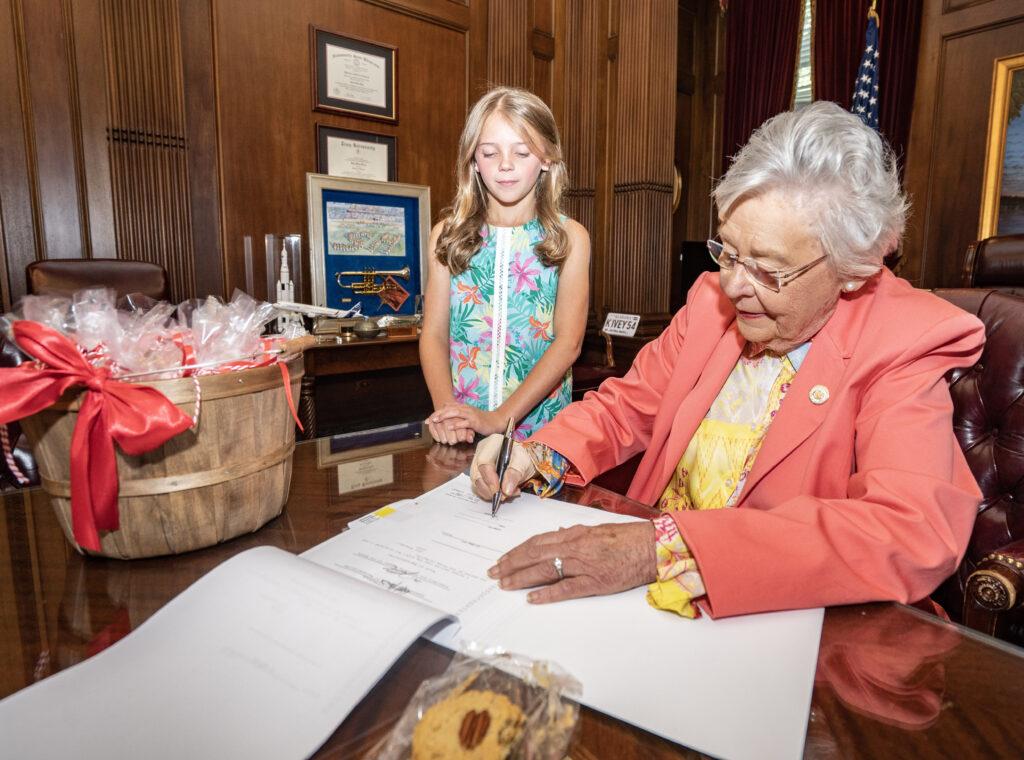
On Friday, Alabama Governor Kay Ivey met with Montgomery 4th grader and recipe creator Mary Claire Cook to consider whether or not to sign legislation making Cook’s creation, the Yellowhammer Cookie, the official state cookie of the State of Alabama. Governor Ivey taste-tested the cookie for herself and gave it the stamp of approval. Ivey added her signature on the bill to officially name the Yellowhammer Cookie the official state cookie. Governor Ivey commented, “Sweet Home Alabama just got a little sweeter!” House Bill 421 (HB421) is sponsored by State Representative Reed Ingram (R-Montgomery). The legislation was carried in the Alabama Senate by State Senator Will Barfoot (R-Pike Road). “This week, you all have had the opportunity to see, and more importantly taste, the yellowhammer cookie,” Barfoot said, holding one up in the air for members to see. “This was brought to me by some fourth graders at Trinity Presbyterian School.” Reed explained that the students learned that Alabama did not have an official state cookie, so the students resolved to fix this situation by holding a cookie contest. The fourth graders submitted cookies, and the seniors judged them. Ultimately the Yellowhammer Cookie was judged the best cookie to submit to the legislature. “Twenty-four recipes were submitted,” Barfoot said. “That was narrowed down to five. Seniors from the government class at Trinity were brought in to judge the cookies, and the yellowhammer cookie was selected.” The cookies contain peanuts, pecans, and oats – all crops grown and well-adapted to Alabama. The pecan is already the official nut of Alabama, and the peanut is the official legume of the state of Alabama. Alabama Today asked Cook if making the cookie was something an ordinary person could do or if it required a factory to produce. “George Washington Carver’s work at Tuskegee Institute on peanuts is important to Alabama,” Barfoot said. Sen. David Sessions (R-Mobile) said, “It has peanuts and pecans. I raise both of them on my farm.” The legislation passed the Senate 35 to 0. Cook was joined at the Statehouse by her teachers Katherine Bandy and Kylie Osborne to lobby legislators. Former Congresswoman Martha Roby (R-AL02) also played an active role in these efforts. Lieutenant Governor Will Ainsworth recognized Cook for her work, and she was applauded by the members of the Senate. Tuesday will be the last day 25 of the 2023 Alabama Regular Legislative Session. To connect with the author of this story or to comment, email brandonmreporter@gmail.com.
Legislature sends the Yellowhammer cookie legislation to Gov. Kay Ivey
On Wednesday, the Alabama Senate voted unanimously to make the Yellowhammer cookie the official cookie of the state of Alabama. The Yellowhammer cookie is the creation of Mary Claire Cook, a fourth-grade student at Trinity Presbyterian School in Montgomery, with some help from her grandmother. The students at Trinity were studying state symbols when they learned that Alabama did not have an official state-designated cookie, so they endeavored to create one. House Bill 421 (HB421) is sponsored by State Representative Reed Ingram (R-Montgomery). The legislation was carried in the Alabama Senate by State Senator Will Barfoot (R-Pike Road). “This week, you all have had the opportunity to see, and more importantly taste, the yellowhammer cookie,” Barfoot said, holding one up in the air for members to see. This was brought to me by some fourth graders at Trinity Presbyterian School.” “Twenty-four recipes were submitted,” Barfoot said. “That was narrowed down to five. Seniors from the government class at Trinity were brought in to judge the cookies, and the yellowhammer cookie was selected.” The cookies contain peanuts, pecans, and oats – all crops grown and well-adapted to Alabama. The pecan is already the official nut of Alabama, and the peanut is the official legume of the state of Alabama. “George Washington Carver’s work at Tuskegee Institute on peanuts is important to Alabama,” Barfoot said. Sen. Linda Coleman-Madison (D-Birmingham) said that the contest to select the state cookie should have been more “statewide.” “I think there should be some guidelines if we are going to do it,” Coleman-Madison said. “There are children who have food allergies to peanuts. I really wish we had some more participation.” “This is state law that we are passing,” Coleman-Madison continued. “When people come to the state of Alabama, this is the state cookie. We need to have some criteria. We need to have some more involvement.” Sen. David Sessions (R-Mobile) said, “It has peanuts and pecans. I raise both of them on my farm.” The legislation passed the Senate 35 to 0. Cook was viewing from the gallery with her teachers Katherine Bandy and Kylie Osborne. Lieutenant Governor Will Ainsworth recognized Cook for her work, and she was applauded by the members of the Senate. The legislation has already passed the House of Representatives. It now goes to the Governor for her consideration. Wednesday was day 25 of the 2023 Alabama Regular Legislative Session. To connect with the author of this story or to comment, email brandonmreporter@gmail.com.
Alabama House votes to advance state cookie legislation
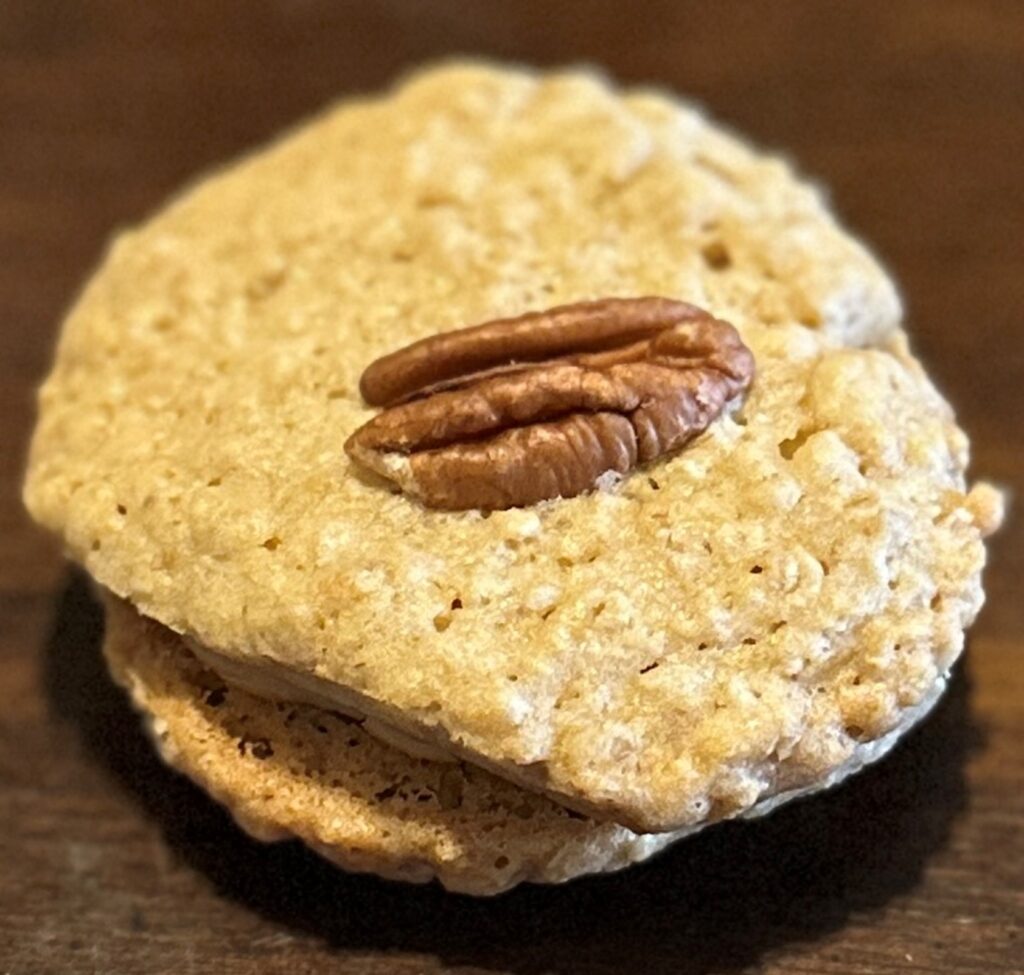
On Tuesday, the Alabama House of Representatives voted to pass legislation establishing the yellowhammer cookie as the official state cookie. House Bill 421 (HB421) is sponsored by State Representative Reed Ingram. Reed explained that legislation making the “Yellowhammer Cookie” the official state-designated cookie was brought to him by the Fourth graders at Trinity Presbyterian School in Montgomery. Katherine Bandy is a counselor at Trinity. “We are learning about state symbols and Alabama history,” Bandy said. “And we figured out that Alabama doesn’t have a state cookie.” Reed explained that the students resolved to fix this situation by holding a cookie contest. The fourth graders submitted cookies, and the seniors judged them. Ultimately the Yellowhammer Cookie was judged the best cookie to submit to the legislature. “We needed a state cookie,” Bandy said. Mary Claire Cook developed the winning recipe. Alabama Today asked Cook if making the cookie was something an ordinary person could do or if it required a factory to produce. “Anyone can make it,” Cook assured. “I make it myself.” The Yellowhammer Cookie contains oats and pecans and has a peanut butter filling. Bandy explained that those three ingredients are essential because they are grown here in Alabama by Alabama farmers. The pecan is already the official nut of Alabama, and the peanut is the official legume of the state of Alabama. Cook explained that she began this project with her grandmother. They looked up recipes and began substituting in Alabama ingredients before arriving at the Yellowhammer Cookie. The Yellowhammer Cookie was chosen over two dozen other submissions. The fourth graders from Trinity were on hand at the House gallery to watch the bill be debated on the Alabama House of Representatives floor. Ingram explained that the last state symbol passed by the legislature was the decision to make the sweet potato the official state vegetable. Speaker of the House Nathaniel Ledbetter recognized the fourth graders for their involvement in the legislative process. At Ledbetter’s request, the whole body gave them a round of applause in recognition of their work. State Rep. A.J McCampbell told Ingram, “Usually when you have a bill, I have got to scrutinize it. The only problem I have with this bill is that you are asking us to designate this the state cookie, and I have not had one. I need a cookie. Where’s my cookie?” Ingram said, “I think they can arrange that.” Rep. Danny Garrett told Ingram, “One thing I have learned about you other than you are a great legislator and a great man is that you know cookies.” Rep. Napoleon Bracy said, “I got into politics when I ran for president of the SGA.” “Students learn Alabama history in the fourth grade,” Bracy explained. Ingram said, “We had a big shout-out to George Washington Carver for his work with the peanut.” Ingram explained that the Yellowhammer Cookie “is kind of like an oatmeal cookie with peanut butter in the middle.” “Is this something that we can mass produce? Have we trademarked this?” Bracy said. “This is something they can talk about on Shark Tank.” “This is something great for these students,” Bracy said. “It is uncontroversial. A lot of times, the first two bills on the calendar are kind of divisive.” Rep. Mary Moore said, “I want to thank you for paying attention to young people. I appreciate you for highlighting Dr. Carver and his work.” Speaker Ledbetter thanked former Congresswoman Martha Roby for helping the children navigate the legislative process with their bill. HB421 was passed 103 to 0. It now goes to the Alabama Senate for their consideration. Ingram told Alabama Today that he thinks Senator Will Barfoot will carry the bill in the Senate. The Art of Alabama Politics Facebook page shared the recipe. Wednesday will be day 22 of the 2023 Alabama Regular Legislative Session. To connect with the author of this story or to comment, email brandonmreporter@gmail.com.
Legislature votes to regulate psychoactive cannabinoids
On Wednesday, the Alabama Legislature approved legislation that set the minimum age to purchase psychoactive cannabinoids at 21. The House of Representatives made several changes to the legislation when they passed it on Tuesday. Specifically, the House voted to jettison a 5% tax on the products that the Senate had included in their version of the bill. The House substitute also added a requirement for stores to put those products out of the reach of children and in child-proof containers. On Wednesday afternoon, the Senate voted to concur with the House changes and send the legislation to the Governor. Senate Bill 66 (SB66) is sponsored by State Senator Tim Melson. It was carried in the Alabama House of Representatives by State Representative Russell Bedsole. Bedsole explained that the legislation deals with psychoactive cannabinoids: Delta 8 and Delta 10. “This legislation contains penalties if you are caught selling this,” Bedsole said. “There are penalties if you are caught in possession of these if you are under 21.” Bledsole explained that these products are packaged in such a way that they are designed and target children. “There is no oversight,” Bedsole said. “Oftentimes, the THC content is much higher than advertised on the packaging.” Rep. Juandalynn Givan said, “Thank you for bringing this. We have had some problems in Jefferson County with students purchasing candies and getting sick. We need to get a handle on what is going on with these candies. We had an incident with a young girl last week in Jefferson County who got really sick from one of these candies.” Givan said that these products sold on the shelves differ from marijuana. “The weed man is my friend,” Givan said. “This bill has nothing to do with the weed man. This is being sold in the open market in convenience stores on the shelf. There is also a problem with cough syrup and other products on the shelf.” “People don’t realize how dangerous these products are,” Bedsole said. “I hope there is a task force like Steve Marshall used to shut these bingos down,” Givan said. “I pray that there is a task force that goes into these stores.” Rep. Chris Sells said, “It is a great bill. I support anything that helps the children.” Rep. Anthony Daniels said, “I don’t understand why we have not to this point cracked down on this. It has had a negative impact on our communities.” Bedsole said, “Originally, this had a tax of five percent on it when it came out of the Senate. That tax has been removed.” “This product must be placed in a place not accessible to children,” Bedsole said. “This product should be behind the counter.” “There will be some form of community service for those below 21 found to be in possession,” Bedsole said, Rep. Barbara Drummond said, “I am so happy to see this bill as well as others that will come. I am for anything that we can do to protect children.” Rep. John Rogers asked, “How do you stop an adult from giving it to the kids?” “You can ask that question about so many laws that are on our books,” Bedsole answered. “We believe this bill is a good first step.” “The sub that came out of committee did not have an additional tax,” Bedsole said. The House voted to adopt the committee substitute 105 to 0. “I have a friendly amendment,” said Rep. Reed Ingram. “All the amendment does is that all the packaging has to be in a child-resistant container.” Bedsole replied, “I do consider the amendment to be a friendly amendment.” The House voted to adopt the Ingram amendment 105 to 0. Rep. Ron Bolton brought an amendment that raised the penalty for a third offense for violating this statute to $400. “The judge could still make the decision to require community service,” Bolton said. SB66 passed the House 105 to 0 On Wednesday, it returned to the Senate. Sen. Melson asked that the Senate concur with the House changes. “All they actually did was remove the tax that we had,” Melson said. “They also put it behind the counter and also put it in child-proof containers. I would like to concur with the House.” The full Senate voted to concur 33 to 0. SB66 now goes to the Governor for her consideration. Thursday will be day 18 of the 2023 Alabama Regular Legislative Session. To connect with the author of this story or to comment, email brandonmreporter@gmail.com.
House Committee advances legislation to levy stiff penalties on violent crimes using a firearm

On Wednesday, the Alabama House Public Safety and Homeland Security voted to advance legislation that would crack down on crimes involving the use of a firearm. House Bill 301 is sponsored by State Representatives Reed Ingram. According to the synopsis, this bill would establish a list of criminal offenses deemed felonies dangerous to human life. The bill would provide enhanced criminal penalties for possessing, brandishing, or discharging a firearm while committing a felony dangerous to human life. This bill would also prohibit possessing a firearm by certain individuals released on bond or personal recognizance when the underlying criminal offense for which the person was arrested is a felony dangerous to human life. It would prohibit the possession of a firearm by certain individuals previously convicted of a felony dangerous to human life within a 25-year period. Rep. Ingram introduced an amendment to the bill in Committee. “The Amendment removed some of the mandatory sentencing,” Ingram said. Rep. Tim Wadsworth asked, “They can’t get probation? They can’t get community corrections? They can’t get a split sentence?” Ingram replied, “Only if they commit the crime.” Barry Matson is the Executive Director of the Alabama District Attorneys Association. Rep. Allen Treadaway Chairs the House Public Safety and Homeland Security Committee. Chairman Treadaway asked about concerns that the Judges Association had with the bill. “We have been working with the bill for quite a long time,” Matson told the Committee. “We will continue to work on this before it gets to the floor.” Matson explained that the Alabama Judges Association has asked that the bill be carried over in Committee. However, the amendment removing the mandatory minimums addressed the judges’ concerns. While he has not yet gotten agreement from Judge Phil Seay, head of the Judges Association – they are longtime friends, and he believes that this amendment has addressed most of the judges’ concerns with the legislation. Alabama has the fifth highest rate of gun deaths (murder, suicide, and accidents combined) in the nation. The Public Safety and Homeland Security Committee voted to give HB301 a favorable report as amended. The legislation could be considered by the full House of Representatives as early as Tuesday. Tuesday will be day 14 of the 2023 Alabama Regular Legislative Session. The Alabama Constitution of 1901 limits the regular session to a maximum of thirty legislative days in a regular session. To connect with the author of this story or to comment, email brandonmreporter@gmail.com.
Legislature passes bill to prevent municipalities from adding to state building codes

On Thursday, the Alabama Legislature passed legislation that would prevent municipalities from adding additional requirements for homebuilders that are not found in the state building code. Senate Bill 40 (SB40) is sponsored by State Senator Chris Elliott. The legislation was carried in the Alabama House of Representatives by State Representative Reed Ingram. Rep. Ingram told the Legislature that extra demands from municipalities were driving up the cost of new home construction. “A lot of municipalities are making them do extra work,” Ingram said. “They are making that add extra support for roof solar panels and add extra wiring for electric stoves in homes in a subdivision that are built for gas stoves.” SB40 prohibits the adoption or enforcement of certain building codes requiring the installation of certain latent, non-operable features in a residential structure.” “It is not what the builder wants or what the homeowners want,” Ingram explained. “They are making them run a 220 line and do a lot of extra work for electric stoves that are not needed. It affects every home in the entire subdivision. You have never had to do that before.” “This is a bill from the Homebuilders Association,” Ingram explained. “This is happening all over the state. It is adding extra cost for the homeowner.” Rep. Laura Hall asked if the League of Municipalities opposed this. Ingram said, “It came through my committee, and we had no group opposition.” “Some are also requiring to wire for electric cars,” Ingram said. “The homeowner may not want an electric car. You can always go back and wire in for electric cars.” “When you are building a spec home, if a builder wants to have all gas or electric, that is his choice,” Ingram added. Rep. Scott Stadthagen said, “I want to thank you for your efforts on behalf of the homebuilding industry. Rep. Brett Easterbrook said, “I have been a home builder for 38 years. We are probably spending $25,000 and $30,000 extra on a house in Mobile and Baldwin Counties because of this.” Rep. Curtis Travis said, “I want to thank you for bringing this bill to give some control over the arbitrary decisions of local governments.” Rep. Anthony Daniels said,” This is a good bill that will help consumers. I am supportive of this bill.” Rep. Mack Butler said, “This is a liberty issue.” SB40 passed the House of Representatives 104 to 0 without amendment. It has already passed the Senate, so it now goes to the Governor for her consideration. Tuesday will be Day 14 of the 2023 Alabama Regular Legislative Session. The Alabama Constitution of 1901 limits the Legislature to no more than thirty days in a regular session. To connect with the author of this story or to comment, email brandonmreporter@gmail.com.
Judge strikes down Alabama laws against panhandling

A federal judge last week struck down Alabama laws against panhandling, ruling that the statutes are unconstitutional. U.S. District Judge W. Keith Watkins issued the order Friday permanently enjoining the state from enforcing the laws against begging and pedestrian solicitation. The ruling came after the Alabama Law Enforcement Agency conceded that the appellate court ruled similar laws violate a person’s right to free speech. The decision ended litigation filed in 2020 challenging the laws on behalf of people who had been ticketed or jailed for panhandling in Montgomery. Legal groups that filed the lawsuit said the laws criminalized poverty. “The injunction is a victory for marginalized groups that find themselves in tough economic circumstances and in need of help,” Tish Gotell Faulks, legal director for the American Civil Liberties Union of Alabama, said in a statement about the litigation. “Criminalizing the solicitation of charitable donations does nothing to advance public safety. Instead, it multiplies already existing barriers for people experiencing homelessness. This can include unaffordable fines and fees, the loss of their freedom through incarceration, and a criminal record – all of which are obstacles to obtaining housing and economic security.” State lawyers conceded in an earlier court filing that the judge was bound by a decision from the 11th U.S. Circuit Court of Appeals finding such statutes as a violation of free speech rights. “The First Amendment was not originally understood to require the government to permit panhandling on public … even so, that begging is entitled to First Amendment protection is currently the law of this circuit,” state attorneys representing Alabama Law Enforcement Agency Secretary Hal Taylor wrote. Alabama lawmakers in the coming weeks are expected to take up new legislation aimed at preventing people from loitering on public highways, which could be a new avenue to target panhandlers. The bill by Republican Rep. Reed Ingram of Pike Road would increase the penalties for loitering on the side of state highways. “This bill is a public safety bill. We’re going after making the roads safer,” Ingram said. Ingram said he expects to adjust the legislation to spell out that the officer has the option to take the person to a shelter. “We want to find out if this person has mental health issues, drug issues whatever it may be, so we can find a way to help,” he said. Ingram said he expects the bill to be debated by a legislative committee as soon as next week. Republished with the permission of The Associated Press.
Ten pre-filed bills to watch
Winter is almost over. The coming of Spring means flowers, cutting grass, weekend trips to the beach, lazy days on the lake fishing, turkey hunting, and baseball. It also means the Alabama Legislature is returning for the 2023 Alabama Regular Legislative Session. The constitutional purpose of the legislative session is to pass the state budgets for 2024. However, Alabama has 105 members of the State House of Representatives and 35 members of the Alabama Senate, and all of them have their own ideas about laws that they want to change. Thirty-six bills have already been pre-filed ahead of the session. Some of these bills will be dead on arrival and won’t even get a hearing in committee. Some bills, like increasing the scope of practice for podiatrists to include procedures on the ankle, are debated almost every year. This year that bill is being carried by Sen. Greg Albritton as Senate Bill 8 (SB8). The podiatrists’ scope of practice is limited by state law. This bill would make Alabama more in line with other states regarding podiatry. In the past, this legislation has been staunchly opposed by orthopedic surgeons and the Alabama Medical Association. One bill on a fast track toward passage increases the criminal penalties for drug traffickers who sell and distribute fentanyl. House Bill 1 is sponsored by State Representative Matt Simpson. This bill “would provide for mandatory terms of imprisonment for a person who engages in the unlawful sale, manufacture, delivery, or possession of one or more grams of fentanyl as a single component. This bill would also impose additional criminal penalties for subsequent violations.” As introduced, HB1 would make the sale, manufacture, or possession of one gram or more of fentanyl “trafficking” under Alabama Law. The penalty for one to less than two grams of fentanyl would be a mandatory minimum sentence of three years in prison and a minimum fine of $50,000. If two grams, but less than four grams, the mandatory minimum sentence would be ten years and a fine of $100,000. For four grams or more but less than eight grams, the sentence would be at least 25 years and a fine of $500,000. If eight grams or more life and $750,000. 107,000 Americans died of drug overdoses in 2021 – most of them from fentanyl. In Alabama, high schools dealing with overdoses during the school day is becoming a real problem for teachers and administrators. New Speaker of the House Nathaniel Ledbetter told reporters during the organizational session in January that Simpson’s legislation will be a top priority for the House Republican Caucus this session. Expect early movement on this bill. Senate Bill 12 (SB12) would make Law Enforcement Memorial Day, which is celebrated on the first Friday in May of each year, a state holiday. The bill was sponsored by State Sen. Will Barfoot. State Rep. Russell Bedsole has introduced similar legislation in the House as HB5. House Bill 4 (HB4) would make it a felony for employers to have their employees microchipped. HB4 “would prohibit employers and certain other individuals from requiring another individual to be implanted with a microchip. This bill would also make a violation of this act a Class D felony.” HB4 is sponsored by State Rep. Prince Chestnut. House Bill 24 (HB24) would ban persons “from loitering on a public roadway or in the right-of-way of a public roadway.” HB24 is sponsored by Rep. Reed Ingram. The legislation would also ban fishing from bridges. House Bill 6 (HB6) is a parental rights bill sponsored by Rep. Kenneth Paschal. HB6 would “provide that the government may not burden certain fundamental rights of parents unless the burden is narrowly tailored to a compelling state interest.” The bill affirms that fit parents have a fundamental right “to direct the education, upbringing, care, custody, and control of their children.” State Rep. Ed Oliver has introduced a bill to ban the teaching of divisive concepts. That legislation is House Bill 7. “This bill would prohibit certain public entities, including state agencies, local boards of education, and public institutions of higher education, from promoting or endorsing, or requiring affirmation of, certain divisive concepts relating to race, sex, or religion.” Banned concepts would include: a. That any race, color, religion, sex, ethnicity, or national origin is inherently superior or inferior. b. That individuals should be discriminated against or adversely treated solely because of their race, color, religion, sex, ethnicity, or national origin. c. That the individual moral character of an individual is solely determined by his or her race, color, religion, sex, ethnicity, or national origin. d. That solely by virtue of an individual’s race, color, religion, sex, ethnicity, or national origin, the individual is inherently racist, sexist, or oppressive, whether consciously or subconsciously. e. That individuals, by virtue of race, color, religion, sex, ethnicity, or national origin, are inherently responsible for actions committed in the past by other members of the same race, color, religion, sex, ethnicity, or national origin. f. That fault, blame, or bias should be assigned to a race, color, religion, sex, ethnicity, or national origin, or to members of a race, color, religion, sex, ethnicity, or national origin, solely on the basis of race, color, religion, sex, ethnicity, or national origin. g. That any individual should be asked to accept, acknowledge, affirm, or assent to a sense of guilt, complicity, or a need to apologize solely on the basis of his or her race, color, religion, sex, ethnicity, or national origin. House Bill 14 (HB14) by Rep. Chris England would require that a death penalty sentence can only be applied when there is a unanimous vote of the jurors to impose the death penalty. Presently all it takes is a majority of the jurors. House Bill 12 (HB12), also sponsored by England, would make it a class A misdemeanor if a person carrying a concealed firearm fails to inform law enforcement upon request that he or she is in possession of a concealed pistol or firearm. This
Nathaniel Ledbetter announces a second round of House committee chairs
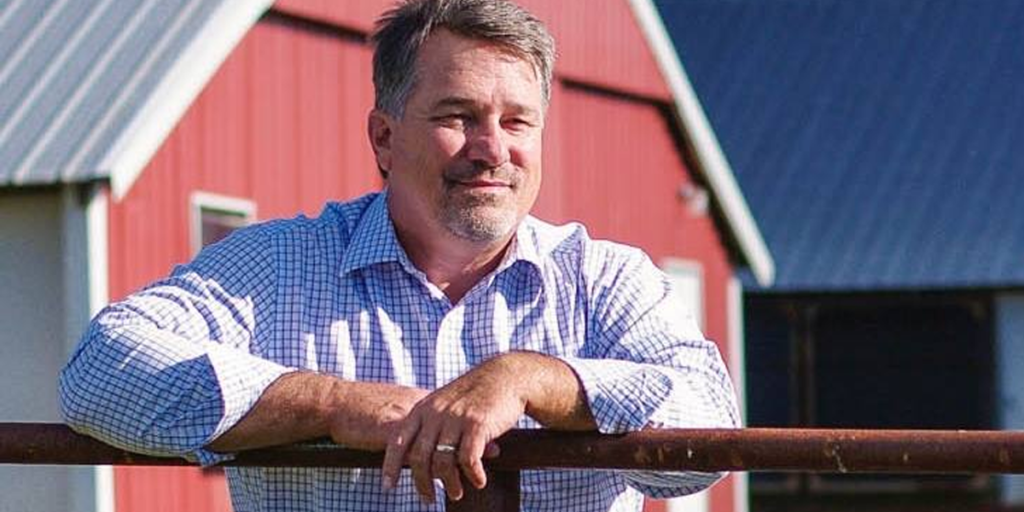
State Rep. Nathaniel Ledbetter announced his second round of committee chairs on Monday. Ledbetter is the Alabama House Republican Caucus choice to be the next Speaker of the House in the Alabama House of Representatives, and under the rules of the Legislature, the Speaker appoints most of the committee chairs. Ledbetter announced the appointment of Rep. Jim Carns to serve as Chair of the House Commerce and Small Business Committee, a role he previously held under outgoing Speaker Mac McCutcheon. Carns served in the state legislature from 1990 to 2006. From 2006 to 2010, he served on the Jefferson County Commission. He returned to the House in 2011. Carns is a businessman with experience in manufacturing. Ledbetter announced the appointment of State Rep. Margie Wilcox to chair the Boards, Agencies, and Commissions Committee. Wilcox returns for her third consecutive term in the Legislature. During the last quadrennium, Wilcox chaired the Alabama Legislature’s Joint Transportation Committee and the Joint License Plate Oversight Committee. Wilcox owns and operates a taxicab company in Mobile. She has previously served as vice chair of the House County and Municipal Government Committee. Rep. Danny Crawford returns as the Agriculture and Forestry Committee chair. Crawford was elected to the Alabama House in a 2016 special election. He served on the Athens City Council from 1993-2005 and was employed with the Farm Service Agency for 33 years. He was appointed state director by President George W. Bush in 2001. State Rep. Reed Ingram will return as the chair of the County and Municipal Government Committee. Ingram served in the House since 2014 and was the chair of the County and Municipal Government Committee since 2018. Ingram is a well-known businessman and restauranter from Montgomery. He previously served on the Montgomery County Commission from 2004 to 2014. Ledbetter is appointing State Rep. Randall Shedd to chair the Transportation, Utilities, and Infrastructure Committee. Shedd has served in the House since 2013. He previously served as the chairman of the Cullman County Commission and as the mayor of Fairview. He worked as the director of the Cullman County Commission on Aging. Shedd previously chaired the House Urban and Rural Development Committee and was vice chair of the House Children and Senior Advocacy Committee. “From rural to urban areas, from employers to employees, and from tradesmen to consumers, the collective decisions made by these committees affect every Alabamian in some manner,” Ledbetter said. “All of these individuals have my full faith and confidence, and I am certain they will always work on behalf of the citizens each of us seek to serve.” Ledbetter has previously announced his first round of appointments. All of these appointments are conditional on Ledbetter being selected as Speaker in the organizational session of the House of Representatives in January. Since Republicans hold a 77-member supermajority in the 105-member Alabama House, it is highly likely that Ledbetter will be selected as Speaker, so will then be able to make these appointments officially. Ledbetter has served in the House since 2014. He previously was the Mayor of Rainsville and has served on the town council. He has worked for the Sand Mountain Electric Cooperative as accounts manager. To connect with the author of this story, or to comment, email brandonmreporter@gmail.com.
Steve Flowers: Incumbency prevails in 2022 State House races
Folks, believe it or not, we are closing in on six months before next year’s election year. The primary election is set for May 24, 2022. In Alabama, all our major constitutional officers are on the ballot next year. The governor’s office is the premier race in the state, and that coveted and powerful post is set for its four-year quadrennial run. Therefore, this big political year is referred to as the gubernatorial year. Those of us who follow Alabama politics have been salivating with anticipation for a cavalcade of great races. However, the power of incumbency has devasted the big year into a yawn. All the major state offices are held by popular incumbents, who are either running unopposed or have minimal opposition. The consolation prize was that there would be the legislative races. After all, this is where the real power in the state rests. You can simply look at where the special interest and PAC money is spent to verify that fact. However, the omnipotent power of incumbency has also encroached on those races. The Alabama House of Representatives has 105 members. There are 77 Republicans and 28 Democrats. The large majority of incumbents are running for reelection – both Republicans and Democrats. The overwhelming majority of these incumbents will have no opposition. However, in the House, there will be some major changes in leadership because of retirement or moving on to new posts. Speaker of the House Mac McCutcheon is not running for reelection. This has created an interesting and spirited race within the Republican Caucus ranks for Speaker. In addition, Victor Gaston of Mobile, who is Speaker Pro Tem, is also retiring. Bill Poole of Tuscaloosa, who chaired the powerful House Ways and Means Education Budget Committee, has left the House to be the State Finance Director. House Rules Committee Chairman Mike Jones of Andalusia is running for the open Senate seat of retiring Senator Jimmy Holley. Two of the freshman House members are running for statewide office. Wes Allen of Troy is running for Secretary of State, and Andrew Sorrell of Tuscumbia is running for State Auditor. In addition, Connie Rowe of Jasper is leaving the House to become an administrative assistant to Lt. Gov. Will Ainsworth. Some of the veteran House members who are choosing to hang up their legislative cleats include Howard Sanderford of Huntsville, Mike Ball of Huntsville, K.L. Brown of Jacksonville, Kerry Rich of Marshall, Allen Farley of Jefferson, Harry Shiver of Baldwin, Mike Holmes of Elmore, and Becky Nordgren of Etowah. The most noteworthy retiree may be Representative Steve McMillan of Baldwin County, who is retiring after serving close to 43 years in the House. Steve has been a quiet yet very effective voice for the people of Baldwin County. They all will be missed. Some of the high profile and powerful members of the House, who will return for another four years with no or token opposition, are Steve Clouse of Ozark, Nathaniel Ledbetter of Dekalb County, and Danny Garrett, Jim Carns, David Wheeler, and David Faulkner of Jefferson. Danny Garrett has ascended to Chairman of the House Ways and Means Education. Other leaders returning are Chris Pringle, Reed Ingram, Randall Shedd, Tracy Estes, Chris Sells, David Standridge, Ginny Shaver, Jim Hill, Alan Baker, Joe Lovvorn, Chris Blackshear, Kyle South, Paul Lee, Jeff Sorrells, Rhett Marques, Steve Hurst, Joe Faust, and Margie Wilcox. The Democratic leadership will remain intact. There is an illustrious array of House Democratic leaders, including Anthony Daniels, Chris England, Laura Hall, Peb Warren, Barbara Boyd, A.J. McCampbell, Berry Forte, Dexter Grimsley, Thomas Jackson, Kevin Lawrence, Mary Moore, Juandalynn Givan, and veteran John Rogers. Two of the Democratic House veterans from Jefferson County, Louise Alexander and Merika Coleman, are both running for an open Jefferson County Senate Seat, leaving both their House seats up for grabs. There may be an increase in the number of females in the House of Representatives. It has already begun with the election of Cynthia Almond of Tuscaloosa, who was elected without opposition to replace Bill Poole. In addition, Patrice Penni McClammy won the Montgomery District 76 seat of her late father, Thad McClammy. She won with no opposition. See you next week. Steve Flowers is Alabama’s leading political columnist. His weekly column appears in over 60 Alabama papers. He served 16 years in the state legislature. Steve may be reached at www.steveflowers.us.
