
Viewers’ guide: Rising tensions on display in 3rd GOP debate
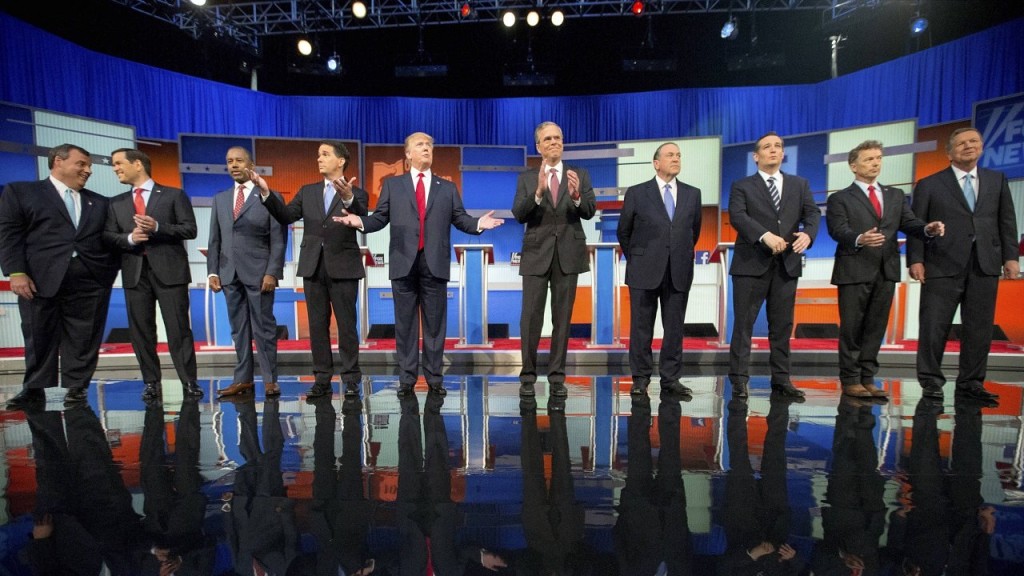
Expect the 10 candidates participating in the third Republican presidential debate to highlight rising tensions in the unsettled field. Political outsiders Donald Trump and Ben Carson are the front-runners in national polls, and they may take aim one another during the 8 p.m. EDT debate in Boulder, Colorado. But the anticipated sparring among the experienced politicians in the race could prove just as intense, given the dwindling time for them to stand out in the crowded contest. The 2016 voting starts Feb. 1 in Iowa. Some things to look for in the two-hour debate: — JEB THE REASSURER Jeb Bush‘s standing in the race has never been weaker. The former Florida governor is the son and brother of presidents. Because of his overwhelming financial advantage, he was considered the front-runner for several months, even when he started to lag in the polls. But his campaign showed signs of financial distress last week by announcing a big payroll cut. The internal problems shined new light on Bush’s liabilities, including underwhelming showings as a campaigner. He needs to have a strong night to help reassure nervous supporters that he has the strength to survive a suddenly uphill battle. — ET TU, RUBIO No one is better positioned to benefit from Bush’s struggles than his Florida protege, Marco Rubio. Especially after Wisconsin Gov. Scott Walker quit the race, the 44-year-old first-term senator is considered one of the few candidates who can bridge the GOP’s warring factions by appealing to establishment and hard-line wings. Bush’s team has identified Rubio as its greatest threat. The two may be longtime friends, but expect Bush to go on the attack. Rubio has largely avoided getting dragged into the back-and-forth so far. He may have no option Wednesday night. — IT’S NOT BRAIN SURGERY Carson, a retired neurosurgeon, may be one of the least known candidates despite his top-of-the-pack polling. After playing bit parts in the first two debates, Carson has become a higher priority for his rivals, particularly those chasing the antiestablishment vote. None has gone after Carson more aggressively than billionaire businessman Donald Trump, who has questioned Carson’s energy, policies and religion. The soft-spoken Carson has refused to counterattack, but expect him to defend himself and explain his positions in the face of mounting pressure. His aides also hope he will tone down the rhetoric; during the campaign he’s made references to Nazis and slavery. — TRUMP LOOKING UP Only in the past week or two has Trump shown signs of vulnerability, but the showman is the ultimate wild card on the debate stage. He has shown a willingness to say or do virtually anything on national television, and heading into the debate, he has jabbed at just about every challenger – none more so than Carson. Based on the ratings in previous debates, people are drawn to the Trump show, but are they growing tired of his act? — THE OTHERS New Jersey Gov. Chris Christie was a political powerhouse not long ago. Kentucky Sen. Rand Paul was among the most interesting figures in politics. Texas Sen. Ted Cruz was a champion college debater. Former technology executive Carly Fiorina was an earlier debate winner. Yet all came into Wednesday night’s round as supporting actors. With 10 candidates on the stage for two hours, there simply won’t be enough time for everyone to stand out – and some of them need to. Republished with permission of The Associated Press.
GOP debate fact check: Jeb Bush did not bend in opposition to casino gambling
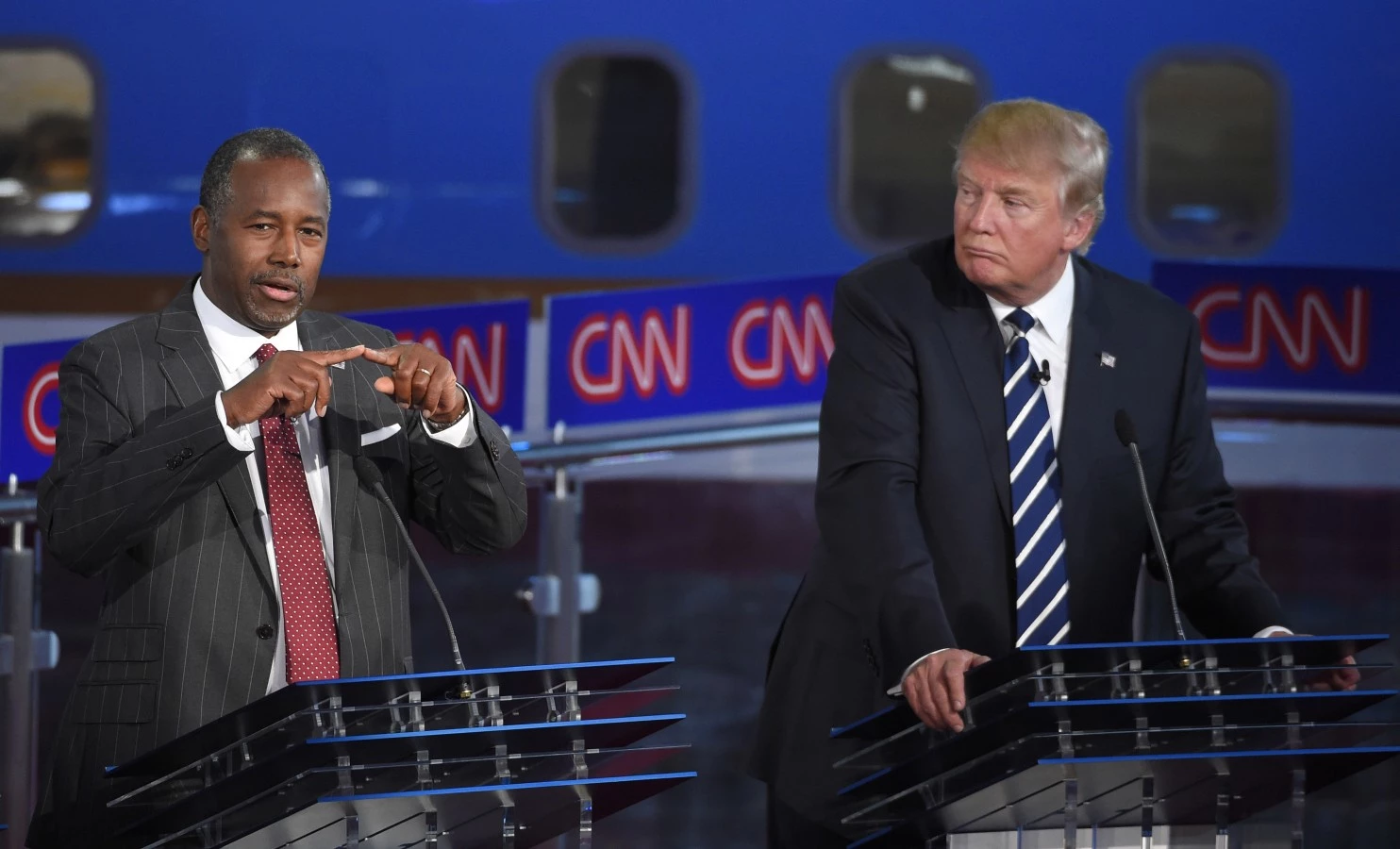
Viewers of the second Republican presidential debate heard inflated claims about Planned Parenthood abortion practices and the risks of vaccines, as well as a dubious assertion by Donald Trump that he wasn’t interested in establishing casinos in Florida back in Jeb Bush‘s days as a candidate for governor. Some of the claims in the debate Wednesday night and how they compare with the facts: TRUMP: “I’m in favor of vaccines, do them over a longer period of time, same amount, but just in little sections and I think you’re going to see a big impact on autism.” THE FACTS: Medical researchers have debunked claims that vaccines given to children can lead to autism and developmental disorders. The Institute of Medicine, part of the National Academy of Sciences, says vaccines are not free from adverse effects, “but most are very rare or very mild.” A study that drew a connection between autism and vaccines was retracted in 2010. For all of that, Trump asserted that a child of one of his employees “went to have the vaccine and came back and a week later got a tremendous fever, got very, very sick, now is autistic.” With those remarks, Trump waded into subject matter that had scalded a few others on the stage. In February, Paul said he’d heard of “many tragic cases of walking, talking normal children who wound up with profound mental disorders after vaccines.” But he quickly backed down under criticism from pediatric experts and others, and endorsed vaccines. New Jersey Gov. Chris Christie, too, clarified that he supported the measles vaccine after appearing to question it. — BUSH: “The one guy that had some special interests that I know of that tried to get me to change my views on something – that was generous and gave me money – was Donald Trump. He wanted casino gambling in Florida.” TRUMP: “I didn’t. … Totally false….” BUSH: “I’m not going to be bought by anybody.” TRUMP: “I promise if I wanted it, I would have gotten it.” THE FACTS: Trump’s hopes of expanding casino operations in Florida in the mid-1990s were well known at the time. Trump employed a prominent lobbyist to represent his gambling interests in Florida. And news reports from that time show he hosted a fundraiser to help Bush’s campaign for governor and donated $50,000 to the Florida Republican Party during that campaign. Bush did not bend in his opposition to casino gambling. It is not clear whether Trump approached Bush directly on the casino matter, but his interest in the enterprise is a matter of record. — TEXAS SEN. TED CRUZ: “On these videos, Planned Parenthood also essentially confesses to multiple felonies. It is a felony with 10 years’ jail term to sell the body parts of unborn children for profit. That’s what these videos show Planned Parenthood doing.” THE FACTS: The Center for Medical Progress released five videos showing furtively recorded conversations with Planned Parenthood officials, recorded by people posing as representatives of a fictitious private company that buys fetal tissue for researchers. In the videos, Planned Parenthood officials discuss how they obtain tissue from aborted fetuses for research, how they decide how much to charge and how it’s possible to alter the procedure to enhance the chances of recovering the organs being sought. But the officials also repeatedly say they are only allowed by law to recover costs, not to make a profit. The videos don’t unambiguously show otherwise. — CHRIS CHRISTIE: “In New Jersey, we have medical marijuana laws, which I’ve supported and implemented.” THE FACTS: Christie has gone slow in implementing New Jersey’s medical marijuana law, which was signed before he took office, and has argued it is little more than “a front for legalization.” Medical marijuana in New Jersey is tightly restricted and state lawmakers said Christie’s administration has placed “arbitrary and unnecessary” restrictions on the program. Patients and doctors, for instance, must register with the state and pay a $200 fee apiece. Only patients suffering from one of six conditions, including terminal cancer, multiple sclerosis and muscular dystrophy, may apply. — TRUMP: “In Wisconsin, you’re losing $2.2 billion right now. … I would do so much better than that.” WISCONSIN GOV. SCOTT WALKER: “Mr. Trump, you’re using the talking points of the Democrats. … We balanced a budget.” THE FACTS: Trump’s figures are way out of date. Wisconsin, like many states, is required by law to balance its budgets. Last year, the Legislature’s budget-watchers projected that a $1 billion surplus would accrue by June of this year. Walker and his GOP-run legislature later passed a series of tax cuts. But state revenues slowed and by November the projected surplus had turned into a $2.2 billion projected shortfall. After making a series of budget cuts to compensate, Walker in July signed a budget that was balanced, as the law requires. — TRUMP: “I want to build a wall, a wall that works. So important, and it’s a big part of it.” BEN CARSON: “I was down in Arizona a few weeks ago at the border. I mean, the fences that were there were not manned, and those are the kind of fences when I was a kid that would barely slow us down. So, I don’t see any purpose in having that.” THE FACTS: The expectation that a fence all along the border with Mexico could stop illegal crossings is not borne out by the fencing that’s already been built – about 700 miles of it. But neither is that fence as porous as Carson suggests. The reality is somewhere in between. Maintaining the existing multibillion-dollar fencing has been a time-consuming task for Border Patrol agents, who routinely patrol the fence line looking for holes or other damage. It was never designed, or expected, to block all illicit traffic from coming across the border, but instead to act as a deterrent and slow those who try crossing on foot. Even so, a fence section that appears unmanned is not
10’s a crowd? GOP prepares for double digits on debate stage
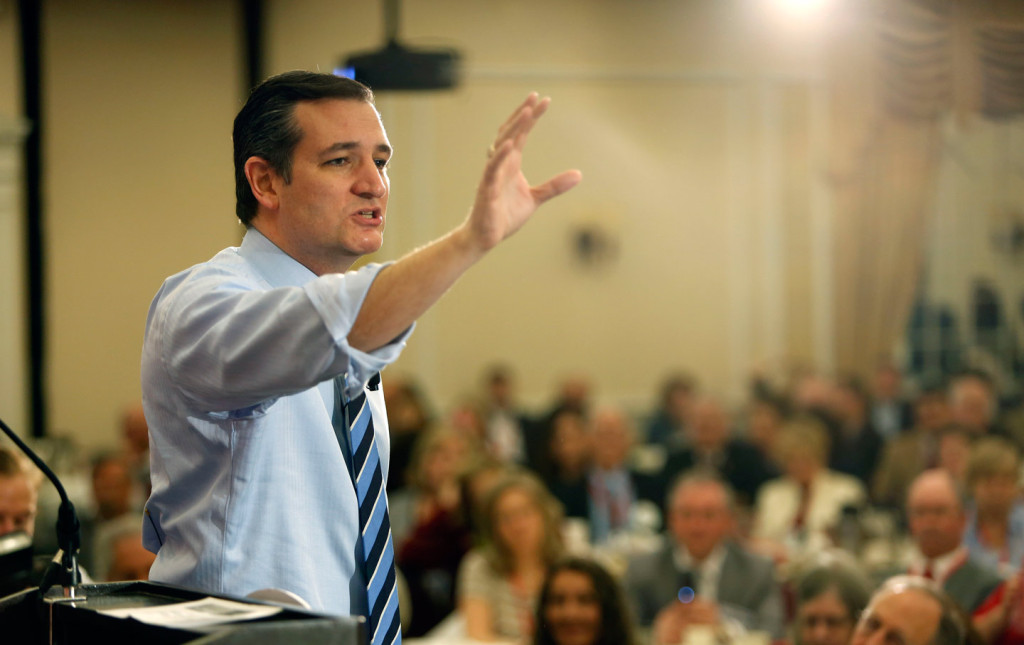
The first Republican presidential debate will feature no fewer than 10 candidates. That’s according to guidelines released Wednesday by debate hosts Fox News and Facebook, which offer the first clues as to how the GOP will handle its largest presidential class in recent memory. Party officials have been working privately in recent weeks to prevent its first debate in August from becoming a nationally televised circus, while lesser-known candidates have been lobbying for access. Only announced candidates will be allowed to participate, according to the new guidelines. Participation will be limited to those who “place in the top 10 of an average of the five most recent national polls, as recognized by Fox News.” More than 10 candidates would be allowed on the debate stage in the event of a tie. At least 15 high-profile contenders are expected to compete for a spot, a group likely to include eight current or former governors, four senators, two accomplished business executives and a renowned neurosurgeon. There will be winners and losers under the new system. The winners could include the likes of Donald Trump, a businessman and reality television star who has already launched a presidential exploratory committee. While some party officials were reluctant to grant him a spot on stage should he run, he has placed within the top 10 in most recent polls. The losers could include statewide office holders who have struggled to gain national traction. Those on the bubble include former Texas Gov. Rick Perry, Louisiana Gov. Bobby Jindal, 2012 presidential candidate Rick Santorum, Ohio Gov. John Kasich, and former technology executive Carly Fiorina, the only woman in the Republican field. Their roads to the White House would be even steeper without the opportunity to stand out in a nationally televised debate. “I’ll look forward to making the cut and making my case to GOP voters on Aug. 6,” Fiorina wrote on Twitter. Several candidates have lobbied Republican officials in recent weeks to consider creative options, including debate “heats” featuring seven or eight candidates at a time on consecutive nights. CNN, which plans to hold a GOP debate in September, said Wednesday it will divide its event into two parts: one featuring the 10 highest-polling candidates, the other including “candidates who meet the minimum threshold of 1 percent in public polling but are ranked outside the top 10.” Republican National Committee Chairman Reince Priebus said, “We support and respect the decision CNN has made.” For its August debate, Fox News also promised to provide “additional coverage and air time … to those candidates who do not place in the top 10,” according to Michael Clemente, the network’s executive vice president of news editorial. There will be 12 GOP presidential debates between August and March, with the first scheduled for Aug. 6 in Cleveland. The moderators for the first meeting include Fox anchors Bret Baier, Megyn Kelly and Chris Wallace. Republished with permission of The Associated Press.
Rick Perry to say June 4 if he’ll run again for President
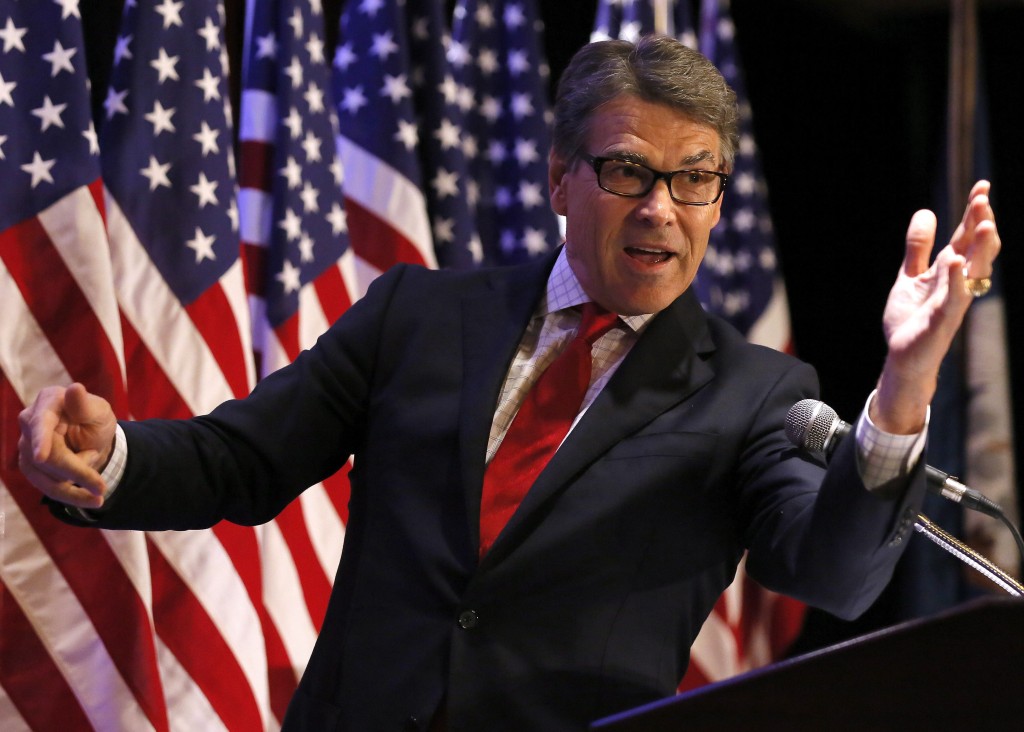
Former Texas Gov. Rick Perry will say whether he is running for president at an announcement next month in Dallas. The longest-serving governor in Texas history has spent months traveling in the early voting states of Iowa, New Hampshire and South Carolina as he gears up for a second White House bid. Perry’s wife, Anita, tweeted the first word of Perry’s plan for an announcement and then emailed supporters about it. “America is facing a time of testing, and it’s clear that we need principled leadership and an optimistic vision to see us through after eight years of the Obama Administration,” she wrote. A spokesman said Friday Perry is not ready to declare his candidacy. “He’s announcing his intentions on June 4,” Perry spokesman Travis Considine said in Washington, where he was traveling with Perry. “He has not said what he’ll be announcing. You’ll have to stay tuned.” Asked if he knew whether Perry had made up his mind, senior adviser Jeff Miller said, “I do know that,” but refused to give any details. When Perry got into the 2012 presidential race, he announced his campaign in South Carolina. He entered as a potential front-runner but flamed out after a series of blunders, including an infamous “oops” moment when Perry couldn’t remember, during a GOP debate, the name of the third Cabinet agency he wanted to eliminate. Perry left office in January and is facing a criminal abuse-of-power indictment in Austin for threatening in 2012 to veto state funding for public corruption prosecutors and then doing so. Besides maintaining his travel schedule, Perry has been studying with policy experts in an effort to make a stronger impression than he did in his first presidential run. Republished with permission of the Associated Press.
GOP wrestling with too many ’16 prospects for a TV debate
Never have more than 10 candidates taken the stage for a televised Republican presidential debate. Wish the GOP luck in trying to keep it that way. With the party’s first debate set for August, Republicans must decide to either allow what could become a nationally televised circus act, or figure out how to fairly whittle down a field likely to include eight current or former governors, four senators, two accomplished business executives and a renowned neurosurgeon. More than a half-dozen contenders have already begun to lobby party officials for access in a debate season that could be unlike any other. The GOP has an advantage in drawing “one of the most diverse, broad” fields it’s ever had, said Saul Anuzis, a former Republican National Committee member from Michigan. “But what if by the first debate we still have 10 to 15 viable candidates? That’s going to be a zoo.” Part of the problem is basic math. In a 90-minute debate featuring so many candidates, there would be only enough time for opening and closing statements and two, maybe three questions — with no time left over for the interaction between candidates that makes for an actual debate. Thus, a process filled with opportunity as the GOP seeks to highlight its diverse crop of candidates, but also fraught with risk as some of the traditional ways of making the cut could exclude some who have won statewide office, not to mention the only woman and African-American in the field. “This is the political equivalent of breaking an atom open,” said Republican National Committee strategist Sean Spicer. Worried they might be left out, several candidates are encouraging the RNC to consider creative options, including debate “heats.” Brad Todd, an adviser to the super PAC backing Louisiana Gov. Bobby Jindal, is pushing RNC Chairman Reince Priebus to hold two 90-minute debates on consecutive nights featuring different groups of candidates. Rick Santorum, the runner-up in the 2012 Republican primary contest, floated the same idea as he visited with RNC officials in Arizona this week. “I am concerned about potentially a large field and any attempt to try to squeeze that field down to the preferred group,” Santorum said. “If you drew straws to the two different debates, I guarantee you you’d have good people in both debates that would draw audiences.” Others are privately pressing party leaders to allow for the broadest participation possible in the first debate, set for this August in Cleveland. Businessman and TV personality Donald Trump is among those whose advisers have spoken directly with Priebus in recent days. “Selfishly, the networks would put me on because I get great ratings,” said Trump, who has launched a presidential exploratory committee. “We spoke to Reince today and they want me on.” Yet Trump’s place on the debate stage is by no means assured. There is broad agreement that participants must be announced candidates and reach an undetermined threshold in national polling, with final criteria to be approved by the television networks partnering with the party to host 12 debates between August and March. There are currently eight contenders who poll consistently at or above 5 percent: Former Florida Gov. Jeb Bush, Wisconsin Gov. Scott Walker, former Arkansas Gov. Mike Huckabee, Florida Sen. Marco Rubio, Kentucky Sen. Rand Paul, New Jersey Gov. Chris Christie, Texas Sen. Ted Cruz and retired neurosurgeon Ben Carson. While Trump typically polls close to 5 percent when included in surveys, there are several high-profile prospects who do not. Among them: former Pennsylvania Sen. Santorum, former Texas Gov. Rick Perry, Ohio Gov. John Kasich, South Carolina Sen. Lindsey Graham, Louisiana Gov. Bobby Jindal and former technology executive Carly Fiorina. Organizers are also considering factors such as campaign and super PAC fundraising, experience in office, polling in the early voting states and the desire to have as diverse a field on stage as possible. Spicer said Friday the RNC opposes any consideration of race or sex as criteria, but some party officials are particularly focused on elevating Fiorina, the only woman in the Republican field. The overwhelming front-runner on the Democratic side is Hillary Rodham Clinton. “Sex should not be one of the criteria that the committee uses, and I’m quite confident I’ll be on the debate stage,” Fiorina, who is drawing roughly 1 percent in national polls, told reporters this week during the RNC’s spring meeting in Phoenix. Kasich supporters, meanwhile, are incredulous that a two-term governor from a must-win swing state could be excluded. “If they don’t put him in the debate, there’s going to be some explaining to do,” said Ohio GOP chairman Matt Borges. Republished with permission of the Associated Press.
