
Jon Hunstman Jr. in late running for secretary of state
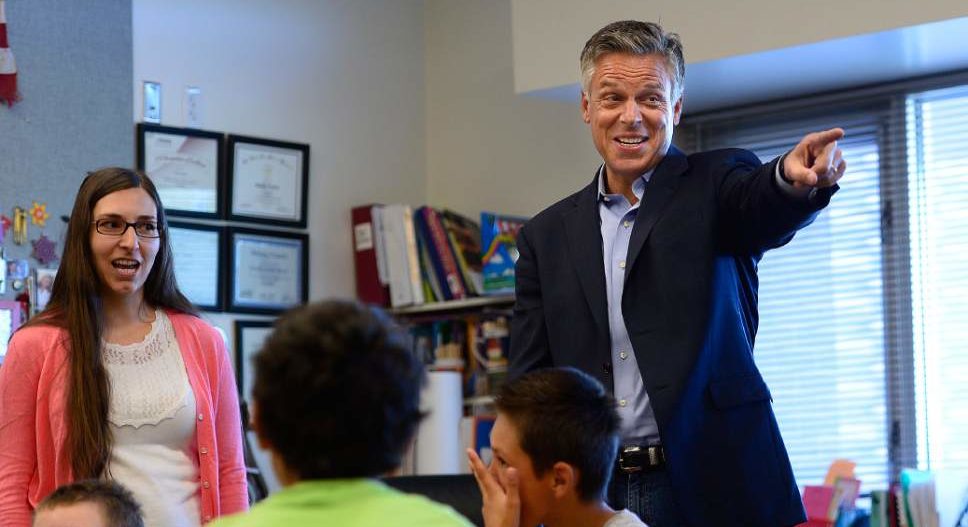
President-elect Donald Trump, still mulling key Cabinet positions, attended a lavish costume party Saturday night hosted by some of his biggest donors at their palatial Long Island mansion. Trump, who did not sport a costume, reveled with guests at the Mercer family estate for the annual Christmas party; the theme was “Villains and Heroes.” An invitation to the annual December party is a coveted ticket in Republican circles, never more so than this year. Several strategists who helped engineer Trump’s upset win were attending, including incoming White House senior counselor Stephen Bannon and senior aide Kellyanne Conway. Both Conway and Bannon have close ties to Rebekah Mercer, the daughter of hedge fund manager Robert Mercer. The younger Mercer became Trump’s leading and most influential donor and urged him to bring Bannon and Conway into the campaign in August. Rebekah Mercer, who ran a pro-Trump Super PAC, had compared the electoral race between Trump and his Democratic opponent Hillary Clinton to an “apocalyptic choice,” so the night’s “Villains and Heroes” theme was perhaps fitting. Trump’s sojourn to the party was his only expedition on Saturday outside the Manhattan skyscraper that bears his name. He is expected to lie low the remainder of the weekend, before returning to transition meetings in New York on Monday and the next stop of his “thank you” tour in North Carolina on Tuesday. Trump is also still mulling his choice to lead the State Department, one of the most powerful and prominent Cabinet positions. According to two people close to the transition, Trump is moving away from two of the front-runners for the job, former New York City Mayor Rudy Giuliani and Mitt Romney, the 2012 GOP nominee. Giuliani’s international business ties and public campaigning for the job are said to have rankled Trump. And while Trump has met twice with Romney, he’s said to be aware of the risks of angering his supporters by tapping a Republican who was among his fiercest critics. Former CIA director David Petraeus is still in the mix, though both people close to the transition said Trump’s prolonged decision-making process has left the door open to other options. One of the sources said Trump was open to expanding his short list of secretary of State prospects. Among the possibilities: Jon Huntsman, a former Republican Utah governor who also served as the ambassador to China and speaks Mandarin. The people close to the transition insisted on anonymity because they were not authorized to discuss the private process publicly. Trump also made no mention Saturday of his decision to speak on the phone with Taiwan’s leader, a breach of long-standing tradition that risks enmity from China. Trump’s conversation with Taiwanese President Tsai Ing-wen drew an irritated, although understated, response from China, as Foreign Minister Wang Yi said Saturday that the contact was “just a small trick by Taiwan” that he believed would not change U.S. policy toward China, according to Hong Kong’s Phoenix TV. Chinese officials said they lodged a complaint with the U.S. and reiterated a commitment to seeking “reunification” with the island, which they consider a renegade province. After the phone conversation Friday, Trump tweeted that Tsai “CALLED ME.” He also groused about the reaction to the call: “Interesting how the U.S. sells Taiwan billions of dollars of military equipment but I should not accept a congratulatory call.” Republished with permission of the Associated Press.
Ted Cruz app data collection helps campaign read minds of voters
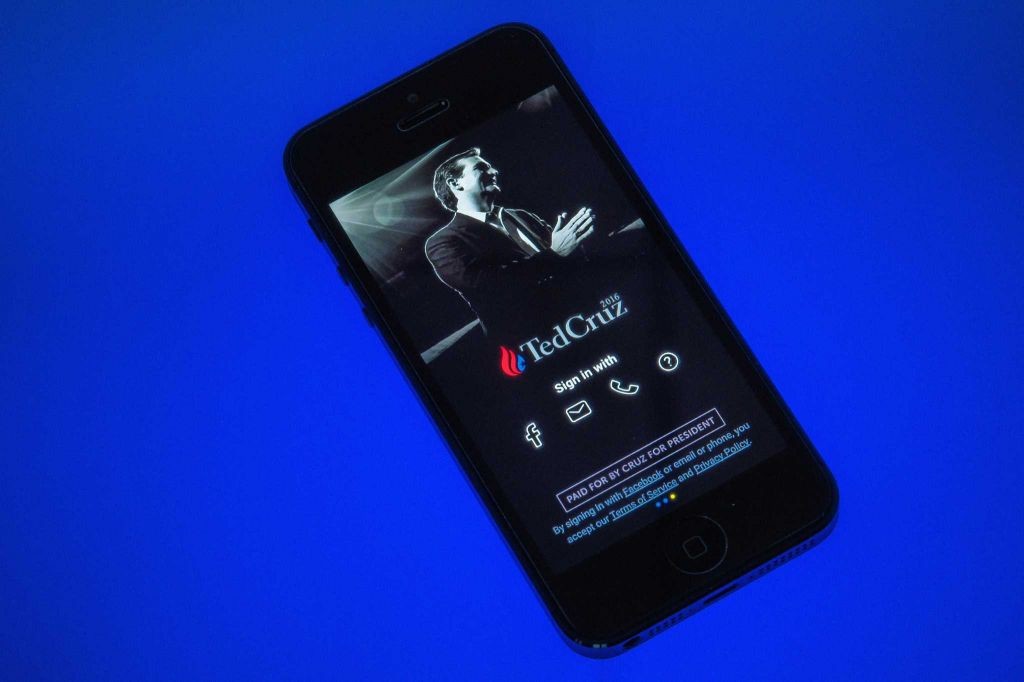
Protecting the privacy of law-abiding citizens from the government is a pillar of Ted Cruz‘s Republican presidential candidacy, but his campaign is testing the limits of siphoning personal data from supporters. That information and more is then fed into a vast database containing details about nearly every adult in the United States to build psychological profiles that target individual voters with uncanny accuracy. Cruz’s sophisticated analytics operation was heralded as key to his victory in Iowa earlier this month — the first proof, his campaign said, that the system has the potential to power him to the nomination. After finishing a distant third in New Hampshire, Cruz is looking to boost the turnout of likely supporters in South Carolina and in Southern states with primaries on March 1, where voters are more evangelical and conservative. The son of mathematicians and data processing programmers, Cruz is keenly and personally interested in the work. “Analytics gives the campaign a roadmap for everything we do,” said Chris Wilson, data and digital director. “He has an acute understanding of our work and continually pushes me on it.” Data-mining to help candidates win elections has been increasing among both Republicans and Democrats. Mobile apps by other presidential campaigns also collect some information about users. But The Associated Press found the Cruz campaign’s app — downloaded to more than 61,000 devices so far — goes furthest to glean personal data. The Cruz app prompts supporters to register using their Facebook logins, giving the campaign access to personal information such as name, age range, gender, location and photograph, plus lists of friends and relatives. Those without a Facebook account must either provide an email address or phone number to use the app. By contrast, the app offered by GOP candidate Ben Carson‘s campaign asks supporters to surrender the same information as Cruz from their Facebook accounts, but also gives an option to use it without providing any personal information. Carson’s app separately asks users to let the campaign track their movements and asks them to voluntarily supply their birthdate and gender — including options for “male,” ”female” and “other.” Ohio Gov. John Kasich‘s campaign app doesn’t request personal information from supporters, but it repeatedly nags users to let the campaign track their movements until they answer yes. Democratic Sen. Bernie Sanders‘ app, “Field the Bern,” requires supporters to sign in using their Facebook account or an email address, and it also repeatedly asks to let the campaign track their movements until they answer yes. The Cruz app separately urges users to let it download their phone contacts, giving the campaign a trove of phone numbers and personal email addresses. The campaign says that by using its app, “You hereby give your express consent to access your contact list,” but Wilson said the campaign will not do this to anyone who declines to allow it when the app requests permission. Cruz’s app also transmits to the campaign each user’s physical location whenever the app is active, unless a user declines to allow it. The campaign said it does this “so that we can connect you to other Cruz Crew users based on your particular geographic location.” The campaign tells users it can share all the personal information it collects with its consultants or other organizations, groups, causes, campaigns or political organizations with similar viewpoints or goals. It also shares the material with analytics companies. Cruz’s campaign combines the information with data from a group called Cambridge Analytica, which has been involved in his efforts since fall 2014. A Cambridge investor, Robert Mercer, has given more money than anyone else to outside groups supporting Cruz. Sanders’ campaign said it shares personal information from supporters with its consultants and vendors but not analytics companies. Cambridge has a massive 10 terabyte database — enough to fill more than 2,100 DVDs — that contains as many as 5,000 biographical details about the 240 million Americans of voting age. Cambridge considers its methodology highly secretive, but it may include such details as household income, employment status, credit history, party affiliation, church membership and spending habits. Cambridge uses powerful computers and proprietary algorithms to predict Americans’ personality traits. The Cruz campaign paid Cambridge $3.8 million in 2015, accounting for more than 8 percent of all its spending. Two outside groups supporting Cruz, including one directly funded by $11 million from Mercer, paid the firm $682,000 since December. Cambridge has five employees at Cruz headquarters in Houston and 70 others split between New York City and the Washington suburbs. The power of Cruz’s data-driven systems was on display in Iowa. The GOP candidates held similar positions on issues such as abortion and gun control. Cambridge helped differentiate Cruz by identifying automated red light cameras as an issue of importance to Iowa residents upset with government intrusion. Potential voters living near the red light cameras were sent direct messages saying Cruz was against their use. “Everything in this campaign is data-driven. I’ve never seen anything like it,” said Jerry Sickles, a paid field representative in Hooksett, New Hampshire, who uses the Cruz Crew app. “We just know exactly who our voters are, and we will make sure they get out to vote.” Cruz, the junior senator from Texas, has been outspoken about protecting Americans’ personal information from the government, including the National Security Agency. “Instead of a government that seizes your emails and your cell phones, imagine a federal government that protected the privacy rights of every American,” he said when announcing his campaign. Cruz campaign officials say it’s different for the government versus a campaign to collect data. Sickle said Cruz is building on the use of big data pioneered by the successful Democratic campaigns of Barack Obama in 2008 and 2012. “It’s not like we’re giving it to the NSA,” Sickle said. A campaign spokeswoman, Alice Stewart, added: “Why wouldn’t we want to use every tool available to us to win?” The scope of Cruz’s system is formidable. Cambridge’s database combines government and
Ted Cruz super PAC prepares for millions of dollars in TV ads
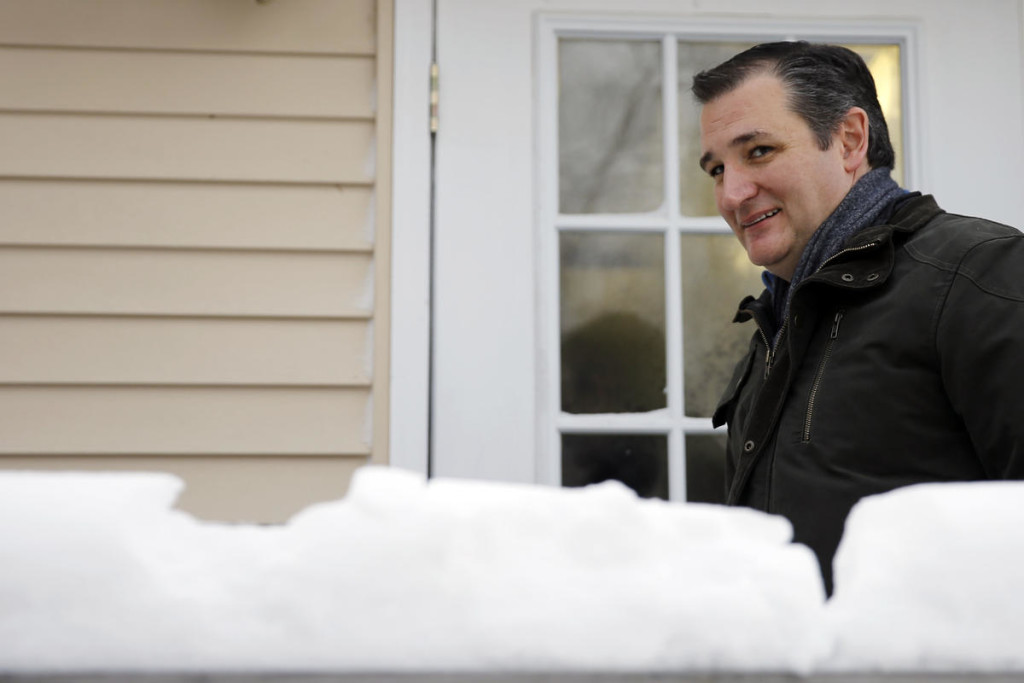
A well-funded outside group helping Texas Sen. Ted Cruz fight for the Republican presidential nomination has purchased $2.5 million of television advertising time — an investment that catapults it to the top tier of spenders in the 2016 race. Keep the Promise I, one of more than a half dozen Cruz-themed super political action committees, placed new TV ads to begin airing Tuesday in Iowa, the first state up in the primary contest, spokeswoman Kristina Hernandez said Monday. The ad buy expands to third-to-vote South Carolina in a week, she said. The ads come as Cruz appears to be picking up steam in the still-crowded Republican primary. He is at or near the top of recent polls in Iowa without having spent much campaign money to advertise there. Likewise, his super PACs have been slow to start spending major money on commercials. That changes with this ad buy. The new investment more than doubles what Keep the Promise I had previously booked on ads and puts it well ahead of Cruz’s official campaign spending on TV, according to advertising tracker Kantar Media’s Campaign Media Analysis Group. The commercials supplement the on-the-ground efforts, mailings, and digital and radio advertising of four coordinated super PACs that all use a variation of the name “Keep the Promise.” The message of the new 30-second ad echoes Cruz’s campaign theme that he has stood up to Democrats and Republicans alike. It includes clips of Cruz at a debate and at some of his own campaign appearances, and features people asserting that he can be trusted. “He actually went to Washington, D.C., and did what he told the voters he was going to do,” one woman says. “When I tell you I’m going to do something, I’m going to do exactly what I said I’d do,” Cruz is shown saying at the end of the ad. By law, super PACs cannot take directions from the candidate they’re helping, but they can significantly influence the race because — unlike the candidates’ official campaigns — they face no limits on fundraising and can tap trusted former aides of the candidate to shape their messages. The Keep the Promise super PAC quartet raised more than $37 million in the first six months of the year, making it one of the best-funded outside efforts supporting any presidential candidate. Fundraising reports documenting what these kinds of outside groups raised between July and December are due to federal regulators at the end of this month. Keep the Promise I, which so far is the most active of any of the four, is funded almost exclusively by Robert Mercer, a New York hedge-fund billionaire. There’s a bit of irony that Mercer’s group is spending big on an ad portraying Cruz as a truth-teller: Just last week Cruz criticized fellow presidential contender Donald Trump for his “New York values.” Explaining what he meant by that at the GOP debate Thursday night, Cruz said, “Everyone understands that the values in New York City are socially liberal or pro-abortion or pro-gay-marriage, focus around money and the media.” Republished with permission of the Associated Press.
