
Barry Moore appointed to House Judiciary Committee
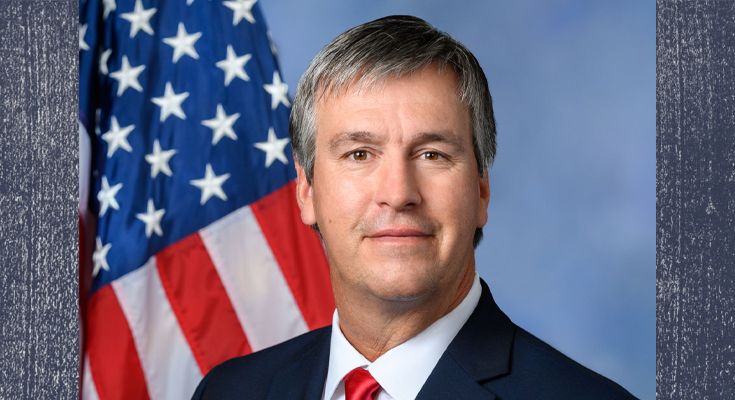
Congressman Barry Moore was appointed to the House Judiciary Committee. Moore said that it was an “honor” to be appointed to serve on the “prestigious” committee. “It is a great and humbling honor to be appointed to serve on the prestigious House Judiciary Committee and serve alongside my friend and our chairman, Jim Jordan, to defend our foundational American freedoms,” said Rep. Moore. “The Judiciary Committee will be the tip of the spear this Congress fighting to ensure that the American people’s government works to protect their civil liberties, not undermine them to advance a political agenda. With President Biden in the White House, we have a big task ahead, but I’m ready to get to work.” Congressman Jordan is the Chairman of the House Judiciary Committee. “We’re excited to welcome all new and returning members of the House Judiciary Committee to the 118th Congress,” Chairman Jordan said in a statement. “House Judiciary Republicans are ready to get to work on the important issues facing the American people by passing legislation that will secure the southern border, investigating the weaponization of the federal government against the American people, and reining in Big Tech’s censorship of free speech.” Chairman Jordan sent letters on Tuesday to White House Chief of Staff Ron Klain, Attorney General Merrick Garland, FBI Director Christopher Wray, DHS Secretary Alejandro Mayorkas, Education Secretary Miguel Cardona, ATF Director Steve Dettelbach, and DEA Administrator Anne Milgram renewing outstanding requests for communications and documents. Jordan claimed that for two years, the Biden Administration has stonewalled Congress, refused to comply with basic document requests and avoided transparency and accountability for its failures. Jordan said that House Judiciary Republicans are committed to holding each agency accountable under the new majority and will use compulsory processes, if necessary, to get answers for the American people. “Since the beginning of the Biden Administration, we have made several requests for information and documents concerning the operations and actions of the Department of Homeland Security,” Jordan wrote in the letter to Mayorkas. “These requests remain outstanding. As we begin the 118th Congress, we write again to reiterate our outstanding requests and ask that you immediately comply in full.” Mayorkas faces heavy criticism from House Republicans for his handling of the southern border situation and the documented chaos there. “Mayorkas swore an oath to “well and faithfully discharge the duties of [his] office.” Look at the border and the terrible numbers on his watch,” Moore said on social media. “Can anyone make the argument he is discharging the duties of his office well? He has to go, and if Biden won’t hold him accountable, House Republicans must.” Moore was just re-elected to his second term representing Alabama’s Second Congressional District. Moore previously served in the Alabama House of Representatives from 2010 to 2018. He was elected to Congress in 2020, after his second run for office. Moore is a veteran. He owns a garbage collection business in Enterprise. He is a graduate of Auburn University. To connect with the author of this story, or to comment, email brandonmreporter@gmail.com.
Joe Biden outpacing Donald Trump, Barack Obama with diverse judicial nominees
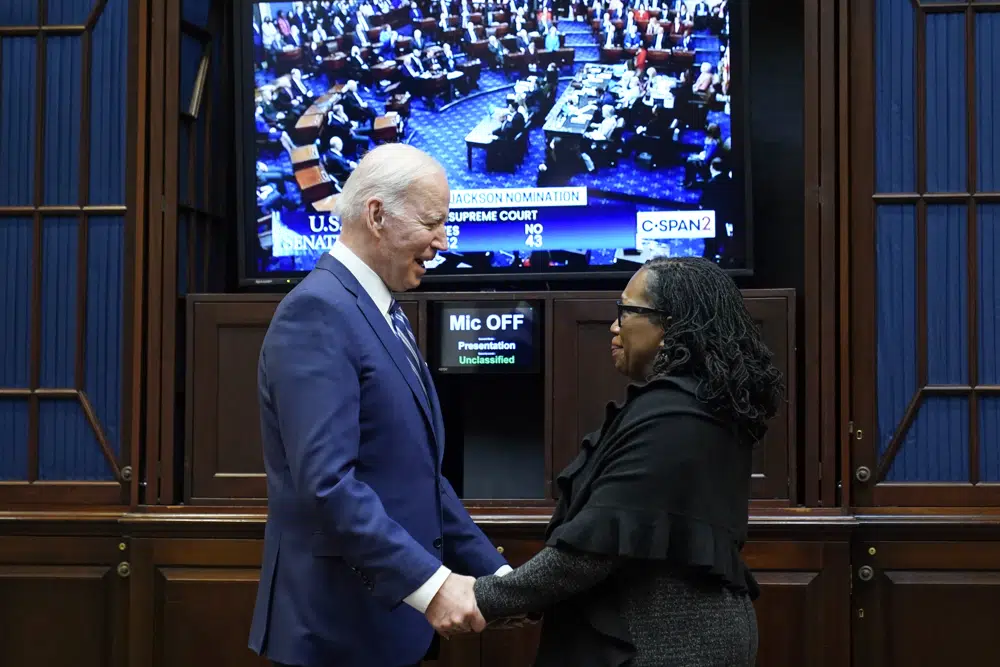
For the Biden White House, a quartet of four female judges in Colorado encapsulates its mission when it comes to the federal judiciary. Charlotte Sweeney is the first openly LGBT woman to serve on the federal bench west of the Mississippi River and has a background in workers’ rights. Nina Wang, an immigrant from Taiwan, is the first magistrate judge in the state to be elevated to a federal district seat. Regina Rodriguez, who is Latina and Asian American, served in a U.S. attorney’s office. Veronica Rossman, who came from the former Soviet Union with her family as refugees, is the first former federal public defender to be a judge on the 10th U.S. Circuit Court of Appeals. With these four women, who were confirmed during the first two years of President Joe Biden’s term, there is a breadth of personal and professional diversity that the White House and Democratic senators have promoted in their push to transform the judiciary. “The nominations send a powerful message to the legal community that this kind of public service is open to a lot of people it wasn’t open to before,” Ron Klain, the White House chief of staff, told The Associated Press. “What it says to the public at large is that if you wind up in federal court for whatever reason, you’re much more likely to have a judge who understands where you came from, who you are, and what you’ve been through.” Klain said that “having a more diverse federal bench in every single respect shows more respect for the American people.” The White House and Democratic senators are closing out the first two years of Biden’s presidency having installed more federal judges than did Biden’s two immediate predecessors. The rapid clip reflects a zeal to offset Donald Trump’s legacy of stacking the judiciary with young conservatives who often lacked in racial diversity. So far, 97 lifetime federal judges have been confirmed under Biden, a figure that outpaces both Trump (85) and Barack Obama (62) at this point in their presidencies, according to data from the White House and the office of Senate Majority Leader Chuck Schumer. D-N.Y. The 97 from the Biden presidency includes Supreme Court Justice Ketanji Brown Jackson, that court’s first Black woman, as well as 28 circuit court judges and 68 district court judges. Three out of every four judges tapped by Biden and confirmed by the Senate in the past two years were women. About two-thirds were people of color. The Biden list includes 11 Black women to the powerful circuit courts, more than those installed under all previous presidents combined. There were also 11 former public defenders named to the circuit courts, also more than all of Biden’s predecessors combined. “It’s a story of writing a new chapter for the federal judiciary, with truly extraordinary folks representing the broadest possible types of diversity,” said Paige Herwig, a senior White House counsel. The White House prioritized judicial nominations from the start, with Biden transition officials soliciting names of potential picks from Democratic senators in late 2020. Sen. Dick Durbin, D-Ill., chairman of the Senate Judiciary Committee, swiftly moved nominees through hearings and Schumer set aside floor time for votes. Particular focus was placed on nominees for the appellate courts, where the vast majority of federal cases end, and those coming from states with two Democratic senators, who could find easier consensus in a process where there’s still significant deference given to home-state officials. Democrats hope to speed up the tempo of confirmations next year, a goal more easily accomplished by a 51-49 Senate that will give them a slim majority on committees. In the past two years, votes on some of Biden’s more contested judicial nominees would deadlock in committee votes, requiring more procedural steps that ate up valuable Senate floor time. Republicans had also picked up the confirmation pace considerably in Trump’s final two years in office, after GOP senators put in place a rule change — now being used by Democrats — that significantly shortened the time required to process district court nominees. Schumer said he also hopes to install more judges in appeals courts that shifted rightward under Trump, an effort that the majority leader described as rebalancing those courts. “Trump loaded up the bench with hard right ‘MAGA’ type judges who are not only out of step with the American people, they were even out of step with the Republican Party,” Schumer said in an interview, using shorthand for Trump’s 2016 campaign slogan, “Make America Great Again.” Schumer added: “We had a mission, it’s not just a predilection. It was a mission to try and redress that balance.” Despite their limited power to actually derail Biden’s judicial picks, some Republicans have fought ferociously against many of them, arguing that their views were out of the legal mainstream despite Democratic arguments otherwise. The precarious 50-50 Senate, where Schumer’s plans were often thwarted by ailments or absences, meant several Biden nominees languished for months and were never confirmed before the Senate wrapped up its work this year. Democrats also say certain judicial nominees, particularly women of color, were unfairly targeted by their GOP critics, leading to tense fights in the Judiciary Committee. “The Republicans have just got a problem with this. Not all of them, some do,” Durbin said in an interview. “And when you call them out on it … ‘Why is it consistently women of color that are the object of your wrath?’ and they can’t answer.” Sen. Josh Hawley, R-Mo., a committee member, said Biden’s picks were “very, very left, but unapologetically so.” He said Durbin’s assertions about Republicans were “absurd.” “I think the president made a commitment to his base that he was going to put people who shared a very left-wing worldview, who are generally quite critical of, for instance, the criminal justice system, think that it is systemically racist,” Hawley said. Despite the strengthened Democratic majority, the White House could nonetheless confront some challenges when it comes to nominating and confirming judges over the next two
After unrelenting summer, Joe Biden looks to get agenda on track
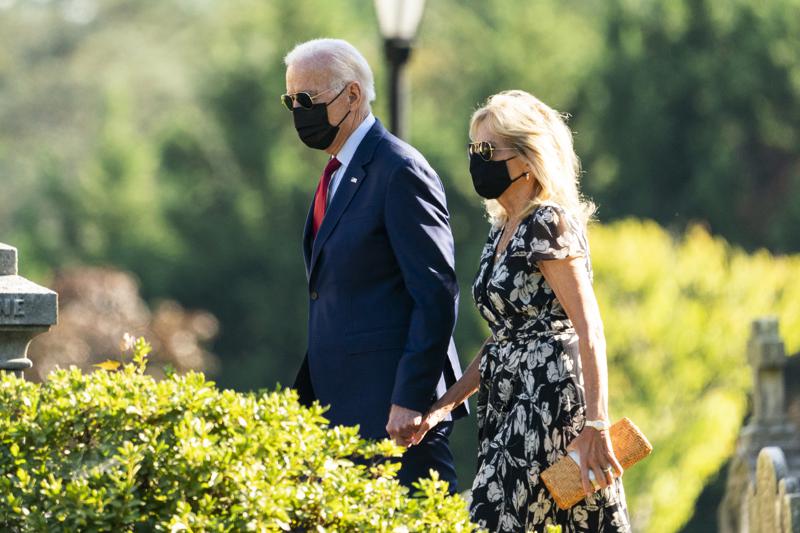
The collapse of the Afghan government, a surge of COVID-19 cases caused by the delta variant, devastating weather events, a disappointing jobs report. What next? After a torrent of crises, President Joe Biden is hoping to turn the page on an unrelenting summer and refocus his presidency this fall around his core economic agenda. But the recent cascade of troubles is a sobering reminder of the unpredictable weight of the office and fresh evidence that presidents rarely have the luxury of focusing on just one crisis at a time. Biden’s unyielding summer knocked his White House onto emergency footing and sent his own poll numbers tumbling. “The presidency is not a job for a monomaniac,” said presidential historian Michael Beschloss. “You have to be multitasking 24 hours a day.” Never has that been more true than summer 2021, which began with the White House proclamation of the nation’s “independence” from the coronavirus and defying-the-odds bipartisanship on a massive infrastructure package. Then COVID-19 came roaring back, the Afghanistan pullout devolved into chaos, and hiring slowed. Biden now hopes for a post-Labor Day reframing of the national conversation toward his twin domestic goals of passing a bipartisan infrastructure bill and pushing through a Democrats-only expansion of the social safety net. White House officials are eager to shift Biden’s public calendar toward issues that are important to his agenda and that they believe are top of mind for the American people. “I think you can expect the president to be communicating over the coming weeks on a range of issues that are front and center on the minds of the American people,” said White House press secretary Jen Psaki. “Certainly, you can expect to hear from him more on his Build Back Better agenda, on COVID and his commitment to getting the virus under control, to speak to parents and those who have kids going back to school.” During the chaotic Afghanistan evacuation, the White House was central in explaining the consequences of Biden’s withdrawal decision and the effort to evacuate Americans and allies from the country. Now, officials want to put the State Department and other agencies out front on the efforts to assist stranded Americans and support evacuees, while Biden moves on to other topics. It’s in part a reflection of an unspoken belief inside the White House that for all the scenes of chaos in Afghanistan, the public backs his decision, and it will fade from memory by the midterm elections. Instead, the White House is gearing up for a legislative sprint to pass more than $4 trillion in domestic funding that will make up much of what Biden hopes will be his first-term legacy before the prospects of major lawmaking seize up in advance of the 2022 races. On Friday, in remarks on August’s disappointing jobs report, Biden tried to return to the role of public salesman for his domestic agenda and claim the mantle of warrior for the middle class. “For those big corporations that don’t want things to change, my message is this: It’s time for working families — the folks who built this country — to have their taxes cut,” Biden said. He renewed his calls for raising corporate rates to pay for free community college, paid family leave, and an expansion of the child tax credit. “I’m going to take them on,” Biden said of corporate interests. While Biden may want to turn the page, though, aides are mindful that the crises are not done with him. Biden is planning to speak this week on new efforts to contain the delta variant and protect kids in schools from COVID-19. And his administration continues to face criticism for his decision to pull American troops from Afghanistan before all U.S. citizens and allies could get out. “President Biden desperately wants to talk about anything but Afghanistan, but Americans who are hiding from the Taliban, ISIS, and the Haqqani network don’t give a damn about news cycles, long weekends, and polling — they want out,” said Republican Sen. Ben Sasse of Nebraska. He called on the Biden White House on Friday to provide a public accounting of the number of Americans and their allies still stuck inside Afghanistan. Biden also will soon be grappling with the fallout from the windup of two anchors of the government’s COVID-19 protection package: The federal moratorium on evictions recently expired, and starting Monday, an estimated 8.9 million people will lose all unemployment benefits. The president also is still contending with the sweeping aftereffects of Hurricane Ida, which battered the Gulf states and then swamped the Northeast. After visiting Louisiana last week, he’ll get a firsthand look at some of the damage in New York and New Jersey on Tuesday. Already, he is trying to turn the destruction wrought by the hurricane into a fresh argument for the infrastructure spending he’s been pushing all along, telling local officials in Louisiana, “It seems to me we can save a whole lot of money and a whole lot of pain for our constituents — if when we build back, we build it back in a better way.” According to White House officials, even as other issues dominated headlines, Biden and his team have maintained regular conversations with House Speaker Nancy Pelosi, D-Calif., and Senate Minority Leader Mitch McConnell, R-Ky., about the president’s legislative agenda. His legislative team held more than 130 calls and meetings with members of Congress, their chiefs of staff, and aides on the infrastructure bill and spending package, and his administration has held over 90 meetings with legislative staff on crafting the reconciliation bill. Responding to concerns raised by pivotal Sen. Joe Manchin, D-W.Va., over the price tag on the roughly $3.5 trillion social spending package, White House chief of staff Ron Klain told CNN on Sunday that he was convinced that the Democrat was “very persuadable” on the legislation. Cabinet officials have also been engaged with lawmakers, officials said, and traveled to 80 congressional districts to promote the agenda across the country while Biden was kept in Washington. Biden, said Beschloss, may have
Joe Biden’s ‘Jobs Cabinet’ to sell infrastructure
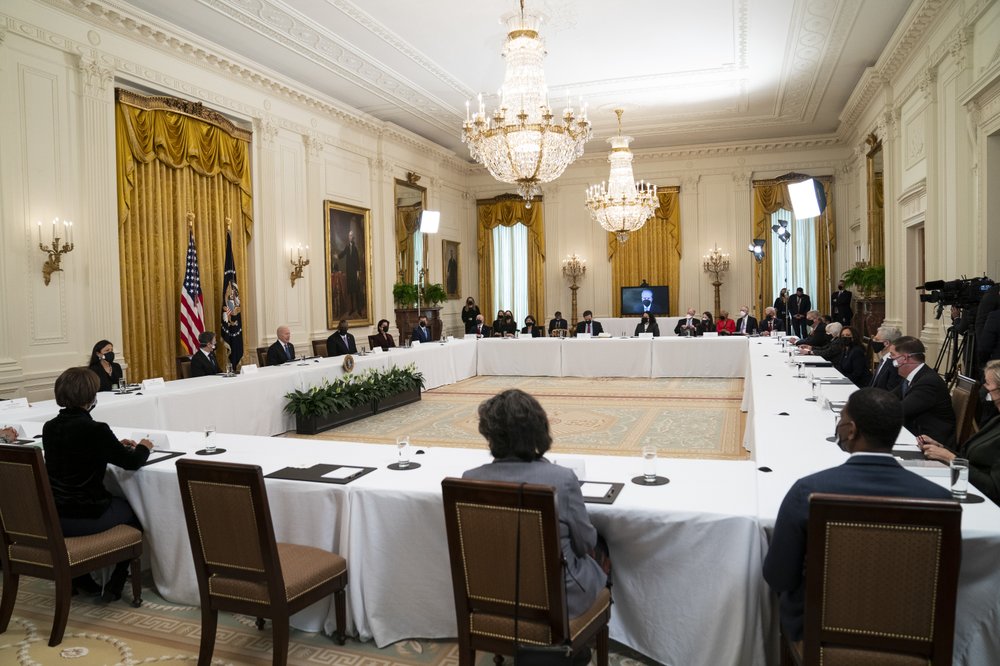
President Joe Biden set about convincing America it needs his $2.3 trillion infrastructure plan on Thursday, deputizing a five-member “jobs Cabinet” to help in the effort. But the enormity of his task was clear as Senate Minority Leader Mitch McConnell’s vowed to oppose the plan “every step of the way.” Speaking in Kentucky, McConnell said he personally likes Biden, and they’ve been friends a long time. But the president will get no cooperation from the GOP, which objects to the corporate tax increases in the plan and says they would hurt America’s ability to compete in a global economy. “We have some big philosophical differences, and that’s going to make it more and more difficult for us to reach bipartisan agreements,” the Republican leader said. White House chief of staff Ron Klain said the key to any outreach is that the proposal’s ideas are already popular. Americans want smooth roads, safe bridges, reliable public transit, electric vehicles, drinkable water, new schools, and investments in manufacturing, among the plan’s many components, he said. “We kind of think it’s just right,” Klain said in a televised interview with the news organization Politico. “But we’re happy to have a conversation with people, less about the price tag, more about what are the elements that should be in the plan that people think are missing.” Those conversations could be limited to Democrats as McConnell declared: “I’m going to fight them every step of the way.” Biden told his Cabinet at its first meeting that he is enlisting several of them to help with the push: Transportation Secretary Pete Buttigieg, Energy Secretary Jennifer Granholm, Housing and Urban Development Secretary Marcia Fudge, Labor Secretary Marty Walsh, and Commerce Secretary Gina Raimondo. “Working with my team here at the White House, each Cabinet member will represent me in dealings with Congress, engage the public in selling the plan and help organize the details as we refine it and move forward,” Biden said. The task will involve lots of salesmanship for a legacy-making piece of legislation that Biden announced in a Wednesday speech. His administration must sway Congress. It needs to rally voters. It’s also looking to outside economists to back the plan. It’s monitoring Wall Street for any celebrations or jitters. It’s forming alliances with advocates while dealing with critics of the plan’s corporate tax hikes and project details. And Biden’s administration also intends, per the plan, to cajole other nations to stop slashing their own tax rates in what has been a race-to-the-bottom to attract and retain multinational businesses. Biden’s vehicle for financing his infrastructure plans is a key dividing line. Republicans object to raising the corporate tax rate to 28% from 21%, one of the many changes so that business taxes would fund infrastructure. Republicans had cut the corporate rate from 35% in 2017, a hallmark policy achievement of Donald Trump’s presidency. Within Washington and corporate board rooms, the administration is attracting its share of accolades and rebukes on his proposal. In Biden’s own party, liberal Democrats in Congress want him to go bigger. And Democrats representing high-tax states want to remove a 2017 tax code change that limited deductions of state and local taxes for individuals. House Speaker Nancy Pelosi expressed no qualms about the proposal’s scope. “It was in the tradition of America — to think big,” Pelosi said at a press conference Thursday. “And now, in this century, President Biden is undertaking something in the tradition of thinking big, being transformational, and creating jobs for America.” While many leading business groups oppose the higher taxes, some major companies see reason for optimism because of the innovations that would be encouraged by the plan. Automakers Ford, General Motors, and Toyota endorsed the general concepts of Biden’s plan, which calls for the construction of 500,000 electric vehicle charging stations by 2030 in what would be a shift away from gasoline-powered cars. But some environmentalists said the plan’s shift away from fossil fuels that cause climate change was not substantial enough. “Biden has pledged to cut carbon emissions 50% and decarbonize our electricity sector, but this proposal won’t even come close,” said Brett Hartl, government affairs director at the Center for Biological Diversity. The White House was quick to address the climate change concerns. Climate adviser Gina McCarthy said the administration expects the infrastructure package to include Biden’s pledge to set a national standard requiring utilities to produce 100% carbon-free electricity by 2035. The proposed electricity standard “is going to be fairly robust, and it’s going to be inclusive,” McCarthy said. “I think we can get to the results that we’re looking for in a number of different ways. If a clean energy standard can be done, we think it should be done.’’ For every criticism of the plan’s details, there were also plaudits for its broader approach. Harvard University economist Larry Summers, a former treasury secretary, endorsed Biden’s plan after previously criticizing the $1.9 trillion coronavirus relief plan because of its size and debt-based financing. He downplayed any risks from corporate tax hikes since low-interest rates mean the costs of obtaining capital are already low for many companies. “I am excited,” Summers said on Twitter. “The economy’s capacity will go up.” The plan also carries a political dimension as organized labor is mobilizing to get the package passed, an important push given the steady recent Republican gains among working-class voters. Biden’s plan, with its focus on construction and manufacturing jobs, has the potential to reverse some of that slide — and the unions that backed him in 2020 are promising to help deliver votes on infrastructure. “Our members are an army a half-million strong, that will make calls, visit members of Congress and rally for good jobs building our nation’s infrastructure,” said Terry O’Sullivan, general president of Laborers International Union of North America, one of the largest construction trades unions. “We did it with boots on the ground to get President Biden elected.” Republished with the permission of the Associated Press.
Joe Biden aims for quicker shots, ‘independence from this virus’

One year after the nation was brought to a near-standstill by the coronavirus, President Joe Biden pledged in his first prime-time address Thursday night to make all adults eligible for vaccines by May 1 and raised the possibility of beginning to “mark our independence from this virus” by the Fourth of July. He offered Americans fresh hope and appealed anew for their help. Speaking in the White House East Room, Biden honored the “collective suffering” of Americans over the past year in his 24-minute address and then offered them a vision for a return to a modicum of normalcy this summer. “We are bound together by the loss and the pain of the days that have gone by,” he said. “We are also bound together by the hope and the possibilities in the days in front of us.” He predicted Americans could safely gather at least in small groups for July Fourth to “make this Independence Day truly special.” But he also cautioned that this was a “goal” and attaining it depends on people’s cooperation in following public health guidelines and rolling up their sleeves to get vaccinated as soon as eligible. Only that, he said, can bring about an end to a pandemic that has killed more than 530,000 Americans and disrupted the lives of countless more. “While it was different for everyone, we all lost something,” Biden said of the sacrifices of the yearlong-and-counting pandemic. The speech came just hours after Biden signed into law a $1.9 trillion relief package that he said will help defeat the virus, nurse the economy back to health and deliver direct aid to Americans struggling to make ends meet. Some cash distributions could begin arriving in the bank accounts of Americans this weekend. “This historic legislation is about rebuilding the backbone of this country,” Biden said as he signed the bill in the Oval Office. Most noticeable to many Americans are provisions providing up to $1,400 in direct payments and extending $300 weekly emergency unemployment benefits into early September. Also included are expanded tax credits over the next year for children, child care, and family leave — some of the credits that Democrats have signaled they’d like to make permanent — plus spending for renters, food programs, and people’s utility bills. In his Thursday night address, Biden said that as vaccine supplies continue to increase, he will direct states and territories to make all adults eligible for vaccination by May 1. The U.S. is expecting to have enough doses for those 255 million adults by the end of that month, but Biden warned the process of actually administering those doses would take time, even as his administration looks to instill confidence in the safety of the vaccines to overcome hesitance. “Let me be clear, that doesn’t mean everyone’s going to have that shot immediately, but it means you’ll be able to get in line beginning May 1,” he said. Biden announced an expansion of other efforts to speed vaccinations, including deploying an additional 4,000 active-duty troops to support vaccination efforts and allowing more people — such as medical students, veterinarians, and dentists — to deliver shots. He is also directing more doses toward some 950 community health centers and up to 20,000 retail pharmacies, to make it easier for people to get vaccinated closer to their homes. Biden added that his administration is planning to launch a nationwide website to help people find doses, saying it would address frustrations so that there would be “no more searching day and night for an appointment.” Even as he offered optimism, Biden made clear that the July 4 timetable applied only to smaller gatherings, not larger ones, and requires cooperation from Americans to continue to wear face coverings, maintain social distancing, and follow federal guidelines meant to slow the spread of the virus in the near term. He also called on them to roll up their sleeves to get vaccinated as soon as they’re eligible. This is “not the time to not stick with the rules,” Biden said, warning of the potential for backsliding just as the nation is on the cusp of defeating the virus. “I need you, the American people,” he added. “I need you. I need every American to do their part.” The House gave final congressional approval to the sweeping package by a near party-line 220-211 vote on Wednesday, seven weeks after Biden entered the White House and four days after the Senate passed the bill. Republicans in both chambers opposed the legislation unanimously, characterizing it as bloated, crammed with liberal policies, and heedless of signs the crises are easing. Biden had originally planned to sign the bill on Friday, but it arrived at the White House more quickly than anticipated. “We want to move as fast as possible,” tweeted chief of staff Ron Klain. Biden’s initial prime-time speech was “a big moment,” said presidential historian and Rice University professor Douglas Brinkley. “He’s got to win over hearts and minds for people to stay masked and get vaccinated, but also recognize that after the last year, the federal government hasn’t forgotten you.” Biden’s evening remarks were central to a pivotal week for the president as he addresses the defining challenge of his term: shepherding the nation through the twin public health and economic storms brought about by the virus. On Monday, the Centers for Disease Control and Prevention released initial guidance for how vaccinated people can resume some normal activities. On Wednesday, Congress approved the president’s $1.9 trillion “American Rescue Plan,” aimed at easing the economic impact of the virus on tens of millions of people. And the nation was on pace to administer its 100 millionth dose of vaccine as soon as Thursday. Almost exactly one year ago, President Donald Trump addressed the nation to mark the WHO’s declaration of a global pandemic. He announced travel restrictions and called for Americans to practice good hygiene but displayed little alarm about the forthcoming catastrophe. Trump, it was later revealed, acknowledged
Joe Biden signs big virus aid bill before speech to nation
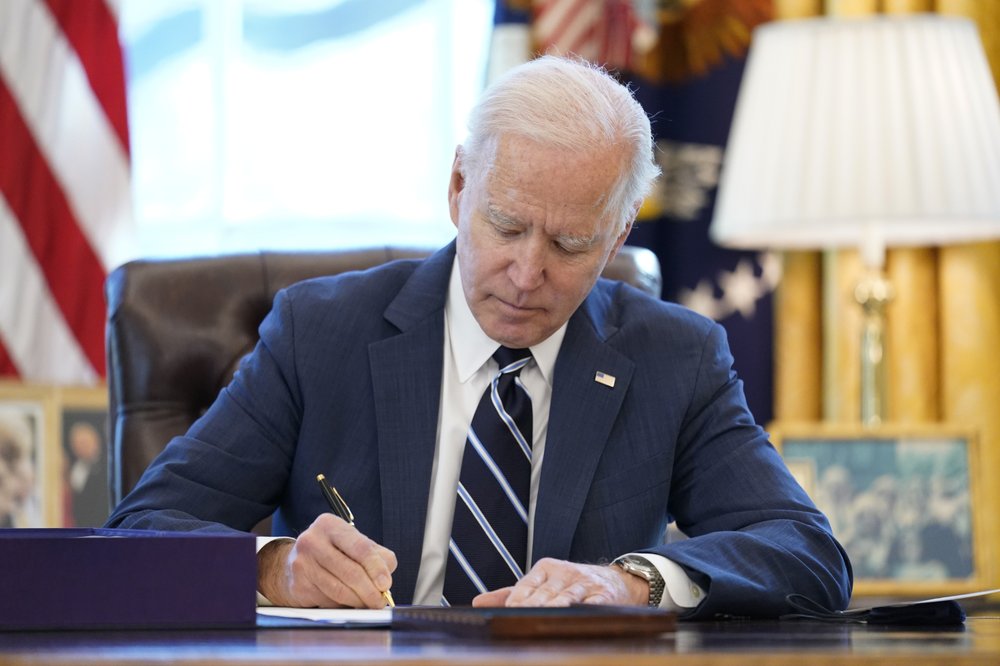
Marking a year of loss and disruption, President Joe Biden on Thursday signed into law the $1.9 trillion relief package that he said will help the U.S. defeat the coronavirus and nurse the economy back to health. Some checks to Americans could begin arriving this weekend. The signing came hours before Biden delivers his first prime-time address since taking office. He’s aiming to steer the nation toward a hungered-for sentiment — hope — as he marks one year since the onset of the pandemic that has killed more than 530,000 Americans. “This historic legislation is about rebuilding the backbone of this country,” Biden said as he signed the bill in the Oval Office. Most noticeable to many Americans are provisions providing up to $1,400 in direct payments, some of which could begin landing in bank accounts this weekend and extending $300 weekly emergency unemployment benefits into early September. Also included are expanded tax credits over the next year for children, child care, and family leave — some of the credits that Democrats have signaled they’d like to make permanent — plus spending for renters, feeding programs, and people’s utility bills. The House gave final congressional approval to the sweeping package by a near party-line 220-211 vote on Wednesday, seven weeks after Biden entered the White House and four days after the Senate passed the bill. Republicans in both chambers opposed the legislation unanimously, characterizing it as bloated, crammed with liberal policies, and heedless of signs the crises are easing. Biden originally planned to sign the bill on Friday, but it arrived at the White House more quickly than anticipated. “We want to move as fast as possible,” tweeted White House chief of staff Ron Klain. He added, “We will hold our celebration of the signing on Friday, as planned, with congressional leaders!” Previewing his Thursday night remarks, Biden said he would “talk about what we’ve been through as a nation this past year, but more importantly, I’m going to talk about what comes next.” Biden’s challenge will be to honor the sacrifices made by Americans over the past year while encouraging them to remain vigilant despite “virus fatigue” and growing impatience to resume normal activities given the tantalizing promise of vaccines. Speaking on the one-year anniversary of the World Health Organization’s declaration of a pandemic, he’ll mourn the dead, but also project optimism about the future. “This is a chance for him to really beam into everybody’s living rooms and to be both the mourner in chief and to explain how he’s leading the country out of this,” said presidential historian and Rice University professor Douglas Brinkley. “This is a big moment,” Brinkley added. “He’s got to win over hearts and minds for people to stay masked and get vaccinated, but also recognize that after the last year, the federal government hasn’t forgotten you.” Biden’s evening remarks in the East Room are central to a pivotal week for the president as he addresses the defining challenge of his term: shepherding the nation through the twin public health and economic storms brought about by the virus. On Monday, the Centers for Disease Control and Prevention released initial guidance for how vaccinated people can resume some normal activities. On Wednesday, Congress approved the president’s $1.9 trillion “American Rescue Plan,” aimed at easing the economic impact of the virus on tens of millions of people. And the nation was on pace to administer its 100 millionth dose of vaccine as soon as Thursday. Biden said he would focus his remarks on what his administration plans to deliver in the coming months, but also reiterate his call for Americans to continue to practice social distancing and wear face coverings to hasten the end of the pandemic. “I’m going to launch the next phase of the COVID response and explain what we will do as a government and what we will ask of the American people,” he said. He added: “There is light at the end of this dark tunnel of the past year. There is real reason for hope.” Almost exactly one year ago, President Donald Trump addressed the nation to mark the WHO’s declaration of a global pandemic. He announced travel restrictions and called for Americans to practice good hygiene but displayed little alarm about the forthcoming catastrophe. Trump, it was later revealed, acknowledged that he had been deliberately “playing down” the threat of the virus. For Biden, who has promised to level with the American public after the alternate reality of Trump’s virus talk, the imperative is to strike the correct balance “between optimism and grief,” said Princeton history professor and presidential scholar Julian Zelizer. “Generally, the country likes optimism, and at this particular moment they’re desperate for optimism, but you can’t risk a ‘Mission Accomplished’ moment,’” he said, warning against any premature declaration that the threat has been vanquished. Fifty days into his presidency, Biden is experiencing a polling honeymoon that his predecessor never enjoyed. Yet public sentiment remains stubbornly polarized and fewer people among his critics seem willing to say they’ll give him a chance than was the case for earlier presidents. Overall, he has earned strong marks on his handling of the pandemic. According to a poll from The Associated Press-NORC Center for Public Affairs Research released last week, 70% of Americans back the Democratic president’s handling of the virus response, including 44% of Republicans. The White House hopes that as Biden assumes the role of cheerleader for the virus relief package, the elements of the $1.9 trillion bill that are popular with Republicans will boost his support even further. Brinkley said Biden’s decision to deliver a speech aimed directly at the nation before he makes the traditional presidential address to a joint session of Congress signals that it is as much an “introduction” of the president and his administration to the American people as a status report on his first 50 days in office. Presidential addresses to Congress “tend to be a series of soundbites,” Brinkley said. “This way,
Biden adds Obama administration veterans to top staff
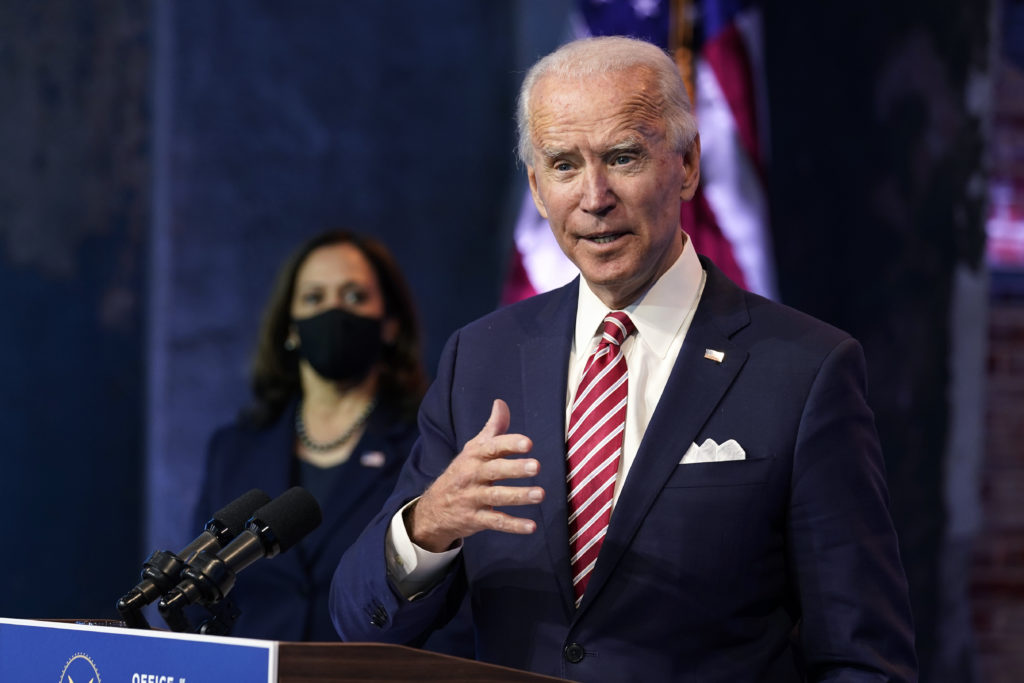
President-elect Joe Biden is adding four Obama-Biden administration veterans to his top ranks as he continues to build out his White House team. Cathy Russell, who was Jill Biden’s chief of staff during the Obama administration, will serve as director of the White House Office of Presidential Personnel, evaluating applicants for administration roles. Louisa Terrell, who served as a legislative adviser to the president in the Obama administration and worked as deputy chief of staff for Biden in the Senate, will be director of the White House Office of Legislative Affairs. Terrell has already been engaged in Capitol Hill outreach as part of Biden’s transition team. Carlos Elizondo, who was social secretary for Jill Biden during the Obama administration, will reprise his role and serve as social secretary for the incoming first lady. And Mala Adiga will serve as her policy director. Her role hints at what Biden may focus on as first lady — Adiga previously worked as a director for higher education and military families at the Biden Foundation and also advised Jill Biden on policy during the Obama administration. The announcements come just a few days after Biden unveiled his first major round of top White House staff, including the appointment of his current campaign manager, Jen O’Malley Dillon, to serve as deputy chief of staff, and campaign co-chair Rep. Cedric Richmond as director of the White House Office of Public Engagement. Late last week, he announced that longtime aide Ron Klain will serve as his chief of staff. While the new hires give a sense of the White House that Biden is beginning to build, he has yet to appoint someone to fill the role of COVID-19 coordinator, which Klain announced this week, or name individuals for key communications roles. His team has thousands more staff-level roles to fill when it takes over the administration in January, and they’re currently reviewing applications and reaching out to potential candidates for key roles. Biden has indicated he plans to make and announce some of his Cabinet picks around Thanksgiving, and he said Thursday he’s already made his decision for treasury secretary. Republished with the permission of the Associated Press.
Joe Biden filling top White House team with campaign veterans

President-elect Joe Biden announced a raft of top White House staff positions on Tuesday, drawing from the senior ranks of his campaign and some of his closest confidants to fill out an increasingly diverse White House leadership team. Biden confirmed that former campaign manager Jen O’Malley Dillon will serve as deputy chief of staff, while campaign co-chair Louisiana Rep. Cedric Richmond and campaign adviser Steve Ricchetti will hold senior roles in the new administration. Richmond will leave his Louisiana congressional seat to fill the White House job. The president-elect also announced that Mike Donilon, a longtime Biden confidant, will serve as a senior adviser; Dana Remus, the campaign’s current general counsel, will be counsel to the president; Julie Chavez Rodriguez, one of Biden’s deputy campaign managers, will serve as director of the White House Office of Intergovernmental Affairs; and Annie Tomasini, Biden’s current traveling chief of staff, will serve as the director of Oval Office operations. Anthony Bernal, who served as Jill Biden’s chief of staff on the campaign, will serve as a senior adviser to her, and Julissa Reynoso Pantaleon, a former Obama ambassador to Uruguay, will be her chief of staff. The new hires represent an initial wave of what will ultimately be hundreds of new White House aides hired in the coming weeks as Biden builds out an administration to execute his governing vision. The Democrat will be inaugurated Jan. 20. Late last week, Biden tapped former senior campaign adviser Ron Klain to serve as his chief of staff. The latest round reflects Biden’s stated commitment to diversity in his staff — the team includes four people of color and five women. “America faces great challenges, and they bring diverse perspectives and a shared commitment to tackling these challenges and emerging on the other side a stronger, more united nation,” Biden said in a statement. O’Malley Dillon, 44, was the first woman to manage a successful Democratic presidential campaign. She is a veteran political operative who worked on both of Barack Obama’s White House bids. Rodriguez, granddaughter of the late farmworker union leader César Chávez, was national political director on Sen. Kamala Harris’ 2016 presidential team before coming to the Biden campaign and served in the Obama administration. Richmond, a 47-year-old African American, will be a senior adviser to the president and director of the White House Office of Public Engagement, the role Valerie Jarrett filled in the Obama administration. He’s expected to engage with Congress and focus on the Black community and other minority groups. Richmond formally announced that he was taking the position at a news conference at a regional airport in eastern New Orleans, not far from his home. He said he will step down from his congressional post in January. Richmond said he believes having Biden’s ear in a West Wing office will enable him to help Louisiana and other Southern states with similar problems, including poverty, poor health outcomes, and ineffective education. “This new role will allow me to offer advice to the president when he wants it — maybe sometimes when he doesn’t want it,” Richmond said. A former chair of the Congressional Black Caucus, Richmond was among Biden’s earliest high-profile supporters and served as his campaign co-chair. Richetti, Donilon, Tomasini, and Bernal all have long-standing relationships with the Biden family. Ricchetti was Biden’s chief of staff during Obama’s second term, while Donilon has advised him in various roles since 1981, and Tomasini served in communications roles for Biden when he was still a senator. Bernal worked for Jill Biden during the 2008 Obama-Biden campaign and in various roles for her during both terms of the Obama administration. Less clear is the shape of Biden’s Cabinet, which will be subject to Senate confirmation. Since winning the election earlier this month, the president-elect has been hunkered down with Vice President-elect Harris near his home in Delaware preparing for the business of governing. Biden will begin rolling out his higher-profile Cabinet picks in the coming weeks. Republished with the permission of the Associated Press.
Joe Biden eyes Washington veterans for key administration posts
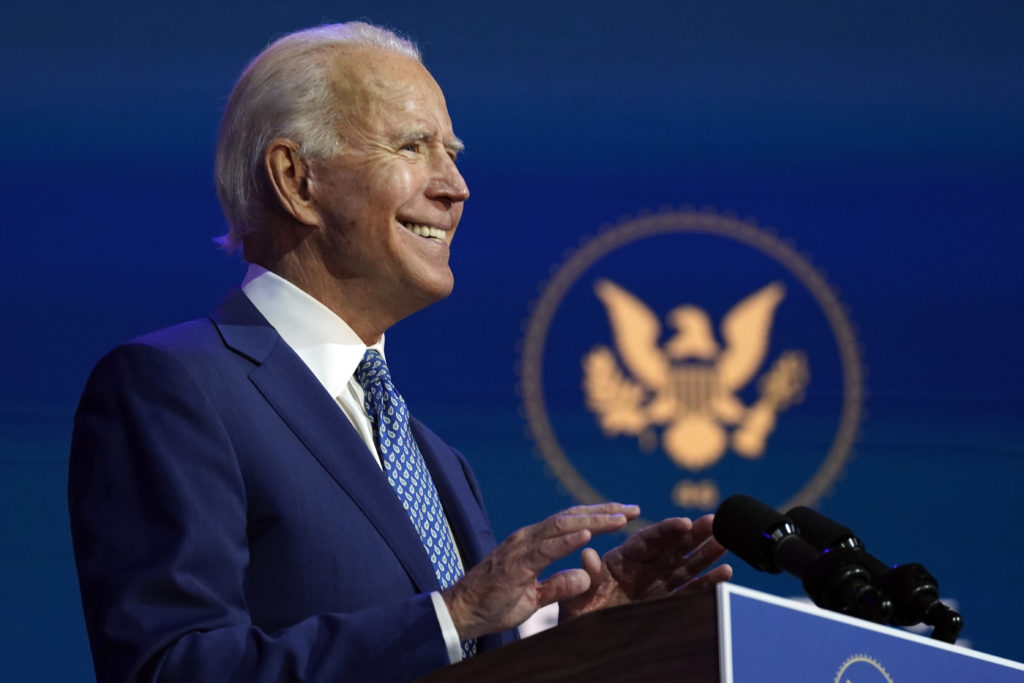
President-elect Joe Biden is looking to build out his nascent White House staff with more traditional Washington insiders, a notable departure from four years in which President Donald Trump filled his team with outsiders and government antagonists. Ron Klain is an early favorite to become Biden’s chief of staff, according to multiple people familiar with planning who spoke on condition of anonymity to speak freely about private discussions. He has decades of Washington experience that includes being Biden’s chief of staff when he was vice president, in addition to serving as the Ebola response coordinator in 2014 and having a central role in the Obama administration’s financial crisis response. Delaware Sen. Chris Coons, a longtime Biden ally and friend, is seen as a potential choice for secretary of state. Rep. Karen Bass of California, whom Biden considered for vice president, is seen as a potential housing and urban development secretary. Both served in Congress for the past decade. Biden is expected to move quickly to name a chief of staff, but other top Cabinet positions will likely take longer. The names under consideration represent Biden’s effort to move Washington past the tumult of President Donald Trump’s administration and fill out his government with more seasoned professionals. The task is taking on even greater urgency than in past transitions because Biden will take office in January amid a raging pandemic that will likely consume the early days of his presidency and require a full government response. Biden made clear on Monday that he would focus on the pandemic by forming a coronavirus advisory board. Former Surgeon General Vivek Murthy, who was named a co-chair of that panel, is seen as a contender for the top job at the Department of Health and Human Services. New Mexico Gov. Michelle Lujan Grisham, who ran her state’s health department, is also being eyed for the position. Even for roles where Biden has the opportunity to make history and appoint the first woman or African American Cabinet secretary, like at defense and treasury, Biden is said to be considering options with decades of experience in their chosen fields. Roger Ferguson, who served as vice-chair of the Federal Reserve under Bill Clinton and George W. Bush, is a potential treasury secretary, while Michele Flournoy, a former undersecretary of defense, is seen as a top pick to lead the Pentagon. Some Democrats are hopeful that the more traditional picks will help rebuild morale among the thousands of civil servants who felt thwarted at doing their jobs under Trump. “You’re not only talking about people who have an expertise in government functions, you’re talking about people who have a great deal of respect for government functions,” said Ed Espinoza, former western states political director for the Democratic National Committee. “That’s a key distinction between the Trump administration and a Biden administration.” It’s a striking shift from Trump, who built out his Cabinet with a raft of unorthodox picks, many of whom were openly skeptical of the federal government’s role in the jobs they were tasked with. Betsy DeVos, an advocate for steering federal money to private charter schools, led the Education Department. Scott Pruitt, the former Oklahoma attorney general who’s a skeptic of the science showing humans contribute to climate change, ran the Environmental Protection Agency. And Republican Rep. Mick Mulvaney of South Carolina, who initially served as White House budget director, supported shutting down the government to rein in federal spending and was critical of some of the proposals Trump aimed to invest in, like a massive infrastructure policy. Still, Biden faces a number of major unknowns as he prepares for the presidency. First, the scope of Biden’s first-term agenda will hinge on which party controls the Senate, which remains in question with two special Senate elections in Georgia scheduled for the first week in January. Democrats have acknowledged they will likely need to pare back some of Biden’s campaign trail promises even if they do hold the majority in a closely divided Senate, and a slim majority could also affect the kinds of nominees Biden can hope to get approved for top Cabinet slots. The most imminent unknown for Biden, however, remains to what extent Trump and his administration will work with the former vice president as his team begins its efforts to transition the government. The General Services Administration is tasked with formally recognizing Biden as president-elect, beginning the transition process. But the agency’s Trump-appointed administrator, Emily Murphy, has not started the process and has given no guidance on when she will do so. That lack of clarity is fueling questions about whether Trump, who has not publicly recognized Biden’s victory and has falsely claimed the election was stolen, will impede Democrats as they try to establish a government. There is little precedent in the modern era of a president erecting such hurdles for his successor. The stakes are especially high this year because of the coronavirus pandemic, which will require a comprehensive government response. “America’s national security and economic interests depend on the federal government signaling clearly and swiftly that the United States government will respect the will of the American people and engage in a smooth and peaceful transfer of power,” Jen Psaki, a Biden transition aide, tweeted Sunday. South Carolina Rep. Jim Clyburn, an ally of Biden’s on Capitol Hill, said that if Trump continues to drag his feet, then he hopes that “my conservative friends in Congress will have an intervention.” “This country is bigger than one person, and to allow the people of this country to suffer — we are near 245,000 deaths, and we’re still messing around and won’t get the relief that people need,” he said. Indeed, some Republicans on Capitol Hill called for a smooth transition Monday. Maine Sen. Susan Collins, a moderate Republican and occasional Trump antagonist, congratulated Biden on his victory and said in a statement that “presidential transitions are important” and that Biden and Vice President-elect Kamala Harris should “be given every opportunity
In debate countdown, Donald Trump holds rally, Joe Biden does prep

President Donald Trump pushed into arguably the most important state on the electoral map on Tuesday, opting for a rally in Pennsylvania instead of formal debate practice two days ahead of the final presidential debate that may be his last, best chance to alter the trajectory of the 2020 campaign. Democrat Joe Biden took the opposite approach, holing up for debate prep in the leadup to Thursday’s faceoff in Nashville. But Trump, trailing in polls in most battleground states, continued his travel blitz in the race’s final fortnight, and delivered what his campaign has wanted to be his closing message. “This is an election between a Trump super recovery and a Biden depression. You will have a depression the likes of which you have never seen,” the president said in Erie. “If you want depression, doom and despair, vote for Sleepy Joe. And boredom.” But the president’s pitch that he should lead the rebuilding of an economy ravaged by the pandemic has been overshadowed by a series of fights. In the last two days he has attacked the nation’s leading infectious disease expert and a venerable TV newsmagazine while suggesting that the nation was tired of talking about a virus that has killed more than 220,000 Americans. Before leaving the White House, Trump taped part of an interview with CBS’ “60 Minutes” that apparently ended acrimoniously. On Twitter, the president declared his interview with Lesley Stahl to be “FAKE and BIASED,” and he threatened to release a White House edit of it before its Sunday airtime. Also trailing in fundraising for campaign ads, Trump is increasingly relying on his signature campaign rallies to deliver a closing message to voters and maximize turnout among his GOP base. His trip Tuesday to Pennsylvania was one of what is expected to be several to the state in the next two weeks. “If we win Pennsylvania, we win the whole thing,” Trump said in Erie. Erie County, which includes the aging industrial city in the state’s northwest corner, went for President Barack Obama by 5 percentage points in 2012 but broke for Trump by 2 in 2016. That swing, fueled by Trump’s success with white, working-class, non-college-educated voters, was replicated in small cities and towns and rural areas and helped him overcome Hillary Clinton’s victories in the state’s big cities. But Trump will likely need to run up the score by more this time around as his prospects have slipped since 2016 in vote-rich suburban Philadelphia, where he underperformed by past Republican measures. This raises the stakes for his campaign’s more aggressive outreach to new rural and small-town voters across the industrial north. His aides worry that his opponent is uniquely situated to prevent that, as Biden not only hails from Scranton, but has built his political persona as a representative of the middle and working classes. Trump, who spoke for less than an hour, showed the crowd a video of various Biden comments on fracking in a bid to portray Biden as opposed to the process. The issue is critical in a state that is the second leading producer of natural gas in the country. Biden’s actual position is that he would ban new gas and oil permits, including for fracking, on federal lands only. The vast majority of oil and gas does not come from federal lands. Three weeks of wrangling over the debate format and structure appeared to have subsided Tuesday after the Commission on Presidential Debates unveiled a rules change meant to reduce the chaotic interruptions that plagued the first Trump-Biden encounter last month. This time, Trump and Biden will each have his microphone cut off while his rival delivers an opening two-minute answer to each of the six debate topics, the commission announced. The mute button won’t figure in the open discussion portion of the debate. Trump was to have been joined in Erie by first lady Melania Trump, in what was to be her first public appearance since she and the president were sickened with COVID-19. But her chief of staff, Stephanie Grisham, said Tuesday that Mrs. Trump has a lingering cough and would not accompany the president. As Trump was on the road, Biden was huddling at his lakeside home in Wilmington, Delaware, with senior adviser Ron Klain, who is in charge of debate preparation. Also on hand: a group of aides that the campaign has purposely kept small to reduce the risk of spreading the coronavirus. Biden, who taped his own interview with “60 Minutes” on Monday at a theater near his home, had no public events Tuesday or Wednesday and wasn’t scheduled to travel — except to the debate itself — on Thursday. His running mate, California Sen. Kamala Harris, was out campaigning, and he was expected to receive a late boost from former President Barack Obama, who was to host an event Wednesday in Philadelphia. Biden is now tested about every two days for the coronavirus and has never been found to be positive. He suggested before last week’s planned second debate in Miami that the proceedings shouldn’t happen if Trump was still testing positive for COVID-19 after contracting the virus earlier in the month. The candidates instead held dueling town halls on separate networks after the commission said the debate should occur virtually, citing safety concerns, and Trump rejected the idea. Biden has been tightlipped about his preparation for the Nashville debate, saying only that he has focused on watching Trump’s past statements on key issues. Biden’s advisers see the final debate as a chance to discuss foreign policy, which they see as one of their candidate’s strengths. Biden has praised the Trump administration for helping to broker deals that the Gulf states of Bahrain and the United Arab Emirates signed recognizing Israel, but otherwise has accused the president of shunning allies and making foreign relations more volatile at most points around the globe. The debate comes as Trump is again defending his handling of the coronavirus pandemic that has killed more
Both sides prepare for marathon Brett Kavanaugh confirmation hearing
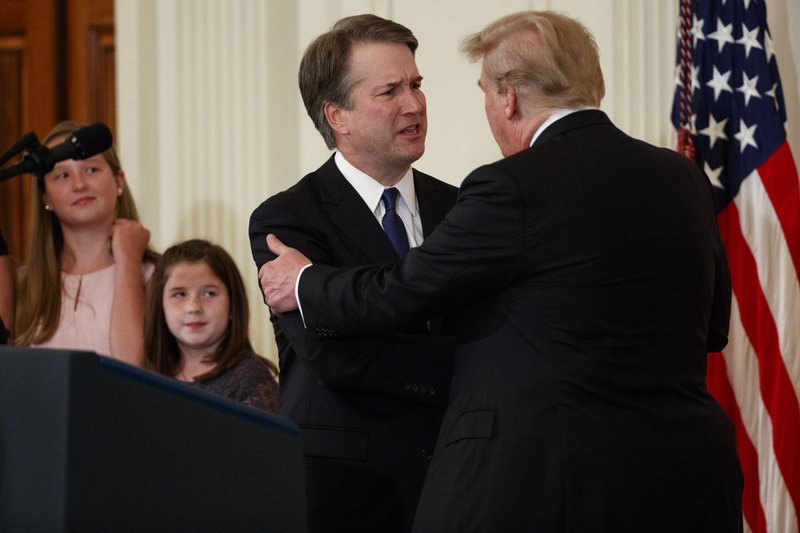
Supreme Court nominee Brett Kavanaugh isn’t the only one engaging in practice sessions ahead of next week’s grueling confirmation hearing before the Senate Judiciary Committee. Senators from both parties also are prepping for the four-day marathon — including Wednesday’s multi-hour question-and-answer exchange — in which Kavanaugh’s views on the biggest legal issues of the day are expected to be mined for the conservative judge’s approach to the law. Abortion, executive power, campaign finance reform, regulatory oversight and gun violence are among the many topics senators in particular are preparing to probe after the 53-year-old appellate court judge raises his right hand and is sworn in for the hearings. President Donald Trump’s pick for the court has long been readying for this moment. A White House operation is focused primarily on defending Kavanaugh and amplifying his answers, with Senate Republicans set to take the lead in going after Democrats on the committee. The White House has assembled a team of attorneys from the counsel’s office, Kavanaugh’s roster of former clerks, and other Republican lawyers to document his record and meticulously prepare him for the questions they expect him to face. For every line of questioning, the lawyers and communications aides have prepared suggested responses for Kavanaugh to deploy and amplifying material to release to the public. The operation is standard for any confirmation process, but given the polarized political environment the White House is preparing for an intense battle. The process began shortly after Kavanaugh’s selection, with the team arranging binders on every conceivable issue. They now line the office used by the confirmation team in the Eisenhower Executive Office Building and many will move over to Capitol Hill for the hearing. In the subsequent weeks, White House attorneys and his former law clerks engaged Kavanaugh in question and answer sessions on those topics, as communications and legislative affairs aides looked on. Those conversations evolved into topical sessions and then to full mock hearings. The committee’s former chairman, Sen. Orrin Hatch, R-Utah, chaired the mock sessions, as he and a number of other senators took turns grilling the judge on issues they expect committee members to raise, according to a Republican aide granted anonymity to discuss the process. Sen. Lindsey Graham, R-S.C., also participated, according to a source familiar with the sessions. Justice Department and White House attorneys, as well as outside allies, stood in for key Republican and Democratic senators on the committee. The officials would not say how many mock hearings have been conducted, but they insist Kavanaugh is well prepared. In the office suite serving as a substitute for the committee’s hearing room, White House aides have sought to make the hours-long sessions as realistic as possible, employing timers and lights like those used for witnesses and even having staffers role-play as expected protesters. Senators, at least on the Democratic side, are engaged in similar moot sessions. Sen. Chris Coons, D-Del., enlisted the expertise of Ron Klain, a former White House official and top debate prep adviser, for mock exchanges. He plans to focus much of his inquiry into Kavanaugh’s views on executive power. For the first round of questions, each senator on the panel is allotted 30 minutes. “There’s a lot of different topics to focus on, but given the context we’re in, I am most concerned about Judge Kavanaugh’s long and demonstrated record of thinking that the executive branch should have more power than it does now,” Coons said. “It has to give one pause in a context where our current president is currently being investing by a special counsel.” Republicans are also preparing but an aide to the committee chairman, Sen. Chuck Grassley of Iowa, said other than reading his questions aloud a few times beforehand, he’s doesn’t feel the need to engage in practice sessions. “This is his 15th Supreme Court hearing,” said spokesman Taylor Foy about the 84-year-old senator. “He’s good.” Once Kavanaugh settles in before the committee, a crew of White House advisers, lawyers, and GOP strategists won’t be far away. Senior aides are set to huddle in a room off the committee’s hearing room, with a larger group of staffers working out of a “war room” in the vice president’s office suite in the Capitol. There Judiciary Committee staff, leadership aides, and White House allies will coordinate their rapid-response operation with the Republican National Committee and conservative outside groups like America Rising and the Judicial Crisis Network. The RNC will be launching a public messaging push, which includes a website to educate Americans about Kavanaugh’s record. Republished with the permission of the Associated Press.
