
East Alabama’s controversial Sabal Trail pipeline on target for June operation
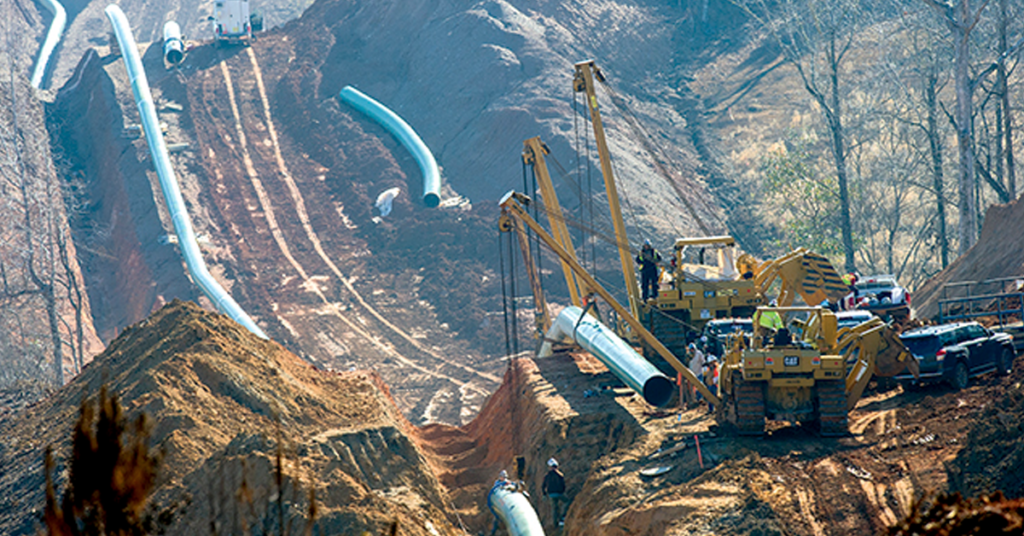
A 515-mile-long natural gas pipeline, which includes 86.4-miles in east Alabama, is on target to begin operation in June. The Sabal Trail Transmission pipeline is a joint project by three energy companies —Spectra Energy Corp., NextEra Energy Inc. and Duke Energy — and will transport natural gas from the Transco pipeline north of Alexander City, Ala., extend through the southwest corner of Georgia and end in central Florida near Orlando. The three-state pipeline is currently “about 85 percent complete with overall construction,” Andrea Grover, Director or Stakeholder Outreach for the Sabal Trail Transmission told Alabama Today. With construction underway in Tallapoosa, Chambers, Lee and Russell Counties, the pipeline is roughly 70% complete in Alabama, Grover added. Expected to provide a significant economic benefit to the Yellowhammer State, the pipeline creates both short-term and long-term jobs and adds capital investment and tax base to the state’s economy. During the current construction phase, the economic benefits include: 1,112 construction jobs available $37,240,486 funds from jobs being created $49,685,416 additional funds contributed by non-directly related construction activity $140,412,196 amount generated for the state after construction is completed In addition, the permanent economic impact and operations in Alabama will include: 94 permanent jobs after construction is completed $2,953,302 funds from jobs being created $4,907,082 additional funds contributed by non-directly related construction activity $10,757,812 amount generated for the state after construction is completed Despite the anticipated economic gains, environmental groups oppose the trail’s construction, saying it could threaten people’s health and access to clean water. On its face, this pipeline should be rejected for the threat it poses not only to our climate, but to the public health of communities it would affect,” said Lena Moffitt, Director of Sierra Club’s Beyond Dirty Fuels campaign. “Rather than doubling down on outdated, dirty fuels, we should complete our transition to 100 percent clean, renewable energy.” However, the Transmission contends they’ve taken comprehensive steps to address environmental groups’ concerns. “Regarding potential impacts on water supplies: Natural gas is lighter than air, meaning in the unlikely event it escapes from the pipeline, the gas can only travel up through the soil into the atmosphere and dissipate,” Grover explained in a column last month. “It cannot travel down through soils to water supplies. No toxins are released that would affect water quality.” She continued, “The project has been evaluated publicly over the past three years to ensure environmental permitting agencies, all levels of local, state and federal government, communities and landowners’ questions were addressed and impacts along the pipeline route were minimized. Sabal Trail hosted more than 50 open houses and public meetings and underwent a well-documented, comprehensive review by the Federal Energy Regulatory Commission (FERC).”
Alabama has one of the fastest growing counties for Hispanics in the U.S., research shows

America’s fastest growing Hispanic populations are not in places one would expect — Florida, California, or Texas. It’s in rural states like Alabama and North Dakota. Alabama’s Russell County had a 92 percent Latino population growth rate between 2007 and 2014, according to a new survey by the Pew Research Center. That makes it fourth in the nation, behind three counties in North Dakota. Russell County is on the eastern border of central Alabama and Georgia, just south of Columbus. Williams County, in northwestern North Dakota, led the pack with a 367 percent increase, followed by Stark County, also in North Dakota, with 294 percent. The Washington Post reports on the study, which shows the largest growth of Hispanic populations in the United States is in a “handful of rural counties far from metropolitan areas dominated by Latinos.” This demographic shift could soon start reshaping the political landscape in mostly rural states; a move Democrats are already beginning to embrace. Acknowledging this population change, Hillary Clinton’s campaign has brought in Hispanic outreach directors for Georgia, Pennsylvania, and North Carolina, making it the first time a presidential campaign has focused its Latino efforts in those areas. Clinton began airing Spanish-language ads this week in Nevada and Florida. Another finding in the study: most Hispanics dispersing throughout the country do not speak Spanish only. As many as 72 percent of Hispanics moving to these fastest-growing counties are identified as “English proficient,” which means they only speak English at home, or speak English along with another language. The national average is 68 percent.
Robert Bentley calls for Special Election to replace the late Lesley Vance
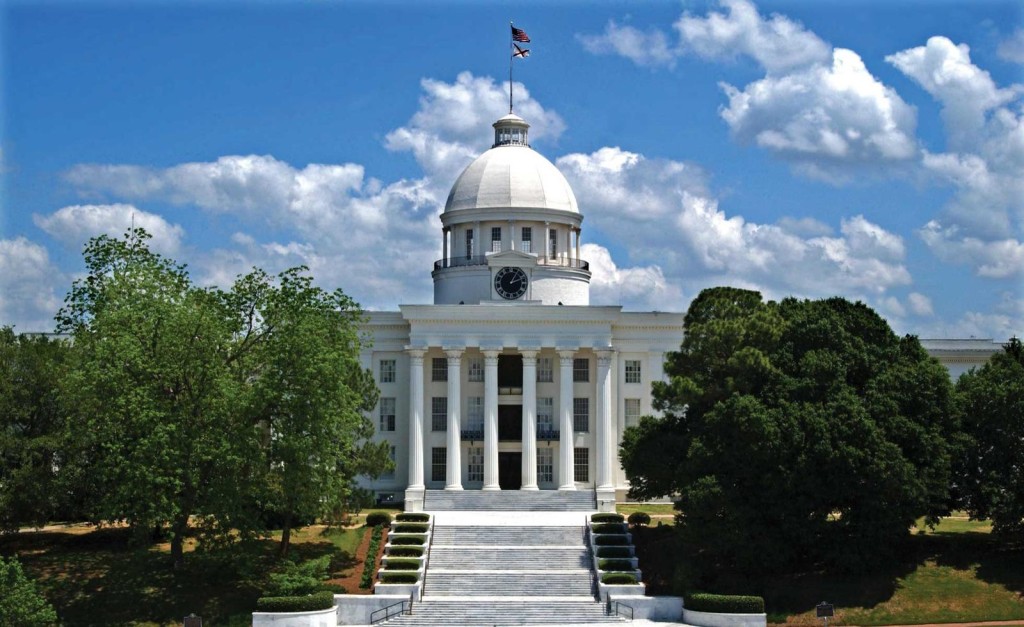
Gov. Robert Bentley released one of his most solemn orders in recent memory Monday night, calling for a special election in House District 80 to replace the late Rep. Lesley Vance. Vance passed away last Tuesday at the age of 76, after a long struggle with what news reports have called “an extended illness.” The timeline for the special election, set for April 12, is as follows according to an announcement from the governor’s office: A Special Primary Election for the District 80 House seat will be held on Tuesday, January 19, 2016. Or, in the event that a Special Primary Election is not necessary because the major parties have only one candidate, the Special General Election will be held on Tuesday, April 12, 2016. If necessary because of one candidate not receiving a majority of the votes in the Special Primary Election, a Special Primary Runoff Election will be held on Tuesday, March 1, 2016. If a Special Primary Runoff Election is not necessary because one candidate receives a majority of the votes in the Special Primary Election, the Special General Election will be held on Tuesday, April 12, 2013. If a Special Primary Runoff Election is required, the Special General Election will be held on Tuesday, May 10, 2013. Major-party candidates have until Tuesday, November 17 at 5:00 p.m. to file to run for the seat. The state parties must certify their qualified candidates to the Secretary of State within 48 hours in order to appear on the ballot. “This timeline gives candidates time to qualify, allows voters time to learn about candidates, and allows time for those who are unable to vote in-person to arrange to vote by absentee ballot,” Bentley said in a release. “Representative Vance was a great man and a dedicated public servant. I know the next representative for District 80 will be a strong advocate for people in the district, just like Rep. Vance was during his time in the Alabama House of Representatives,” said Bentley. HD 80 covers parts of Lee and Russell counties, in the state’s eastern central region. “Today, the citizens of Russell and Lee Counties and the entire state of Alabama lost a great leader in the passing of Representative Lesley Vance,” Hubbard said last week. “Chairman Vance was a fine man and an effective legislator who nobly fought for his constituents for more than 20 years.” Vance was first elected to the Legislature in 1994, switching his party affiliation to Republican in 2010, giving the GOP a supermajority in the Alabama House.
