
Donald Trump boasts of hiring only the best, but picks haunt him

President Donald Trump likes to boast that he hires only the best people. But his personnel choices keep coming back to haunt him. One of the people Trump hired for the White House was working as a foreign agent while advising him during the election. His campaign chairman caught the Justice Department’s attention for similarly surreptitious work. And a third campaign adviser was reportedly surveilled by the FBI as part of an investigation into whether or not he was a Russian spy. The tales of Michael Flynn, Paul Manafort and Carter Page — none of whom still work for Trump — have created a steady drip of allegations that have clouded Trump’s early presidency and raised persistent questions about his judgment. At worst, Trump’s personnel picks appear to have left his campaign — and perhaps his White House — vulnerable to the influence of foreign powers. At best, they expose the long-term implications of his understaffed and inexperienced campaign organization and undermine his promises to surround himself with top-notch talent. “Vetting new hires is standard procedure for presidential campaigns for exactly this reason,” said Alex Conant, who advised Sen. Marco Rubio‘s 2016 presidential campaign. “Every employee is also a potential liability on a presidential campaign.” During the campaign, Trump said he hired “top, top people” and would fill his administration “with only the best and most serious people.” Yet Manafort, Flynn and Page have indeed become political liabilities for Trump that he can’t shake in the White House. All three are being scrutinized as part of the FBI and congressional investigations into whether Trump associates helped Russia meddle in the 2016 election. The president has denied any nefarious ties to Russia and says he has no knowledge that his advisers were working with Moscow during the election. The president’s culpability appears greatest with Flynn, a retired U.S. Army lieutenant general who traveled with Trump frequently during the campaign and was tapped as national security adviser after the election. Flynn had been lobbying for a company with ties to Turkey during the 2016 election and even wrote an editorial on behalf of his client that was published on Election Day. “No one expects them to do the equivalent of an FBI background check, but a simple Google search could have solved a lot of these problems,” Dan Pfeiffer, who served as senior adviser to President Barack Obama, said of Trump’s team. After Trump’s victory, Flynn’s lawyers alerted the transition team that he may have to register as a lobbying for a foreign entity, according to a person with knowledge of those discussions. The White House hired him anyway. After the inauguration, Flynn’s lawyers told the White House counsel’s office that the national security adviser would indeed have to move forward with that filing. Flynn was fired in February after the White House said he misled Vice President Mike Pence and other top officials about his conversations with Russia’s ambassador to the United States. Lobbying for foreign interests is legal and lucrative. Both Republican and Democratic operatives offer their services to overseas clients. But the Justice Department requires Americans working on behalf of foreign interests to register, disclosing the nature of their work, the foreigners they dealt with and the amount of money they made. Willful failure to register for foreign lobbying work can carry up to a five-year prison sentence, but the Justice Department rarely brings criminal charges and instead urges violators to register. On Wednesday, a spokesman for former Trump campaign chairman Manafort said that he, too, under pressure from the Justice Department, would formally file for prior foreign lobbying. Manafort’s work for political interests in Ukraine occurred before he was hired as Trump’s campaign chairman, spokesman Jason Maloni said, though the U.S. government raised questions about his activities after he was hired by Trump. Manafort was pushed out of Trump’s campaign in August after The Associated Press reported that his consulting firm had orchestrated a covert Washington lobbying operation on behalf of Ukraine’s ruling political party without disclosing that work to the U.S. government. The White House did not respond to questions Wednesday about when Trump learned about Manafort’s foreign lobbying work and his discussions with the U.S. government about registering as a foreign agent. The questions surrounding Page are perhaps the most serious. On Tuesday, The Washington Post reported that the Justice Department obtained a highly secretive warrant to monitor his communications because there was reason to believe he was working as a Russian spy. In March, Trump personally announced Page as part of a newly minted foreign policy advisory team. But as questions began swirling about Page’s ties to Russia, the campaign started moving away from the little-known investment banker. Trump has since said he has no relationship with him. The New York Times reported Wednesday that the Justice Department only obtained the warrant after the campaign distanced itself from Page. In an interview Thursday with ABC’s “Good Morning America,” Page described his affiliation with the Trump campaign as having served as “an informal member of a committee which was put together — a team of individuals who were looking at various foreign policy issues.” Chris Ashby, a Republican elections lawyer, said that while it’s easy to blame Trump for missing red flags about his campaign advisers, it’s not always possible to dig up details that potential hires aren’t willing to disclose on their own. “In the ideal world, you could rely on paid background checks, but you’d have to have the money and the time,” Ashby said. “The farther down the ranks you go and certainly when you reach the ranks of unpaid advisers, that becomes impractical.” Republished with permission of The Associated Press.
Jeff Sessions spoke with Russian envoy in 2016, Justice Dept says
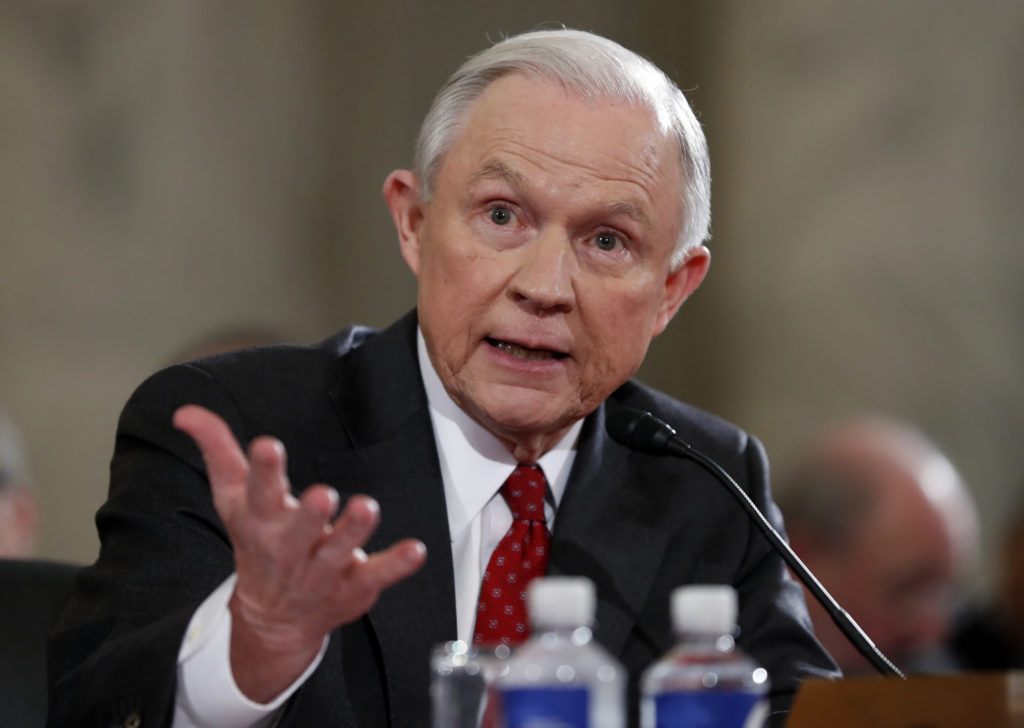
Attorney General Jeff Sessions talked twice with Russia’s ambassador to the United States during the presidential campaign, the Justice Department confirmed, communications that spurred calls in Congress for him to recuse himself from an investigation into Russian interference in the U.S. election. Sessions, an early supporter of President Donald Trump‘s candidacy and a policy adviser to the Republican, did not disclose those discussions at his Senate confirmation hearing in January when asked what he would do if “anyone affiliated” with the campaign had been in contact with officials of the Russian government. Sessions replied that he had not had communications with the Russians. In a statement late Wednesday, Sessions said, “I never met with any Russian officials to discuss issues of the campaign. I have no idea what this allegation is about. It is false.” Justice Department spokeswoman Sarah Isgur Flores said Wednesday night that “there was absolutely nothing misleading about his answer.” That statement did not satisfy Democrats, who even before Wednesday had sought his recusal from the ongoing federal investigation and had raised questions about whether he could properly oversee the probe. Sessions said Thursday in a brief interview with NBC, “I have said that, when it’s appropriate, I will recuse myself.” White House spokeswoman Sarah Huckabee Sanders earlier called the disclosure of the talks with the ambassador, Sergey Kislyak, “the latest attack against the Trump administration by partisan Democrats.” She added that Sessions “met with the ambassador in an official capacity as a member of the Senate Armed Services Committee, which is entirely consistent with his testimony.” House Democratic leader Nancy Pelosi accused Sessions of “lying under oath” and demanded that he resign. Other Democrats called on him to step aside from the investigation. House Majority Leader Kevin McCarthy, appearing Thursday on MSNBC’s “Morning Joe” show, “I just think he needs to clarify what these meetings were.” The California Republican said it isn’t unusual for members of Congress to meet with ambassadors, but he added that if a question arose about the integrity of a federal investigation, “I think it’d be easier” for an attorney general to step away from the probe. Sessions had more than 25 conversations with foreign ambassadors last year in his role as a U.S. senator and senior member of the Armed Services Committee, and had two separate interactions with Kislyak, the department confirmed. One was a visit in September in his capacity as a senator, similar to meetings with envoys from Britain, China, Germany and other nations, the department said. The other occurred in a group setting following a Heritage Foundation speech that Sessions gave during the summer, when several ambassadors — including the Russian ambassador — approached Sessions after the talk as he was leaving the stage. Revelations of the contacts, first reported by The Washington Post, came amid a disclosure by three administration officials that White House lawyers have instructed aides to Trump to preserve materials that could be connected to Russian meddling in the American political process. The officials who confirmed that staffers were instructed to comply with preservation-of-materials directions did so on condition of anonymity because they were not authorized to publicly disclose the memo from White House counsel Don McGahn. On the Sessions revelation, Rep. Adam Schiff of California, the top Democrat on the House Intelligence Committee, said: “If reports are accurate that Attorney General Sessions — a prominent surrogate for Donald Trump — met with Ambassador Kislyak during the campaign, and failed to disclose this fact during his confirmation, it is essential that he recuse himself from any role in the investigation of Trump campaign ties to the Russians.” Asked by reporters Monday about the prospect of a recusal, Sessions had said, “I would recuse myself from anything that I should recuse myself on.” At the confirmation hearing in January, Sen. Al Franken of Minnesota asked Sessions about allegations of contact between Russia and Trump aides during the 2016 election. He asked Sessions what he would do if there were evidence that anyone from the Trump campaign had been in touch with the Russian government during the campaign. Sessions replied he was “unaware of those activities.” Then he added: “I have been called a surrogate at a time or two in that campaign and I didn’t have, did not have communications with the Russians, and I’m unable to comment on it.” Flores, the Justice Department spokeswoman, said that response was not misleading. “He was asked during the hearing about communications between Russia and the Trump campaign — not about meetings he took as a senator and a member of the Armed Services Committee,” she said in a statement. Franken said in a statement he was troubled that the new attorney general’s response to his question was “at best, misleading.” He said he planned to press Sessions on his contact with Russia. “It’s clearer than ever now that the attorney general cannot, in good faith, oversee an investigation at the Department of Justice and the FBI of the Trump-Russia connection, and he must recuse himself immediately,” Franken said. Separately in January, Sen. Patrick Leahy, a Judiciary Committee Democrat, asked Sessions in a written questionnaire whether “he had been in contact with anyone connected to any part of the Russian government about the 2016 election, either before or after election day.” Sessions replied simply, “No.” Republished with permission of The Associated Press.
Blake Dowling: Consumers can avoid feeling the ‘email Bern’ by hackers

Debbie Wasserman Schultz got to “Feel the Bern” in the form of a hostile crowd of Florida delegates at the Democratic National Committee. Why were these Bern Victims so fired up? The email scandal of course, which led to Schultz’s resignation. The pro-Clinton digital documentation that was revealed in this breach and scandal is a mess. There are several old school rules of thumb that my grandparent’s used to use which were “make sure to get it in writing” and “make sure to not put that in writing.” You should have the same approach to writing emails. “I don’t care if anyone reads this ever.” If it’s not that, delete. Emails can be sent/forwarded to the wrong people, handed over to the courts, watched by the National Security Agency, and for Debbie and the gang at the DNC, hacked. The DNC realized something was wrong going back as far as April. They brought in a professional security firm to analyze their network; they found a breach, blocked it, but it was too late. The bad guys had been inside their world for a year, and they had already taken everything they wanted. It is suspected that a nation state was behind the hack (Russian-backed cybercrime syndicate – Guccifer 2.0 is suspected), and I was asked by the Orlando Sentinel this week how you stop something like that? (See my Q & A with Paul Owens later this week.) The short answer is; you don’t. If you have the resources to build nuclear weapons and fly in space, you can pile up enough code, hackers, hardware and software to perpetuate a successful cyber threat against anyone. Like Bill Clinton and the intern, it’s going to happen eventually. What you need to be thinking about is how to minimize the threat. Your password is your front line of defense. To those of you that have a password that is a variation of the word password or a word that can be found in the dictionary. FAIL. Those rules from information technology experts have been read over and over: use a number, a capital letter, and a symbol in every password gives you some security. There are software programs designed to auto-hack passwords, and by following these protocols, you might just stop a threat in its tracks. The most common attacks are Trojans, Phishing schemes, denial of service (DOS) attacks, Ransomware/Malware (Cryptolocker), and password attacks/brute force attacks. In conjunction with a strong password, put your email somewhere smart. Don’t use a free hosting service for email. There are a dozen examples of free email, but I will minimize my risk of a nasty letter in the mail and not call them by name. You get what you pay for, both in life and email. Use a cloud platform with a “Tier 4” data center. Tier 4 is defined as critical servers and computer systems in a Data Center, with fully redundant subsystems (cooling, power, network links, storage, etc.) and compartmentalized security zones controlled by biometric access control methods. If you have your email on a local server, make sure a state of the art firewall is deployed, and in all cases have up to date hardware with the latest patches, as well as anti-virus and antispam solutions in place. Lastly, if an attack, breach or theft occurs, have a solid backup of your email and data in place. The Russians, Chinese, the 14 people in North Korea with internet access and the wacko next door could all be potential cyber criminals. You can buy kits on the dark web to become a cybercriminal in about seven minutes. So keep thinking defensively, to that end, another way to keep the bad guys out is “two-factor authentication.” This is a method of confirming a user’s identity by utilizing a combination of two different components. These components may be something that the user knows, something that the user possesses or something that is inseparable from the user. An example from everyday life is the withdrawing of money from an ATM. You have to have a bank card (something that the user possesses, 1 factor) and a PIN (personal identification number, 2 factor) allows the transaction to be carried out. The same goes to logging into a commercial site, when they text you a code to enter. Criminals are not getting dumber, but the average American is; see the Pokémon Go craze if you need further evidence. So when it comes to email, keep your eyes wide-open, and security top of mind. Be safe out there. ___ Blake Dowling is chief business development officer at Aegis Business Technologies. His technology columns are published by several organizations. Contact him at dowlingb@aegisbiztech.com or at www.aegisbiztech.com.
