
Bradley Byrne introduces legislation to make schools safer
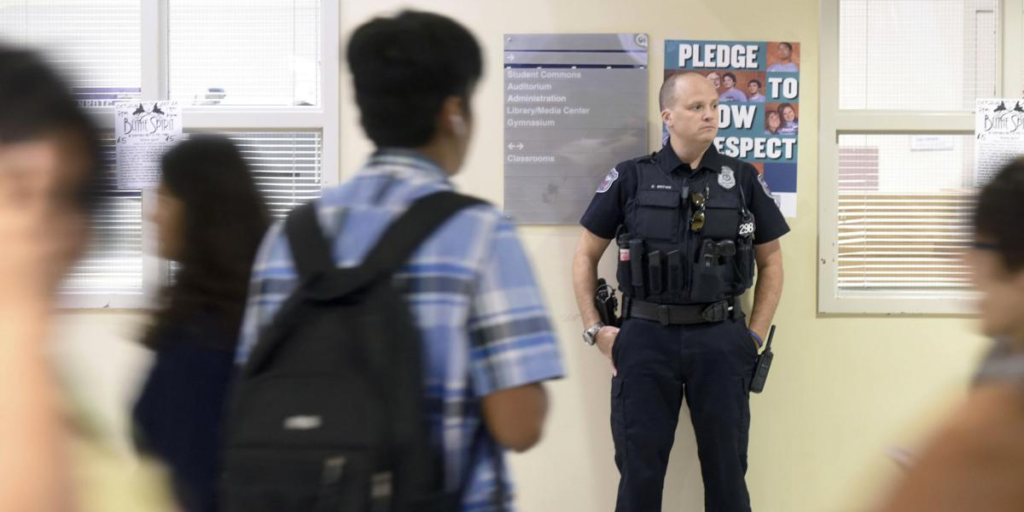
Schools nationwide will soon be safer for students, teachers, and faculty if Alabama 1st District U.S. Rep. Bradley Byrne has anything to say about it. A member of the House Education and the Workforce Committee, Byrne recently introduced the Make Schools Safer Act to provide school officials with better information regarding school safety. His bill requires the Director of the Institute of Education Sciences — part of the U.S. Dept. of Education, an the nation’s leading source for rigorous, independent education research, evaluation and statistics — to include studies and resources relating to school safety and mental health as part of the What Works Clearinghouse, which is available to educators, counselors, and principals. “School safety should be a priority for every level of government,” said Byrne. “While I do not want the federal government to mandate how schools protect their students, I believe it is appropriate for the federal government to provide high quality research and information to schools about the best practices for keeping students safe, coordinating with law enforcement, and identifying at-risk students. My bill offers a simple yet profound step toward making our schools safer.” The new studies and resources will focus on educating appropriate school personnel on techniques for identifying students who may need assistance, collaborate with health care professionals, state and local law enforcement, youth organizations, and parents to implement procedures to assist students. By making resources available, Byrne’s legislation endeavors to allow schools to select the approach that works best for them, rather than prescribing a one-size-fits-all solution from the federal government. Read Byrne’s bill below:
Phil Williams: A full-spectrum approach to school safety
In the wake of the recent horrific school shootings in Santa Fe, Texas, and Parkland, Florida, and today’s tragic events at a middle school in Noblesville, Indiana, I found myself reviewing another opinion piece that I wrote in December of 2012. That one was written in the aftermath of the Sandy Hook shooting in Connecticut. Fast forward six years and we are there again. There is no way to say with any certainty whether any of these incidents were entirely predictable or preventable. But what is predictable are the usual, oversimplified calls for gun control, or the opposite response of arming teachers. We can do better than that. What is needed is a far more robust and comprehensive view of the situation. It is time for state and federal funding to be applied to a broader solution in what the U.S. Army refers to as “Full Spectrum Operations.” Full spectrum operations require equal and continuous application of offensive, defensive, stabilizing, and civil measures. It is not enough to simply shout “Arm the teachers!” or “Take their guns!” The leaders of every community should look to a broader view. In the offensive category of full spectrum operations, we must be proactive in the areas of mental health and on-site response capability. Mental health is often overlooked in these debates, but studies indicate it is nearly always a factor in the incidents themselves. We should recruit, train and place social workers to work in our schools and set the student ratio at a reasonable level to ensure their ability to interact with students and faculty. At the same time, it is past due for every school to have a uniformed school resource officer on duty. Both the social worker and the SRO should then be able to interact with each other and provide input on student issues that comes from firsthand knowledge. The average costs to the budgets for a school counselor or an SRO are each roughly the equivalent of hiring an additional teacher. That’s an investment we can and should make. In the defensive and stabilizing categories, we must make our schools harder targets with additional standoff capabilities. Every school should have controlled access and live-feed security cameras. Staff and students should conduct active shooter drills the same as they do for tornado drills. Barriers can be easily placed in front of major entryways to prevent vehicular forced entry. Up-to-date school schematics for both public and private schools should be on file with state and local law enforcement to better equip them for response. Funds currently allocated for technology and facilities improvement in Alabama’s education funding should be immediately modified to allow for security expenses determined at the local discretionary level. A robust, layered defense is necessary for every facility, and the cost to create these defensive measures is minimal by comparison to our multi-billion dollar state education budget. Lastly, full spectrum operations are never complete until the civil aspect has been addressed. Local communities need to ensure that they are fully engaged in providing what they can to the schools in their jurisdictions. Several years ago, one of the smallest towns in my legislative district smartly chose to annex land to get their municipal limits adjacent to a rural elementary school, in order to provide a municipal police officer as an SRO, at no cost to the school system. The mayor and town council felt that it was their responsibility to watch out for those kids. What a testimony. Whether via state grants, discretionary funds from elected officials, parent-teacher associations, churches and faith-based organizations, or simply an increased willingness by local citizens to engage the process, it is absolutely necessary for communities to rally around their schools and ensure that they have what they need to prevent another senseless tragedy. In truth, all of the measures just described are not guaranteed to stop every attempt by a committed killer to harm one of our children. But if the application of a full spectrum approach to school safety saves just one life….just one….it will be worth it. ••• A decorated U.S. Army officer who served in Afghanistan and Iraq, Phil Williams represents District 10 in the Alabama State Senate, which is comprised of all or parts of Etowah, Cherokee, St. Clair, and DeKalb counties. Follow him on Twitter for his latest legislative updates: @SenPhilWilliams
Walt Maddox releases School Safety Plan
With school safety on the forefront of everyone’s minds; Walt Maddox released his school safety plan that he would implement if elected Governor on Wednesday. “Our children deserve a bright and safe future,” Maddox said on his campaign website. “There is no higher priority for government, for society, than ensuring that our children are protected.” Legislative officials are under pressure to make a decision regarding school safety given last week’s national school walkout meant to honor the 17 victims of the Marjory Stoneman Douglas High School shooting Parkland, Fla. In his release, Maddox listed five school safety strategies that he will instill if elected Governor of Alabama: School hardening Training school security officers and staff Restrictions on guns Early identification of potential attacker Support gun control Maddox will face former state Supreme Court Chief Justice Sue Bell Cobb, along with Christopher Countryman, James Fields, Doug Smith and Anthony White in the June 5 Democratic primary. The winner will go on to face the Republican nominee in the general election, to be selected among: Gov. Kay Ivey, Tommy Battle, Bill Hightower, Scott Dawson, or Michael McAllister. Read Maddox’s full school safety plan below: 1. School Hardening Our schools were built with open doors and were never constructed with the level of security in mind that we now must demand. Our schools have become soft targets for those who want to harm our children and our way of life. All future schools must be designed and built with security as a central focus. In addition to the physical improvements, every Alabama school must be protected by a trained and certified law enforcement professional (School Security Officers). 2. Training school security officers and staff School Security officers will be highly trained to work with in a school environment. There will also be required active shooter and other school safety training for local law enforcement, staff and administrators. Planning and integration of responses are vital in preventing these incidences or saving lives. 3. Restrictions on guns No gun will ever be allowed on a school premise at any time except for the trained school security officers. 4. Early identification of potential attacker Protocols will be in place to identify people who are prone to violence in an effort to prevent any harm. This includes the integration of the Department of Mental Health, Alabama Law Enforcement Agency, and local law enforcement and school systems. 5. Support gun control We will fully support rational gun control efforts to ensure those that are mentally unstable do not get guns. Together, we can secure our schools, make our children safe, and protect the future by allowing our students to focus on their reason for being there – to improve their minds, expand their knowledge, and prepare them to be the leaders of tomorrow.
Twinkle Cavanaugh asks Alabama Legislature to train teachers as Reserve Deputy Sheriffs

In the wake of Wednesday’s school shooting in Parkland, Fla. people across the country are looking for solutions to prevent similar massacres in the future. One such solution-seeker is the president of the Alabama Public Service Commission (PSC) and Lt. Governor candidate Twinkle Andress Cavanaugh. She’s asking the Alabama Legislature to consider a 2013 school safety law, which was passed for Franklin County, to be considered statewide. Spearheaded by Red Bay-Democrat State Rep. Johnny Mack Morrow, the Alabama legislature passed HB404 in 2013, which allows suitable teachers, school personnel, and locals to volunteer to be trained as Reserve Deputy Sheriffs and carry firearms on school grounds in Franklin County. Cavanaugh says the law has has given the state a model to study for almost five years when it comes to the subject of school safety “I find it shameful when people, on both sides of the aisle, play politics with tragedies. This is an exploitation tactic used almost exclusively by liberals, hotheads, and children,” Cavanaugh said in a press release. “Yesterday there was a knee-jerk reaction to try to capture the headlines of every news story in Alabama for political gain. I believe we need strong, measured leadership that puts our children and teachers first- not political pandering.” Cavanaugh added, “Yesterday, I spoke with Franklin County Sheriff Shannon Oliver, along with the bill’s sponsor, and the bill seems to be working in Franklin County. I would ask that the legislature look at this bill and look how well it has worked for Franklin County. This bill could be expanded to a statewide level on a bipartisan basis, as the 2013 bill passed without a single ‘nay’ vote in both the House and the Senate.” This bill would allow local control of school safety, giving decision-making power to a county’s sheriff, principals, and school board. According to Cavanaugh, many Alabama counties do not have the funding for resource officers, leaving law enforcement with a long response time to schools in an active shooter situation. Which is precisely why HB404 was introduced and passed in the first place — following the Sandy Hook school shooting, the Franklin County Sheriff’s Office realized that their response time in a similar situation would be over thirty minutes to East Franklin.
Betsy DeVos touts school choice, STEM as education priorities
Education Secretary Betsy DeVos has put forth a new set of priorities for states, schools and universities competing for federal grant money. The priorities include school choice, science and technology, special education and school safety. The Education Department awards approximately $4 billion per year in new and continuation competitive grants across some 80 programs, the agency said Thursday. Education secretaries have historically used these competitions to push their priorities. “It’s a little nudge,” said Chad Aldeman, an associate partner at Bellwether Education Partners. “This allows the department to nudge the education field toward these priorities.” There are a total of 11 priorities on DeVos’ list. After receiving public comments on these proposals, the agency will settle on one or several of them. Promoting school choice has been a key focus of the Trump administration. School choice refers to providing parents and their children with options besides their district public school, such as charter schools, vouchers or education savings accounts to attend private schools. DeVos and her supporters say these options better serve students’ individual needs and can benefit children whose local schools are underperforming. Critics say charter and private schools don’t necessarily outperform neighborhood schools and they lack accountability mechanisms. Sen. Patty Murray of Washington, the top Democrat on the Senate committee devoted to education, criticized DeVos’ priorities as a way to privatize education and said the department should be focusing on supporting local, public education. “Since her confirmation hearing, I have voiced concern that Secretary DeVos would abuse her position to prioritize privatization, and that’s exactly what we’re seeing,” Murray said. “Instead of listening to the millions of students, parents and teachers who stood up against her extreme ideological agenda, her proposal will allow her to prioritize applicants that would siphon taxpayer funds away from the public schools that serve the vast majority of students.” Republished with permission from the Associated Press.
ATF, Crime Stoppers increase reward to keep Alabama schools safe, gun-free
The Bureau of Alcohol, Tobacco, Firearms and Explosives (ATF) and the Central Alabama Crime Stoppers have joined forces to help make Alabama schools a little more safe. According to the Alabama News Network, the ATF will now offer a $500 reward through Crime Stoppers for any tip that leads to the confiscation of a gun on school grounds, including after-school sanctioned events. Previously students were offered $50 gift cards. The reward increase comes in the wake of the program’s proven track record of success. During the 2015-16 school year, Central Alabama Crime Stoppers paid out a total of $900 to tipsters for school-related crimes throughout the River Region. The Scholastic Tip Line resulted in 22 criminal arrests and the clearance of 29 criminal cases on school grounds. Students from every school in Autauga, Elmore, Lowndes, Macon, Montgomery, Pike and Tallapoosa counties are eligible for the increased reward. Designed to help law enforcement fight crime by gathering information from the public, Crime Stoppers encourages the public to help them fight crime by offering tipsters anonymity, even accepting tips through their Facebook page. Anyone with information about guns being brought to school in the River Region is asked to call their local police or Central Alabama Crime Stoppers at 215-STOP.
