
Joe Biden eyes Washington veterans for key administration posts
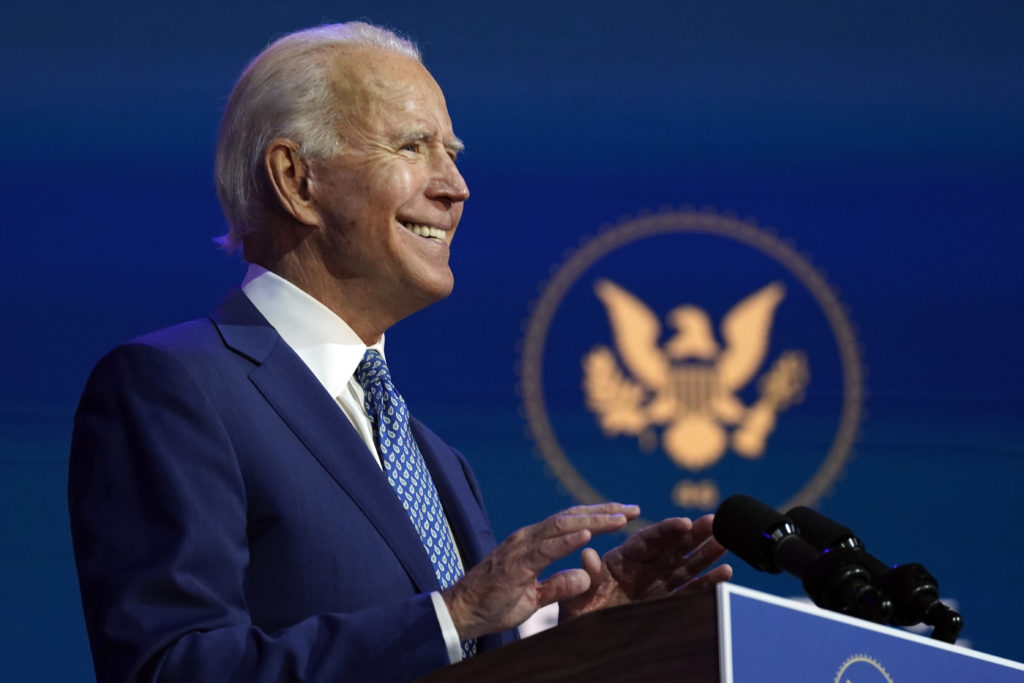
President-elect Joe Biden is looking to build out his nascent White House staff with more traditional Washington insiders, a notable departure from four years in which President Donald Trump filled his team with outsiders and government antagonists. Ron Klain is an early favorite to become Biden’s chief of staff, according to multiple people familiar with planning who spoke on condition of anonymity to speak freely about private discussions. He has decades of Washington experience that includes being Biden’s chief of staff when he was vice president, in addition to serving as the Ebola response coordinator in 2014 and having a central role in the Obama administration’s financial crisis response. Delaware Sen. Chris Coons, a longtime Biden ally and friend, is seen as a potential choice for secretary of state. Rep. Karen Bass of California, whom Biden considered for vice president, is seen as a potential housing and urban development secretary. Both served in Congress for the past decade. Biden is expected to move quickly to name a chief of staff, but other top Cabinet positions will likely take longer. The names under consideration represent Biden’s effort to move Washington past the tumult of President Donald Trump’s administration and fill out his government with more seasoned professionals. The task is taking on even greater urgency than in past transitions because Biden will take office in January amid a raging pandemic that will likely consume the early days of his presidency and require a full government response. Biden made clear on Monday that he would focus on the pandemic by forming a coronavirus advisory board. Former Surgeon General Vivek Murthy, who was named a co-chair of that panel, is seen as a contender for the top job at the Department of Health and Human Services. New Mexico Gov. Michelle Lujan Grisham, who ran her state’s health department, is also being eyed for the position. Even for roles where Biden has the opportunity to make history and appoint the first woman or African American Cabinet secretary, like at defense and treasury, Biden is said to be considering options with decades of experience in their chosen fields. Roger Ferguson, who served as vice-chair of the Federal Reserve under Bill Clinton and George W. Bush, is a potential treasury secretary, while Michele Flournoy, a former undersecretary of defense, is seen as a top pick to lead the Pentagon. Some Democrats are hopeful that the more traditional picks will help rebuild morale among the thousands of civil servants who felt thwarted at doing their jobs under Trump. “You’re not only talking about people who have an expertise in government functions, you’re talking about people who have a great deal of respect for government functions,” said Ed Espinoza, former western states political director for the Democratic National Committee. “That’s a key distinction between the Trump administration and a Biden administration.” It’s a striking shift from Trump, who built out his Cabinet with a raft of unorthodox picks, many of whom were openly skeptical of the federal government’s role in the jobs they were tasked with. Betsy DeVos, an advocate for steering federal money to private charter schools, led the Education Department. Scott Pruitt, the former Oklahoma attorney general who’s a skeptic of the science showing humans contribute to climate change, ran the Environmental Protection Agency. And Republican Rep. Mick Mulvaney of South Carolina, who initially served as White House budget director, supported shutting down the government to rein in federal spending and was critical of some of the proposals Trump aimed to invest in, like a massive infrastructure policy. Still, Biden faces a number of major unknowns as he prepares for the presidency. First, the scope of Biden’s first-term agenda will hinge on which party controls the Senate, which remains in question with two special Senate elections in Georgia scheduled for the first week in January. Democrats have acknowledged they will likely need to pare back some of Biden’s campaign trail promises even if they do hold the majority in a closely divided Senate, and a slim majority could also affect the kinds of nominees Biden can hope to get approved for top Cabinet slots. The most imminent unknown for Biden, however, remains to what extent Trump and his administration will work with the former vice president as his team begins its efforts to transition the government. The General Services Administration is tasked with formally recognizing Biden as president-elect, beginning the transition process. But the agency’s Trump-appointed administrator, Emily Murphy, has not started the process and has given no guidance on when she will do so. That lack of clarity is fueling questions about whether Trump, who has not publicly recognized Biden’s victory and has falsely claimed the election was stolen, will impede Democrats as they try to establish a government. There is little precedent in the modern era of a president erecting such hurdles for his successor. The stakes are especially high this year because of the coronavirus pandemic, which will require a comprehensive government response. “America’s national security and economic interests depend on the federal government signaling clearly and swiftly that the United States government will respect the will of the American people and engage in a smooth and peaceful transfer of power,” Jen Psaki, a Biden transition aide, tweeted Sunday. South Carolina Rep. Jim Clyburn, an ally of Biden’s on Capitol Hill, said that if Trump continues to drag his feet, then he hopes that “my conservative friends in Congress will have an intervention.” “This country is bigger than one person, and to allow the people of this country to suffer — we are near 245,000 deaths, and we’re still messing around and won’t get the relief that people need,” he said. Indeed, some Republicans on Capitol Hill called for a smooth transition Monday. Maine Sen. Susan Collins, a moderate Republican and occasional Trump antagonist, congratulated Biden on his victory and said in a statement that “presidential transitions are important” and that Biden and Vice President-elect Kamala Harris should “be given every opportunity
New EPA acting chief, Andrew Wheeler reassures agency’s staffers
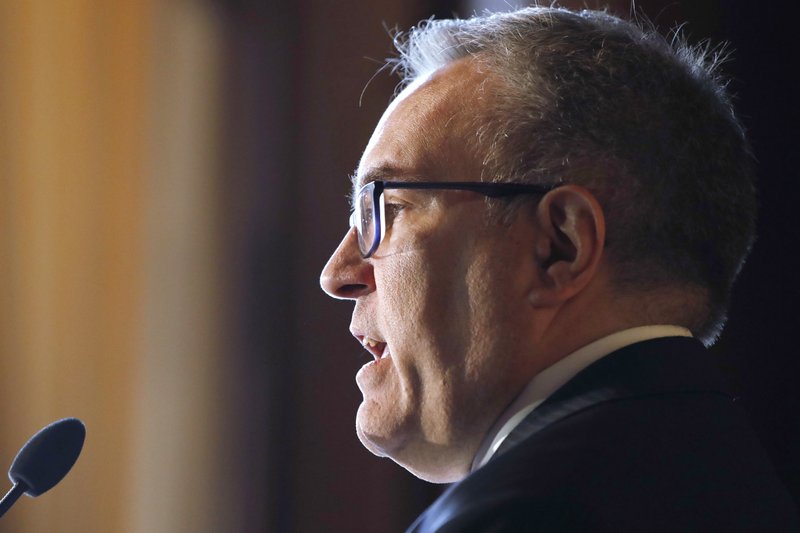
The new acting head of the Environmental Protection Agency is telling agency staffers that he has their backs and will seek their input as he sets the way forward for the troubled agency. Andrew Wheeler spoke to EPA staffers Wednesday for the first time since Scott Pruitt quit as agency administrator last week after months of ethics scandals. Wheeler made no mention of the allegations that led to Pruitt’s resignation. But he told staffers he understands how stressful management changes are. Wheeler, speaking at agency headquarters, told workers, “You will find me and my team ready to listen.” Pruitt had been battling federal investigations over his luxury spending, high security costs and other matters. He had also been accused of shutting out career staffers at the EPA. Republished with the permission of the Associated Press.
EPA’s relief and worries after Scott Pruitt’s exit
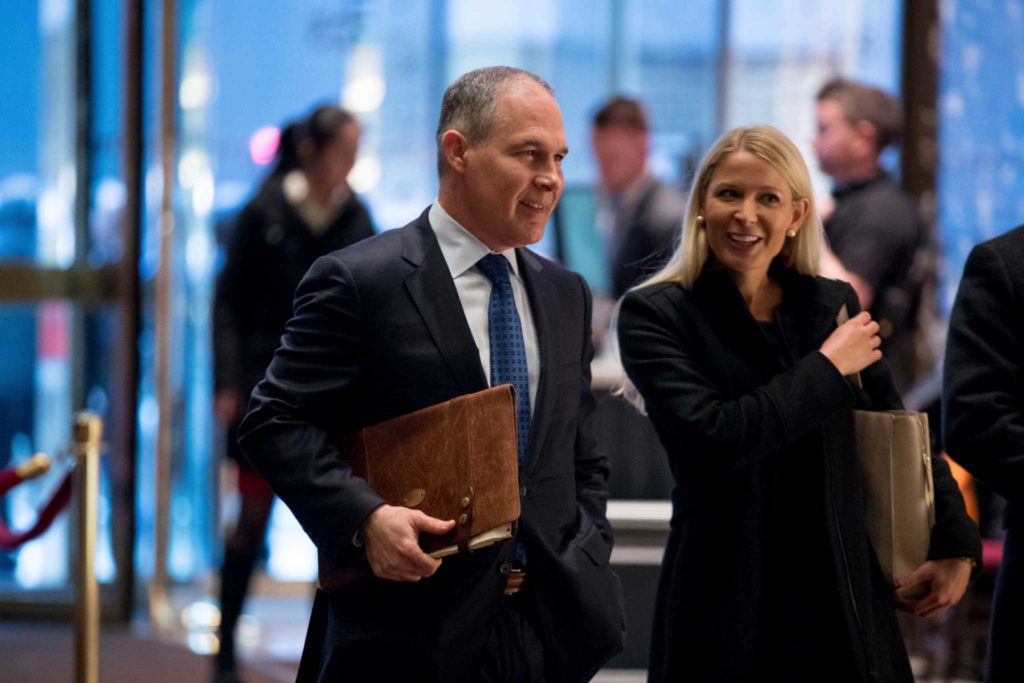
Taking over from an ambitious predecessor known for seeking out the rich, powerful and conservative, the Environmental Protection Agency’s newly named acting chief has promised to reach out to anxious staffers throughout the demoralized agency and to lawmakers of both political parties. By late afternoon Friday, there had been no public comment from either Scott Pruitt, whose resignation President Donald Trump announced Thursday after months of Pruitt’s ethics scandals, or Andrew Wheeler, the Washington veteran and former coal lobbyist who Trump announced as the agency’s acting head. In an email sent out to EPA staffers Thursday night and obtained by the Associated Press, Wheeler said he was honored to take temporary leadership of the agency where he started his Washington career in the early 1990s, as an EPA employee dealing with toxic substances and other matters. “I look forward to working hard alongside all of you,” Wheeler wrote agency employees. Pruitt, Oklahoma’s attorney general at the time of his EPA appointment, had embraced the perks of office in Washington. He instituted unusual and costly round-the-clock protection for himself, flew premium class to Europe and North Africa, and directed agency staffers to help seek housing for his family, high-dollar employment for his wife, and pleasures such as luxury lotion and tickets to top sporting events. Trump had praised Pruitt for his regulation-trimming ways at EPA. On Thursday, however, Trump said Pruitt himself had concluded the EPA chief’s ethics scandals were too much of a distraction and was stepping down. Some EPA staffers linked to Pruitt’s tumultuous 17-month tenure feared for their jobs Friday, former top staffers under Pruitt said. That included the roughly 20 members of a security detail Pruitt’s EPA had created to guard him around the clock. The guards were originally trained for investigating environmental crimes. The agency’s security officials are expected to decide what level of protection Wheeler needs. “There’s definitely that fear” of a shake-up among Pruitt’s remaining political appointees, said Kevin Chmielewski, the former deputy chief of staff who fell out of favor with Pruitt after questioning spending. “This is the follow-up stories, the people’s lives he’s affected, going down to the agents and everyone else.” Some scientists and other career staffers, who learned of Pruitt’s departure through news and social media on Thursday, quietly expressed relief, Elizabeth Southerland, who quit last year as the science director at the agency’s Office of Water, said after hearing Thursday and Friday from many still at the agency. Wheeler’s public statements show him to be a skeptic, like Pruitt, about the extent to which coal, oil and gas emissions drive climate change, something that mainstream science says is indisputable fact. After leaving his four-year stint at the EPA in the 1990s, Wheeler became the top staffer for the Senate’s most ardent challenger of manmade climate-change, Republican Sen. James Inhofe of Oklahoma. Wheeler then went to work as a lobbyist for top coal companies and other businesses and interests. In a hearing on his appointment as the agency’s deputy administrator last November, Wheeler described himself as someone who “always tried to find common ground and work across the aisle” in Washington. Where Pruitt openly criticized the work of EPA employees under the Obama administration, Wheeler at the Senate committee hearing made a point of praising the agency’s career staffers as “some of the most dedicated and hard-working employees” in federal government. Wheeler told the Washington Examiner earlier this year he was focusing on repairing relationships with EPA career staff who bristled at Pruitt’s leadership. At the EPA, staffers expect Wheeler to stick to the agenda set by Pruitt and Trump: Cutting environmental regulations that the Trump administration and industries see as unnecessarily burdensome to business, Southerland, the former water official, said. “There’s not a single person who doesn’t think that will happen,” Southerland said of the current EPA staffers she has talked to. However, “they think at least the contemptuous behavior will stop,” she said. She was referring to allegations that Pruitt ignored all but his own political appointees at the agency, and used his office for personal gain. EPA’s press office sent out biographical information on Wheeler late Friday, but did not respond to interview requests for him. Republished with the permission of the Associated Press.
Scott Pruitt is out, handing EPA reins to former coal lobbyist
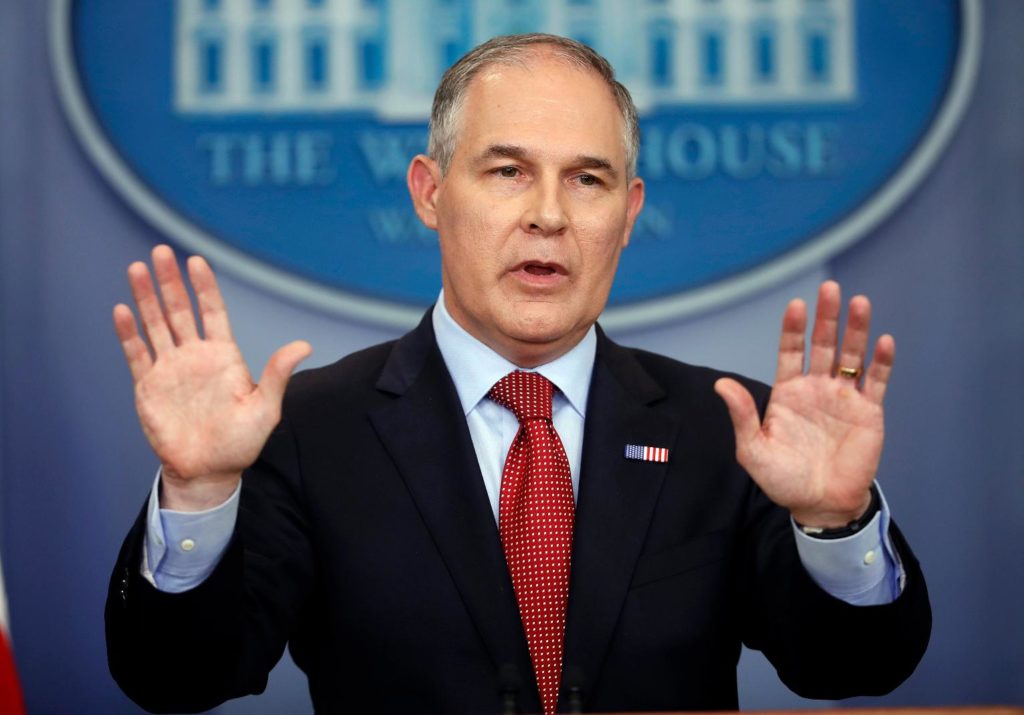
Bowing out after months of scandals, Scott Pruitt is turning the Environmental Protection Agency over to a far less flashy deputy who is expected to continue Pruitt’s rule-cutting, business-friendly ways as steward of the country’s environment. With Pruitt’s departure, President Donald Trump lost an administrator many conservatives regarded as one of the more effective members of his Cabinet. But Pruitt had also been dogged for months by scandals that spawned more than a dozen federal and congressional investigations. EPA Deputy Administrator Andrew Wheeler, a former coal industry lobbyist, will take the helm as acting administrator starting Monday. “I have no doubt that Andy will continue on with our great and lasting EPA agenda,” Trump tweeted Thursday in announcing Pruitt’s resignation. Republicans say Wheeler is well-qualified to lead the EPA, having worked at the agency early in his career. He also was a top aide at the Senate Environment Committee before becoming a lobbyist nine years ago. Democrats and environmental groups decried Wheeler as an apologist for the coal industry. He’s also a former top aide to GOP Sen. James Inhofe of Oklahoma, who rejects mainstream climate science. Sen. Tom Udall of New Mexico, one of the most relentless and vocal of Pruitt’s Democratic critics in Congress, said he expects more of the same with Wheeler as chief. “Somebody that destructive, I think it’s good to have them go, no doubt about it,” Udall said of Pruitt in an interview. “But let’s not forget he was carrying out President Trump’s policies.” The prospect of more EPA rollbacks even after Pruitt is gone is “really, really worrisome to me,” he said. “The head of the agency’s changed, but I don’t think there’s any indication that the acting administrator will do anything any different.” Talking to reporters on Air Force One, Trump continued to praise his scandal-plagued EPA chief, saying there was “no final straw” and he had not asked for Pruitt’s resignation. “Scott is a terrific guy,” Trump said. “He came to me and said I have such great confidence in the administration I don’t want to be a distraction. … He’ll go and do great things and have a wonderful life, I hope.” In his resignation letter to Trump, obtained by The Associated Press, Pruitt expressed no regrets. “It is extremely difficult for me to cease serving you in this role first because I count it a blessing to be serving you in any capacity, but also, because of the transformative work that is occurring,” Pruitt wrote. “However, the unrelenting attacks on me personally, my family, are unprecedented and have taken a sizable toll on all of us.” Pruitt, a Republican, had appeared Wednesday at a White House picnic for Independence Day, wearing a red-checked shirt and loafers with gold trim. Trump gave him and other officials a brief shout-out, offering no sign of any immediate change in his job. Pruitt’s resignation came days after two of his closest advisers spoke to House oversight committee investigators and revealed new, embarrassing details in ethics scandals involving Pruitt. Samantha Dravis, who recently resigned as Pruitt’s policy chief, told investigators last week that Pruitt had made clear to her before and after he became EPA administrator that he would like the attorney general’s job, held then and now by Jeff Sessions. Pruitt “had hinted at that (sic) some sort of conversation had taken place between he and the president,” Dravis told congressional investigators, according to a transcript obtained Thursday by the AP. “That was the position he was originally interested in.” A former Oklahoma attorney general close to the oil and gas industry, Pruitt had filed more than a dozen lawsuits against the agency he was picked to lead. Arriving in Washington, he worked relentlessly to dismantle Obama-era environmental regulations that aimed to reduce toxic pollution and planet-warming carbon emissions. During his less than two-year tenure, Pruitt crisscrossed the country at taxpayer expense to speak with industry groups and hobnob with GOP donors, but he showed little interest in listening to advocates he derided as “the environmental left.” Those groups quickly applauded his departure. “Despite his brief tenure, Pruitt was the worst EPA chief in history,” said Kieran Suckling, executive director of the Center for Biological Diversity. “His corruption was his downfall, but his pro-polluter policies will have our kids breathing dirtier air long after his many scandals are forgotten.” Like Trump, Pruitt voiced skepticism about mainstream climate science and was a fierce critic of the Paris climate agreement. The president cheered his EPA chief’s moves to boost fossil fuel production and roll back regulations opposed by corporate interests. But despite boasts of slashing red tape and promoting job creation, Pruitt had a mixed record of producing real-world results. Many of the EPA regulations Pruitt scraped or delayed had not yet taken effect, and the tens of thousands of lost coal mining jobs the president pledged to bring back never materialized. Pruitt quit following a series of revelations involving pricey trips with first-class airline seats and unusual security spending, including a $43,000 soundproof booth for making private phone calls. He also demanded 24-hour-a-day protection from armed officers, resulting in a swollen 20-member security detail that blew through overtime budgets and racked up expenses of more than $3 million. Pruitt routinely ordered his EPA staff to do personal chores for him, including picking up his dry cleaning and trying to obtain a used Trump hotel mattress for his apartment. He had also enlisted his staff to contact conservative groups and companies to find a lucrative job for his unemployed wife, including emails seeking a Chick-fil-A franchise from a senior executive at the fast-food chain. Pruitt’s job had appeared in jeopardy since the end of March, when ABC News first reported that he leased a Capitol Hill condo last year for just $50 a night. It was co-owned by the wife of a veteran fossil fuels lobbyist whose firm had sought regulatory rollbacks from EPA. The slew of damaging revelations, many of which came to
Scandal-plagued EPA Administrator Scott Pruitt resigns
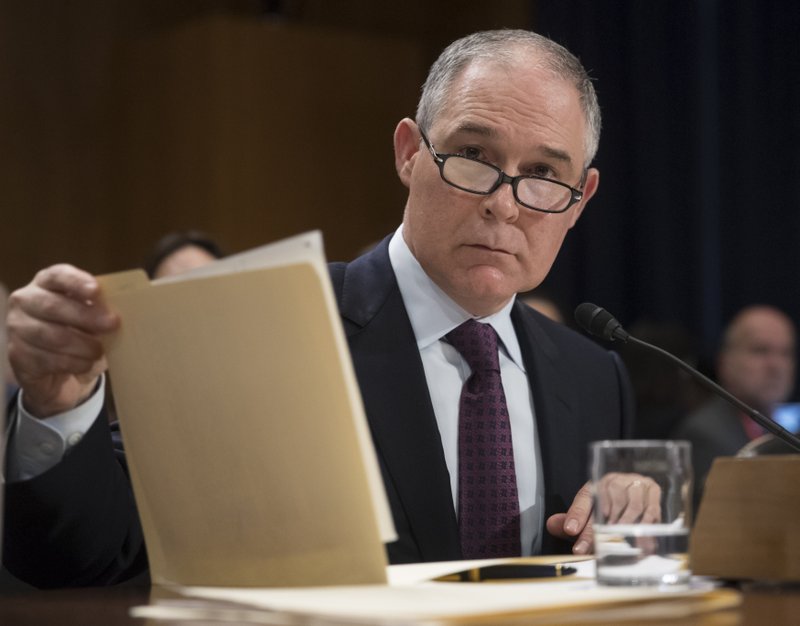
President Donald Trump says he has accepted the resignation of scandal-plagued Environmental Protection Agency Administrator Scott Pruitt. Pruitt had become a constant source of embarrassment to a president who had entered Washington promising to “Drain the Swamp.” Pruitt has faced an array of ethical questions about his travel spending, security costs, dealings with industry lobbyists and misuse of government resources. He had denied wrongdoing in the face of multiple congressional and oversight inquiries. Despite the scandals, Trump has been approving of Pruitt’s efforts to reduce regulations that the administration says curb business growth. Trump writes on Twitter, “Within the Agency Scott has done an outstanding job.” Activists have argued those cuts have endangered the environment. Trump tweets that Deputy Administrator Andrew Wheeler will assume the acting administrator position Monday. Republished with the permission of the Associated Press.
Democratic lawmakers seek criminal corruption probe of EPA’s Scott Pruitt
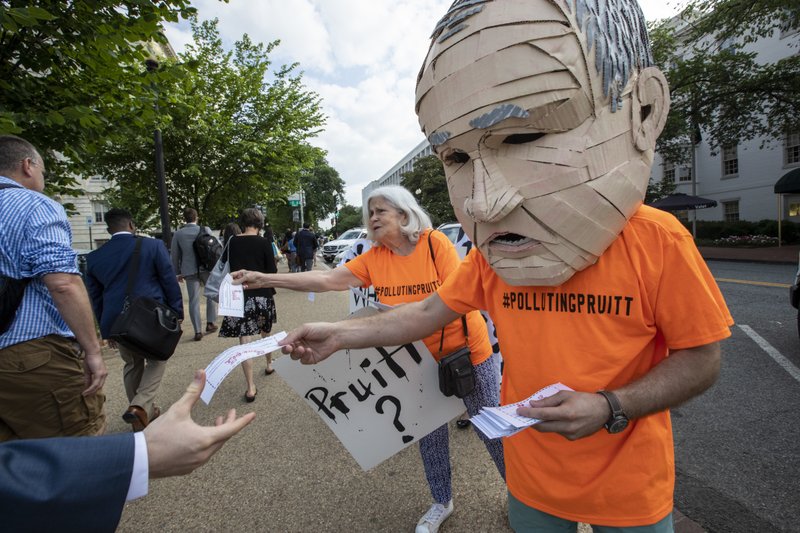
House Democrats on Friday formally requested that the Justice Department investigate Environmental Protection Agency Administrator Scott Pruitt for potential criminal conduct. In a letter to FBI Director Chris Wray and Justice criminal division chief John Cronan, six Democratic lawmakers with oversight of Pruitt’s agency allege he repeatedly violated federal anti-corruption laws by seeking to leverage his government position for personal gain. As evidence, the Democrats cite Pruitt’s $50-a-night lease of a Capitol Hill condo tied to a lobbyist seeking to influence his agency, directing an EPA aide to contact a senior Chick-fil-A executive as part of an effort to land his family a franchise, and a $2,000 payment to his wife from organizers of a conference the administrator then attended at taxpayer expense. A spokesman for Pruitt did not immediately respond to messages seeking comment. The letter was signed by Democratic Reps. Gerald Connolly and Donald Beyer of Virginia, Jamie Raskin of Maryland, Ruben Gallego of Arizona, Pramila Jayapal of Washington and Ted Lieu of California. Connolly is a senior member of the House Committee on Oversight and Government Reform and serves as the ranking Democrat on the Subcommittee on Government Operations. President Donald Trump signaled Friday he is still standing by his embattled EPA chief, even as Pruitt’s support among other Republicans has started to erode. “Scott Pruitt is doing a great job within the walls of the EPA,” Trump told reporters at the White House. “I mean, we’re setting records. Outside he’s being attacked very viciously by the press. And I’m not saying that he’s blameless. But we’ll see what happens.” For his part, Pruitt sought to laugh off the controversy this week over his using government resources to seek a “business opportunity” with the fast-food fried chicken chain whose owners are known for supporting conservative Christian causes, including outspoken opposition to same-sex marriage. “I mean, look, my wife is an entrepreneur herself. I love, she loves, we love Chick-fil-A as a franchise of faith,” Pruitt said in a TV interview on Wednesday. In their letter, the House Democrats make their case that Pruitt’s conduct rises to the level of criminal conduct. “At the very least, we know that federal ethics laws bar public officials from using their position or staff for private gain,” the Democrats wrote to Wray and Cronan. “Administrator Pruitt has certainly done just that. Further, his actions related to his wife’s employment and the quid-pro-quo condo situation with industry lobbyists may have crossed a line into criminal conduct punishable by fines or even by time in prison.” Republished with the permission of the Associated Press.
Scott Pruitt: Dealing with water contaminant a ‘national priority’
Dealing with a slate of toxic chemicals contaminating some drinking water systems around the country is a national priority, Environmental Protection Agency chief Scott Pruitt said Tuesday. Pruitt, who drew scrutiny from lawmakers after EPA emails released this month showed that the agency had intervened in the publication of a new government study on the contaminants, convened what he called a national summit on the chemicals. The chemicals are as perfluoroalkyl and polyfluoroalkyl. Used in some nonstick coatings, in firefighting foam and elsewhere, the chemicals can cause developmental defects and other health problems. Authorities say the contaminants are present in dangerous levels in some water systems, including several near military bases and industries. Pruitt drew questions from Republican and Democratic lawmakers last week after emails obtained under the Freedom of Information Act revealed an unidentified White House official calling a pending federal toxicological report on the chemical a “potential public-relations nightmare.” The emails also revealed EPA officials intervening in the release of the study, which remains unpublished. Politico first reported on the emails. Pruitt, formerly the Republican attorney general of Oklahoma, invited what the EPA said were 200 people to Tuesday’s Washington session on the chemicals. The people attending represented states, tribes, the chemical industry and other sectors, along with some environmental representatives. “It’s clear this issue is a national priority,” Pruitt said, opening the session. He pledged to start work toward establishing a legal maximum limit for the contaminants in drinking water systems. The EPA would reach out to communities with drinking water contaminated by the chemicals over the summer, agency officials said. The EPA is “very focused upon action,” Pruitt said. “We want to hear from all of you as we take the next step.” Environmental groups and some lawmakers have accused Pruitt of meeting more often with industry representatives, conservative political groups and lobbyists than with ordinary people affected by dangers that the EPA regulates. The EPA barred some news organizations, including The Associated Press, from Tuesday’s meeting. EPA spokesman Jahan Wilcox said the session was invitation-only and there was no room for the AP, but did not say what criteria were used in determining which media the agency invited. Republished with the permission of the Associated Press.
Donald Trump’s VA choice bows out in latest Cabinet flame-out
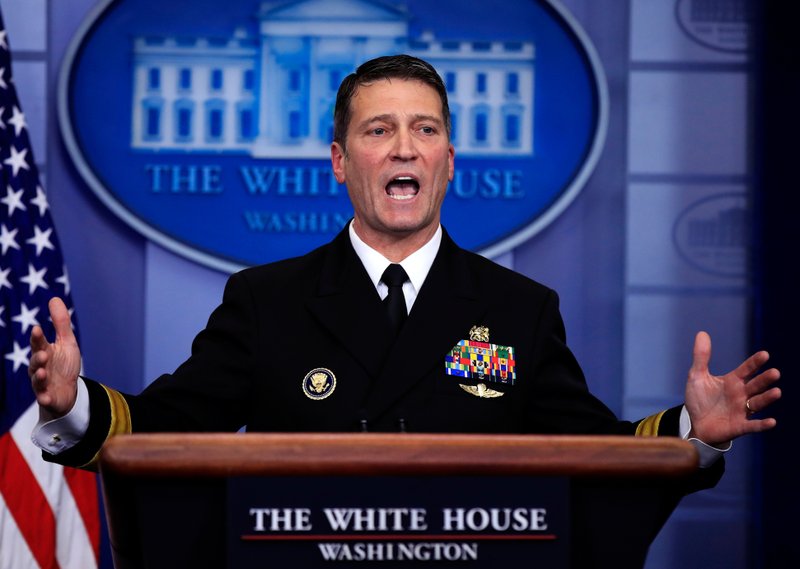
President Donald Trump’s White House doctor reluctantly withdrew his nomination to be Veterans Affairs secretary Thursday in the face of accusations of misconduct, the latest embarrassing episode highlighting Trump’s struggles to fill key jobs and the perils of his occasional spur-of-the-moment-decision-making. The weeks-long saga surrounding the nomination of Navy Dr. Ronny Jackson leaves the government’s second-largest agency without a permanent leader while it faces an immediate crisis with its private health care program. And it abruptly tarnished the reputation of a doctor beloved by two presidents and their staffs. White House officials say they are taking a new look at the way nominees’ backgrounds are checked — and they believe they will persuade Trump to take additional time to ensure that a replacement is sufficiently vetted. The leading person now under consideration for the VA post is former Rep. Jeff Miller, who chaired the House Veterans Affairs Committee before retiring last year, according to White House officials. Miller is a strong proponent of expanding private care for veterans, a Trump priority. Trump quickly selected Jackson, a rear admiral in the Navy, to head the VA last month after firing Obama appointee David Shulkin following accusations of ethical problems and a mounting rebellion within the agency. Jackson, a surprise choice who has worked as a White House physician since 2006, faced immediate questions from Republican and Democratic lawmakers as well as veterans groups about whether he had the experience to manage the massive department of 360,000 employees serving 9 million veterans. Then this week’s unconfirmed allegations by current and former colleagues about drunkenness and improper prescribing of controlled substances, compiled and released by Democrats, made the nomination all but unsalvageable. “The allegations against me are completely false and fabricated,” Jackson said in a statement announcing his withdrawal. Press secretary Sarah Huckabee Sanders said Jackson was back at work at the White House on Thursday. But his future there remains uncertain. He had stepped aside from directing Trump’s medical care and leading the medical unit while his nomination was being considered. “I would hope the White House would closely consider whether he is the best person to provide medical care for the president,” said Democratic Sen. Chris Coons of Delaware. Trump himself praised Jackson, saying, “He’s a great man, and he got treated very, very unfairly.” Then the president went after Democratic Sen. Jon Tester of Montana, who released a list of allegations against Jackson that was compiled by the Democratic staff of the Senate Veterans Affairs Committee. Trump aides said the president was furious with Tester, who faces a tough re-election fight this fall, and plans to aggressively campaign against him. “I think Jon Tester has to have a big price to pay in Montana,” Trump warned on “Fox & Friends” on TV. Tester, meanwhile, called on Congress to continue its investigation of Jackson. “I want to thank the service members who bravely spoke out over the past week. It is my constitutional responsibility to make sure the veterans of this nation get a strong, thoroughly vetted leader who will fight for them,” he said. Elsewhere in the capital, Congress was questioning another Trump official whose job appears in jeopardy. Scott Pruitt, head of the Environmental Protection Agency, was questioned closely by House Democrats about revelations of unusual security spending, first-class flights, an advantageous condo lease and more. Even Republicans who support Pruitt’s deregulation efforts, said his conduct needed scrutiny. Tom Price, Trump’s first secretary of the Department of Health and Human Services, resigned last year after criticism of his use of private charter flights and military jets. The turmoil at the VA comes as it faces a budget shortfall for its private-sector Veterans Choice program, a campaign priority of Trump’s, with lawmakers deadlocked over a long-term fix due to disagreements over cost and how much access veterans should have to private doctors Veterans are “exhausted by the unnecessary and seemingly never-ending drama,” said Paul Rieckhoff, executive director of Iraq and Afghanistan Veterans of America. “VA’s reputation is damaged, staff is demoralized, momentum is stalled and the future is shockingly unclear.” The VA issued a statement late Wednesday that it would push to have Congress move on an expansion of Choice next month. Sen. Johnny Isakson of Georgia, chairman of the Veterans Affairs Committee, said Thursday he would “work with the administration to see to it we get a VA secretary for our veterans and their families.” White House officials were visibly dismayed Wednesday and Thursday as they watched Jackson suffer the blows of the allegations. The doctor, who is well-liked by and has personal relationships with many White House staffers, cited the withering pressure for withdrawing from consideration for the post, but maintained he had done nothing wrong. Trump said on Fox that he has an idea for a replacement nominee, adding it will be “someone with political capability.” Miller, the former congressman who was described as the leading candidate, is a strong proponent of expanding private care for veterans, Miller led the push to create Choice in 2014. However, major veterans groups and Democrats stand opposed to an aggressive expansion of Choice, seeing the effort as a potential threat to VA medical centers. Dan Caldwell, executive director of the conservative Concerned Veterans for America, urged the White House to take more time “to carefully select and vet a new nominee” who could head VA. “The VA currently has a competent Acting Secretary in Robert Wilkie who can manage the VA along with the rest of his leadership team,” he said. “Considering the tremendous challenges that the last three VA secretaries have faced, it is important that a capable individual with a high level of integrity is selected.” During the presidential campaign, Trump repeatedly pledged to fix the VA by bringing accountability and expanding access to private doctors, criticizing the department as “the most corrupt.” At an Ohio event last July, Trump promised to triple the number of veterans “seeing the doctor of their choice.” Currently, more than 30
Lax vetting on Trump nominees begins to frustrate senators
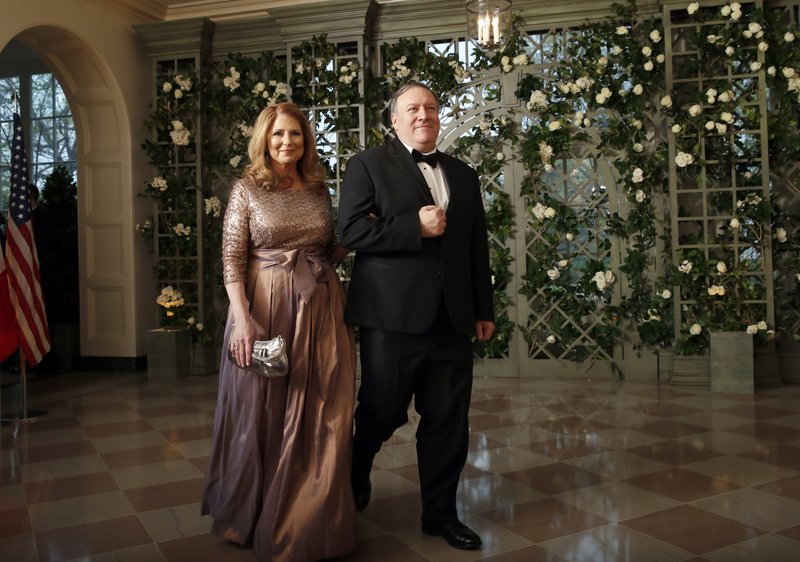
As President Donald Trump’s pick to lead Veterans Affairs skids to a halt, senators from both parties are voicing frustration that the White House is skipping crucial vetting of nominees and leaving lawmakers to clean up the mess. That sentiment was evident Tuesday on Capitol Hill after senators delayed hearings for White House physician Ronny Jackson, Trump’s surprise pick to head the VA. Jackson is facing questions about improper workplace behavior, and even Trump himself acknowledged that there were concerns about his nominee’s experience. “The White House still seems to be feeling its way on the nomination process,” said Sen. Susan Collins, R-Maine, “and does not fully appreciate how important it is to do a thorough vetting and FBI background check on nominees.” Sen. John Thune, R-S.D., said that while lawmakers want to be “deferential as much as we can” to the president’s preferences for his Cabinet, “it would be nice to know some of the issues that come up after the fact before the fact.” Trump, who promised to fill his administration with the “best people,” often gravitates toward advisers he has a personal connection with or who look the part, drawing on the approach he took as a business executive. But as president, the result is a growing list of Cabinet secretaries and other officials who do not appear to undergo the rigorous scrutiny typically expected for White House hires. Andy Puzder, Trump’s initial choice to lead the Labor Department, stepped aside before his confirmation hearings, in part over taxes he belatedly paid on a former housekeeper not authorized to work in the United States. Health and Human Services Secretary Tom Price won confirmation, but ultimately resigned amid disclosures about his expensive travel habits. Others are fighting similar charges, most notably Scott Pruitt, the embattled head of Environmental Protection Agency. Pruitt faces multiple allegations of improper housing, expensing and other practices, prompting several lawmakers to call for him to step down. The Senate has increasingly become a partisan battleground for nomination fights, a war that escalated when President Barack Obama was in the White House and Senate Democrats, who had majority control, changed the rules to allow majority vote for confirming most nominees — the so-called nuclear option — to get around GOP filibusters. Republicans returned the favor once Trump was in the White House, and they had the Senate majority, deploying the tactic to seat Neil Gorsuch on the Supreme Court. Some GOP senators argue that Democrats are slow-walking even those Trump nominees with a solid track record, including Mike Pompeo, who got votes from 14 Democrats and one aligned independent last year during his confirmation for CIA director. Pompeo is now in line to run the State Department, but has faced stiff opposition from some of the same Democrats who backed him a year ago. The Democratic opponents are going to “embarrass themselves,” said Sen. John Cornyn, R-Texas. Thune called it “really a new low.” But questions about the White House’s vetting standards have no doubt given Democrats fresh ammunition to challenge Trump’s Cabinet picks. “Our Republican colleagues bemoan the pace of the nominations,” said Senate Minority Leader Chuck Schumer, D-N.Y. But he said because of the administration’s “quick, sloppy vetting process,” the Senate job of vetting nominees “is more important than ever before.” Sen. Patty Murray, D-Wash., said senators don’t have to agree with a nominee’s position on the issue, but the Senate has a historic role — to advise and consent — that the president’s picks are up to the job. “We’re not going to allow nominees to be jammed through without proper scrutiny and debate,” Murray said. “Now hopefully, the events of the last 24 hours have made it very clear why this is so important.” Asked about the adequacy of vetting process Tuesday, Senate Majority Leader Mitch McConnell said that such questions are better raised with the White House. “Look,” McConnell said, “it’s up to the administration to do the vetting.” Republished with the permission of the Associated Press.
Cabinet chaos: Trump’s team battles scandal, irrelevance
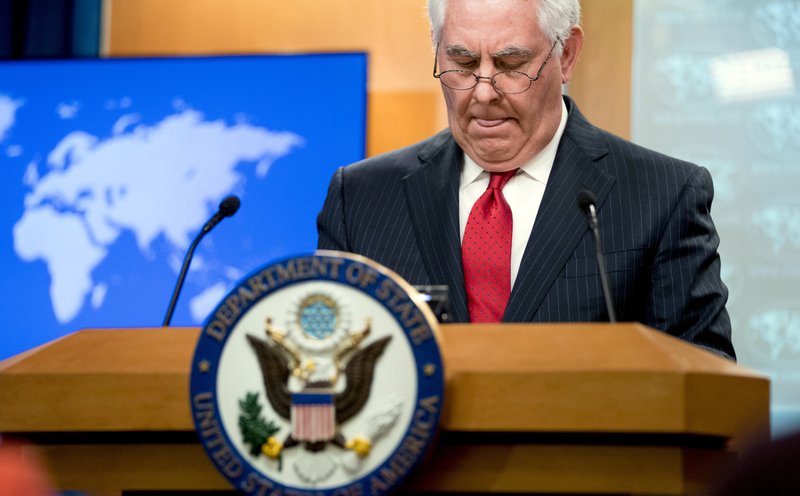
One Cabinet member was grilled by Congress about alleged misuse of taxpayer funds for private flights. Another faced an extraordinary revolt within his own department amid a swirling ethics scandal. A third has come under scrutiny for her failure to answer basic questions about her job in a nationally televised interview. And none of them was the one Trump fired. President Donald Trump’s Cabinet in recent weeks has been enveloped in a cloud of controversy, undermining the administration’s ability to advance its agenda and drawing the ire of a president increasingly willing to cast aside allies and go it alone. Trump’s ouster of Secretary of State Rex Tillerson on Tuesday may have just been the first salvo in a shakeup of a Cabinet that, with few exceptions, has been a team of rivals for bad headlines and largely sidelined by the White House. “Donald Trump is a lone-wolf president who doesn’t want to co-govern with anybody and doesn’t want anyone else getting the credit,” said presidential historian Douglas Brinkley of Rice University. “For his Cabinet, he brought in a bizarre strand of outsiders and right-wing ideologues. Many are famed conservative or wealthy business people, but that doesn’t mean you understand good governance.” The string of embarrassing headlines for Trump’s advisers, as well as the president’s growing distance from them, stands in sharp contrast to how he portrayed the group last year. “There are those that are saying it’s one of the finest group of people ever assembled as a Cabinet,” Trump said then. On Tuesday, the president hinted after firing Tillerson that more changes may be forthcoming, saying an ideal Cabinet is in the making. “I’ve gotten to know a lot of people very well over the last year,” Trump told reporters at the White House, “and I’m really at a point where we’re getting very close to having the Cabinet and other things that I want.” Even as Trump routinely convened Cabinet meetings in front of the cameras for “Dear Leader”-type tributes over the past year, his relationship with many of its members began to splinter. Last summer he began publicly bashing Attorney General Jeff Sessions, a former close adviser who was the first senator to back his campaign. Furious that the attorney general recused himself from the Russia probe that has loomed over the White House, Trump has privately mused about firing Sessions and taken to delivering unprecedented Twitter broadsides against him. Trump has used the words “beleaguered” and “disgraceful” to describe Sessions, who only recently stood up to the president and defended his recusal decision. Tillerson also frequently clashed with Trump, who never forgave the outgoing secretary of state for reportedly calling him “a moron” last summer after grumbling that the president had no grasp of foreign affairs. The pair never developed a particularly warm relationship. Last November, during a full day of meetings in Beijing, Trump and his senior staff were served plates of wilted Caesar salad as they gathered in a private room in the Great Hall of the People. None of the Americans moved to eat the unappetizing dish, but Trump prodded Tillerson to give it a try, according to a senior administration official. “Rex,” the president said, “eat the salad.” Tillerson declined, despite Trump’s urging. After repeatedly undermining and contradicting Tillerson, Trump at last fired his secretary of state in a tweet. Trump in recent days has told confidants that he feels emboldened. He’s proud of his unilateral decisions to impose sweeping tariffs on metal imports and to meet with North Korean dictator Kim Jong Un, and far less willing to put up with disloyalty around him, according to a person who has spoken to the president in recent days but was not authorized to discuss private conversations publicly. Trump’s esteem for the Cabinet has faded in recent months, according to two White House officials and two outside advisers. He also told confidants that he was in the midst of making changes to improve personnel and, according to one person who spoke with him, “get rid of the dead weight” — which could put a number of embattled Cabinet secretaries on notice. The officials all spoke on condition of anonymity to discuss internal matters. Interior Secretary Ryan Zinke underwent questioning Tuesday by Senate Democrats, who accused him of spending tens of thousands of dollars on office renovations and private flights while proposing deep cuts to conservation programs. Zinke pushed back, saying he “never took a private jet anywhere” — because all three flights he had taken on private planes as secretary were on aircraft with propellers, not jet engines. Veterans Affairs Secretary David Shulkin’s days on the job may be limited after a bruising internal report found ethics violations in connection with his trip to Europe with his wife last summer, according to senior administration officials. He also has faced a potential mutiny from his own staff: A political adviser installed by Trump at the Department of Veterans Affairs has openly mused to other VA staff about ousting the former Obama administration official. Trump has floated the notion of moving Energy Secretary Rick Perry to the VA to right the ship, believing Shulkin has become a distraction, according to two people familiar with White House discussions. They were not authorized to discuss internal deliberations and spoke on condition of anonymity. Others under the microscope: —White House aides deemed Education Secretary Betsy DeVos’ recent appearance on “60 Minutes” a disaster as she struggled to defend the administration’s school safety plan and could not answer basic questions about the nation’s education system. —Housing and Urban Development Secretary Ben Carson came under fire last month after reports his agency was spending $31,000 for a new dining set, a purchase HUD officials said was made without Carson’s knowledge. —Environmental Protection Agency Administrator Scott Pruitt has faced questions about $25,000 spent on a soundproof “privacy booth” inside his office to prevent eavesdropping on his phone calls and another $9,000 on biometric locks. —The first Cabinet member to
EPA Administrator taps former Alabama official Trey Glenn to lead Region 4
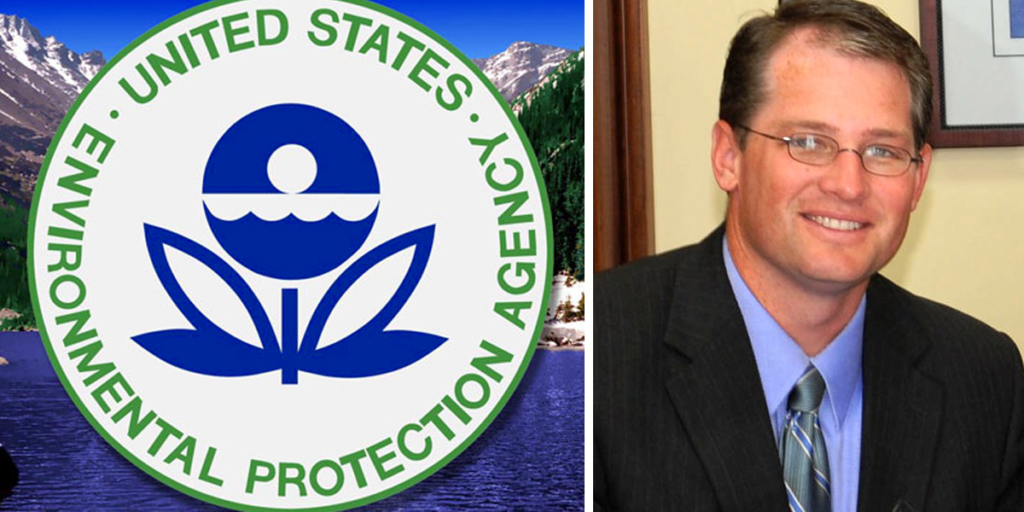
The former director of the Alabama Department of Environmental Management (ADEM), Trey Glenn, has been named the U.S. Environmental Protection Agency’s (EPA) Region 4 Administrator. Glenn will oversee environmental protection efforts across Alabama, Florida, Georgia, Kentucky, Mississippi, North Carolina, South Carolina, and Tennessee. As director of ADEM from 2005 – 2009, Glenn managed over 600 employees tasked with ensuring a safe, healthy, and productive environment to all Alabama residents. Prior to that he served as division director for the Alabama Office of Water Resources from 2001- 2005 where he was responsible for leading day-to-day operations on coordinating and managing Alabama’s water resources. Most recently, he’s been working as an independent engineer consultant and business owner, focused on environmental issues. EPA Administrator Scott Pruitt made the announcement of his appointment on Monday. Glenn is Pruitt’s first appointment of a regional administrator since being confirmed in February. “Trey Glenn will bring invaluable experience as regional administrator having spent over two decades working in the field of environmental and regulatory policy,” said Pruitt. “Mr. Glenn will help us carry out President Trump’s vision of creating a more streamlined and efficient EPA that focuses on the Agency’s core mission, while also providing more regulatory certainty to our nation’s businesses.” Alabama Governor Kay Ivey echoed Pruitt’s confidence in Glenn. “We are proud to have a person of Trey Glenn’s caliber leading such an important organization for our area. His experience as Director of the Alabama Department of Environmental Management places him in a unique position to be prepared to work with these southern states,” said Ivey. “We are also especially glad to know someone with in-depth knowledge of Alabama will be overseeing our region. Our state looks forward to working closely with Trey and the EPA team to ensure the needs of the state are met and that we stay environmentally friendly.” Alabama’s Senior U.S. Sen. Richard Shelby said he believes Glenn is well-prepared for his new role. “As an accomplished environmental engineer from Alabama, Trey Glenn is well-prepared for this new role and challenge as the EPA Region 4 Administrator,” added Shelby. “Trey has a proven record of leveraging internal and external operations to advance clearly defined goals. Having served as the director of the Alabama Department of Environmental Management, he understands the value and importance of state authority and control. I am confident that Trey will provide respected leadership across the eight state region, while also promoting and protecting a strong and healthy environment.” Business Council of Alabama President and CEO William J. Canary also issued a statement in support of Glenn. “Trey’s experience as director of the Alabama Department of Environmental Management, at the Alabama Office of Water Resources, and his engineering and management work as a business owner in the private sector gives him valuable knowledge that will serve both citizens, businesses, and the environment,” Canary said. “As a valuable member of the BCA advocacy team, Trey provided important leadership and advice in environmental matters for Alabama’s business community.” Lance LeFleur, Director of Alabama Department of Environmental Management, who has working experience with Glenn said he’s confident Glenn will do an outstanding job in his new role. “I have had the opportunity to work with Trey Glenn as I transitioned into my position as Director of the Alabama Department of Environmental Management – a position he previously occupied – so I have seen his capabilities first hand,” assured LeFleur. “President Trump made a wise choice in selecting Trey. I am confident he will do an outstanding job, especially considering he will have an exceptionally fine career staff in Region 4 at his side. I look forward to working with Trey in assuring for Alabama citizens a safe, healthful, and productive environment.”
EPA chief pledges to streamline Superfund pollution cleanups
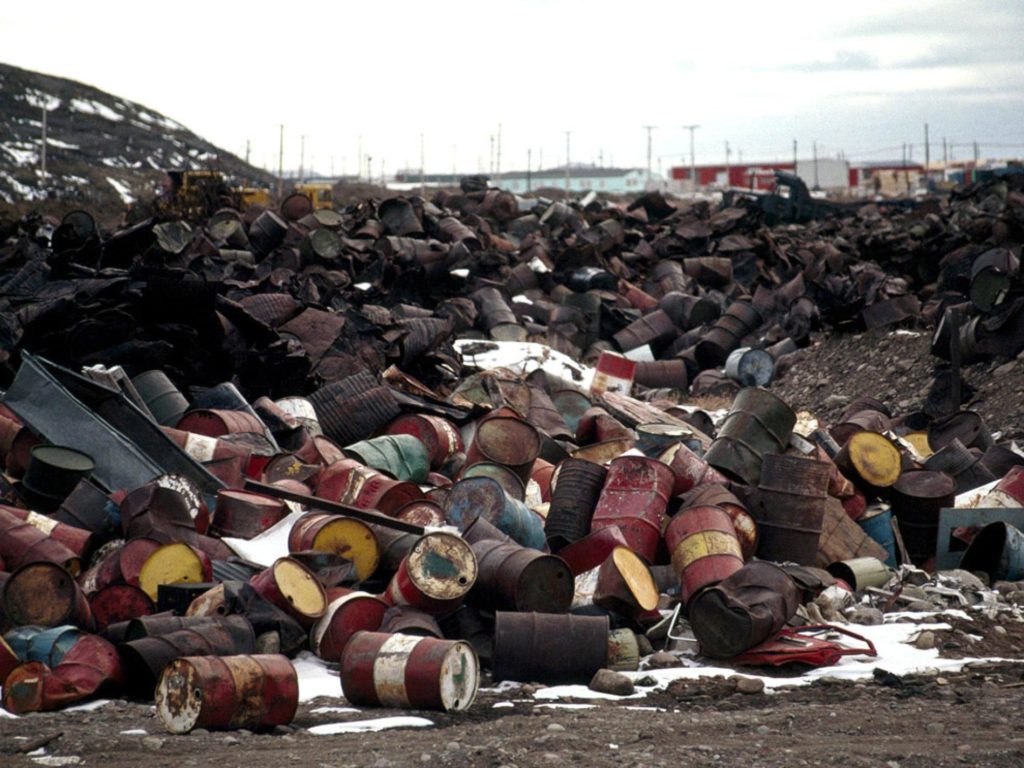
President Donald Trump‘s environmental chief issued a list of directives on Tuesday he says will revitalize the federal program that cleans up hazardous waste sites. Environmental Protection Agency chief Scott Pruitt unveiled 42 recommendations from a Superfund Task Force he appointed in March. Among the steps Pruitt outlined will be prioritizing sites that can be redeveloped or where nearby residents are still under threat from the spread of harmful chemicals. Pruitt has pledged to make mitigating decades-old pollution a top priority for the EPA, even as he has moved to block or delay Obama-era regulations aimed at curbing ongoing contamination from coal-fired power plants and fossil-fuel production. “There is nothing more core to the agency’s mission than revitalizing contaminated land,” Pruitt said, according to a media release. “I commend the team effort of the career and political staff on the Task Force, working together to develop recommendations that are detailed, but also workable – to ensure that we can expedite the protection of human health and the environment around these properties and accelerate the reuse.” There are now more than 1,300 Superfund sites nationally, some of which have languished for years without cleanup plans or funding. President Trump’s proposed 2018 budget seeks to cut money for the program by 30 percent, though Congressional Republicans have indicated they are likely to approve less-severe cuts. Money for Superfund is already about half what it was in the 1990s. The majority of cleanup money has been spent in just seven highly industrialized states, topped by New Jersey. The EPA routinely tries to compel the companies responsible for the pollution to pay, but taxpayers often end up on the hook due to corporate spinoffs and bankruptcies. The work is typically carried out by private contractors. Pruitt has played down the potential impact of the proposed budget cuts, saying the agency will accomplish more with less money under his leadership by improving oversight and efficiency. Republished with permission of The Associated Press.
