
Welcome to the partisan fury, Michelle Wolf
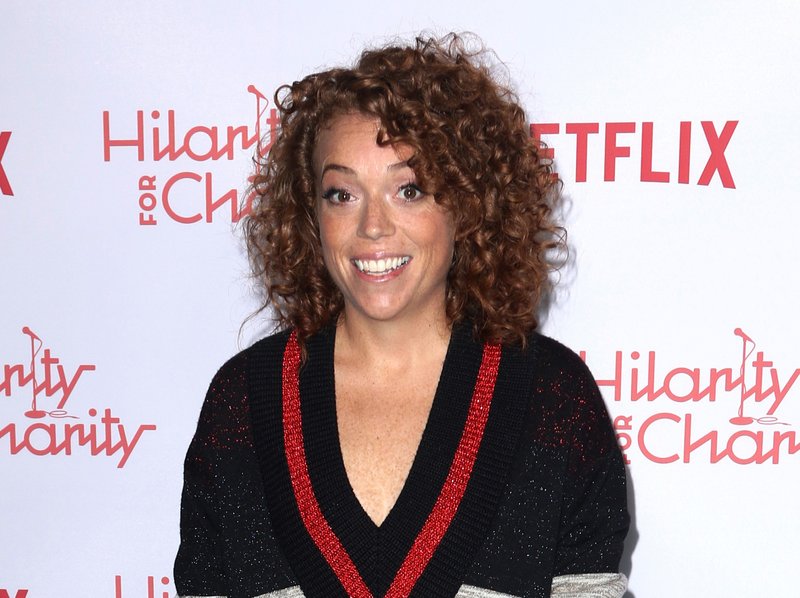
White House Correspondents Association roaster Michelle Wolf joins a club with likes of Kathy Griffin, Khizr Khan, Stormy Daniels and David Hogg — little-known or unknown figures who suddenly became surrogates for the hyper-partisan rhetorical warfare of the Trump era. President Trump tweeted his disgust at Wolf’s weekend routine on Monday, she was a hot topic on “The View” and the subject of a long and loud CNN exchange between Chris Cuomo and a conservative official. Journalists wondered if the annual WHCA dinner should be changed or ditched. A backlash quickly surfaced. Wolf had become a political symbol, much like Parkland student Hogg when he spoke out on gun restrictions, Khan when he spoke against Trump at the Democratic National Convention, Griffin when she posted a picture of herself with a mock-up of Trump’s severed head. Trump’s supporters took up the cause. Cuomo interviewed Matt Schlapp, chairman of the American Conservative Union, who tweeted that he and his wife, Mercedes Schlapp, director of strategic communications at the White House, walked out of the dinner. A “Fox & Friends” chyron read: “Should all women be critical of Wolf’s jokes?” Former White House press secretary Sean Spicer called it a disgrace, to which Wolf tweeted: “Thank you.” But a backlash to the criticism quickly developed, with some wondering why the correspondents should be surprised to get edgy comedy from an edgy comedian. “The comedian did her job,” said Sara Haines on “The View” Monday. “She is there to push the envelope.” Don’t like it? “Hire a juggler next year,” ABC’s Jimmy Kimmel tweeted. In his interview with Schlapp, Cuomo pressed the point that many Trump opponents made: how can you be insulted by Wolf’s routine and not by some of the things that Trump has said or done? While Wolf’s performance was vulgar and unseemly, “the three-year performance of candidate and president Donald Trump has been vulgar, unseemly and infinitely more damaging to our civil discourse,” tweeted conservative commentator Bill Kristol. The White House quickly sniffed an opportunity. Trump, who held a rally in Michigan at the same time as the dinner, asked aides for an update soon after leaving the stage. When he watched it being talked about on cable TV the next day, he called several outside advisers to bash the comedian, saying she was unfunny and mean-spirited. He told at least one confidante that it again proved he can’t get a fair shake from the media and he was certain his base would agree with him Wolf, who begins a Netflix show later this month and is best known for work on Comedy Central’s “The Daily Show,” was not made available to The Associated Press on Monday. She tweeted a few replies to critics. Her routine directed barbs at Congress, Democrats and the media. But the jokes that targeted Trump, his daughter Ivanka and press aides Sarah Huckabee Sanders and Kellyanne Conway attracted the most negative attention. Her comedy was risque; C-SPAN radio cut away from her routine over what its management called an “abundance of caution” about whether she’d violate FCC indecency guidelines. Wolf joked that Ivanka Trump had proven as useful to women as “a box of empty tampons.” She wished for a tree to fall on Conway, not so she’d get hurt — just stuck. Wolf suggested Sanders burns facts and uses the ashes to create perfect eye makeup. Margaret Talev, president of the reporters’ organization that puts on the dinner, said in a statement that she’d heard from members who expressed dismay with Wolf’s monologue. The WHCA wanted to honor free press and great reporting, “not to divide people,” Talev said. “Unfortunately, the entertainer’s monologue was not in the spirit of that mission.” Some reporters, notably Maggie Haberman of The New York Times in expressing support for Sanders, made their feelings known publicly. It’s not the first time comics have made people uneasy at the event, particularly since it has been televised across the country: Don Imus, Stephen Colbert and Larry Wilmore all had their critics. Trump’s absence magnified the reaction to Wolf, since no one took to the podium to punch back. Trump did so on Twitter. “The White House Correspondents’ Dinner is DEAD as we know it,” he tweeted Monday. “This was a total disaster and an embarrassment to our great Country and all that it stands for. FAKE NEWS is alive and well and beautifully represented on Saturday night!” Republished with the permission of the Associated Press.
Trump gives thumbs-down to comic who roasted his spokeswoman
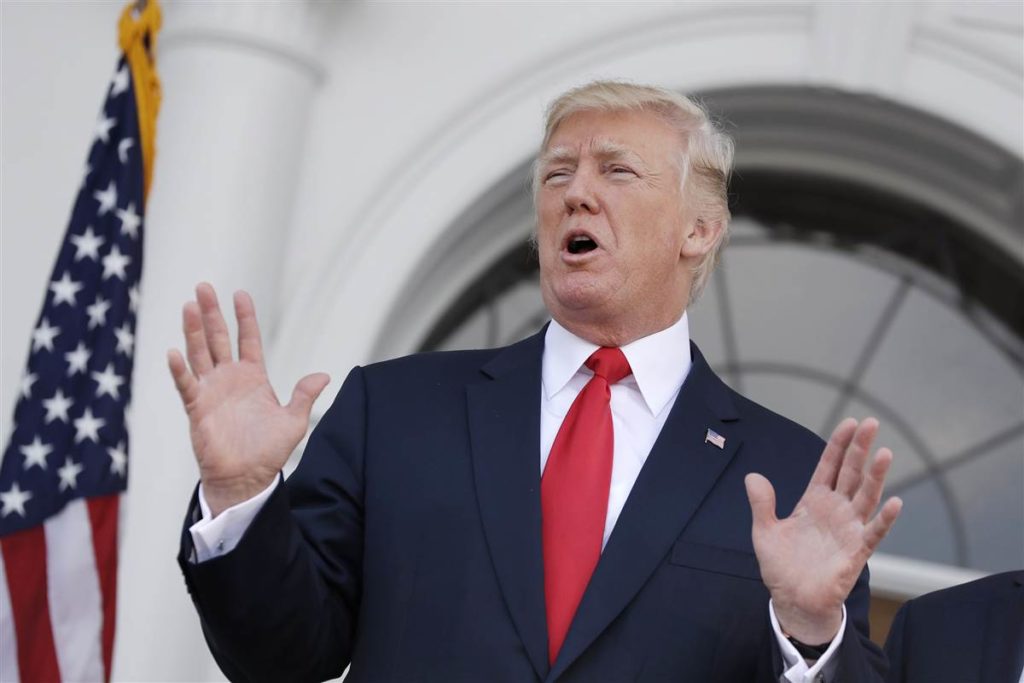
The reviews are in: President Donald Trump gave a thumbs-down Sunday to the comedian who roasted his chief spokeswoman at the annual White House Correspondents’ Association dinner, offending present and past members of his administration, including one who walked out in protest. The organization’s leader said she regretted that Michelle Wolf’s routine may end up defining an evening that was designed to rally around journalism. WHCA President Margaret Talev said she has “heard from members expressing dismay with the entertainer’s monologue and concerns about how it reflects on our mission.” She said she will work with the incoming president of the group and take comments from members on their views “on the format of the dinner going forward.” Trump joined in the criticism. “Everyone is talking about the fact that the White House Correspondents Dinner was a very big, boring bust…the so-called comedian really ‘bombed,’” Trump tweeted Sunday. The president, who regularly lobs sharp attacks at the news media, including individual news organizations and reporters, declined to attend the journalism awards dinner for the second consecutive year. He instead held a campaign rally in Michigan. Wolf is known as a contributor on Comedy Central’s “The Daily Show With Trevor Noah.” But some of her jokes, particularly a series of barbs about White House press secretary Sarah Huckabee Sanders as Sanders sat just feet away, seemed to spark the most outrage. Sean Spicer, who preceded Sanders at the White House lectern, tweeted after dinner that the night “was a disgrace.” Others, including Ed Henry, chief national correspondent for Fox News and a former association president, and MSNBC’s “Morning Joe” co-host Mika Brzezinski, called on the association to apologize to Sanders. Brzezinski has been the subject of personal attacks by Trump. Henry also called on Wolf to apologize. Matt Schlapp, chairman of the American Conservative Union, tweeted that he and his wife, Mercedes Schlapp, director of strategic communications at the White House, walked out of the dinner. “Enough of elites mocking all of us,” he said. Talev, Bloomberg News’ senior White House correspondent, said she didn’t want a dinner celebrating the constitutional right to free speech to be overshadowed by the ensuing uproar over Wolf’s jokes. “My only regret is that to some extent those 15 minutes are now defining four hours of what was a really wonderful unifying night and I don’t want the cause of unity to be undercut,” Talev said Sunday on CNN’s “Reliable Sources.” Talev said she spoke to Sanders after Wolf’s routine and “I told her that I knew that this was a big decision whether or not to attend the dinner, whether to sit at the head table and that I really appreciated her being there.” “I thought it sent an important message about the role of government and the press and being able to communicate with one another and work together,” Talev added. No Trump administration officials attended the dinner last year after Trump decided to skip it. Many were in the audience Saturday night, however, including counselor Kellyanne Conway, herself a target of Wolf, and Commerce Secretary Wilbur Ross. Sanders sat at the head table with association board members. Talev said that, by tradition, the association does not review the comedian’s monologue before it is delivered. “We don’t censor it. We don’t even see it,” she said. Wolf tweeted “thank you” to Spicer. As he did last year, Trump flew to a Republican-friendly district to rally supporters in an attempt to counter the dinner. He assured the audience in Washington Township, Michigan, a state he won in 2016, that he’d rather be there than at “that phony Washington White House Correspondents’ Dinner.” Wolf’s act, which also included abortion jokes, had some in the audience laughing. Others sat in stony silence. Among Wolf’s less off-color one-liners: —“Just a reminder to everyone, I’m here to make jokes, I have no agenda, I’m not trying to get anything accomplished, so everyone that’s here from Congress you should feel right at home.” —“It is kinda crazy that the Trump campaign was in contact with Russia when the Hillary campaign wasn’t even in contact with Michigan.” —“He wants to give teachers guns, and I support that because then they can sell them for things they need like supplies.” Wolf closed by saying, “Flint still doesn’t have clean water,” a reference to the Michigan city where lead-tainted tap water flowed into homes for 18 months before a disaster was declared in 2015. The state recently decided to end distribution of free bottled water in Flint, saying the tap water was now as “good or better” than in many communities. Republished with the permission of the Associated Press.
James Comey compares Donald Trump to mob boss
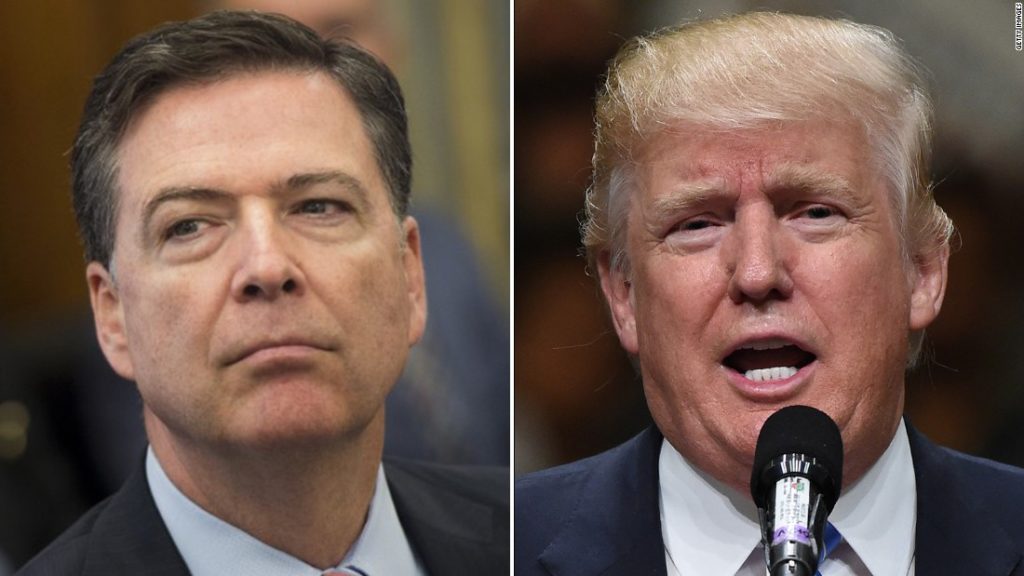
Firing back at a sharply critical book by former FBI director James Comey, President Donald Trump blasted him Friday as an “untruthful slime ball,” saying, “It was my great honor to fire James Comey!” Trump reacted on Twitter early Friday, the day after the emergence of details from Comey’s memoir, which says Trump is “untethered to truth,” and describes him as fixated in the early days of his presidency on having the FBI debunk salacious rumors he said were untrue but that could distress his wife. The book, “A Higher Loyalty,” is to be released next week. The Associated Press purchased a copy this week. In the book, Comey compares Trump to a mafia don and calls his leadership of the country “ego driven and about personal loyalty.” Comey also reveals new details about his interactions with Trump and his own decision-making in handling the Hillary Clinton email investigation before the 2016 election. He casts Trump as a mobster-like figure who sought to blur the line between law enforcement and politics and tried to pressure him personally regarding his investigation into Russian election interference. The book adheres closely to Comey’s public testimony and written statements about his contacts with Trump and his growing concern about Trump’s integrity. It also includes strikingly personal jabs at Trump that appear sure to irritate the president. The 6-foot-8 Comey describes Trump as shorter than he expected with a “too long” tie and “bright white half-moons” under his eyes that he suggests came from tanning goggles. He also says he made a conscious effort to check the president’s hand size, saying it was “smaller than mine but did not seem unusually so.” “Donald Trump’s presidency threatens much of what is good in this nation,” Comey writes, calling the administration a “forest fire” that can’t be contained by ethical leaders within the government. On a more-personal level, Comey describes Trump repeatedly asking him to consider investigating an allegation involving Trump and Russian prostitutes urinating on a bed in a Moscow hotel, in order to prove it was a lie. Trump has strongly denied the allegation, and Comey says that it appeared the president wanted it investigated to reassure his wife, Melania Trump. Trump fired Comey in May 2017, setting off a scramble at the Justice Department that led to the appointment of Robert Mueller as special counsel overseeing the Russia investigation. Mueller’s probe has expanded to include whether Trump obstructed justice by firing Comey, which the president denies. Trump has assailed Comey as a “showboat” and a “liar.” Top White House aides also criticized the fired FBI director on Friday. White House spokeswoman Sarah Huckabee Sanders questioned Comey’s credibility in a tweet and White House counselor Kellyanne Conway said Comey took “unnecessary, immature pot shots.” Comey’s account lands at a particularly sensitive moment for Trump and the White House. Officials there describe the president as enraged over a recent FBI raid of his personal lawyer’s home and office, raising the prospect that he could fire Deputy Attorney General Rod Rosenstein, who appointed Mueller, or try to shut down the probe on his own. The Republican National Committee is poised to lead the pushback effort against Comey by launching a website and supplying surrogates with talking points that question his credibility. Trump has said he fired Comey because of his handling of the FBI’s investigation into Clinton’s email practices. Trump used the investigation as a cudgel in the campaign and repeatedly said Clinton should be jailed for using a personal email system while serving as secretary of state. Democrats, on the other hand, have accused Comey of politicizing the investigation, and Clinton herself has said it hurt her election prospects. Comey writes that he regrets his approach and some of the wording he used in his July 2016 press conference in which he announced the decision not to prosecute Clinton. But he says he believes he did the right thing by going before the cameras and making his statement, noting that the Justice Department had done so in other high profile cases. Every person on the investigative team, Comey writes, found that there was no prosecutable case against Clinton and that the FBI didn’t find that she lied under its questioning. He also reveals new details about how the government had unverified classified information that he believes could have been used to cast doubt on Attorney General Loretta Lynch’s independence in the Clinton probe. While Comey does not outline the details of the information — and says he didn’t see indications of Lynch inappropriately influencing the investigation — he says it worried him that the material could be used to attack the integrity of the probe and the FBI’s independence. Comey’s book will be heavily scrutinized by the president’s legal team looking for any inconsistencies between it and his public testimony, under oath, before Congress. They will be looking to impeach Comey’s credibility as a key witness in Mueller’s obstruction investigation, which the president has cast as a political motivated witch hunt. The former FBI director provides new details of his firing. He writes that then-Homeland Security Secretary John Kelly — now Trump’s chief of staff — offered to quit out of disgust at how Comey was dismissed. Kelly has been increasingly marginalized in the White House and the president has mused to confidants about firing him. Comey also writes extensively about his first meeting with Trump after the election, a briefing in January 2017 at Trump Tower in New York City. Others in the meeting included Vice President Mike Pence, Trump’s first chief of staff, Reince Priebus, Michael Flynn, who would become national security adviser, and incoming press secretary, Sean Spicer. Comey was also joined by NSA Director Mike Rogers, CIA Director John Brennan and Director of National Intelligence James Clapper. After Clapper briefed the team on the intelligence community’s findings of Russian election interference, Comey writes, he was taken aback by what the Trump team didn’t ask. “They were about to lead a country
Politics and Sean Spicer take center stage at Emmy Awards
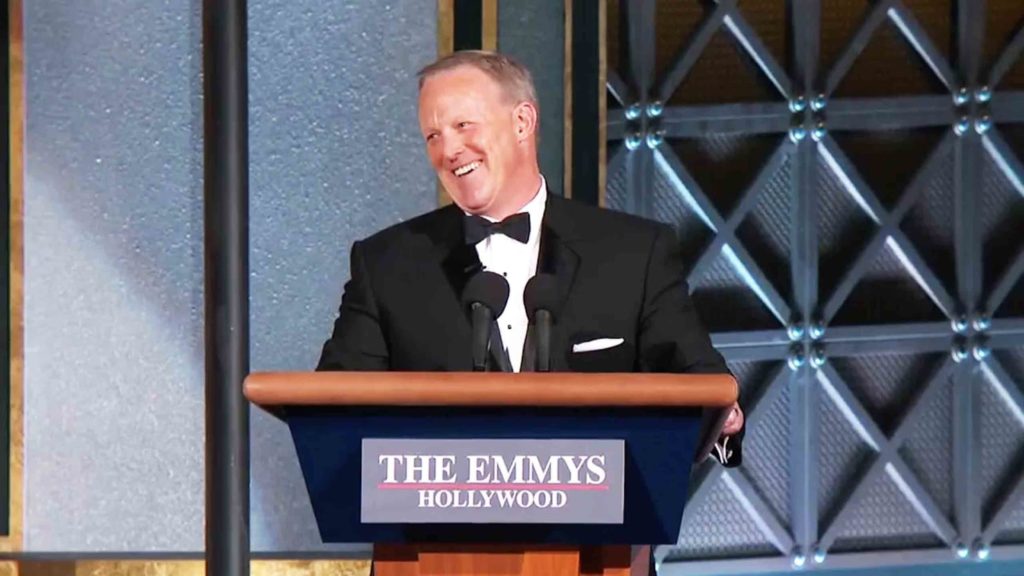
Weeks after leaving his job, former White House press secretary Sean Spicer was onstage at the Emmy Awards on Sunday joking about one of his first – and more dubious – claims from the press room. Host Stephen Colbert, playing the straight man in his opening monologue, said it was difficult to tell how many people would be watching the show. At that point, Spicer wheeled a podium onto the Los Angeles stage. “This will be the largest audience to witness an Emmys period, both in person and around the world,” Spicer said. The reference was to his Inauguration Day claims, contradicted by photos, about how big the audience was for President Donald Trump’s oath of office. “Wow,” Colbert replied. “That really soothes my fragile ego.” Even without Spicer’s surprise appearance, politics couldn’t help but make its way onto the Emmy Awards stage, especially since Colbert noted that Trump was the biggest TV star of the year. Spicer’s joke rubbed several people the wrong way on social media, and Colbert didn’t let him off the hook, either. Pointing out Robert DeNiro in the audience, he noted that the actor had been nominated for his role in the HBO movie “Wizard of Lies” (about Bernard Madoff). Colbert joked that he thought the movie was “The Sean Spicer Story.” On Twitter, actor Zach Braff contended the Spicer appearance was too soon: “I’m not ready to laugh ‘with’ Sean Spicer,” he tweeted. One of former President Barack Obama‘s top aides, Dan Pfeiffer wrote, “congrats to @seanspicer for his new job as the punchline to an unfunny joke.” But he got some sympathy backstage from an unexpected source in Alec Baldwin, who won an Emmy for his memorable portrayal of Trump on “Saturday Night Live.” “I think the average person is very grateful for him to have a sense of humor and participate,” Baldwin said. “And Spicer obviously was compelled to do certain things that we might not have respected, we might not have admired, we might have been super critical of in order to do his job, but I’ve done some jobs that are things you shouldn’t admire or respect me for, either.” Colbert blamed the Emmys for Trump’s election as president. He suggested if Trump had won an award for “Celebrity Apprentice,” he might not have run for president. He showed a clip of a presidential debate where Trump said he should have won an Emmy. “Unlike the presidency, Emmys go to the winner of the popular vote,” he said. Baldwin couldn’t resist picking up that baton when he grasped his trophy. “I suppose I should say, at long last, Mr. President, here is your Emmy,” he said. “SNL” had a smash year with its political comedy, led particularly by Baldwin and Melissa McCarthy‘s impersonation of Spicer. It dominated the Emmys, too, with the show winning for variety sketch series and Kate McKinnon, who portrayed Hillary Clinton, taking a supporting actress award. McKinnon thanked Clinton from the stage for her “grace and grit.” Lorne Michaels, the longtime top producer at “Saturday Night Live,” said he knew it was an important year for the show to get things just right. “It was one of the most amazing years we’ve ever had because everything changed every day,” he said backstage. Donald Glover, best actor winner in a comedy for his role in “Atlanta,” brought up the president his acceptance speech, saying that “I want to thank Trump for making black people No. 1 on the most oppressed list.” A number of nominees wore blue ribbons, distributed by the ACLU in support of the Deferred Action for Childhood Arrivals program, known as DACA. “They asked us if he would wear these ribbons to bring attention to the DACA children – the 800,000 vulnerable children were waiting for Congress and our administration to give them permanent, safe homes – and not keep them in this limbo that is terrifying all of them and really affecting lives,” said actor Mandy Patinkin. Three acting veterans got in the toughest shot at Trump – without mentioning his name. Dolly Parton, Jane Fonda and Lily Tomlin, the stars of the movie “Nine to Five,” appeared to present an award. “Back in 1980 in that movie, we refused to be controlled by a sexist, egotistical, lying, hypocritical bigot,” Fonda said. “And in 2017,” Tomlin added, “we still refuse to be controlled by a sexist, egotistical, lying, hypocritical bigot.” Republished with permission from the Associated Press.
Anthony Scaramucci out of White House job as John Kelly takes charge
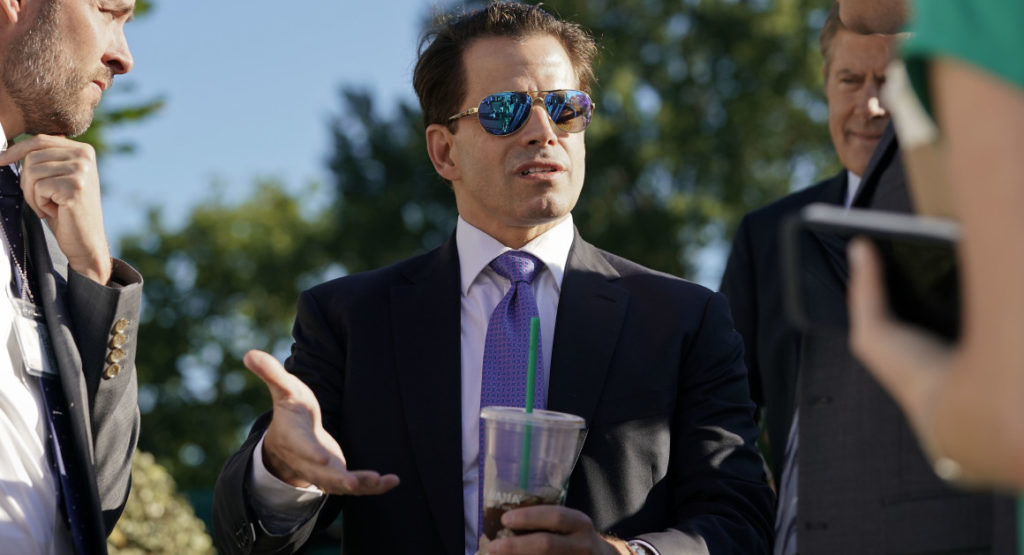
Anthony Scaramucci is out as White House communications director after just 11 days on the job – and just hours after former Gen. John Kelly took over as President Donald Trump‘s new chief of staff. Hoping to turn the page on a tumultuous opening chapter to his presidency, Trump had insisted earlier Monday that there was “no chaos” in his White House as he swore in the retired Marine general as his second chief of staff. Not long after, Scaramucci, who shocked many with his profane outburst last week against then-chief of staff Reince Priebus, was gone. In the words of the White House announcement, he was leaving because he “felt it was best to give Chief of Staff John Kelly a clean slate and the ability to build his own team.” The three-sentence release concluded, “We wish him all the best.” The statement about Scaramucci’s departure used the same “clean slate” language that departing press secretary Sean Spicer used to describe his own reason for resigning the day Trump brought Scaramucci aboard. Spicer remained in the White House on Monday, saying he was there to assist with the communications transitions. As the Scaramucci news spread, Kelly was in the East Room smiling and taking pictures with guests who were gathering for a Medal of Honor presentation. Earlier, in an Oval Office ceremony, Trump predicted Kelly, who previously served as Homeland Security chief, would do a “spectacular job.” And the president chose to highlight the rising stock market and positive jobs outlook rather than talk about how things might need to change in his White House under Kelly. Trump on Friday ousted Priebus as chief of staff and turned to Kelly, who he hopes will bring military discipline to an administration weighed down by a stalled legislative agenda, infighting among West Wing aides and a stack of investigations. Scaramucci’s brief tenure shoved internal White House disputes into the open. In media interviews, he trashed Priebus as a “leaker” and senior White House aide Steve Bannon as a self-promoter. One of Scaramucci’s first – and it turns out only – acts was to force out a communications aide seen as loyal to Priebus. Spicer, Priebus and Bannon had all objected to Trump’s decision to hire Scaramucci, who would have reported directly to the president. While Trump is looking for a reset, he pushed back against criticism of his administration with this tweet: “Highest Stock Market EVER, best economic numbers in years, unemployment lowest in 17 years, wages raising, border secure, S.C.: No WH chaos!” In fact, economic growth averaged 2 percent in the first half of this year, a pace Trump railed against as a candidate and promised to lift to 3 percent. The stock market first hit a record under President Barack Obama and has kept growing. The unemployment rate, too, started to decline on Obama’s watch. And wage gains have been weak. Trump on Monday convened his first Cabinet meeting with Kelly at his side, telling his team it is “doing incredibly well” and “starting from a really good base.” On how he would deal with rising tensions with North Korea, Trump said only: “It will be handled.” Seated across from Trump was Attorney General Jeff Sessions, who has stayed on the job while Trump has publicly savaged him in interviews and on social media. Kelly’s success in a chaotic White House will depend on how much authority he is granted and whether Trump’s dueling aides will put aside their rivalries to work together. Also unclear is whether a new chief of staff will have any influence over the president’s social media histrionics. Former Trump campaign manager Corey Lewandowski, who was ousted from the campaign in June 2016, said on NBC’s “Meet the Press” that he expected Kelly would “restore order to the staff” but also stressed that Trump was unlikely to change his style. “I say you have to let Trump be Trump. That is what has made him successful over the last 30 years. That is what the American people voted for,” Lewandowski said. “And anybody who thinks they’re going to change Donald Trump doesn’t know Donald Trump.” Kelly’s start follows a wild week, marked by a profane tirade by Scaramucci, the president’s continued criticism of his attorney general and the failed effort by Senate Republicans to overhaul the nation’s health care law. In addition to the strains in the West Wing and with Congress, Kelly starts his new job as tensions escalate with North Korea. The United States flew two supersonic bombers over the Korean Peninsula on Sunday in a show of force against North Korea, following the country’s latest intercontinental ballistic missile test. The U.S. also said it conducted a successful test of a missile defense system located in Alaska. Sen. Dianne Feinstein, D-Calif., said on CBS’ “Face the Nation” that she hopes Kelly can “be effective,” and “begin some very serious negotiation with the North and stop this program.” Another diplomatic fissure opened Sunday when Russian President Vladimir Putin said the U.S. would have to cut its embassy and consulate staff in Russia by several hundred under new sanctions from Moscow. In a television interview, Putin indicated the cutback was retaliation for new sanctions in a bill passed by Congress and sent to Trump. Trump plans to sign the measure into law, the White House has said. After Putin’s remarks, the State Department deemed the cutbacks “a regrettable and uncalled for act” and said officials would assess the impact and how to respond to it. While Trump is trying to refresh his team, he signaled that he does not want to give up the fight on health care. On Twitter Sunday, he said: “Don’t give up Republican Senators, the World is watching: Repeal & Replace.” The protracted health care fight has slowed work on Trump’s other policy goals, including a tax overhaul and infrastructure investment. But Trump aides made clear that the president still wanted to see action on health care. White House
Sarah Sanders replaces Sean Spicer as press secretary
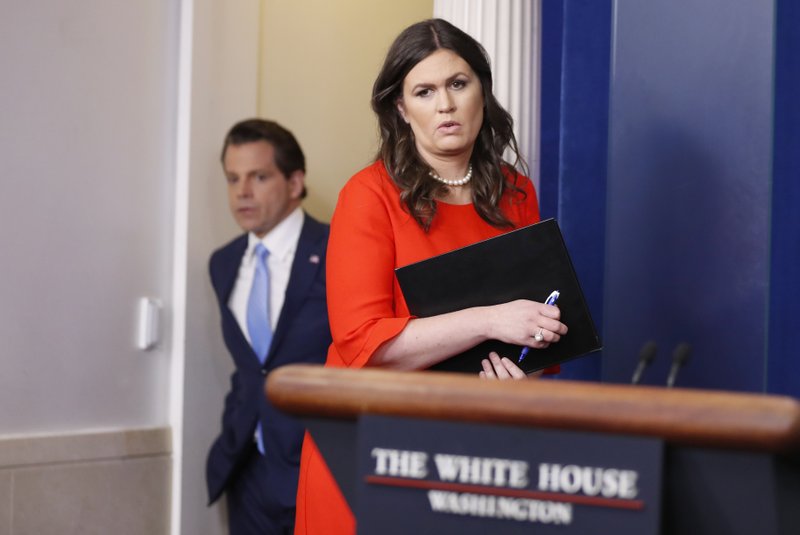
The Latest on changes to the White House communications staff (all times local): 2:45 p.m. New York financier Anthony Scaramucci has been formally named White House communications director and Sarah Huckabee Sanders has been promoted to press secretary in the Trump White House’s latest shakeup. Trump says in a statement read by Sanders that he’s “grateful” for departing press secretary Sean Spicer’s “work on behalf of my administration and the American people.” He adds: “just look at his great television ratings!” Scaramucci also is addressing reporters at the White House. He calls Spicer “a true American patriot” and says he hopes Spicer “goes on to make a tremendous amount of money.” ___ 2 p.m. Outgoing press Secretary Sean Spicer says that he chose to resign from his position to give incoming communications director Anthony Scaramucci a fresh start. Spicer says during a brief phone conversation with The Associated Press following his announced departure that, “we’re at the point where” the president “could benefit from a clean slate.” He says he felt it would be best for Scaramucci to be able to build his own operation “and chart a new way forward.” Spicer is also complimenting Scaramucci, a New York financier and frequent defender of the president who was a staple at Trump Tower during the president’s transition. Spicer says of Scaramucci’s hiring: “It’ll be great, he’s a tough guy.” ___ 1:50 p.m. White House press secretary Sean Spicer says it’s been “an honor” and “privilege” to serve President Donald Trump and the country. Spicer resigned Friday in protest over the hiring of a new White House communications director. He says in a tweet that he will continue his service through August. One person with knowledge of the situation said Spicer objected to the hiring of New York financier Anthony Scaramucci’s lack of qualifications for the communications role. The person spoke on condition of anonymity because they were not authorized to discuss the personnel matter publicly. ___ 1 p.m. White House deputy press secretary Sarah Huckabee Sanders will be conducting an on-camera briefing on Friday afternoon, following White House press secretary Sean Spicer’s resignation. Spicer announced his departure after President Donald Trump hired a new White House communications director, ending his rocky six-month tenure as Trump’s top spokesman. Sanders has been handling most of the briefing duties in recent weeks, and most briefings have been off-camera. The last on-camera White House briefing was held on June 29. ___ 12:35 p.m. White House chief of staff Reince Priebus says he supports incoming communications director Anthony Scaramucci “100 percent.” His comments come moments after White House press secretary Sean Spicer resigned over Scaramucci’s hiring. Priebus and Spicer spent years working closely together at the Republican National Committee. Priebus has also reportedly opposed hiring Scaramucci for various administration positions. Priebus told The Associated Press that he and Scaramucci are “very good friends.” He says it’s “all good here” at the White House. ___ 12:07 p.m. White House press secretary Sean Spicer is resigning his position, according to two people with knowledge of the decision. One of those people said Spicer is quitting because of objections over the appointment of a new White House communications director, New York financier Anthony Scaramucci. The people with knowledge of the decision insisted on anonymity because they were not authorized to discuss the personnel matter publicly. Republished with permission of The Associated Press.
Sean Spicer out as WH press secretary; seeking ‘less public’ role, replacement
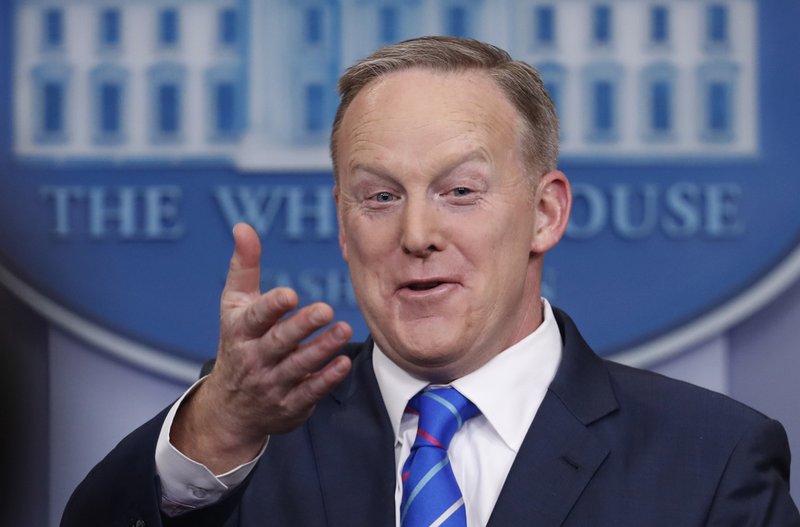
White House press secretary Sean Spicer is seeking to take on a more strategic role that would give him a limited presence in the daily press briefings that have made him a prominent face of the Trump administration. A senior administration official and three people familiar with the potential changes said Monday that Spicer has discussed taking a more senior communications role at the White House. The three people said he has reached out to possible successors at the podium and as communications director. The people spoke on condition of anonymity in order to discuss internal deliberations before a final decision is made. “We have sought input from many people as we look to expand our communications operation. As he did in the beginning, Sean Spicer is managing both the communications and press office,” said Sarah Huckabee Sanders, a deputy White House press secretary. She declined further comment on the potential changes. Discussions about overhauling the White House communications office have been ongoing for several weeks, according to the senior administration official. Spicer’s preference is to step away from the press briefings entirely, though other configurations have also been discussed. It’s unclear how quickly a decision will be made, and, as with all things involving President Donald Trump, the situation could change. Major staffing shake-ups have been a constant subject of conversation at the White House, but have failed to materialize in recent weeks, aside from the departure of communications director Mike Dubke in early June. The White House has consulted an array of Republicans and Trump allies, including Laura Ingraham, the conservative radio host and political commentator. However, Ingraham is not expected to take the press secretary position. David Martosko, the U.S. political editor of London’s Daily Mail, who covered the president’s campaign, has also interviewed for senior communications jobs, according to a person familiar with the interviews who spoke on condition of anonymity to discuss the private deliberations. The possible changes for Spicer were first reported by Bloomberg News and Politico. Spicer’s public role has already diminished in recent weeks. The White House has increasingly tapped Cabinet officials and other White House advisers to address reporters on camera and moved to take some of the daily briefings off cable television to keep the focus on Trump, who makes a habit of watching the televised performances. Spicer spoke Monday from the podium at an off-camera gaggle that barred broadcast outlets from using the audio of the question-and-answer session. Asked about the changes, Spicer said Trump had spoken before cameras during an Oval Office meeting with the president of Panama and would later make remarks in front of the media at an event with technology leaders. “There are days that I’ll decide that the president’s voice should be the one that speaks and iterate his priorities,” Spicer said. The White House has generally only used that excuse on days that the president has held a press conference or delivered a major speech. Spicer’s briefings have been must-see TV during the start of the Trump era, beginning with his fiery, inaccurate claim that journalists wrongly portrayed the size of Trump’s inauguration audience. He has been the subject of recurring skits by comic Melissa McCarthy on “Saturday Night Live” and his afternoon briefings have garnered strong ratings. In April, the former Republican National Committee strategist apologized for making an “inappropriate and insensitive” statement comparing Adolf Hitler to Syrian President Bashar Assad by suggesting Hitler “didn’t even sink to using chemical weapons.” His comments ignored Hitler’s use of gas chambers to kill Jews. Trump threatened in May to shut down daily press briefings and told Fox News Channel at the time that Spicer was “doing a good job, but he gets beat up.” The president has long seen himself as his most effective spokesman, and has faulted his communications team for much of the early turbulence at the White House as well as the backlash from the firing of FBI Director James Comey. Republished with permission of The Associated Press.
Darryl Paulson: Will Donald Trump be dumped? – The 25th Amendment
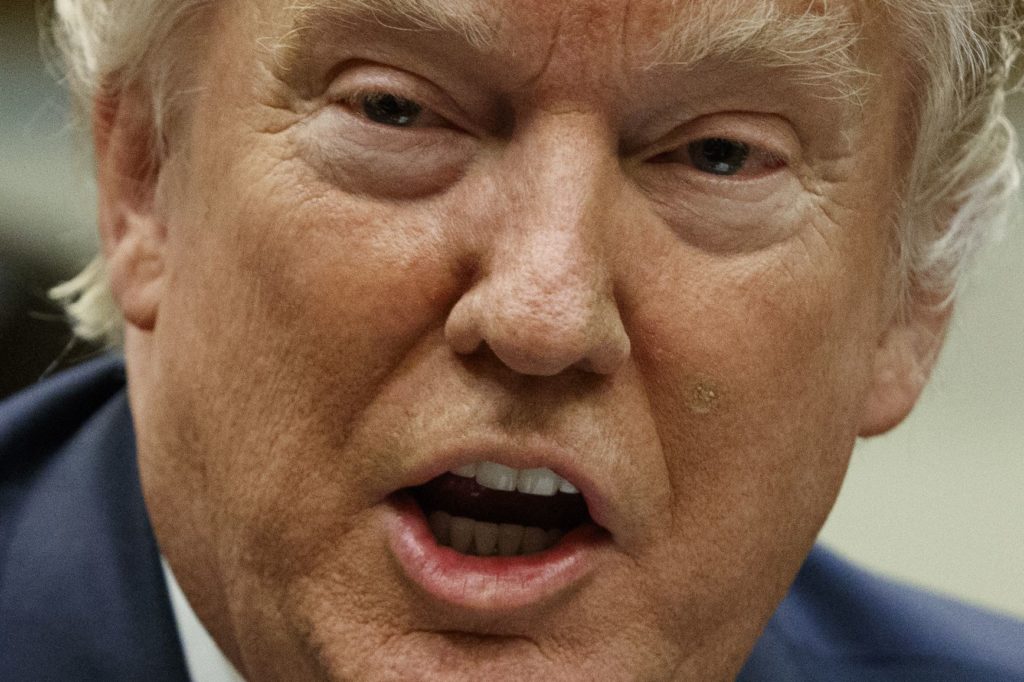
Each day seems to bring more trouble for President Donald Trump. He fired his National Security Adviser Michael Flynn after just three weeks in his position. Then came the firing of FBI Director James Comey. Numerous other individuals in his administration are supposedly on the chopping block, ranging from Press Secretary Sean Spicer to Chief-of-Staff Reince Priebus to Attorney General Jeff Sessions. The FBI investigation of Russian influence in the 2016 election discovered that at least five members of the Trump administration or campaign team had met with Russian officials. Many had failed to disclose these meetings as was required. Before firing Comey, Trump asked the FBI Director on several occasions to pledge his loyalty to the president. Comey promised his “honesty,” but failed to pledge his loyalty. Trump also asked Comey to drop his investigation of Flynn because he is a “good guy.” When Trump fired Comey, he called him a “nut job,” and threatened Comey that he better “hope that there are no ‘tapes’ of our conversation.” Trump also stated that Comey was a bad administrator of the FBI and had lost the support of his colleagues. Finally, Trump said the firing of Comey was done to relieve pressure on the Russian investigation which Trump called “a made-up story.” There is a growing national discussion of removing Trump as president either through the provisions of the 25th Amendment or through impeachment. Neither approach would be easy. Both the 25th Amendment and impeachment raise the specter of a “constitutional coup.” After only six months in office, how will the American public react to what looks like an attempt to nullify the results of the recent presidential election? The 25th Amendment was added to the Constitution in February 1967 and was the result of the assassination of President Kennedy. The Constitution did not provide a means to replace the vice president when he assumed office on the death of the president. There was also no mechanism to remove the president due to disability temporarily or permanently. The vice president and a majority of the cabinet could remove the president if they found him “unable to discharge the powers and duties of his office.” It could also occur if a congressionally appointed body of experts concluded the president was no longer capable of performing his duties. If the president opposes his removal, Congress has three weeks to debate and decide the issue. It requires a two-thirds vote of both houses to remove the president and there is no appeal. The 25th Amendment has been invoked six times since its ratification. On Oct. 12, 1973, Vice President Spiro Agnew resigned and was replaced by Gerald Ford. Ford was confirmed 92-3 by the Senate and 387-35 by the House. The following year, President Richard Nixon resigned the office of president due to Watergate. Ford assumed the presidency on the same day that Nixon resigned, Aug. 9, 1974. Ford became the only person to be both vice president and president without being elected to the positions. On Sept. 20, 1974, President Ford selected Nelson Rockefeller as his vice president. Rockefeller was confirmed 90-7 by the Senate and 287-128 by the House. Three incidents involve the 25th Amendment and presidential disability. On July 12, 1985, President Reagan underwent a colonoscopy and transferred power to Vice President George H.W. Bush for several hours. In 2002 and 2007, President George W. Bush transferred power to Vice President Dick Cheney during two colonoscopies. The presidential disability provisions were considered twice during the Reagan administration but were rejected. On March 30, 1981, President Ronald Reagan was shot by a deranged assassin. Reagan was incapable of turning over powers to his vice president, and vice president Bush decided not to invoke the powers even though Reagan was not capable of governing for several days. In 1987, outgoing Chief Donald Regan warned incoming Chief-of-Staff Howard Baker to be ready to invoke the 25th Amendment. Regan and other staff members were concerned that the president was disengaged from his duties and spent much of his time watching movies. Baker summoned close aides to the president and they all agreed to carefully monitor the president at a luncheon meeting the following day. The president was alert and funny and Baker considered the debate over. “This president is fully capable of doing his job.” One of the concerns over the 25th Amendment is its potential for misuse. In 1964, three years prior to the adoption of the 25th Amendment, 1,000 psychologists said Republican presidential candidate Barry Goldwater was not psychologically fit to be president. Goldwater sued and won. In 1973, the American Psychological Association adopted the “Goldwater Rule,” barring members from making a diagnosis without doing an in-person exam. The Goldwater Rule did not stop 50,000 mental health professionals from signing a petition stating that Trump is “too seriously mentally ill to perform the duties of president and should be removed under the 25th Amendment.” I suspect these “liberals” let their politics get in the way of science, much like Republicans do with climate change. Responding to a letter to The New York Times from a retired Duke psychology professor that Trump was a “malignant narcissist,” an Emeritus professor at Duke Medical School responded that Trump “may be a world-class narcissist, but that doesn’t make him mentally ill. … The antidote is political, not psychological.” Finally, Jeff Greenfield of CNN, commented that attempts to remove Trump under the 25th Amendment for mental health reasons are a “liberal fantasy.” Part II: Will Trump be dumped? Impeachment. ___ Darryl Paulson is Emeritus Professor of Government at USF St. Petersburg specializing in Florida politics and elections.
Does Donald Trump believe in climate change or not? Aides won’t say
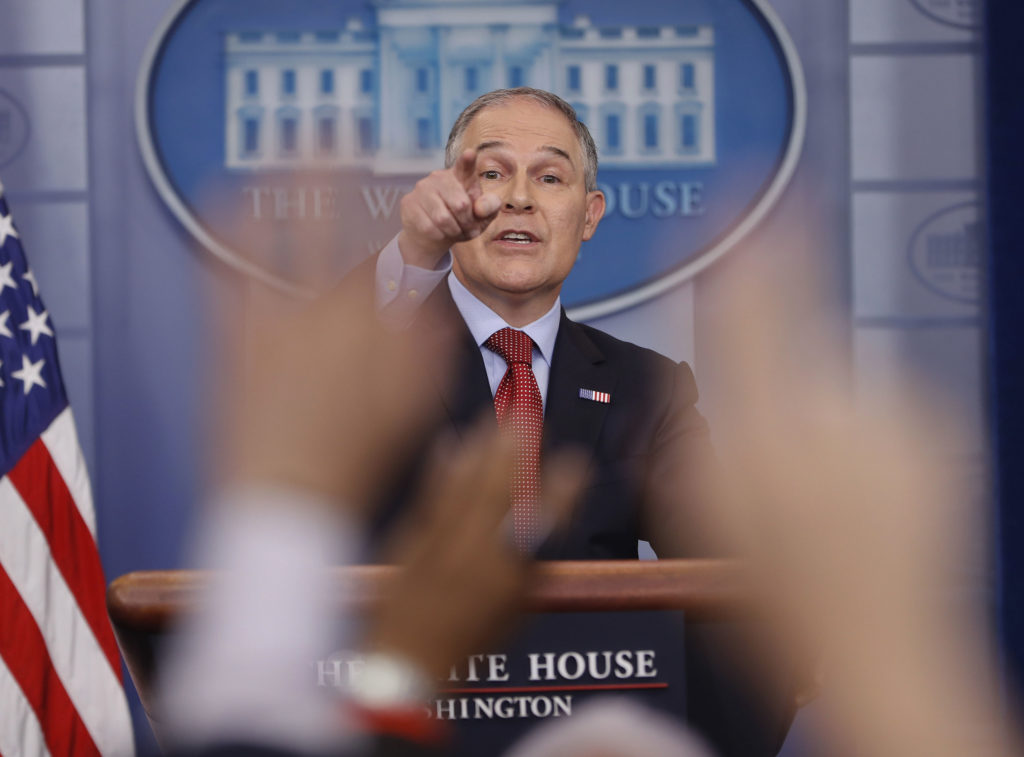
Does he or doesn’t he? Believe in climate change, that is. You’d think that would be an easy enough question the day after President Donald Trump announced he was pulling the U.S. out of the landmark global accord aimed at combating global warming. But don’t bother asking at the White House. “I have not had an opportunity to have that discussion” with the president, responded Press Secretary Sean Spicer on Friday. “You should ask him that,” offered White House Counselor Kellyanne Conway. Environmental Protection Agency chief Scott Pruitt dodged the question, too. The president also ignored it during an unrelated bill-signing. It’s quite a reversal for Trump, who spent years publicly bashing the idea of global warming as a “hoax” and “total con job” in books, interviews and tweets. He openly challenged the scientific consensus that the climate is changing and man-made carbon emissions are largely to blame. “Global warming is an expensive hoax!” he tweeted in 2014. But Trump has been largely silent on the issue since his election last fall. On Thursday, he made scarce mention of it in his lengthy remarks announcing America’s exit from the Paris accord. Instead, he framed his decision as based on economics. Here’s what he’s said before: — TRUMP’S TWEETS: The president’s Twitter feed once was filled with references to “so-called” global warming being a “total con job” based on “faulty science and manipulated data.” An Associated Press search of his Twitter archives revealed at least 90 instances in which he has referred to “global warming” and “climate change” since 2011. In nearly every instance, he expressed skepticism or mockery. “This very expensive GLOBAL WARMING bulls— has got to stop,” he wrote in January 2014, spelling out the vulgarity. Often the president has pointed to cold weather as evidence the climate scientists are wrong. “It’s 46 (really cold) and snowing in New York on Memorial Day — tell the so-called “scientists” that we want global warming right now!” he wrote in May 2013 — one of several instances in which he said that warming would be welcome. “Where the hell is global warming when you need it?” he asked in January 2015. The same message was echoed in the president’s books. In “Great Again: How to Fix Our Crippled America,” Trump made a reference to “the mistaken belief that global climate change is being caused by carbon emissions.” “If you don’t buy that — and I don’t — then what we have is really just an expensive way of making the tree-huggers feel good about themselves,” he wrote. — CANDIDATE AND SKEPTIC: “I’m not a believer in man-made global warming,” Trump told conservative radio host Hugh Hewitt in September 2015, after launching his bid for the White House. He bemoaned the fact that the U.S. was investing money and doing things “to solve a problem that I don’t think in any major fashion exists.” “I am not a believer,” he added, “Unless somebody can prove something to me … I am not a believer and we have much bigger problems.” By March 2016, the president appeared to allow that the climate was changing — but continued to doubt humans were to blame. “I think there’s a change in weather. I am not a great believer in man-made climate change. I’m not a great believer,” he told The Washington Post. “There is certainly a change in weather,” he said. Then-campaign manager, Conway explained Trump’s view this way: “He believes that global warming is naturally occurring. That there are shifts naturally occurring.” — EVOLVING PRESIDENT: In an interview with The New York Times in November, after the election, Trump was asked repeatedly whether he intended to leave the Paris accord and appeared to have a new open-mindedness. “I’m looking at it very closely,” Trump told the newspaper. “I have an open mind to it. We’re going to look very carefully.” He went on to say that he thought “there is some connectivity” between human activity and the changing climate, but that, “It depends on how much.” Asked about the comment several days later, Trump’s now-chief of staff Reince Priebus told Fox News that Trump “has his default position, which is that most of it is a bunch of bunk.” “But he’ll have an open mind and listen to people,” he said. Stay tuned. Republished with permission of The Associated Press.
No trial balloons: Donald Trump flips script with startling ideas
Washington policymakers have a time-tested method for rolling out new ideas: float a trial balloon. Spread rumors of a policy change or selectively leak it to the press, then see how it plays and proceed only if it looks doable. President Donald Trump has flipped that script. Big and startling ideas fly out of his mouth or from his Twitter feed. Then the rest of his administration scrambles to catch up — and to figure out when his statements signal new presidential policies and when they’re offhand remarks that mean little. In the past week alone, Trump has suggested he’s open to higher gas taxes, tweeted that a government shutdown could be a good thing and called North Korean dictator Kim Jong Un a “smart cookie” whom he’d be honored to meet under the right conditions. Trump also invited Philippine leader Rodrigo Duterte, with a troubling human rights record, to visit the White House and insisted the GOP health plan would provide coverage for people with pre-existing medical conditions, even though an ironclad guarantee is not reflected in the latest version of the legislation. Such pronouncements sometimes force Trump’s top policy advisers to try to adjust administration policy to sync with the president’s remarks. His communications aides contort themselves to explain away inconsistencies in administration messages. And blindsided GOP congressional leaders have to decide when to realign their positions and when to stay the course. “It’s a scramble drill in the White House every day, and certainly a scramble drill in Trump’s mind every day,” says Calvin Jillson, a presidential scholar at Southern Methodist University. The frustration of Republican legislators was clear when Trump tweeted Tuesday that the government “needs a good shutdown” in September to fix the “mess,” after Democrats prevailed on a number of spending issues in a bipartisan budget bill designed to keep the government open. “I do wish somebody would take his iPhone away from him,” said Sen. Bob Corker, R-Tenn. “I wish he’d think twice before tweeting,” seconded Sen. John McCain, R-Ariz. House Speaker Paul Ryan wondered aloud: “How many times have I had this, ‘Do you agree with the tweet this morning?’” Ryan said he shared the president’s aggravation with Democrats over the spending negotiations. But he also defended the budget deal, telling reporters it was an “important first step in the right direction.” On North Korea, Trump seemed to recognize the startling nature of his conciliatory comments about Kim in which he told CBS on Sunday that he would be “honored” to meet the leader if circumstances were right. The president labeled his own comments “breaking news.” White House Press Secretary Sean Spicer quickly stressed that Trump wouldn’t meet with the North Korean leader unless he changed course and showed “signs of good faith.” Asked how Trump could be honored to meet with someone who’s threatened to destroy the U.S., Spicer said that because Kim was a head of state, “there’s a diplomatic piece to this.” Likewise, it fell to Spicer to tamp down expectations after Trump told Bloomberg in an interview that he would “certainly consider” generating more money for his big infrastructure plan by raising gasoline and diesel fuel taxes. The idea of raising taxes is a no-go zone for most Republican legislators. Spicer said Trump was merely showing “respect” for an idea that had been raised by industry groups and “there was no endorsement of it or no support of it.” Trump’s interviews sometimes make news to his own team. When Trump promised an AP interviewer last month that he’d roll out his tax plan the following week, officials at the White House and Treasury Department, as well as Republicans on Capitol Hill, were caught off guard. The announcement sent aides scrambling to put together a one-sheet outline of a tax plan by the president’s surprise deadline. Trump’s Twitter feed is an ongoing source of surprise, perhaps most notably his March accusation that President Barack Obama had him wiretapped during the presidential campaign. That triggered an all-out effort by aides to find ways to justify the claim. Jillson allowed that sometimes Trump may appear to be winging it when his statements are planned, such as the president’s phone conversation during the transition with the president of Taiwan. The call generated speculation that Trump had unthinkingly broken longstanding U.S. policy but appears to have been part of a calculated effort to throw China off-balance, Jillson said. Trump’s White House invitation to Duterte, whose record includes extrajudicial killings of suspected drug dealers and users, caught key players at the State Department unaware and left White House officials trying to explain why it would be a good idea. White House chief of staff Reince Priebus framed the president’s invitation as part of an effort to counter the military threat of North Korea, adding that “it doesn’t mean that human rights don’t matter.” Jillson said that while administration officials may feel compelled to align the policies they’re developing with Trump’s latest statements, GOP members of Congress are becoming more discriminating about when they need to sync up with the president’s pronouncements and when they can disregard them. On the bipartisan budget deal, he said, congressional Republicans and Democrats “forgot about Trump for enough time to craft a deal, almost without reference to him, and got a win.” “They’re learning to let this stuff wash off their backs and continue to try to think systematically,” Jillson said. Republished with permission of The Associated Press.
White House defends transparency after visitor log reversal
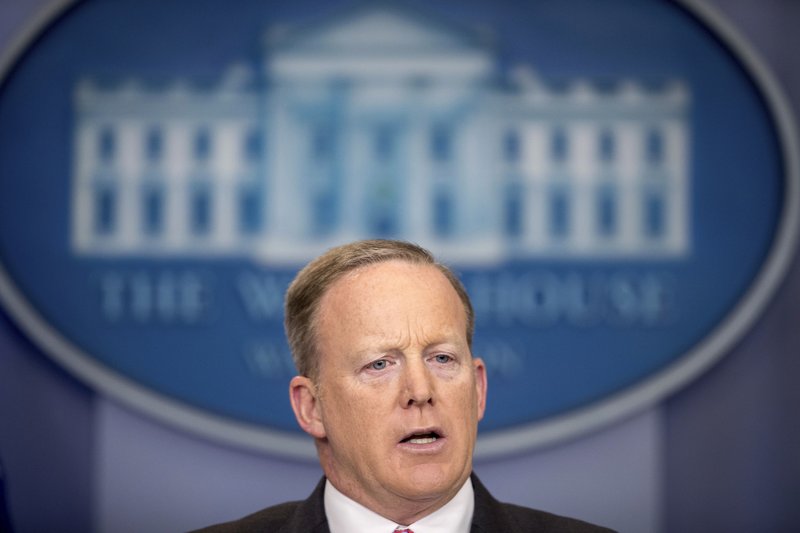
The White House defended its commitment to transparency Monday amid criticism of its decision to keep visitors’ records secret and new calls for President Donald Trump to release his federal tax returns. Government watchdog groups argue Trump is preventing the public from learning basic details about his financial ties and blocking information about the groups and individuals that are trying to influence the White House. The Obama administration released 6 million White House visitor records over eight years. On Monday, White House spokesman Sean Spicer downplayed those disclosures because national security and law enforcement reasons were used to exclude certain visits — despite the fact that the Trump White House has used national security and privacy concerns to justify keeping all visitor information under wraps. Spicer said the Obama White House approach amounted to “faux” transparency. “It’s not really being transparent when you scrub out the names of the people that you don’t want anyone to know were here,” Spicer said. The Obama administration initially fought attempts by Congress and conservative and liberal groups to obtain visitor records. But after being sued, it voluntarily began disclosing the logs in December 2009, posting records every three to four months. It continued to release the records even though a federal appeals court ruled in 2013 that the logs can be withheld under presidential executive privilege. Trump has long faced questions about secrecy and transparency given his refusal to release his federal tax returns, a decision that broke decades of tradition for both presidents and presidential candidates. White House aides have also provided few details about Trump’s activities and meetings during his numerous weekend trips to Florida. Thousands of protesters marched across the country Saturday demanding anew that Trump release his tax returns. But the protests did little to change Trump’s thinking: Spicer maintained that Trump was unable to make the information public because he is under audit, despite the fact that tax experts say an audit would not prevent him from releasing his taxes. Asked whether Trump is simply never going to release his taxes, Spicer said, “We’ll have to get back to you on that.” The White House defended Trump’s overall approach to transparency, noting that the president often opens portions of his meetings with business executives and other visitors to journalists. He also takes questions from reporters on a fairly regular basis, including during news conferences with visiting foreign leaders. “We bring people in, we release participant lists, we give press the opportunity to come into the room, see everybody who’s there, hear part of the discussion,” Spicer said. However, the White House has been tight-lipped about Trump’s activities when he travels to his properties in Florida — his Mar-a-Lago resort and a nearby private golf club. Aides rarely confirm when the president is golfing, even when photos of him on the course pop up on social media. During his recent Easter visit to Florida, the president spent two days at Trump International Golf Course. The White House provided no information about his activities, though CNN obtained images of the president golfing. Republished with permission of The Associated Press.
Who’s who: Trump aides, associates drawing attention
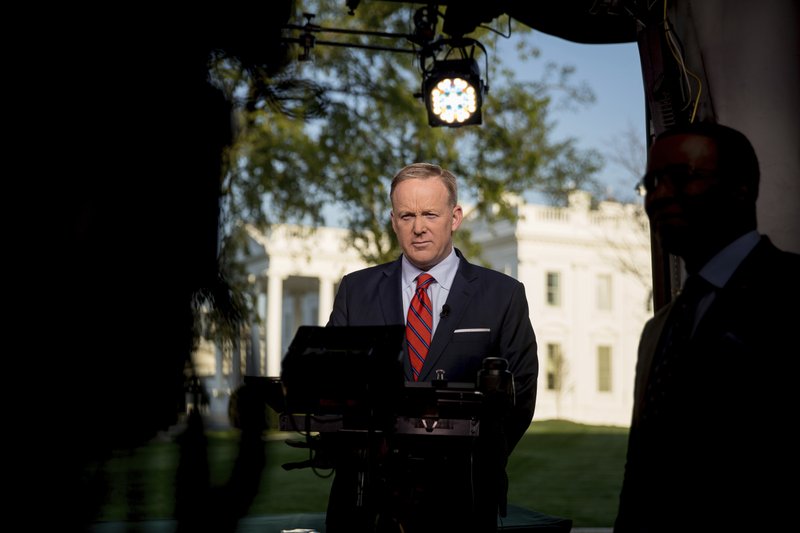
A number of President Donald Trump‘s top and former aides have received unwanted attention in recent days as they struggle with internal divisions, poorly worded comments and investigation revelations. Here’s a rundown of who’s who for those trying to keep track: STEPHEN BANNON Trump’s chief strategist and senior counselor has been the target of the left since he formally joined Trump’s campaign, thanks to the far-right views of the website he used to run, Breitbart News. In an interview with the New York Post this week, Trump appeared to distance himself from Bannon, the chief architect of several major administration policies, including Trump’s stalled travel bans. In the interview, Trump downplayed Bannon’s role in his campaign, claiming that his chief strategist was not involved “until very late.” That’s despite the fact that Bannon took over as the campaign’s CEO in August of last year. Trump’s early months in office have been filled with infighting between his aides. “Steve is a good guy,” Trump told the Post, but cautioned that if the infighting doesn’t stop, he’ll intervene. It was a rare public warning shot heard across Washington. ___ SEAN SPICER The White House press secretary is one of the most visible faces of Trump’s administration. His daily on-camera briefings have become must-see-TV for large swaths of the nation, and he has been repeatedly parodied on shows like “Saturday Night Live.” But Spicer has spent the last 24 hours on an apology tour, after he claimed that Adolf Hitler “didn’t even sink to using chemical weapons.” Critics noted the remark ignored Hitler’s use of gas chambers to exterminate Jews during the Holocaust. The comment marked the second time in as many days that Spicer appeared to struggle to articulate the president’s foreign policy at a critical time. The day before, he suggested that the use of barrel bombs by Syrian President Bashar Assad‘s government might lead to further military action. A White House spokesman later walked back the comment, saying the U.S. position hadn’t changed. Spicer has called his comments about the Holocaust “inappropriate and insensitive.” ___ PAUL MANAFORT Trump’s former campaign chairman’s foreign consulting work has become a headache for the White House. A Manafort spokesman said Wednesday Manafort would be registering as a foreign lobbyist. The spokesman says Manafort’s lobbying work was not conducted on behalf of the Russian government and began before Manafort started working with the Trump campaign. It’s unclear whether Trump was aware that Manafort was in talks with the government about registering before he hired him. Before taking over Trump’s campaign last May, Manafort worked for a slew of foreign clients, including a pro-Russian political party in Ukraine and Russian billionaire Oleg Deripaska. In 2005, he proposed an ambitious plan to promote the interests of “the Putin government” and undermine anti-Russian opposition across former Soviet republics, the Associated Press has reported. The AP also reported Wednesday that at least $1.2 million in payments listed in a handwritten ledger in Ukraine as paid to Manafort were received by his U.S. consulting firm. Manafort has denied any wrongdoing and the White House has tried to downplay Trump’s connections to Manafort, wrongly stating that he played only a “limited role” in Trump’s campaign. ___ CARTER PAGE Page was a little-known critic of the U.S policy toward Russia when he was tapped by Trump to serve as one of a handful of foreign policy advisers. It remains unclear how exactly the two met and what Page’s role actually entailed. But Page is now known to be the focus of a federal investigation of Trump’s campaign ties to Russia. The FBI obtained a secret court order last summer to monitor Page’s communications because the government had reason to believe Page was acting as a Russian agent, The Washington Post reported Tuesday. Page also met with a Russian intelligence operative in 2013 and provided him documents about the energy industry, according to court documents from a 2015 prosecution alleging a Cold War-style spy ring in New York. Page was not accused of wrongdoing related to the case and said in a statement that he shared “basic immaterial information” and publicly available research documents. A former Merrill Lynch investment banker, Page worked out of the company’s Moscow office for three years. He now runs Global Energy Capital, a firm described as focused on energy sectors in emerging markets. ___ MICHAEL FLYNN Trump’s former national security adviser, Flynn was ousted in February for misleading Vice President Mike Pence about the nature his communications with Russian ambassador Sergey Kislyak, the White House said. Flynn was interviewed by the FBI in the early days of the Trump administration about the conversations and his ties to Russia are currently under investigation. He and his firm also recently registered with the Justice Department as foreign agents for lobbying work conducted on behalf of a company owned by a Turkish businessman. A staunch early Trump supporter, Flynn is a retired United States Army lieutenant general and was the former director of the Defense Intelligence Agency. Republished with permission of The Associated Press.
