
Highlights of the $330 billion-plus bill to avoid shutdown
It’s not just about President Donald Trump’s border wall. The border security issues that sparked a 35-day government shutdown are but one element of a massive $330 billion-plus spending measure that wraps seven bills into one, funding nine Cabinet agencies, including the departments of Justice, State, Agriculture, and Commerce. It also contains a variety of other provisions, touching on Medicaid, pesticides and even the permitted length of sugar beet trucks in rural Oregon. While full details haven’t been released, highlights are expected to include: A BILLION HERE, A BILLION THERE Most of the bill deals with spending minutia such as a $1 billion increase to gear up for the 2020 census, an almost 4 percent budget increase for NASA and an $11.3 billion budget for the IRS. Most agencies are kept relatively level compared to last year, and the measure rejects big spending cuts — such as a $12 billion cut to foreign aid and the State Department — proposed by Trump. ___ FEDERAL EMPLOYEE PAY Trump has proposed a pay freeze for civilian federal employees, but the measure would guarantee those workers a 1.9 percent increase, according to No. 2 House Democrat Steny Hoyer of Maryland. The military got a 2.6 percent increase in legislation that passed Congress last year. ___ FLOOD INSURANCE The government’s troubled federal flood insurance program would be extended through Sept. 30 to give lawmakers time to reauthorize the program. The program expired last year but has been temporarily extended in order to avert disruptions in the housing market. ___ ODDS AND ENDS Since the bill is a must-pass vehicle, it’s serving as a locomotive to pull a host of miscellaneous provisions into law. There’s an extension of a Medicaid provision on home- and community-based nursing care, grants for the poor under the Temporary Assistance for Needy Families program and funding fixes to a trust fund that finances dredging and maintenance or ports and harbors. For fans of the truly obscure, there’s a provision to exempt sugar beet trucks in rural Oregon from length limits. Republished with permission from the Associated Press
Richard Shelby: Border security talks ‘stalled’ as clock ticks
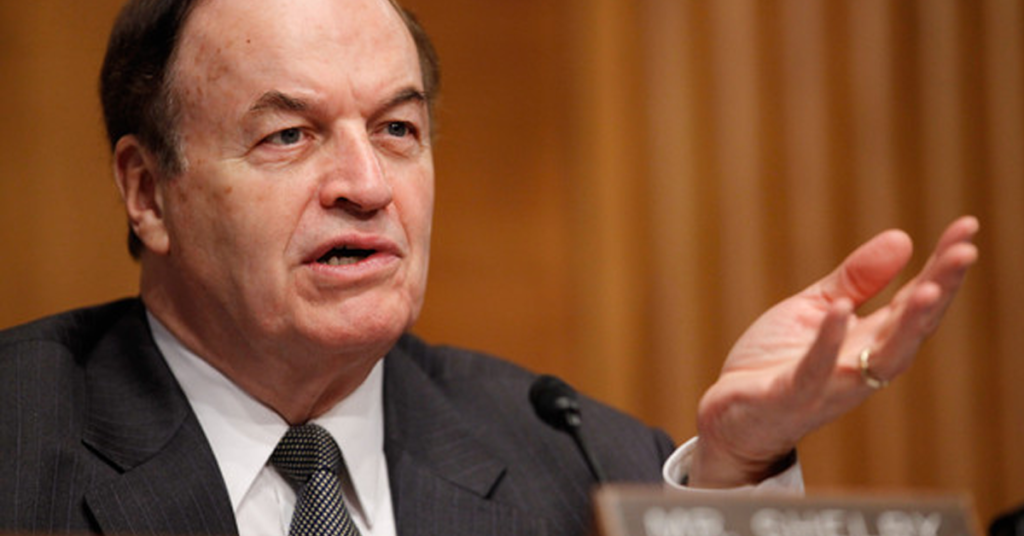
Bargainers clashed Sunday over whether to limit the number of migrants authorities can detain, tossing a new hurdle before negotiators hoping to strike a border security compromise for Congress to pass this coming week. The White House wouldn’t rule out a renewed partial government shutdown if an agreement isn’t reached. With the Friday deadline approaching, the two sides remained separated by hundreds of millions of dollars over how much to spend to construct President Donald Trump’s promised border wall. But rising to the fore was a related dispute over curbing Customs and Immigration Enforcement, or ICE, the federal agency that Republicans see as an emblem of tough immigration policies and Democrats accuse of often going too far. Acting White House chief of staff Mick Mulvaney, in appearances on NBC’s “Meet the Press” and “Fox News Sunday,” said “you absolutely cannot” eliminate the possibility of another shutdown if a deal is not reached over the wall and other border matters. The White House had asked for $5.7 billion, a figure rejected by the Democratic-controlled House of Representatives, and the mood among bargainers has soured, according to people familiar with the negotiations not authorized to speak publicly about private talks. “You cannot take a shutdown off the table, and you cannot take $5.7 (billion) off the table,” Mulvaney told NBC, “but if you end up someplace in the middle, yeah, then what you probably see is the president say, ‘Yeah, OK, and I’ll go find the money someplace else.’” A congressional deal seemed to stall even after Mulvaney convened a bipartisan group of lawmakers at Camp David, the presidential retreat in northern Maryland. While the two sides seemed close to clinching a deal late last week, significant gaps remain and momentum appears to have slowed. Though congressional Democratic aides asserted that the dispute had caused the talks to break off, it was initially unclear how damaging the rift was. Both sides are eager to resolve the long-running battle and avert a fresh closure of dozens of federal agencies that would begin next weekend if Congress doesn’t act by Friday. “I think talks are stalled right now,” Sen. Richard Shelby, Republican-Ala., said Sunday on “Fox News Sunday.” ″I’m not confident we’re going to get there.” Sen. Jon Tester, Democrat-Mont., who appeared on the same program, agreed: “We are not to the point where we can announce a deal.” But Mulvaney did signal that the White House would prefer not to have a repeat of the last shutdown, which stretched more than a month, left more than 800,000 government workers without paychecks, forced a postponement of the State of the Union address and sent Trump’s poll numbers tumbling. As support in his own party began to splinter, Trump surrendered after the shutdown hit 35 days without getting money for the wall. This time, Mulvaney signaled that the White House may be willing to take whatever congressional money comes — even if less than Trump’s goal — and then supplement that with other government funds. “The president is going to build the wall. That’s our attitude at this point,” Mulvaney said on Fox. “We’ll take as much money as you can give us, and we’ll go find the money somewhere else, legally, and build that wall on the southern border, with or without Congress.” The president’s supporters have suggested that Trump could use executive powers to divert money from the federal budget for wall construction, though it was unclear if he would face challenges in Congress or the courts. One provision of the law lets the Defense Department provide support for counterdrug activities. But declaring a national emergency remained an option, Mulvaney said, even though many in the administration have cooled on the prospect. A number of powerful Republicans, including Senate Majority Leader Mitch McConnell, Republican-Ky., have also warned against the move, believing it usurps power from Congress and could set a precedent for a future Democratic president to declare an emergency for a liberal political cause. The fight over ICE detentions goes to the core of each party’s view on immigration. Republicans favor tough enforcement of immigration laws and have little interest in easing them if Democrats refuse to fund the Mexican border wall. Democrats despise the proposed wall and, in return for border security funds, want to curb what they see as unnecessarily harsh enforcement by ICE. People involved in the talks say Democrats have proposed limiting the number of immigrants here illegally who are caught inside the U.S. — not at the border — that the agency can detain. Republicans say they don’t want that cap to apply to immigrants caught committing crimes, but Democrats do. In a series of tweets about the issue, Trump used the dispute to cast Democrats as soft on criminals. He charged in one tweet: “The Border Committee Democrats are behaving, all of a sudden, irrationally. Not only are they unwilling to give dollars for the obviously needed Wall (they overrode recommendations of Border Patrol experts), but they don’t even want to take muderers into custody! What’s going on?” Democrats say they proposed their cap to force ICE to concentrate its internal enforcement efforts on dangerous immigrants, not those who lack legal authority to be in the country but are productive and otherwise pose no threat. Democrats have proposed reducing the current number of beds ICE uses to detain immigrants here illegally from 40,520 to 35,520. But within that limit, they’ve also proposed limiting to 16,500 the number for immigrants here illegally caught within the U.S., including criminals. Republicans want no caps on the number of immigrants who’ve committed crimes who can be held by ICE. As most budget disputes go, differences over hundreds of millions of dollars are usually imperceptible and easily solved. But this battle more than most is driven by political symbolism — whether Trump will be able to claim he delivered on his long-running pledge to “build the wall” or newly empowered congressional Democrats’ ability to thwart him. Predictably each side blamed
State of the Union among most sensitive security challenges

It’s one of the most sensitive security challenges in America: The State of the Union address puts the president, his Cabinet, members of Congress, military leaders, top diplomats and Supreme Court justices all in the same place at the same time for all the world to see. Protecting everyone requires months of planning and coordination involving multiple law enforcement agencies, led by the U.S. Secret Service. Thousands of officers work across agencies in ways seen and unseen. Security for the speech was in the spotlight during the partial government shutdown, when House Speaker Nancy Pelosi cited safety concerns as her reason for delaying President Donald Trump’s speech. But law enforcement officials said the shutdown would not have compromised security if the speech had gone forward as originally scheduled. Now the speech is set for Tuesday. The Secret Service is, well, secretive about its plans, though it provides some details: Long before the speech, a steering committee is formed to explore the best way to secure the event. The Secret Service works with U.S. military, parks and local police, Capitol police, emergency management experts and the FBI. There are 19 subcommittees on areas like crowd management, intelligence and counterterrorism, traffic and crisis. Each subcommittee contains experts across law enforcement. Teams run drills. Officials perform tabletop exercises, running through potential disasters and pore over the report from the previous year to see how they can improve. Analysts comb social media for signs of threatening behavior and monitor world events to help inform how security should be tailored for the event. The tradition and familiarity of the event is also the biggest security challenge; it’s basically the same every year, officials said. And there are only so many ways officials can vary traffic routes or arrivals and departures. “You have to be creative,” said Wes Schwark, assistant to the special agent in charge of the Dignitary Protective Division. “You try not to stick our head out in the same place twice.” On the day of the event, an operations center is set up at an undisclosed location where law enforcement officials scan social media, monitor traffic and protests, drones and other aircraft and communicate potential threats with agents in the field. “We don’t want the problem to be in the chamber, we want the problem to be as far away from the chamber as possible,” said Ken Valentine, special agent in charge of the Dignitary Protective Division, which is tasked with coordinating the event. “We’re trying to push that out so if there is an issue, we’re dealing with it as far away as possible.” The streets around the building are frozen and secured. The Capitol Plaza is locked down and those inside are limited from moving around the building. The president and his entourage typically gather in a room off the House floor to await their entrances to the House chamber. Metro stations are checked, counter-sniper teams with long-arm rifles perch on rooftops, bomb-sniffing dogs, uniformed officers and plainclothes agents patrol. Traffic is locked down. The House Chamber is swept randomly and consistently for explosives. “All of those are more traditional means of countering an attack, but they serve as a deterrent,” Valentine said. The biggest shift in recent history has been the prevalence of technology, both as a possible security concern and a tool. “It gives us a heads-up, or a warning when we are going to start engaging in something that maybe before would have been right up on us,” Schwark said on technology. “It allows us to start taking some type of action sooner.” Despite the heavy security, there is a traditional precaution in case of a disaster: At least one Cabinet member in the line of presidential succession, and at least one Supreme Court justice, stay away from the speech. “Given their public profile, National Special Security Events are potentially attractive targets for malicious actors who may seek to hurt attendees or incite fear into our way of life,” said Homeland Security Secretary Kirstjen Nielsen. “DHS, our component agencies and federal partners work tirelessly to secure the State of the Union.” In the end, Secret Service agents are trained to protect the president and do it every day, so shifting from working the South Lawn to the State of the Union isn’t much of a difference for them, officials said. “It’s just another day at work,” Valentine said. Republished with permission from the Associated Press
State House passes school security funding bill

A bill that would allow Alabama schools to use reserve money from an education savings fund for school security passed the State House on Thursday. Lawmakers voted 96-4 in favor of SB323 sponsored by Montrose-Republican state Sen. Trip Pittman. which specifically would amend the Education Trust Fund Rolling Reserve Act to allow funds in the Education Trust Fund Budget Stabilization Fund to be used to cover the costs of school security. The legislation returns to the Senate with amendments, if passed it expected to be signed into law by Gov. Kay Ivey who announced her support for the bill earlier this month. “Ensuring safety in our schools is a bipartisan issue, and we must do all we can to prevent violence and be sure we are ready to respond in the event such violence does occur,” Ivey said.
Fort Trump: New security measures ring Trump Tower
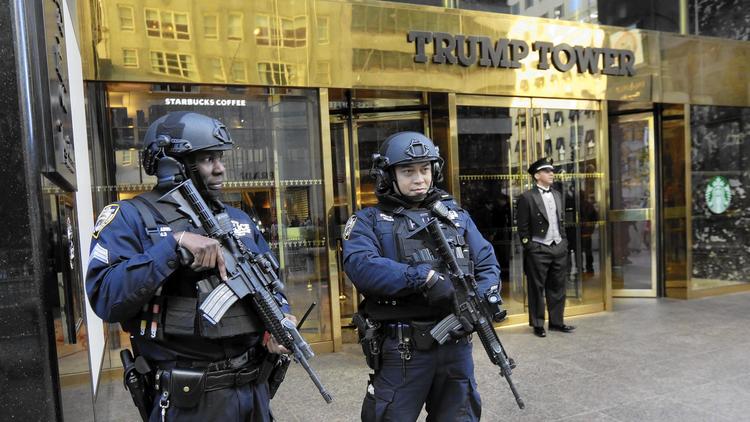
Being a midtown Manhattan neighbor of Donald Trump now that he’s president-elect has come to this: navigating swarms of police officers, barricades, checkpoints and street closings that have turned Trump Tower – a tourist attraction normally open to the public – into a fortress. The extreme security measures began going up around the landmark Fifth Avenue skyscraper on Election Day, when authorities brought in a fleet of heavy Sanitation Department trucks filled with sand to wall off the front of the glittering, 664-foot glass tower and protect it from a potential car bomb attack. Those trucks were gone by Friday, replaced by concrete barriers stamped with the NYPD logo. But the stepped-up security – a team effort by the Secret Service, the New York Police Department and Trump’s private security personnel – isn’t going away. The Secret Service and NYPD wouldn’t detail what lies ahead. That will depend largely on how Trump decides to divide his time between Washington and New York and on an assessment of the vulnerabilities of Trump Tower, where the president-elect lives in a penthouse condo and his Trump Organization is headquartered. “It’s going to take a lot of planning, and it’s going to take a lot of creativity,” said NYPD Deputy Commissioner Steve Davis. The heightened security has already become a concern for some high-end retailers in one of the city’s busiest shopping districts, especially with the holiday season ramping up. “We’ve heard a lot from the customers that it has been a real adventure even getting to us,” said Kevin Hill, manager of Crocket and Jones, a shoe store on West 56th Street. “It probably drives people away,” he said of the security surge. “I thought, ‘Gosh, if he comes up here every week on the weekends, that will be just a nightmare.’” Police officers manning metal barricades asked visitors and shoppers where they were going before they could get onto the Trump Tower block Friday. People who said they were headed for the tower or the flagship Tiffany & Co. store next door were being let through, but the jewelry shop canceled the unveiling next week of its annual Christmas light display. “It’s obviously an important time of year for us,” said Tiffany spokesman Nathan Strauss. Metal barricades also restricted access to a Gucci store on the ground floor of Trump Tower. In the weeks leading up to the election, visitors at Trump Tower were subjected to bag checks and other screening but otherwise had free access to a five-story atrium that has shops and restaurants, including Trump Grill and a Starbucks. Under a zoning deal Trump made with the city in the late 1970s, he is required to keep the atrium open to the public between 8 a.m. and 10 p.m. In August, a young man took advantage of the easy public access, ascended to a public terrace and began scaling the side of the tower Spider Man-style, using suction cups. He made it about 20 stories up before police officers hauled him in through a window. By late last week, though, access was restricted and occasionally cut off completely. Inside the atrium, law enforcement was everywhere, visitors were few and business was slow for the Starbucks and Trump gift shops and restaurants. Still, “it felt very relaxed,” said tourist Richard Corpening, 61, a Trump supporter and contractor from Charleston, South Carolina. “They didn’t even take my coffee away.” Police also closed off the block south of the high-rise and set up guard towers on either end. And they have gotten stricter about diverting delivery trucks away from the tower. This week, the Federal Aviation Administration barred aircraft from flying below 2,999 feet over Trump Tower, saying the airspace restrictions are needed until late January because of “VIP movement.” An organization for private pilots complained that the FAA went too far by limiting access to the Hudson River corridor and its “breathtaking view of the New York City skyline.” More permanent safeguards will take into account the effect on businesses and residents, Secret Service spokesman Martin Mulholland said. “People think we shut stuff down because we can, but we pay close attention to what happens when we close a street or a sidewalk,” he said. “We look for the best solution.” The cost of the security measures is unclear, though the city might seek reimbursement from the Homeland Security Department for some of its expenses. Craig Selimotic Danforth, 47, of Carlsbad, California, appeared startled when he was stopped by police on the way to a meeting at an office building on heavily fortified West 56th Street. Once he was let through, Danforth, who works in the jewelry industry, called the security “a necessary inconvenience.” “This is Trump,” he said. “It’s different than having to block off a couple streets in Chappaqua for the Clintons.” He added: “Everyone is going to have to adapt to this. You brush it off and go on your way.” Republished with permission of the Associated Press.
Birmingham police looks to buy more body cameras
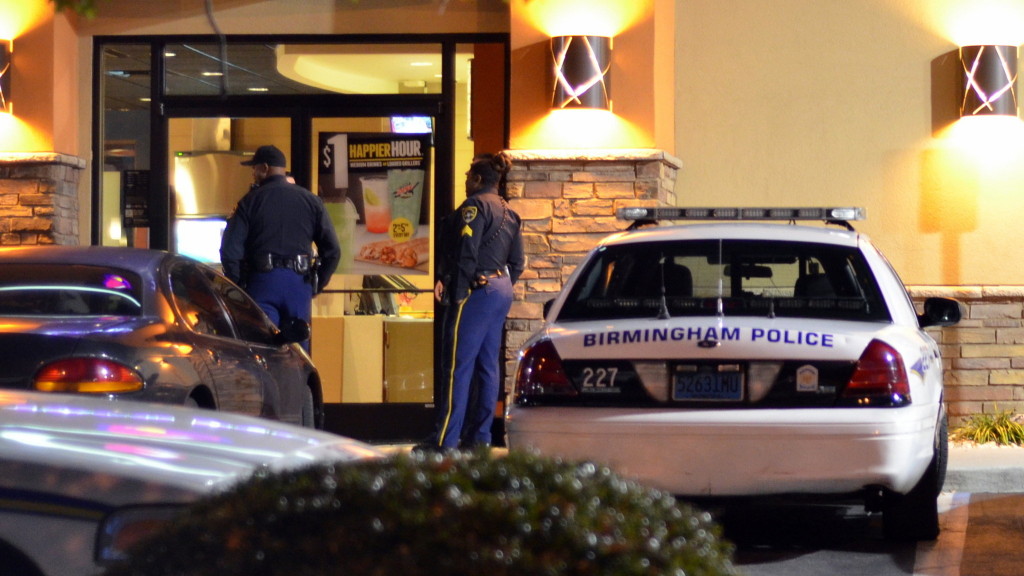
Birmingham police are asking for federal help to buy more body cameras. Al.com reports city council voted Tuesday to approve an application for a $600,000 U.S. Department of Justice grant for the cameras. Police Chief A.C. Roper says federal officials are planning to award grants to a dozen cities and the department is working toward every officer being equipped with a camera. Roper says evening and night shift patrol officers are now outfitted with body cameras. Republished with permission of The Associated Press.
