
Senate slipping away as Dems fight to preserve blue wave
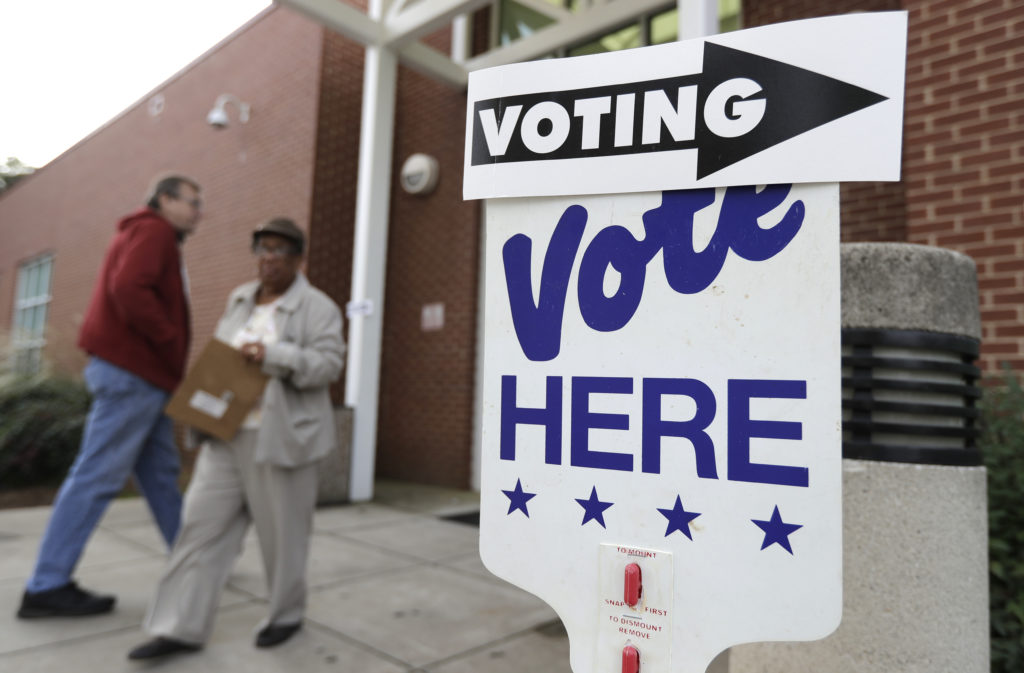
In the closing stretch of the 2018 campaign, the question is no longer the size of the Democratic blue wave. It’s whether there will be a wave at all. Top operatives in both political parties concede that Democrats’ narrow path to the Senate majority has essentially disappeared, a casualty of surging Republican enthusiasm across GOP strongholds. At the same time, leading Democrats now fear the battle for the House majority will be decided by just a handful of seats. “It’s always been an inside straight, and it still is,” Democratic pollster Paul Maslin said of Democrats’ outlook in the Senate, where they need to pick up two seats while holding on to several others in Republican-leaning states to seize the majority. “If it had been a different year, with a different map, we might have had a terrific sweep. That would be a long shot.” While the trend may be troubling for Democrats, the evolving political landscape remains unsettled two weeks before Election Day, even with millions of votes already cast across 20 states. There are signs that the Democrats’ position in the expanding House battlefield may actually be improving. Yet Republican candidates locked in tight races from New York to Nevada find themselves in stronger-than-expected positions because of a bump in President Donald Trump’s popularity, the aftermath of a divisive Supreme Court fight and the sudden focus on a caravan of Latin American immigrants seeking asylum at the U.S. border. Democrats say they never assumed it would be easy. “It’s still much closer than people think, with a surprise or two in the wings,” New York Sen. Chuck Schumer, the top Senate Democrat, told The Associated Press. The midterm elections will decide whether Republicans maintain control of Congress for the final two years of Trump’s first term. Even if Democrats lose the Senate and win the House, they could block much of Trump’s agenda and use subpoena power to investigate his many scandals. Some in the party’s far-left wing have also vowed to impeach the president, while others promise to roll back the Republican tax overhaul and expand health care coverage for all Americans. Democrats have enjoyed an overwhelming enthusiasm advantage for much of the Trump era. They hope an explosion of early voting across states like Florida, Texas and Nevada is further proof of their enthusiasm gap. It took voters in the Houston area less than six hours Monday to set a new opening day record for early voting during a midterm election. And in some Florida counties, two and three times as many voters cast ballots on the first day of early voting Monday compared to four years ago. Public and private polling, however, suggests the GOP is getting more excited as Nov. 6 approaches. “Republican enthusiasm doesn’t quite equal the white-hot enthusiasm of Democratic voters, but the Kavanaugh hearings got it pretty close,” said GOP consultant Whit Ayres. He also attributes the party’s strong position on an unusual Senate map. Democrats are defending 26 seats of the 35 seats in play, including 10 in states that Trump carried in 2016. Ayres calls it “maybe the most Republican-leaning map of our lifetimes.” He expects the GOP to maintain the Senate majority, perhaps adding a seat or two to its current 51-49 edge. Others have begun to envision the GOP picking up as many as four or five new seats. Democrats, meanwhile, have effectively protected their Senate candidates in states across the Midwest — Ohio, Pennsylvania, Michigan and Wisconsin — that helped give Trump the presidency in 2016. They are increasingly pessimistic about picking up any seats, however. The Tennessee Senate contest, in particular, has shifted sharply in Republican Rep. Marsha Blackburn‘s direction in recent weeks, while Democratic pickup opportunities in Arizona and Nevada are now considered toss-ups. In a measure of the deep uncertainty that has defined the Trump era, only one Democratic incumbent — North Dakota’s Heidi Heitkamp — is seen as most in danger of losing. After Heitkamp, Democrats facing the greatest risk of defeat are Joe Donnelly of Indiana, Claire McCaskill of Missouri, and perhaps Bill Nelson of Florida. Texas Democratic Senate candidate Beto O’Rourke has shattered fundraising records and developed a national following, but polls have consistently given Republican Sen. Ted Cruz a significant lead against him. In the race for the House, both sides acknowledge the prospect of a wipeout-style wave is shrinking. It’s not that Democrats won’t be able to wrestle the House majority. But Republican lawmakers are increasingly optimistic, in part because of Trump’s recent performance as the GOP’s campaigner in chief. Republicans say the often-volatile president has been surprisingly on-message during his campaign events, touting the strong economy and doubling down on the Kavanaugh fight to promote his efforts to fill courts with conservative jurists. And while Trump has been criticized by members of his own party for his handling of the case of the death of a Saudi journalist working for The Washington Post, operatives say the matter appears to be having little impact on voters. On a conference call last week, House Majority Leader Kevin McCarthy, R-Calif., urged rank-and-file lawmakers to pony up extra cash and help for tough races. They see hopeful signs in Iowa, Florida and Kansas. Rep. Tom Cole, R-Okla., emerged from the call saying it’s going to be a “dogfight” to the finish. There are signs, however, that Democrats are expanding the House battlefield as Election Day approaches. Republicans in recent days have pumped new money into House districts held by Republicans in Florida, Georgia, Virginia and New York, suggesting they’re on the defensive. Already, Democrats invested in nearly 80 races, including more than a dozen legitimate pickup opportunities in districts Trump carried by at least 9 points. Democrats need a net gain of 23 seats to claim the House majority. The massive battlefield remains a problem for Republicans, who have struggled to match Democratic fundraising and face several first-time candidates not yet tainted by Washington. Still, Dan Sena, the executive director
Senate Democrats: Living out ‘If you give a mouse a cookie’

Since the day President Donald Trump won the election, Democrats have openly flaunted the fact they would do everything they could to derail his presidency, his agenda and essentially anything they could related to him. Chants of “Not my president” could be heard on the streets of D.C. throughout the inauguration and haven’t stopped since. They have shown given any opening whatsoever they will do whatever they can to stop progress and to tarnish anyone associated with the President. Even Senate confirmations for critical agencies have sat around for much longer than in previous administrations. And we’ve watched Trump repeatedly be blamed for policies in existence before he took office. His staff has been accosted out in public. His cabinet officials have been personally and professionally vilified. Everything including his wife’s shoes and recovery time from a medical procedure has come under fire. I thought we’d seen it all until the Brett Kavanaugh confirmation hearings began. When Democrats realized they couldn’t stop the appointment based on his merits, they set out to derail his confirmation by attempting to ruin his character. The twists and turns of the last several weeks are going to have ever lasting consequences as Senator Lindsey Graham passionately said, “This is going to destroy the ability of good people to come forward because of this crap.” The number of holes and inconsistencies in Dr. Christine Blasey Ford‘s accusations from the day they came has out raised red flags for even the most casual observer. That said, Senate Democrats called for another hearing to address the concerns, when they got that they then screamed for an FBI investigation. And then they got that, and now they’re saying that it’s still not enough. They want more time. They want more witnesses. They want more. It reminds me of a book I read to my children, “If you give a mouse a cookie.” The fact is this isn’t about the accusations anymore and if you had any doubt about that Senator Cory Booker was so kind as to finally say so yesterday. Enough already looking at the evidence senators have all that they need to vote plus some. As a voter in Alabama, I call on Senator Doug Jones and the others to reject the partisan gamesmanship that has torn apart more than this nomination process and to confirm Kavanaugh. Top four facts for senators to consider: Not only are there no witnesses, the people Ford claimed were there deny such an event. The holes in Ford’s memory. While not remembering specifics of an event from 35 years ago is in itself surprising the number of holes are in fact. Front door questions. Kavanaugh’s history and testimony and that of those who support him. Senate Democrats have done a great disservice to our nation and to women by using the accusations against Kavanaugh as a prop in their political theater. I hope that the backlash is swift and firm not just with the upcoming elections, but also with Kavanaugh being confirmed.
Alabama delegation weighs in on government shutdown
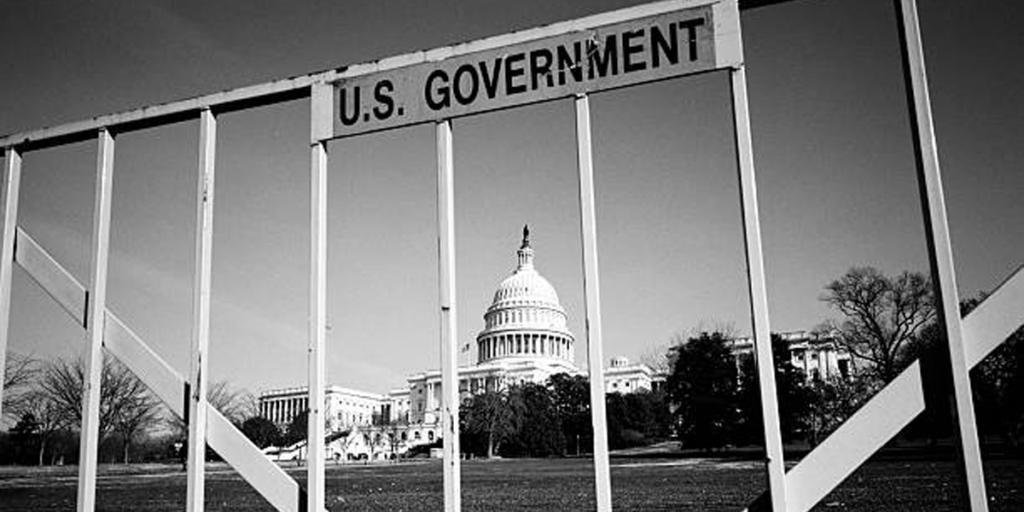
Legislation to prevent the government from shutting down failed Friday night in the U.S. Senate ahead of the midnight deadline, causing the much of the federal government to officially shut down early Saturday morning. The shutdown occurred after Senate Democrats blocked consideration of a four-week stopgap spending measure to keep the government operating. Failure to pass H.R. 195, the Continuing Resolution (CR), caused the government to shut down for the first time since 2013. Social Security and most other safety net programs are unaffected by the lapse in federal spending authority as they are covered by mandatory spending. Critical government functions will continue, with uniformed service members, health inspectors and law enforcement officers scheduled to work without pay. If no deal reached before Monday, two million federal employees will be furloughed and given leave of absence. Here’s what the Alabama delegation is saying about the shutdown: Sen. Richard Shelby: It is unacceptable that Democrats would vote against a measure to keep our government open to do the work of the American people. I do not believe that shutting down the government is a solution to the problems we face as a country. A shutdown is destructive to the American taxpayer, no matter the circumstances. …Democrats have chosen partisan politics over funding our government, funding our troops, and providing health insurance to low-income children and pregnant women. The American people deserve better. Alabama 1st District U.S. Rep. Bradley Byrne: This is shameful. Chuck Schumer and Senate Democrats have officially shut down the federal government. A majority of House members and a majority of Senate members voted to keep the government open and fund the Children’s Health Insurance Program (CHIP) but arcane Senate rules and Democrat obstruction blocked the bill from moving forward. Alabama 2nd District U.S. Rep. Martha Roby: While I continue to have serious concerns with short-term funding measures, I still voted in favor of the Continuing Resolution this week in the House because I believe it is critical that we keep the government open and running, especially as it relates to our military and reauthorization of the Children’s Health Insurance Program (CHIP),” Representative Roby said. “I am deeply disappointed that Senate Democrats chose to let the government shut down over an unrelated immigration issue that does not have an immediate deadline. Alabama 3rd District U.S. Rep. Mike Rogers: One of the fundamental purposes of our government is to provide for the common defense to protect our liberties. Unfortunately, Democrats chose illegal immigrants over our brave men and women who serve in uniform and forced our government to shut down. Their actions also hurt children across East Alabama and the country that rely on CHIP. Playing politics with those who defend our freedom and the health care of the kids who need it the most is unconscionable to me. Alabama 4th District U.S. Rep. Robert Aderholt: Congress has one job that it must do each and every year and that is to keep the government funded through Appropriations bills. Despite bipartisan support for passage of the House bill to fund the government, Senate Democrats have voted to shutdown the government utilizing an arcane parliamentary rule. It is far past time for the Senate to get out of its own way and to get out of the way of the American people. This article will be updated as additional statements are made.
Senate Democrats to propose $1 trillion infrastructure plan
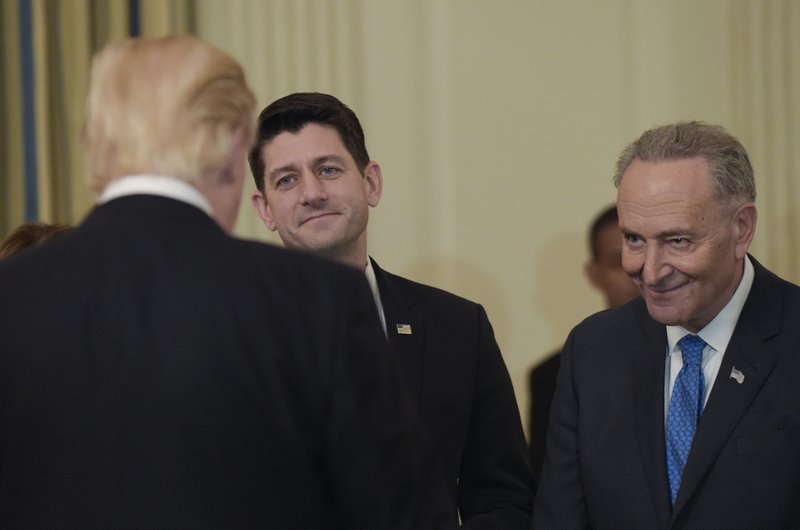
Senate Democrats on Tuesday will propose spending $1 trillion on transportation and other infrastructure projects over 10 years in an attempt to engage President Donald Trump on an issue where they hope to find common ground. Details of the plan provided to The Associated Press include $200 billion for a “vital infrastructure fund.” An example of the types of projects that could be eligible for financing from the fund is the Gateway Program to repair and replace rail lines and tunnels between New York and New Jersey, some of which are over 100 years old and were damaged in Superstorm Sandy in 2012. The project, which would double the number of trains per hour using the tunnels and help enable high-speed Amtrak service, is estimated to cost about $20 billion. Republican leaders, who have said previously that they’re waiting for Trump to offer his own proposal, are unlikely to embrace the Democratic plan. It’s not clear where Democrats would get the money for their proposal. Infrastructure was raised at a meeting Monday between Trump and lawmakers from both parties. Senate Majority leader Mitch McConnell, R-Ky., has said he doesn’t want another infrastructure plan that is effectively an economic stimulus program like the one Congress passed in 2009 at former President Barack Obama‘s behest. “They thought that was an area maybe to find common ground, and then Sen. McConnell made the important point it needs to be paid for because we’ve got $20 trillion in debt,” Sen. John Cornyn of Texas, the No. 2 Senate Republican leader. Trump bemoaned the state of America’s roads, bridges, airports and railways during the presidential campaign and promised to generate $1 trillion in infrastructure investment, putting people to work in the process. But Trump has offered few specifics. Administration officials have indicated they expect Trump to offer details this spring. “Senate Democrats are walking the walk on repairing and rebuilding our nation’s crumbling infrastructure,” Senate Minority leader Charles Schumer, D-N.Y., said. “We ask President Trump to support this common sense, comprehensive approach.” Democrats estimate their plan would create 15 million jobs. Besides transportation, the plan includes money for expanding broadband access in rural areas, water treatment and sewer construction, veterans’ hospitals and schools. A proposal by two of Trump’s financial advisers circulated just after the election calls for using $137 billion in tax credits to generate $1 trillion in private investment in infrastructure projects over 10 years. But investors are typically interested only in projects that have a revenue stream like tolls to produce a profit. Elaine Chao, Trump’s nominee for transportation secretary, told senators last week that she wants to “unleash the potential” of private investors to boost transportation. Charging tolls for roads and bridges is often unpopular. A recent Washington Post poll found that 66 percent of the public opposes granting tax credits to investors who put their money into transportation projects in exchange for the right to charge tolls. The American Association of State Highway and Transportation Officials and transportation industry lobbying groups want a hike in direct federal spending instead of tax credits. What is needed most, they say, is money to address the growing backlog of maintenance and repair projects, most of which are unsuitable for tolling. Republished with permission of The Associated Press.
Senate Democrats block action on president’s trade agenda
Senate Democrats dealt President Barack Obama a stinging setback on trade Tuesday, blocking efforts to begin a full-blown debate on his initiatives. The president’s supporters said they will try again, possibly starting in the House. But they were unable to sugar-coat a solid rebuke of a major Obama priority by members of his own party, some of whom served with him in the Senate. Only one Senate Democrat, Tom Carper of Delaware, voted for a GOP-crafted motion to start considering Obama’s request for “fast track” trade authority. Fast track would let the president present trade agreements that Congress could ratify or reject, but not amend. Proponents needed 60 votes to thwart a Democratic filibuster, but managed only 52 in the 100-member Senate. Tuesday’s vote highlighted the deep divide between Obama and the many congressional Democrats who say trade deals hurt U.S. jobs. Leading the fight against fast track are labor unions and liberal groups, which are crucial to many Democrats’ elections. Most Republican lawmakers support free-trade agreements. They were in the strange position Tuesday of losing a vote but seeing the Democratic president take the blame. “It is the president’s party,” said GOP Sen. Orrin Hatch of Utah. “It’s amazing to me that they would do this to the president on a bill of this magnitude.” Senate Majority Leader Mitch McConnell of Kentucky called the results “pretty shocking.” But Democratic Sen. Bill Nelson of Florida said, “Maybe what McConnell really wants to do is embarrass the president.” Several Democrats said Obama erred by pointedly criticizing a leading Democratic foe on trade, Sen. Elizabeth Warren of Massachusetts, in an interview with Yahoo News. Those Democrats said they bristled when Obama suggested Warren was poorly informed and politically motivated. Democratic senators said they also are tired of seeing the Democratic president cozy up to Republicans on trade. Most Republican lawmakers support trade agreements. But Obama must recruit a fair number of House and Senate Democrats to achieve his trade goals. Several Democrats say they will back fast track only if Republican leaders clear a path for three other trade measures. One, to renew the African Growth and Opportunity Act, is uncontroversial. The second calls for Trade Adjustment Assistance, which provides federal aid to workers displaced by trade agreements. Republicans don’t like it, but reluctantly acknowledge it’s the price for winning even modest Democratic support. The third bill, involving Customs enforcement, is the stickiest. It includes a measure to take actions against countries that keep their currency artificially low, which makes their exports more attractive. The Obama administration opposes the “currency manipulation” measure, saying it could invite international challenges to the Federal Reserve’s policies meant to boost the U.S. economy. McConnell said that only two of the bills — fast track and Trade Adjustment Assistance — would be the subject of initial votes, but senators would have ample chances to address the other two bills during the amendment process. Democrats met at midday and declared McConnell’s package unacceptable. Republished with permission of The Associated Press.
