
Alabama Democrats express frustration over redistricting; GOP proposal to get vote Monday
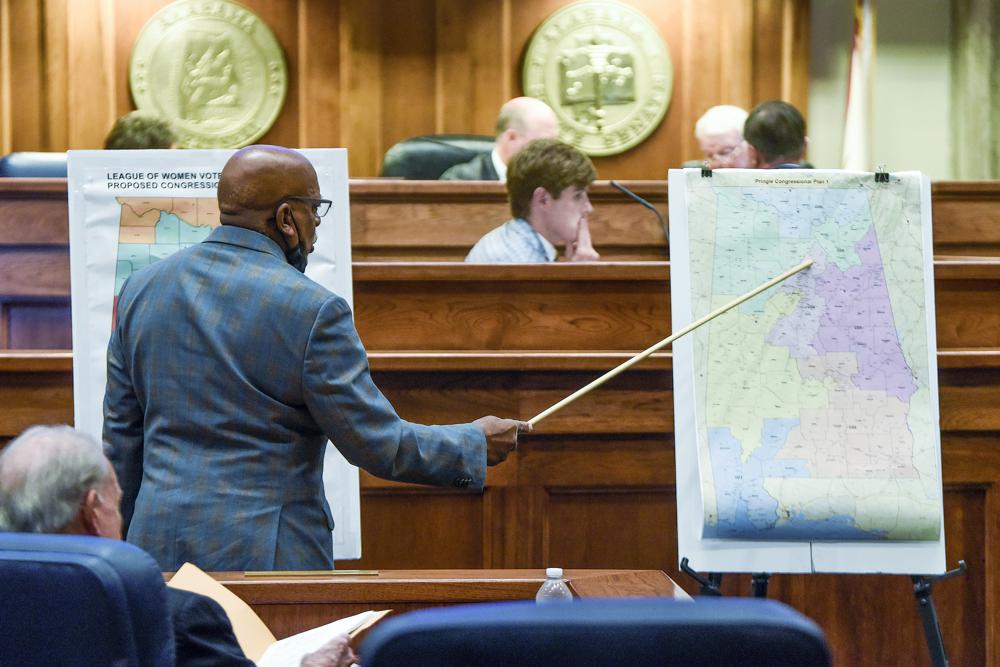
Majority Republican lawmakers have not released their ideas for redrawing Alabama’s congressional districts to comply with a Supreme Court ruling, leading Democrats on Thursday to accuse GOP lawmakers of shutting them, and the public, out of the process ahead of next week’s special session on redistricting. Alabama lawmakers begin the special session Monday to approve a redistricting plan that is being developed by Republicans but hasn’t been presented. “There hasn’t been any public scrutiny on it, and we’re just going to be handed that map at some point over the weekend, maybe even Monday, and say here, ‘Vote on it,’” Rep. Chris England, a Democrat from Tuscaloosa, said after a meeting of the legislature’s redistricting committee. England said he understands that the GOP majority will determine what passes, but said that “something with as much jeopardy attached to it as redrawing the congressional map to satisfy a Supreme Court decision” should be done “in the light of day.” A three-judge panel gave Alabama until July 21 to adopt a new congressional map after the U.S. Supreme Court upheld its ruling that the state likely violated the Voting Rights Act with its current plan that has only one congressional district with a substantial number of Black voters. The Alabama Permanent Legislative Committee on Reapportionment held a meeting Thursday to hear public comments and approve guidelines. House Speaker Pro Tempore Chris Pringle, who serves as co-chairman of the committee, said it will meet Monday to vote on the proposed map. While Democrats accused Republicans of keeping the process shrouded in secrecy, Pringle said they are proceeding as quickly as possible. He said the proposed map will be sent to committee members as soon as possible before the Monday meeting. “We are working on that as fast as we can,” Pringle said. Alabama now has only one majority-Black district out of seven in a state where more than one in four residents are Black. The three-judge panel said in its 2022 ruling that Alabama should have “two districts in which Black voters either comprise a voting-age majority or something quite close to it.” Republicans have the numbers to approve a plan without support from Democratic lawmakers. However, the plan must go back before the three-judge panel. GOP lawmakers risk the court stepping in and drawing its own plan if lawmakers stray too far from the court’s wishes. The group of Black voters that won the Supreme Court case urged committee members Thursday to adopt their proposed map. It would adjust the state’s 2nd Congressional District, now represented by Republican Rep. Barry Moore, to create what is described as an “opportunity” district because it would give Black voters, now making up 50% of the voting-age population, a greater opportunity to elect a candidate of their choice. The proposed district would encompass some Black Belt counties and parts of Mobile County. Some of the plaintiffs described how they joined the case after seeing their communities ignored by the white Republicans who represent their areas. “I want my community to have a seat at that table,” said Shalela Dowdy of Mobile. Some Democrats on the legislative committee disagreed on how to reconfigure the map. Sen. Vivian Davis Figures, D-Mobile, said she will introduce the plaintiffs’ map in next week’s session because it “complies with the court’s instruction.” Sen. Rodger Smitherman, D-Birmingham, favored a rival proposal that would alter the 6th Congressional District, now represented by Republican Rep. Gary Palmer, so it includes all of Jefferson County, which is home to Birmingham. Smitherman argued that a Democrat would have a good opportunity to be elected in the racially diverse district. “Jefferson County is the melting pot,” he said. Republished with the permission of The Associated Press.
Democratic leadership address the Supreme Court rejection of Alabama’s congressional redistricting
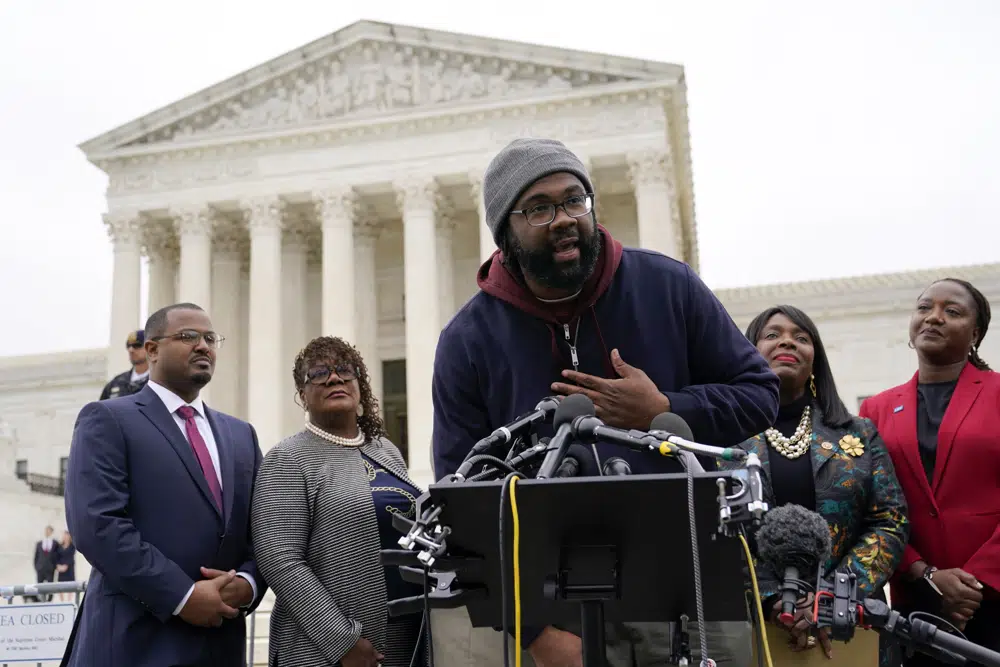
On Thursday, the United States Supreme Court ruled that Alabama must redraw the state’s congressional map to allow an additional Black majority district to account for the fact that the state is 27% Black. The Alabama House Democratic Caucus and the Alabama Legislative Black Caucus both applauded the ruling. Alabama House Minority Leader Anthony Daniels (D-Huntsville) said, “During a severely short and limited map-drawing process, our Caucus spoke at length about our view of the law and provided ways the state could craft at least two districts that reflect fair political opportunities for African American voters.” “We are therefore pleased that the Supreme Court affirmed the decision of the unanimous district court, which found the Alabama maps were discriminatory,” Daniels continued. “We stand ready to participate meaningfully with our colleagues to create a new map that fully complies with the law.” Rep. Terri Sewell wrote on Twitter, “Wow!!! The Supreme Court just upheld Section 2 of Voting Rights Act of 1965 and protected the voices of Black and minority voters. This is a historic victory not only for Black voters in Alabama, but for Democracy itself.” In a press release, Sewell said, “This is a historic victory, not only for Black voters in Alabama, but for Democracy itself. With this decision, the Supreme Court is saying loudly and clearly that the voices of minority voters matter and that fair representation must be upheld. I know that John Lewis and the Foot Soldiers of the Voting Rights Movement are smiling as they look down on us. Today, their sacrifice was rewarded. Our work is not over. We must continue the fight for fair representation by passing the John R. Lewis Voting Rights Advancement Act to restore the full protections of the Voting Rights Act of 1965.” State Senator Merika Coleman (D-Birmingham) is the Chair of the Alabama Legislative Black Caucus. “From the beginning of this case, we have strongly denounced racial gerrymandering and will continue our efforts to ensure that districts are drawn equitably and fairly,” said Sen. Coleman. “I applaud Chief Justice (John) Roberts for preserving Section 2 of the Voting Rights Act. This is a major victory for Black voters in Alabama, as well as the entire nation.” State Representative Napoleon Bracy, Jr. (D-Prichard) is the Vice Chair of the Alabama Black Legislative Caucus. “In a resounding victory for fair representation, the Supreme Court’s unexpected decision stands as a powerful testament to the importance of upholding the Voting Rights Act,” Rep. Bracy said. “By prohibiting racial gerrymandering in Alabama, the Court reaffirms the principle that every citizen’s voice deserves to be heard, regardless of their race. This ruling sends a clear message that political power should not be diluted through discriminatory practices, ensuring that the spirit of democracy remains strong and inclusive in Alabama.” In 2021, the Alabama state legislature produced new congressional maps which closely paralleled the previous 2012 redistricting with just one Black majority district. In a narrow 5-4 decision, the majority of the Court sided with the plaintiffs and affirmed that Section 2 of the Voting Rights Act requires the Alabama legislature to draw a second district where minority voters can elect a candidate of their choice. The decision will also have an impact across the South, as today’s decision clears the way for additional minority districts to be drawn in other states with challenged maps, like Georgia and Louisiana. “It is hard to imagine many more fundamental ‘prerequisites’ to voting than determining where to cast your ballot or who you are eligible to vote for,” Chief Justice John Roberts wrote. The 34-page decision in Milligan penned by Roberts recommits to the Voting Rights Act’s promise as the foundation for justice for all, not just some. Roberts was joined by Justices Sonia Sotomayor, Elena Kagan, Kentaji Brown Jackson, and Brett Kavanaugh. Jeff Loperfido is the Interim Chief Counsel for Voting Rights at the Southern Coalition for Social Justice. “This is a great day for democracy and for the voting rights of Black and Brown communities throughout the South who continue to be the targets of discriminatory laws that seek to silence their voices and stifle their growing political power,” said Loperfido. “The Court’s forceful repudiation of Alabama’s extreme and disingenuous ‘race-blind’ mapping theory is a testament to the important role the Voting Rights Act plays in rooting out discriminatory electoral practices.” The Legal Defense Fund (LDF), American Civil Liberties Union, ACLU of Alabama, Hogan Lovells LLP, and Wiggins, Childs, Pantazis, Fisher & Goldfarb brought the case in November 2021 on behalf of Evan Milligan, Khadidah Stone, Letetia Jackson, Shalela Dowdy, Greater Birmingham Ministries, and the Alabama State Conference of the NAACP. It was argued before the Court on Oct. 4, 2022. The case goes back to the three-judge panel of the Eleventh Circuit Court of Appeals in Atlanta that originally ruled against the State of Alabama. The Supreme Court had stayed its ruling last year at the request of Alabama Governor Kay Ivey, Alabama Attorney General Steve Marshall, and then-Secretary of State John Merrill. The three-judge panel will decide whether to order the Legislature to redraw the districts following the orders of the Court or order the state to adopt a zoning map drawn by the courts. Two alternative maps were presented to the Court by the plaintiffs. The easiest thing would be for the three judges to order the state to accept one of those maps. Whatever happens, Alabama’s Congressional maps will look substantially different than they are today by the end of the year. This will likely impact hundreds of thousands of Alabama voters. The major party primaries for the congressional districts will be on March 6. To connect with the author of this story or to comment, email brandonmreporter@gmail.com.
Supreme Court to rule soon on Alabama Congressional Districts
Alabama’s Congressional Districts could be thrown into chaos in the coming weeks if the U.S. Supreme Court upholds a lower court decision in a case challenging the 2021 congressional redistricting by the Alabama Legislature. The Supreme Court decision in the case of Milligan versus Merrill will be announced in the next few weeks. This decision could have a wide-ranging impact on when states must draw minority-majority districts. The plaintiffs claim that since Blacks are over 27% of the population of Alabama, the Legislature should have drawn two majority-minority districts, not one (Alabama’s Seventh Congressional District). A federal three-judge panel ruled for the plaintiffs and ordered the Legislature to redraw the districts. The state appealed to the U.S. Supreme Court, which voted 5 to 4 to stay the lower court decision until they hear and decide the case. Alabama Attorney General Steve Marshall said that the Supreme Court granted the State’s motion, allowing the Alabama Congressional District map as drawn by the Legislature in November to stand for now. “I’m gratified that the Supreme Court has stepped in to halt the district court’s order, which would have resulted in a congressional map that would have unconstitutionally divided Alabamians based on race,” Marshall stated. “As we have explained throughout this litigation, Alabama’s 2021 plan is an ordinary plan that looks much like the plan approved by a federal court in 1992, the plan approved by a majority-Democratic legislature in 2001, and the plan approved by a majority-Republican legislature in 2011. “Plaintiffs demand a significant overhaul to the map to create a second majority-Black district, but their own experts showed that no such map could be drawn unless traditional race-neutral principles took a back seat to voters’ race,” Marshall explained. “Indeed, one expert used her algorithm to draw two million random versions of Alabama’s map based on race-neutral principles, and not a single one had two majority-black districts. That is why each of the plans proposed by Plaintiffs would split Mobile County for the first time ever, to join voters in Mobile with voters as far away as Phenix City, based on race, all while dividing long-recognized communities centered on the Gulf Coast’s unique economy and culture.” The lawsuit challenging the map was brought by Evan Milligan, Khadidah Stone, Letitia Jackson, Shalela Dowdy, Greater Birmingham Ministries, and the Alabama State Conference of the NAACP, who are represented by the NAACP Legal Defense and Educational Fund, Inc. (LDF), the American Civil Liberties Union (ACLU), the American Civil Liberties Union) of Alabama, Hogan Lovells LLP, and Wiggins, Childs, Pantazis, Fisher & Goldfarb. Civil Rights groups are concerned that the opinion could further narrow the Voting Rights Act, similar to the landmark decision in Shelby v. Holder, which found that the preclearance section of the Voting Rights Act was an arcane measure that had no relevance in the modern world. As a result of the landmark Shelby v. Holder decision, the 2021 redistricting was the first in the state of Alabama in decades that did not have to get preclearance from the U.S. Department of Justice. A victory for the state of Alabama could give state legislatures nationwide more flexibility in how they draw their districts. A strong for the plaintiffs could impact districts beyond Alabama and spark more lawsuits as the two political parties use the courts to gain advantage over the other. On November 2022, six Alabama congressional incumbents (5 Republicans and 1 Democrat) easily sailed to re-election with little drama in districts that look much like how their districts were drawn a decade ago. Alabama congressional Republicans held on to the open Fifth Congressional District. No Alabama congressional district has flipped parties since the Second Congressional District flipped from Democrat to Republican control in 2010. Then Montgomery City Councilwoman Martha Roby defeated incumbent Congressman Bobby Bright. That was also the last time that an Alabama Congressional incumbent lost re-election. The decision is due before the end of June. To connect with the author of this story or to comment, email brandonmreporter@gmail.com.
