
Scramble as last Mississippi abortion clinic shuts its doors
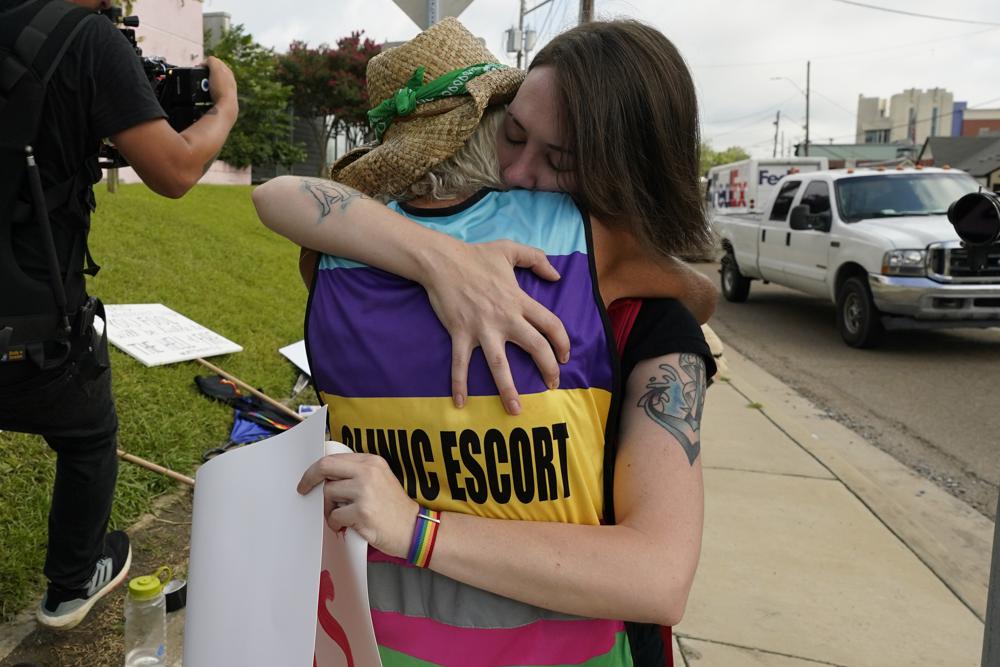
Mississippi’s only abortion clinic has been buzzing with activity in the chaotic days since the U.S. Supreme Court upended abortion rights nationwide — a case that originated in this conservative Deep South state, with this bright-pink medical facility that is closing its doors Wednesday. Physicians at Jackson Women’s Health Organization have been trying to see as many patients as possible before Thursday, when, barring an unlikely intervention by the state’s conservative Supreme Court, Mississippi will enact a law to ban most abortions. Amid stifling summer heat and humidity, clashes intensified Wednesday between anti-abortion protesters and volunteers escorting patients into the clinic, best known as the Pink House. When Dr. Cheryl Hamlin, who has traveled from Boston for five years to perform abortions, walked outside the Pink House, an abortion opponent used a bullhorn to yell at her. “Repent! Repent!” shouted Doug Lane. His words were drowned out by abortion rights supporter Beau Black, who repeatedly screamed at Lane: “Hypocrites and Pharisees! Hypocrites and Pharisees!” Abortion access has become increasingly limited across wide swaths of the U.S. as conservative states enact restrictions or bans that took effect when the Supreme Court overturned Roe v. Wade, the landmark 1973 ruling that legalized abortion nationwide. The court, reshaped by three conservative justices appointed by former President Donald Trump, issued the ruling June 24. But the Mississippi clinic has been inundated with patients since September, when Texas enacted a ban on abortion early in pregnancy. Cars with license plates from Texas, Mississippi, Louisiana, and Arkansas have been driving through Jackson’s Fondren neighborhood to bring women and girls— some of whom appeared to be teenagers — to the Pink House. Drivers parked on side streets near the clinic in the shade of pink and purple crepe myrtles, their car air-conditioners blasting as they waited. Diane Derzis, who has owned the Mississippi clinic since 2010, drove to Jackson to speak at the Pink House hours after the Supreme Court ruling overturning Roe v. Wade. “It’s been such an honor and a privilege to be in Mississippi. I’ve come to love this state and the people in it,” Derzis told those gathered in the sweltering heat. The Supreme Court ruling was in a case called Dobbs v. Jackson Women’s Health Organization — the clinic’s challenge of a 2018 Mississippi law to ban most abortions after 15 weeks. The Pink House had been doing abortions through 16 weeks, but under previous U.S. Supreme Court rulings, abortion was allowed to the point of fetal viability at about 24 weeks. Mississippi’s top public health official, Dr. Thomas Dobbs, was named in the lawsuit, but has not taken a public position about the case. The state’s Republican attorney general urged justices to use the case to overturn Roe v. Wade and give states more power to regulate or ban abortion. Derzis told The Associated Press after the ruling that she didn’t regret filing the lawsuit that eventually undercut nearly five decades of abortion case law. “We didn’t have a choice. And if it hadn’t been this lawsuit, it would have been another one,” said Derzis, who also owns abortion clinics in Georgia and Virginia, and lives in Alabama. The Mississippi clinic uses out-of-state physicians like Dr. Hamlin because no in-state doctors will work there. As the Pink House prepared to close, Dr. Hamlin said she worries about women living in deep poverty in parts of the state with little access to health care. “People say, ‘Oh, what am I supposed to do?’” she said. “And I’m like, ‘Vote.’” Shannon Brewer, the Pink House director, agrees that low-income women will be most affected by being unable to get abortions in-state. Brewer told the AP the anti-abortion protesters know her by name and yell at her but she tunes them out. “They don’t say a lot to me anymore other than, you know, ‘You’re coming to work to kill babies,’” Brewer said. “I’ve been here for 20-something years. So, it’s like when I get out of the car I don’t really hear it because it’s like the same thing over and over and over again.” Some staffers were expected to be in the Pink House on Thursday for paperwork ahead of its closure, but no procedures. With the Mississippi clinic closing, Derzis and Brewer will soon open an abortion clinic in Las Cruces, New Mexico, about an hour’s drive from El Paso, Texas, — calling it Pink House West. Hamlin said she is getting licensed in New Mexico so she can work there. Mississippi and New Mexico are two of the poorest states in the U.S., but have vastly different positions on abortion politics and access. Home to a Democratic-led legislature and governor, New Mexico recently took an extra step to protect providers and patients from out-of-state prosecutions. It’s likely to continue to see a steady influx of people seeking abortions from neighboring states with more restrictive abortion laws. One of the largest abortion providers in Texas, Whole Woman’s Health, announced Wednesday that it is also planning to reopen in New Mexico in a city near the state line, to provide first- and second-trimester abortions. It began winding down operations in Texas after a ruling Friday by the state Supreme Court that forced an end to abortions at its four clinics. Standing outside the Mississippi clinic on June 24, Derzis was pragmatic about the future of the building she had painted bright pink several years ago. “This building will be sold and maybe someone will knock it down and make a parking lot here,” Derzis said. “And that will be sad, but she served her purpose and many women had their abortions here.” Republished with the permission of The Associated Press.
U.S. Supreme Court to take up major abortion rights challenge
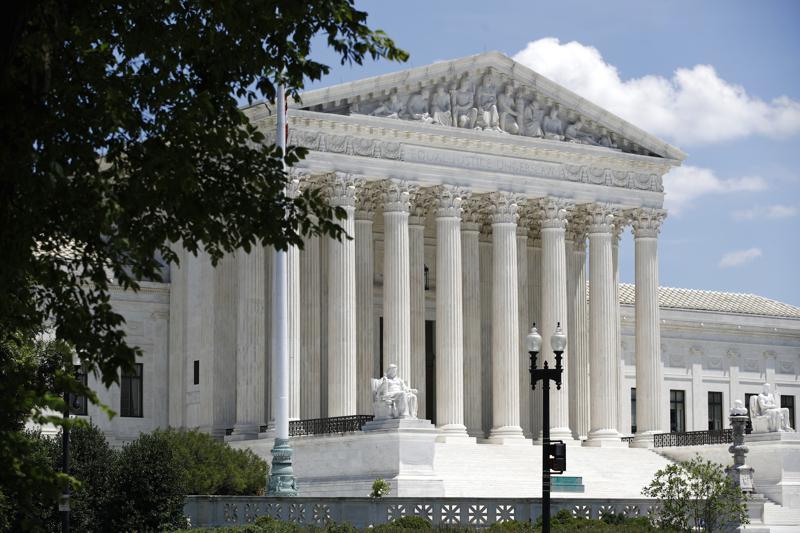
The Supreme Court agreed Monday to a showdown over abortion in a case that could dramatically alter nearly 50 years of rulings on abortion rights. With three justices appointed by President Donald Trump part of a 6-3 conservative majority, the court is taking on a case about whether states can ban abortions before a fetus can survive outside the womb. Mississippi, which is asking to be allowed to enforce an abortion ban after 15 weeks of pregnancy, is not asking the court to overrule the 1973 Roe v. Wade decision confirming a woman’s right to an abortion, or a decision 19 years later that reaffirmed it. But abortion-rights supporters said the case is a clear threat to abortion rights. “The court cannot uphold this law without overturning the principal protections of Roe v. Wade,” Nancy Northup, president and CEO of the Center for Reproductive Rights, said in a call with reporters. Even if the court does not explicitly overrule earlier cases, a decision favorable to the state could lay the groundwork for allowing even more restrictions on abortion, including state bans on abortion once a fetal heartbeat is detected, as early as six weeks. The case probably will be argued in the fall, with a decision likely in the spring of 2022 during the campaign for congressional midterm elections. Mississippi’s ban had been blocked by lower courts as inconsistent with Supreme Court precedent that protects a woman’s right to obtain an abortion before the fetus can survive outside her womb. “States may regulate abortion procedures prior to viability so long as they do not impose an undue burden on the woman’s right, but they may not ban abortions. The law at issue is a ban,” Judge Patrick Higginbotham of the 5th U.S. Circuit Court of Appeals wrote in affirming a lower-court ruling that invalidated the law. The Supreme Court had previously turned down state appeals over previability abortion bans. More than 90% of abortions take place in the first 13 weeks of a woman’s pregnancy, according to the Centers for Disease Control and Prevention. John Bursch, vice president of the anti-abortion Alliance Defending Freedom, said the high court has repeatedly held that states can regulate abortions later in pregnancy. Viability “has never been a legitimate way to determine a developing infant’s dignity or to decide anybody’s legal existence,” Bursch said. The justices had put off action on the case for several months. Justice Ruth Bader Ginsburg, an abortion-rights proponent, died just before the court’s new term began in October. Her replacement, Justice Amy Coney Barrett, is the most open opponent of abortion rights to join the court in decades. Barrett is one of three Trump appointees on the Supreme Court. The other two, Justices Neil Gorsuch and Brett Kavanaugh, voted in dissent last year to allow Louisiana to enforce restrictions on doctors that could have closed two of the state’s three abortion clinics. Chief Justice John Roberts, joined by Ginsburg and the other three liberal justices, said the restrictions were virtually identical to a Texas law the court struck down in 2016. But that majority no longer exists, even if Roberts, hardly an abortion rights supporter in his more than 15 years on the court, sides with the more liberal justices. White House press secretary Jen Psaki said the Biden administration backs legislation that would write the Roe decision into federal law, regardless of the outcome of the Supreme Court case. The legislation would put an end to state efforts to ban abortion, Northup said. The Mississippi law was enacted in 2018 but was blocked after a federal court challenge. The state’s only abortion clinic remains open. About 10% of its abortions are done after the 15th week, said Shannon Brewer, the clinic director at Jackson Women’s Health Organization. The case is separate from a fight over laws enacted by Mississippi and other states that would ban most abortions when a fetal heartbeat is detected. Mississippi also is among 11 states with a total abortion ban waiting to take effect if the Supreme Court overturns its Roe decision, according to NARAL Pro-Choice America. A central question in the case is about viability — whether a fetus can survive on its own at 15 weeks. The clinic presented evidence that viability is impossible at 15 weeks, and the appeals court said that the state “conceded that it had identified no medical evidence that a fetus would be viable at 15 weeks.” Viability occurs roughly at 24 weeks, the point at which babies are more likely to survive. But the state argues that viability is an arbitrary standard that doesn’t take sufficient account of the state’s interest in regulating abortion. The Mississippi law would allow exceptions to the 15-week ban in cases of medical emergency or severe fetal abnormality. Doctors found in violation of the ban would face mandatory suspension or revocation of their medical license. Republished with the permission of the Associated Press.
