
Bipartisan congressional caucus forms to address fentanyl crisis
Labeling the smuggling of illicit fentanyl into the U.S. from Mexico “a national crisis,” a group of lawmakers has formed a bipartisan caucus to address the issue. Led by Republican California Reps. Ken Calvert and Darrell Issa and Democratic Reps. Joe Neguse of Colorado and Madeleine Dean of Pennsylvania, the Bipartisan Fentanyl Prevention Caucus was formed to “coordinate with members from both sides of the aisle to combat the nationwide spike in fentanyl-related overdoses and drug poisonings.” The group says it will work with federal and state law enforcement and “to educate the public and the Congress, in cooperation with prevention and awareness groups to better understand the ongoing threat of fentanyl in communities across America.” “Fentanyl is devastating the lives of Americans in every corner of our country. With fentanyl-related deaths climbing every year, we need new solutions to stop this alarming trend,” Calvert said. “This is not a partisan issue – it’s a national crisis.” Rather than pledging to end the fentanyl crisis, Calvert said he hoped the caucus would “educate Americans on the dangers of fentanyl and provide real solutions that will stop the destruction of this deadly drug.” “Fentanyl is not a new danger. But the deadly threat it poses has now reached every corner of our country, and no community is being spared,” Issa said. “The stakes could not be more clear: If we don’t win the fentanyl fight, we’re not going to just lose my community or my neighbor’s. Or any one of my colleagues. We’re going to lose this country. This caucus is needed now as we tell the truth, develop solutions, and save lives.” When announcing its formation, the caucus didn’t call on the president or Secretary of State Antony Blinken to declare Mexican cartels as Foreign Terrorist Organizations, as Texas Gov. Greg Abbott and 21 attorneys general have repeatedly done. Last September, Abbott issued an executive order designating the Sinaloa Cartel, the Jalisco New Generation Cartel, and any similarly situated Mexican drug cartels as foreign terrorist organizations” under Section 219 of the Immigration and Nationality Act. He also requested President Joe Biden do likewise, the second time he’d made the request since April 2021. In his September 21, 2022 letter, Abbott said since then, “There was no action, no response.” He’s still received no response, his office has told The Center Square. Last week, Blinken told Congress he’d consider designating cartels as FTOs. Two weeks prior, the White House said it didn’t have any intention of doing so. Republican U.S. Sens. Rick Scott of Florida and Roger Marshall of Kansas introduced the Drug Cartel Terrorist Designation Act, which Florida Attorney General Ashley Moody said will “do the job Biden refuses to do – protect the American people.” The caucus also hasn’t demanded the president designate fentanyl as a weapon of mass destruction, as 18 attorneys general have done led by Moody. Fentanyl poisoning remains the leading cause of death among adults between the ages of 18 and 45. Two milligrams, the weight of a mosquito, is lethal. In fiscal years 2021 and 2022, CBP agents confiscated enough fentanyl to kill nearly 5 billion people. Since March 2021, Texas Operation Lone Star officers have seized over 373 million lethal doses of fentanyl. Florida law enforcement officers in a few month’s time last year seized enough fentanyl to kill everyone in Florida. The U.S. Drug Enforcement Administration has issued several public alerts warning Americans about the dangers of fentanyl. Most recently it issued another public alert about the “sharp increase in the trafficking of fentanyl mixed with Xylazine,” an animal tranquilizer referred to on the streets as “Tranq.” It did so after the FDA, CDC, and multiple state agencies issued warnings about Xyzaline being detected in an increasing number of illicit drug mixtures and a growing number of overdose deaths nationwide. “Xylazine is making the deadliest drug threat our country has ever faced, fentanyl, even deadlier,” DEA Administrator Anne Milgram said. DEA has so far seized Xylazine and fentanyl mixtures in 48 of 50 states. Caucus members also include Angie Craig (D-MN), Chris Pappas (D-NH), Raja Krishnamoorthi (D-IL), Melanie Stansbury (D-NM), Chrissy Houlahan (D-PA), Ruben Gallego (D-TX), Nikki Budzinski (D-IL), Marc Veasey (D-TX), Sheila Jackson Lee (D-TX), Raúl Grijalva (D-AZ), Doug Lamborn (R-CO), Sharice Davids (D-KS), Don Bacon (R-NE), Claudia Tenney (R-NY), Andre Carson (D-IN), Ralph Norman (R-SC), Chris Smith (R-NJ), Lance Gooden (R-TX), Bob Latta (R-OH), Andy Biggs (R-AZ), Jake LaTurner (R-KS), Barry Moore (R-AL), David Valadao (R-CA), and Robert Aderholt (R-AL). Republished with the permission of The Center Square.
Congress approves bill to make Juneteenth a federal holiday; Mo Brooks and Mike Rogers voted against
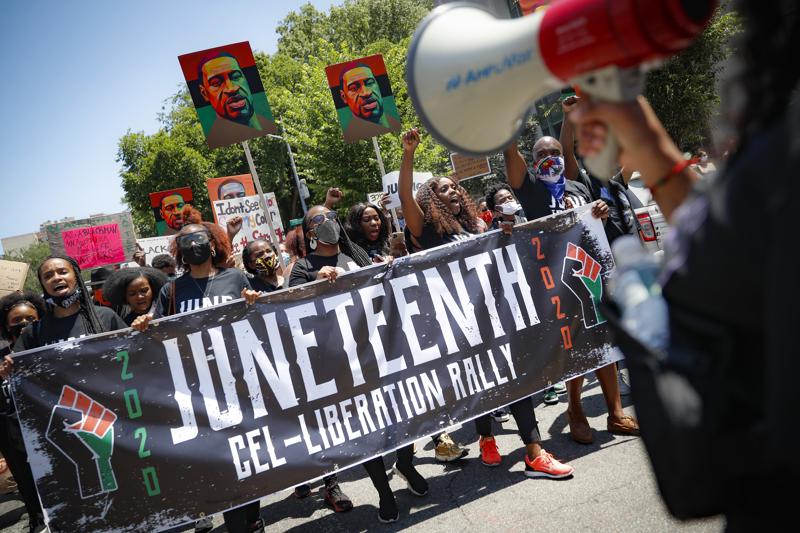
The United States will soon have a new federal holiday commemorating the end of slavery in the nation. The House voted 415-14 Wednesday to make Juneteenth, or June 19th, the 12th federal holiday. The bill now goes to President Joe Biden’s desk, and he is expected to sign it into law. Juneteenth commemorates the day the last enslaved African Americans learned they were free. Confederate soldiers surrendered in April 1865, but word didn’t reach the last enslaved Black people until June 19, when Union soldiers brought the news of freedom to Galveston, Texas. That was also about 2 1/2 years after the Emancipation Proclamation freed slaves in the Southern states. It’s the first new federal holiday since Martin Luther King Jr. Day was created in 1983. “Our federal holidays are purposely few in number and recognize the most important milestones,” said Rep. Carolyn Maloney, D-N.Y. “I cannot think of a more important milestone to commemorate than the end of slavery in the United States.” Rep. Sheila Jackson Lee, D-Texas, speaking next to a large poster of a Black man whose back bore massive scarring from being whipped, said she would be in Galveston this Saturday to celebrate along with Republican Sen. John Cornyn of Texas. “Can you imagine?” said the rather short Jackson Lee. “I will be standing maybe taller than Sen. Cornyn; forgive me for that because it will be such an elevation of joy.” The Senate passed the bill a day earlier under a unanimous consent agreement that expedites the process for considering legislation. It takes just one senator’s objection to block such agreements. “Please, let us do as the Senate. Vote unanimously for passage,” Rep. David Scott, D-Ga., pleaded with his colleagues. The vote comes as lawmakers struggle to overcome divisions on police reform legislation following the killing of George Floyd by police and as Republican state legislators push what experts say is an unprecedented number of bills aimed at restricting access to the ballot box. While Republicans say the goal is to prevent voter fraud, Democrats contend that the measures are aimed at undermining minority voting rights. Several members of the Congressional Black Caucus took to the floor to speak in favor of the bill. Rep. Bonnie Watson Coleman, D-N.J., said she viewed Juneteenth as a commemoration rather than a celebration because it represented something that was delayed in happening. “It also reminds me of what we don’t have today,” she said. “And that is full access to justice, freedom, and equality. All these are often in short supply as it relates to the Black community.” The bill was sponsored by Sen. Edward Markey, D-Mass., and had 60 co-sponsors. Democratic leaders moved quickly to bring the bill to the House floor after the Senate’s vote the day before. Some Republican lawmakers opposed the effort. Rep. Matt Rosendale, R-Mont., said creating the federal holiday was an effort to celebrate “identity politics.” “Since I believe in treating everyone equally, regardless of race, and that we should be focused on what unites us rather than our differences, I will vote no,” he said in a press release. The vast majority of states recognize Juneteenth as a holiday or have an official observance of the day, and most states hold celebrations. Juneteenth is a paid holiday for state employees in Texas, New York, Virginia, and Washington. Under the legislation, the federal holiday would be known as Juneteenth National Independence Day. Rep. Clay Higgins, R-La., said that he would vote for the bill and that he supported the establishment of a federal holiday, but he was upset that the name of the holiday included the word “independence” rather than “emancipation.” “Why would the Democrats want to politicize this by co-opting the name of our sacred holiday of Independence Day?” Higgins asked. Rep. Brenda Lawrence, D-Mich., replied, “I want to say to my white colleagues on the other side: Getting your independence from being enslaved in a country is different from a country getting independence to rule themselves.” She added: “We have a responsibility to teach every generation of Black and white Americans the pride of a people who have survived, endured, and succeeded in these United States of America despite slavery.” The 14 House Republicans who voted against the bill were Andy Biggs of Arizona, Mo Brooks of Alabama, Andrew Clyde of Georgia, Scott DesJarlais of Tennessee, Paul Gosar of Arizona, Ronny Jackson of Texas, Doug LaMalfa of California, Thomas Massie of Kentucky, Tom McClintock of California, Ralph Norman of South Carolina, Mike Rogers of Alabama, Rosendale of Montana, Chip Roy of Texas, and Tom Tiffany of Wisconsin.
