
West Alabama leaders voice their support for continuing the construction of a controversial West Alabama Highway

More than a dozen elected officials throughout western Alabama – from Mobile to Fayette – came together in Thomasville on Tuesday to voice their strong support for continuing construction of the West Alabama Highway. Alabama Governor Kay Ivey supports a plan to four-lane a highway through rural Alabama all the way from Mobile to Florence. Some state leaders and the media are widely criticizing that plan because prioritizing the four-lane highway through West Alabama means that other projects will likely have to be delayed. The West Alabama four-lane highway has been discussed for decades. It would foster economic opportunities, particularly in counties without a four-lane highway or interstate access. It would add a new north-south route in the state, possibly taking some traffic off Interstate 65. The groundbreaking for the project was held on November 12, 2021, and attended by Gov. Ivey and area officials. Building the controversial West Alabama Highway will cost the state an estimated $760 million. The West Alabama Highway will add lanes to U.S. 43 and State Route 69 to complete a four-lane corridor of roughly 80 miles. Supporters at Tuesday’s event agreed the West Alabama Highway will open the region to economic development, jobs, safer commutes, and greater access to medical care and other necessities. Sheldon Day is the Mayor of Thomasville. “If we prepare ourselves today and do the right thing by working hard to make sure this happens, we will lift up the state of Alabama, this part of Alabama, higher than it’s ever seen before,” Mayor Day said. “The goals achieved and the things that can be achieved will be exponential.” Sandy Stimpson is the Mayor of Mobile. Stimpson said the West Alabama Highway is important to Mobile, especially as the Port of Mobile is expanding. Completing construction of the West Alabama Highway offers a new option — other than congested Interstate 65 — for goods being transported north from the port. With the port expansion, “You can just visualize the increased commerce that we will have, and already we have traffic congestion on 65,” Stimpson said. “And, yes, there needs to be things done to improve 65. But it may the quickest and the least expensive thing to do is to fix 43 so that we have two routes coming out of Mobile for one of the biggest economic engines that we have for the entire state to be able to go north to connect to Tuscaloosa, I-22, on to Florence.” Rod Northam is the Mayor of Fayette. Mayor Northam attended the event and discussed the benefits of the four-lane highway connecting Mobile to Tuscaloosa and heading north toward his city and Florence. Another recently announced project – the West Central Alabama Highway – will connect Fayette to Interstate 22. Mayor Northam noted that because there is no four-lane highway through the western part of the state, many residents in north Alabama opt to travel through Mississippi to reach Alabama’s beaches. “That’s tax dollars we’ve lost because they’re going to stop and get food, they’re going to stop and get gas, and they’re going to come down another state and not come down a corridor that connects, hopefully one day, the Shoals to Mobile,” said Mayor Northam. Walt Maddox is the Mayor of Tuscaloosa. Maddox called the West Alabama Highway “one of those win-win-wins. It’s good for Tuscaloosa, it’s good for the Black Belt, and it’s good for the entire state of Alabama.” “So much of our commerce comes up from this region of the state, and what we want to do is export – especially on the automotive side – that back into Mobile,” Mayor Maddox said. “Not only automotive but coal as well, which is important to this region.” Anyone who has traveled up and down Interstate 65 on a Friday afternoon during the summer knows that the interstate is in excess of its capacity and would benefit from widening. Former President Donald Trump even made an issue of the situation when he recently visited Montgomery, promising Republicans that a second Trump administration would prioritize making I-65 at least six lanes from the Tennessee state line to Mobile. Lieutenant Governor Will Ainsworth has prioritized the I-65 widening. Everyone agrees that adding lanes to I-65 is something that the state should do. Gov. Ivey recently announced that I-65 would be widened between Alabaster and Calera in Shelby County at a cost of over $100 million. Where Ainsworth has come into disagreement with Ivey is that building the West Alabama Highway will take ALDOT dollars that could be used on I-65, and borrowing the money to build Ivey’s West Alabama project would limit future road project funding for the state. If somehow Donald Trump avoids prison time, wins the GOP nomination, defeats incumbent President Joe Biden, and tries to honor his promise on I-65, the state will have maxed out its borrowing capacity building the West Alabama Highway and won’t be able to put up matching dollars for an I-65 widening project. A similar situation exists with the long-delayed Corridor X in Jefferson County. Any resources ALDOT spends there means that there are fewer resources available for widening I-65. To connect with the author of this story or to comment, email brandonmreporter@gmail.com.
New U.S. hospitals face fiscal crisis over COVID relief money
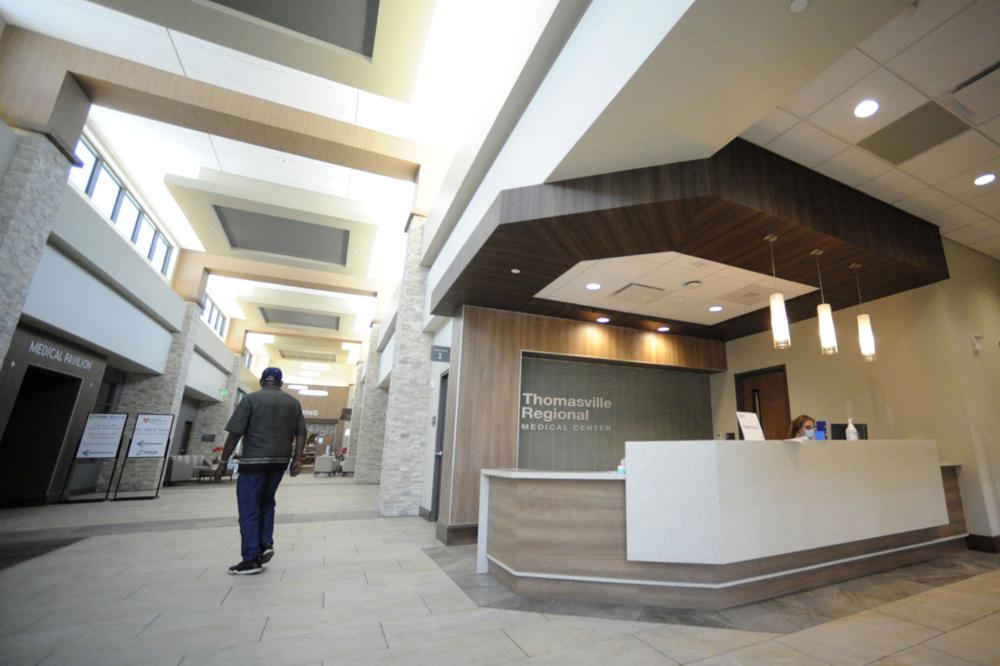
A whole town celebrated in 2020 when, early in the coronavirus pandemic, Thomasville Regional Medical Center opened, offering state-of-the-art medicine that was previously unavailable in a poor, isolated part of Alabama. The timing for the ribbon-cutting seemed perfect: New treatment options would be available in an underserved area just as a global health crisis was unfolding. In the end, that same timing may be the reason for the hospital’s undoing. Now deep in the red two years into the pandemic, the 29-bed, $40 million hospital with a soaring, sun-drenched lobby and 110 employees is among three medical centers in the United States that say they are missing out on millions in federal pandemic relief money because the facilities are so new they lack full financial statements from before the crisis to prove how much it cost them. In Thomasville, located in timber country about 95 miles (153 kilometers) north of the Gulf Coast port of Mobile, hospital officials have worked more than a year to convince federal officials they should have gotten $8.2 million through the CARES Act, not just the $1 million they received. With a total debt of $35 million, the quest gets more urgent each day, said Curtis James, the chief executive officer. “No hospital can sustain itself without getting the CARES Act money that everybody else got,” James said. Employees are trying to save money by cutting back on supplies but residents including Judy Hutto are worried about the hospital’s future. Hutto drove there recently for tests from her home 15 miles (24 kilometers) out in the country. “The areas need it,” she said. “It’s a nice hospital.” CEO Barry Beus also is trying to plug a gap at Rock Regional Hospital, located south of Wichita in Derby, Kansas. The hospital is due as much as $15.8 million, officials said, but because it only opened in April 2019 and lacks complete pre-pandemic financial statements, it has received just a little more than $985,000. The only thing that’s saved the facility from financial ruin so far is the cooperation of doctors, contractors, and vendors who haven’t pushed for payments, he said. “If we lose them, we lose the hospital,” said Beus. Three Crosses Regional Hospital opened in 2020 in Las Cruces, New Mexico, and piled up a staggering $16.8 million in losses in just three quarters while receiving only $28,000 in aid, said Landon Fulmer, a Washington lobbyist working with all three hospitals to obtain additional funding. Each facility is being penalized for being new even though they provided the same costly COVID-19 care as other medical centers and lost revenue from other procedures including elective surgeries, he said. “It really is quite a strange situation in a way, one that shouldn’t have happened,” Fulmer said. With about 420,000 health care providers nationwide already receiving assistance from a $178 billion pot, the government isn’t covering 100% of losses for anyone, said Chris Lundquist, a spokesman for the U.S. Health Resources and Services Administration, which is overseeing the program. “HRSA has strived to provide as much support as possible to as many hospitals as possible within the limits of the law and funding,” he said. The agency said it used proxy financial information for hospitals that opened in 2019 or 2020 to create an equitable payment system. “They have all received funding,” said Lundquist. While virtually all the aid money is spoken for, Lundquist said hospitals seeking additional aid can go through an appeals process. Hospitals also can seek a supplemental appropriation or funding in the upcoming fiscal years, he said. All three of the hospitals say they deserve more. Officials in Thomasville are trying to leverage congressional influence. Mayor Sheldon Day has made several trips to Washington, D.C., to speak with members of the state’s congressional delegation and health officials, and the president of the Alabama Hospital Association, Dr. Don Williamson, has contacted the White House seeking help. “They’ve been assured they’re going to be taken care of. But the fact is, when you’re dealing with government entities, you don’t have the money until you have the money,” said Williamson. Located in southwest Alabama, Thomasville lies within an impoverished area called the Black Belt. About 70% of Black Belt residents qualify for Medicare or Medicaid, and health care has been limited for generations. The last hospital shut down in Thomasville more than a decade ago, leaving only hospitals that offer fewer services in the surrounding region. Officials worked for years to secure a new hospital so residents wouldn’t have to drive 90 minutes for high-tech services such as digital imaging, full surgical options, echocardiograms, 3D mammography, and more. Using a partnership between the city and a municipal health care authority, Thomasville Regional secured federal funding from the Department of Agriculture and opened on March 3, 2020, before cases of COVID-19 caught fire in the rural South. “We thought we were off to a good start,” said James, the chief executive. “And then everything shut down.” Patients stopped showing up for scans, elective surgeries, mammographies, and other moneymaking services because of pandemic shutdowns, and financial reports that looked promising turned perilous within weeks. Recognizing that new hospitals couldn’t calculate COVID-19 losses because they couldn’t compare 2020 numbers with past years, Health and Human Services allowed hospitals to use budget numbers for calculations rather than prior financial statements. That’s how the hospital determined that it was missing out on more than $7 million in aid, James said. While the hospital is still waiting on that aid, he said, the government did agree to provide $1 million in assistance that went to all other hospitals. “That was OK, but other hospitals that are in our region got $8 million, $9 million,” he said. The Birmingham-based Medical Properties Trust recently gave the hospital $2 million and James said leaders are confident Thomasville Regional will eventually get the extra federal aid. “But it will take time,” he said. Like Thomasville Regional, Rock Regional in Kansas saw revenues dry up soon after
