
Joe Biden on racism: White people ‘can never fully understand’
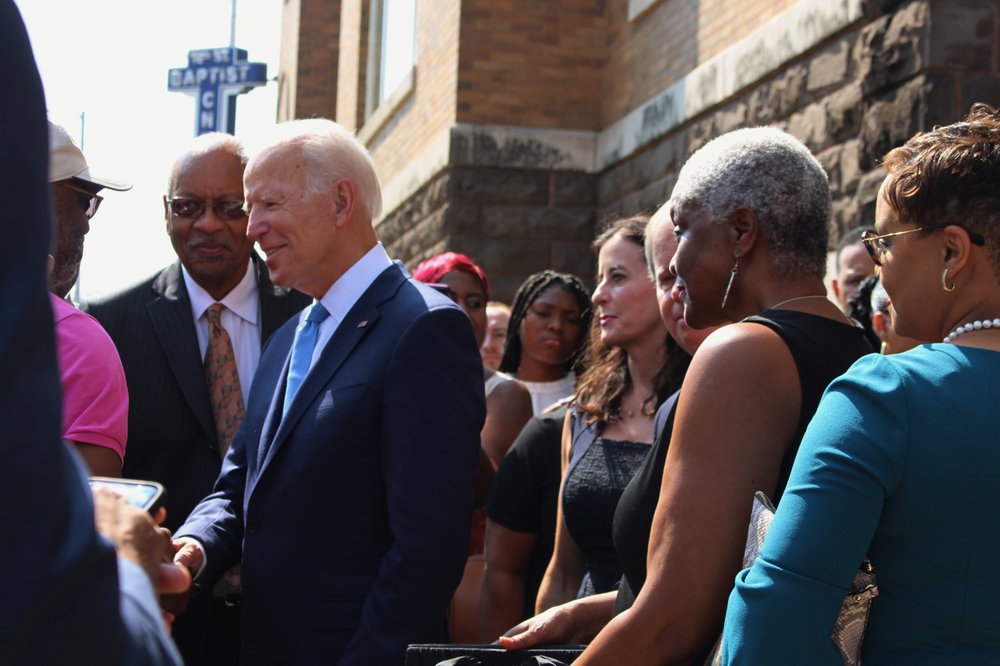
Visiting a black church bombed by the Ku Klux Klan during the civil rights era, Democratic presidential candidate Joe Biden framed current racial tensions as part of an enduring struggle that is older than the nation. “In a centuries long campaign of violence, fear, trauma, brought upon black people in this country, the domestic terrorism of white supremacy has been the antagonist of our highest ideals since before the founding of this country,” Biden told the 16th Street Baptist Church congregation in downtown Birmingham on Sunday as they commemorated the 56th anniversary of the bombing that killed four black girls in 1963. “It’s in the wake of these before-and-after moments,” Biden added, “when the choice between good and evil is starkest.” Biden’s appearance comes at an inflection point for Democrats’ 2020 leader in the polls. He is trying to capitalize on his strength among older black voters while navigating criticism from some African American and other nonwhite leaders, particularly younger ones, who take a skeptical view of the 76-year-old white man’s willingness and ability to address systemic racism. During his 20 minutes at the pulpit, Biden condemned institutional racism as the direct legacy of slavery and lamented that the nation has “never lived up to” the ideals of equality written into its founding documents. But then he added a more personal note — perhaps the closest he would come to addressing his detractors. “Those who are white try,” Biden said, “but we can never fully understand.” The former vice president called out the names of the bombing victims — Addie Mae Collins, Denise McNair, Carole Robertson and Cynthia Wesley — and he drew nods of affirmation as he warned that “the same poisonous ideology that lit the fuse on 16th Street” has yielded more recent tragedies, including in 2015 at a black church in South Carolina, in 2018 at a Jewish synagogue in Pittsburgh and in August at an El Paso, Texas, Walmart frequented by Latino immigrants. The Birmingham church, Biden said, offers an example to those communities and a nation he said must recommit itself to “giving hate no safe harbor — demonizing no one, not the poor, the powerless, the immigrant or the ‘other.’” From his long time in government, first as a senator and then vice president to Barack Obama, the first black president, Biden has deep ties in the black community. Though Biden didn’t mention President Donald Trump in his remarks, he has made withering critiques of the president’s rhetoric and policies on race and immigration a central feature of his candidacy. Yet Biden sometimes draws searing appraisals from younger nonwhite activists who point to complexities in his record. That includes his references to working productively alongside segregationist senators in the 1970s to distrust over his lead role in a 1994 crime law that critics frame as partially responsible for mass incarceration, especially black men. The dynamics flared up again Thursday after Biden, during a Democratic debate, offered a sometimes incoherent answer when asked how the nation should confront the legacy of slavery. At one point, Biden suggested nonwhite parents use a play a record player to help their children with verbal and cognitive development. That led to a social media firestorm and commentary that Biden takes a paternalistic view of black and brown America even as he hammers Trump for emboldening more obvious forms of racism. Author Anand Giridharadas called Biden’s answer “appalling — and disqualifying” for “implying that black parents don’t know how to raise their own children.” Biden’s audience Sunday seemed more to reflect his relative popularity with black voters. Parishioners wielded their cellphones when he arrived with Alabama Sen. Doug Jones, a white politician beloved in the church for his role as the lead prosecutor who secured convictions decades after the bombing occurred. The congregation gave Biden a standing ovation when he completed his remarks. Alvin Lewis, a 67-year-old usher at 16th Street Baptist, said the welcome doesn’t necessarily translate to votes. But as Lewis and other congregants offered their assessment of race relations in the United States under Trump, they tracked almost flawlessly the arguments Biden has used to anchor his campaign. “Racism has reared its head in a way that’s frightening for those of us who lived through it before,” Lewis said, recalling that he was at home, about “20 blocks from here” when the Klan bomb went off at 10:22 a.m. on Sept. 15, 1963. “No matter what anyone says, what comes out of the president of the United States’ mouth means more than anything,” Lewis added, saying Trump “has brought out some nastier times in this country’s history.” Antoinette Plump, a 60-year-old who took in the service alongside lifelong member Doris Coke, 92, said racism “was on the back burner” until Trump “brought out all the people who are so angry.” Coke, who was at the church on that Sunday in 1963, said, “We’ve come a long way.” But she nodded her head as Plump denounced Trump. Nearby sat Fay Gaines, a Birmingham resident who was in elementary school in 1963 — just a few years younger than the girls who died. Gaines said she’s heard and read criticisms about Biden. Asked whether she’d seen his “record players” answer in the debate, she laughed and said she did. But he remains on her “short list” of preferred candidates. “I think there may just be a generational divide,” she said of the reaction. “People who lived through all these struggles maybe can understand how to deal with the current situation a little better.” That means, she said, recognizing a politician’s core values. “I trust Joe Biden,” she said. “History matters. His history matters.” Follow Barrow on Twitter at https://twitter.com/BillBarrowAP. Republished with the permission of the Associated Press.
National lynching memorial and slavery museum sets open date in Alabama
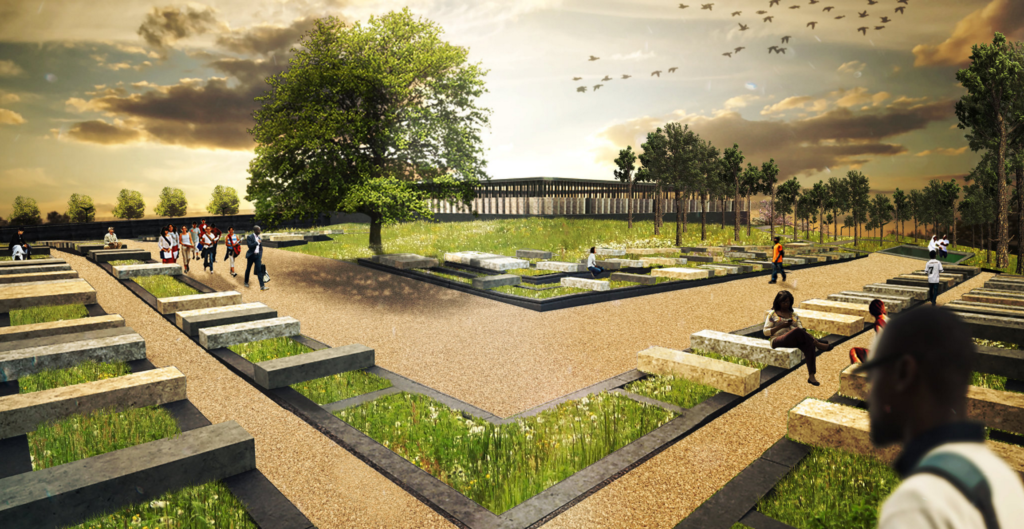
The original capital of the Confederacy, a city once mired in racism, will soon redefine its legacy when it opens the nation’s first memorial dedicated to lynching victims and a new museum dedicated to slavery in the spring. The Equal Justice Initiative on Monday announced it will open the National Memorial for Peace and Justice in Montgomery, Ala. on April 26, 2018. The memorial, devoted to 4,075 blacks EJI’s research shows were killed by lynching in the U.S. from 1877 to 1950, will acknowledge an era of racial terror in the United States when thousands of African Americans were lynched and publicly tortured, sometimes in the presence of thousands of people. Designed with hundreds of six-foot, corten steel monuments aligned in a structure that sits above the city of Montgomery, EJI’s memorial will feature new sculptures from African and African American artists that explore slavery, segregation, and contemporary issues of racial inequality. The spacious park holding the memorial will include a monument for every county in America where a racial terror lynching took place that can be claimed by community groups and installed locally. “Our nation’s history of racial injustice casts a shadow across the American landscape,” Bryan Stevenson, director of EJI, said in a statement. “This shadow cannot be lifted until we shine the light of truth on the destructive violence that shaped our nation, traumatized people of color, and compromised our commitment to the rule of law and to equal justice.” The six-acre site will also feature a museum, From Enslavement to Mass Incarceration, a few blocks away from the memorial that will be situated within 150 yards of one of the South’s most prominent slave auction sites, near the Alabama River dock and rail station where tens of thousands of enslaved black people were trafficked. Check out a preview of the memorial below: Tickets for admission to the museum and the memorial are now available at museumandmemorial.eji.org.
Antebellum slave tax has lingering effect in Alabama politics, finances
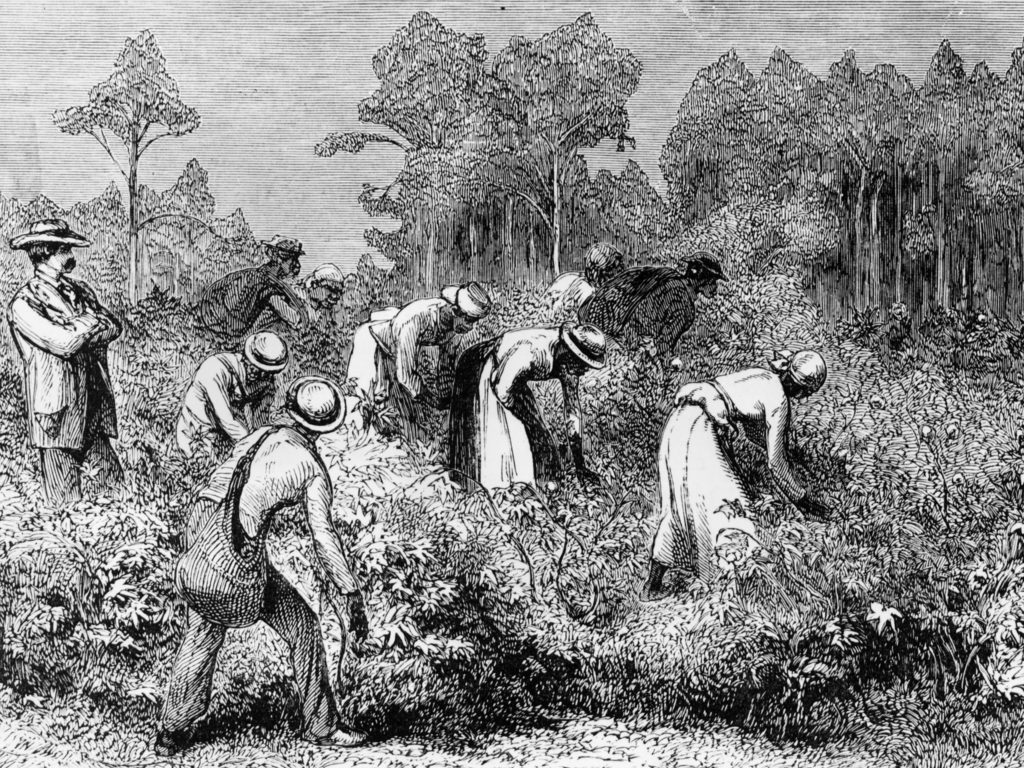
In the late spring or early summer of 1822, a man named Bolling Hall made a list of all his property before taking it to the Autauga County assessor and paying his taxes. On the left side of a piece of parchment, Hall listed hundreds of acres of land he’d acquired since leaving Georgia four years before. He would pay between $2 and $8 an acre on it. He listed a gold watch, as well as a coach, which he valued at $250. The state would collect about $2.50 on it. And in the top right-hand corner, Hall listed “15 negroes under 10 years” and “30 negroes over 10 years.” By law, Hall would have paid 25 cents for every slave younger than 10, and a dollar for those older than 10 — $33.75 for the human beings whose unrequited toil allowed him to buy coaches and gold watches. Alabama tax assessments that year — and for more than four decades after — would include nameless columns of slaves whose existence was critical to the operations of state government. Alabama’s compact with the institution was, for whites, very profitable, and nowhere more than in the state’s slave tax. “It holds the land tax to very low levels because most of the revenue comes from the slave tax,” said J. Mills Thornton, a retired University of Michigan professor and historian of the South. “The result is that small farmers pay virtually no direct taxes.” As slavery twisted politics and society in Alabama and throughout the South, it also warped the state’s finances. For decades, the slave tax was a major pillar of the state’s tax system. Historians estimate that at least through the mid-1850s, the tax on the wealth created by the men, women, and children suffering exploitation — and often, physical and sexual assaults — was the single biggest revenue source for state government. Like slavery, the slave tax would leave a permanent wound on the state. When slavery died, so did the tax. Reconstruction-era efforts to replace the lost revenue with increased property taxes — the only major source left — sparked an angry reaction. Legislators rushed to introduce tax restrictions after Reconstruction without making serious efforts to find other sources of revenue. That set in place decades-long policies that, to this day, make it difficult and sometimes impossible for Alabama to generate enough revenue to pay for its state services. The $1.8 billion General Fund, which pays for most non-education services in the state, should grow no more than $25 million in 2018; the state’s Medicaid agency alone has requested a $44 million increase for the year. “The slave tax in a weird way was a stabilizer,” said Susan Pace Hamill, a University of Alabama professor and expert on state taxation. “It was a bad stabilizer — the whole system of slavery was a bad stabilizer. A shameful stabilizer.” Taxes on slaves weren’t limited to Alabama. In a 2003 article, Boston University School of Law professor Kevin Outterson wrote that the slave tax brought in anywhere from 30 percent of public revenues to, in South Carolina, 60 percent. The federal government levied slave taxes from 1798 to 1802, and again from 1813 to 1817, both times to pay for war. “From colonial times to the Civil War, American governments derived more revenues from slave taxes than any other source,” Outterson wrote. The slave tax went away after the Civil War, but the services it paid for did not. During Reconstruction, Republicans tried to make up the difference with property taxes — the only major source of revenue left — which embittered a population that had grown used to slaveholders paying most taxes. “The history is complicated, but we can say with some certainty that that probably hurt small landowners more than big landowners, and fueled their resentment,” Hamill said. When Democrats recovered control of the Legislature in 1874, they called a constitutional convention. That convention created a document that began the slow disenfranchisement of black voters. But it also put caps on property taxes. “An eminent statesman has said, ‘the power to tax is the power to destroy,’” said Leroy Pope Walker, a Confederate general who served as president of the convention. “Governments should provide against possibilities, as possibilities often become facts.” But the Bourbon Democrats who ruled Alabama for decades — and imposed even more stringent property tax caps in the still-operative 1901 Constitution — never considered the possibility of taxes that might try to replace the lost slave tax. For the most part, officials have avoided the issue. An income tax approved in 1933 enshrined tax rates in the Constitution; the state income tax rates still reflect Great Depression-era values. In the 1970s, the George Wallace administration advanced the “lid bills,” which further restricted the property taxes in the state. Those revenue shortfalls are one of the lasting legacies of slavery: A state government that struggles to pay its bills. “Racial policy is an obvious wound that festers,” Thornton said. “Tax policy is much less so, but it is one of the festering wounds of slavery.” Republished with permission of the Associated Press.
Harsh history: Alabama county may cover up courthouse murals depicting slavery
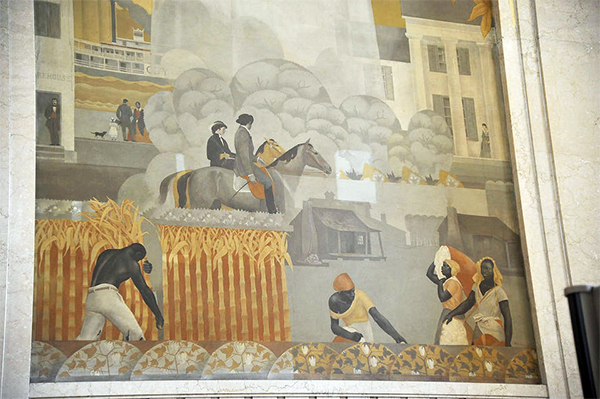
As officials across the South wrestle with what to do about public monuments that reflect a racist heritage, an Alabama county may cover up two courthouse murals that some call offensive. The Jefferson County Commission on Thursday endorsed a recommendation from a special committee to put retractable shades over murals in the Birmingham courthouse that depict black people picking cotton and doing other manual labor against a backdrop of white people in more prominent positions. The commission didn’t take a formal vote, however. It’s not yet clear when that will happen. Committee members and county commissioners said what began as a divisive and emotionally charged discussion evolved into an educational experience that taught everyone involved more about the region’s past, each other and the value of compromise. Members said installing educational panels alongside the murals could help pass that benefit along to the public. “Not everyone can have it their way, no matter how strongly they feel,” said Carl Marbury the former president of Alabama A&M University who served on the committee. “In America we’ve always been able to talk it out, flesh it out and we do agree that the status quo of those murals will not do. But we do not want them destroyed or removed, because they teach us something about history.” The murals “Old South” and “New South” by Chicago artist John Warner Norton were installed in the 1930s. “Both of the murals represent unfair systems, but they didn’t see it that way in that time,” said Linda Nelson, executive secretary of the Jefferson County Historical Commission, who served on the mural committee. Those who called for removing the large rectangular murals that loom over the courthouse lobby have said they romanticize slavery and other forms of inequality. “We’ve come a long way and we don’t need to portray the past as it is,” said county commissioner Sandra Little Brown. Brown, the Rev. Hezekiah Jackson, president of the Metro Birmingham branch of the NAACP, and others have said the artwork sends the wrong message to people who come to the courthouse seeking justice. “It was a culture and a society and a political system and a judicial system that was completely dominated by white people and the murals reflect that Jim Crow society quite clearly,” said Robert Corley, a historian and educator who served as a consultant for the committee. While the county has changed since the 1930’s, Corley said the underlying dynamics portrayed in the murals haven’t disappeared. “The ethos of that previous culture, that previous society still prevail, still echo throughout the present,” he said. The discussion of the murals comes amid renewed scrutiny of Confederate flags and other Old South symbols after nine black churchgoers were killed in Charleston, South Carolina last year. A white man who had been photographed with the Rebel flag has been charged with the slayings. South Carolina officials removed a Confederate flag from their Statehouse lawn after the massacre, and Alabama Gov. Robert Bentley ordered Confederate flags removed from his state’s Capitol grounds. An African-American attorney in Mississippi is suing to eliminate the Confederate flag as a state symbol. Officials in Louisville, Kentucky, recently agreed to move a 70-foot tall Confederate monument the University of Louisville campus. Amid those developments, Birmingham Museum of Art director Gail Andrews asked, “What do we save? What do we keep? What do we try to understand better about the forming of our nation and our county?” “These are not murals that we take pride in today,” she said. “I appreciate that, but they are our history and we need to understand them.” In 2011, Georgia Agriculture Commissioner Gary Black removed murals that had hung in his departmental headquarters since the 1950s, depicting slavery among other things. “I think we can depict a better picture of agriculture,” Black said at the time. The Georgia Museum of Art at the University of Georgia later put them on display, but it added commentary and context, taking a critical look at the artwork and its place in history. The committee’s recommendation to cover the Birmingham artwork wasn’t unanimous. Members compromised on installing shades and panels. “The understanding of the context, the acknowledgment of the brutality of the implications of the murals themselves really helped all of us understand things a whole lot better,” Nelson said. “I don’t think any of the white people in the room escaped the feeling of chagrin and mortification behind the idea of the murals themselves.”
