
Mississippi governor Tate Reeves again proclaims Confederate Heritage Month

Mississippi Gov. Tate Reeves is defending his decision to again name April as Confederate Heritage Month, nearly two years after he signed a law retiring the last state flag in the U.S. that featured a Confederate battle emblem. The Republican governor signed a proclamation without fanfare Friday. It does not mention slavery — the defense of which was Mississippi’s stated reason for trying to secede from the U.S. In response to a question at a news conference Wednesday, Reeves said he issued a Confederate Heritage Month proclamation “in the same manner and fashion that the five governors that came before me, Republicans and Democrats alike, for over 30 years have done.” “And we did it again this year,” Reeves said. “Didn’t think this was the year to stop doing it.” Four governors before Reeves — not five — issued Confederate Heritage Month proclamations. By state law, Mississippi also has a Confederate Heritage Day in April, which is a holiday for state employees. Mississippi has taken steps in recent years to distance itself from symbols of the Confederacy, including removing some monuments, with critics saying the images glorify racism in a state where nearly 40% of residents are Black. In June 2020, Mississippi legislators voted with bipartisan support to retire the Confederate-themed state flag, and voters that November approved a new flag featuring a magnolia. Reeves’s office did not announce his signing of the latest Confederate Heritage Month proclamation. The Mississippi Free Press was the first to report that a Sons of Confederate Veterans chapter on Monday had a social media post showing it. Reeves has issued a similar proclamation each year since becoming governor in January 2020. Reeves’s proclamation says “we honor all who lost their lives in this war” and “it is important for all Americans to reflect upon our nation’s past, to gain insight from our mistakes and successes, and to come to a full understanding that the lessons learned yesterday and today will carry us through tomorrow if we carefully and earnestly strive to understand our heritage and our opportunities which lie before us.” Mississippi’s secession ordinance in 1861 said: “Our position is thoroughly identified with the institution of slavery — the greatest material interest of the world.” Former Mississippi Gov. Ray Mabus, a Democrat who held the office from 1988 to 1992, did not issue a Confederate Heritage Month proclamation, and he criticized Reeves for doing so. “His ‘Confederate Heritage Month’ proclamation sounds like he’s endorsing critical race theory: learn from the past etc,” Mabus wrote Tuesday on Twitter. “Heritage of Confederacy is treason and slavery. We should learn from those things just maybe not in the way he imagines.” Republished with the permission of the Associated Press.
110 Confederate monuments have been removed in U.S. since 2015
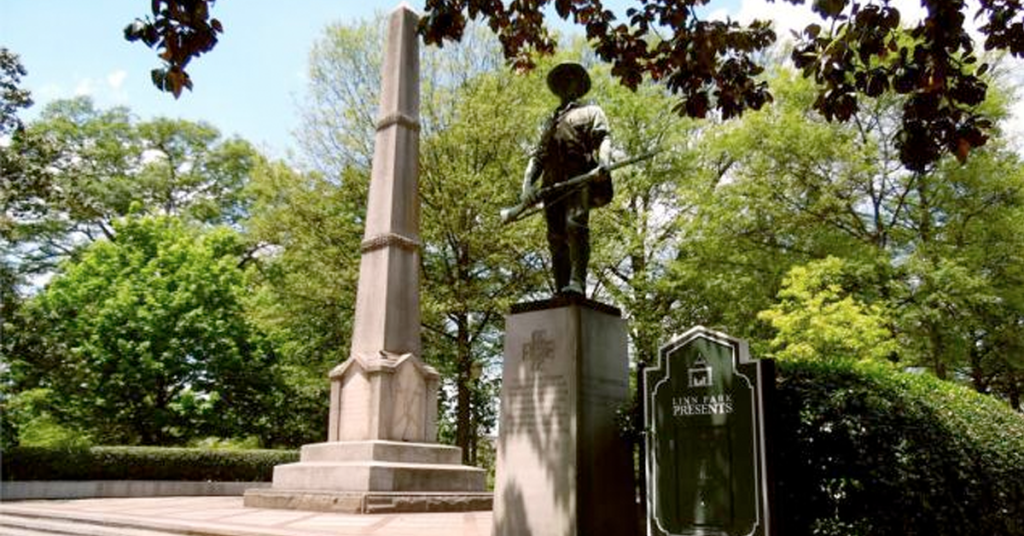
It took generations to erect all the nation’s Confederate monuments, and a new report shows they’re being removed at a pace of about three each month. The study — released Monday by the Southern Poverty Law Center — shows that 110 Confederate monuments have been removed nationwide since 2015, when a shooting at a black church in South Carolina energized a movement against such memorials. The number — which includes schools and roads that have been renamed in California, a repurposed Confederate holiday in Georgia, plus rebel flags and monuments that have been taken down in Alabama, Louisiana and elsewhere — represents a relative handful compared with the more than 1,700 memorials that remain to hail the Southern “lost cause.” But the change is notable considering that removing such memorials wasn’t widely discussed until the killing of nine black people at Emanuel AME Church in Charleston, South Carolina, said Heidi Beirich of the Southern Poverty Law Center, a liberal activist organization based in Montgomery that monitors extremism. White supremacist Dylann Roof has been sentenced to death for the 2015 attack. After the Charleston shooting, photos surfaced of Roof posing with the Confederate battle flag, helping to change the national dialogue. “I think it kind of signifies something monumental,” said Beirich, director of the organization’s Intelligence Project. “I think people are finally willing to confront the history and come to terms with it.” Many of the Confederate monuments that are now controversial were erected in the early 1900s by groups composed of women and veterans. Some honor generals or soldiers; others bear inscriptions that critics say wrongly gloss over slavery as a reason for the war or portray the Confederate cause as noble. The Old South monuments are supported by groups including the Sons of Confederate Veterans, which is erecting new memorials even as others are removed. “They’re taking them down, and we’re putting them up,” said Thomas V. Strain Jr., commander in chief of the organization. He said the group isn’t tracking monument removals or name changes, but to him, 110 “seems a little high.” Members have raised two giant Confederate “mega-flags” on private property and erected four monuments in Alabama alone this year, Strain said, and they’re asking to place a new Confederate monument outside the courthouse in Colbert County, in northwest Alabama. Commissioners are considering the request. The organization also is building a new headquarters that will include The National Confederate Museum in Columbia, Tennessee. The organization, on its website promoting the project, said the museum will counter attempts by opponents “to ban any and all things Confederate through their ideological fascism.” The museum will tell the “Southern side” of the war, Strain said. “It’s not just dedicated to the soldiers, it’s dedicated to the wives and children who had to endure that five years of hell also,” he said. “We’ll have Southern uniforms there, not Union uniforms. We’ll have Southern artillery shells, not Northern ones.” Beirich said the law center’s list of monument removals was compiled through news accounts, tips and crowd-sourcing sites that let people make online reports. Both in tallying removals and remaining memorials, the group counted only monuments that “glorify” the Confederacy and didn’t consider historical markers that denote specific events or sites with a link to the past, such as informative signs at battlefields, Beirich said. While the organization lists 1,730 Confederate monuments nationwide, Beirich said there’s no doubt a lot more exist. “I am sure we have missed many,” she said. Republished with the permission of the Associated Press.
Alvin Holmes wants Confederate flag removed from Capitol grounds

A Montgomery lawmaker on Tuesday said Alabama should remove Confederate flags that fly outside the Alabama Capitol next to a towering monument to Confederate soldiers. Rep. Alvin Holmes, D-Montgomery, said he will file a legislative resolution in the next legislative session to remove Confederate flags from the Capitol grounds. “I think most people realize it’s divisive,” Holmes said. “It has no place on a public building.” A spokeswoman for Gov. Robert Bentley said the governor did not have a comment at this time on whether the Confederate flags should remain on the Capitol grounds. Nor did he say whether he thought the state should stop issuing a vanity license plate for the Sons of Confederate Veterans that includes the battle flag. The Alabama Legislature is expected to meet later this summer for a special session on the budget. Four Confederate flags – the first three official flags of the Confederacy and the square-shaped Confederate battle flag – fly at each corner of an 88-foot-tall Alabama Confederate Monument beside the Alabama Capitol. Calls to remove Confederate symbols that dot the Old South reignited after the massacre of nine people at a black church in South Carolina last week. The white suspect, Dylann Storm Roof, posed in photos displaying Confederate flags and burning or desecrating U.S. flags. South Carolina Gov. Nikki Haley said Monday that the flag should be removed from the Statehouse grounds. South Carolina, like Alabama, once flew the Confederate flag atop its Capitol but moved it to a nearby Confederate monument in 2000 during a compromise with black lawmakers. Virginia Gov. Terry McAuliffe said he wanted the state to stop issuing the Confederate vanity license plates. In Alabama, former Gov. George C. Wallace ordered the Confederate flag hoisted over the Capitol dome in 1963 during a fight with the federal government over ending school segregation. Holmes led a fight in the 1990s to remove the rebel banner from the dome. A judge ruled against the state, which appealed. Then-Gov. Jim Folsom in 1993 made a decision that the Confederate flag, which was taken down in 1992 during dome renovations, would not be put back atop the Capitol when those renovations were complete. “It was really a simple decision. We are no longer part of the Confederate government. I made the decision to remove it and get it behind us,” Folsom said. Folsom said the decision was made to put the flags beside the Confederate monument to display them in “proper historical context.” Gary Carlyle, commander of the Alabama chapter of the Sons of Confederate Veterans, said the flags represent Southern history. “Our prayers and concerns are about nine great citizens who got killed in South Carolina by an evil person.” The Confederate Monument, which was erected in 1898, includes quotes paying tributes to Confederate soldiers including a poem excerpt calling them, “the knightliest of the knightly race.” Holmes said the monument is not as offensive as the flags, which he said have become a symbol of racism and hate. Republished with permission of The Associated Press.
Honoring history does not mean condoning it: Former lawmaker Myron Penn’s actions were disrespectful
There’s a weird trend emerging throughout the state in the past several months: Individuals have decided that their personal opinions towards history should trump tradition, facts and/or the law. First, the portraits of Governors George and Lurleen Wallace were removed from the Rotunda of the Capitol and placed in a lesser trafficked first-floor hallway. State Auditor Jim Zeigler is trying to rectify that. “This was a wrong that needs to be righted,” Zeigler said at the River Region Republican March meeting in Montgomery. “We need to preserve our state’s heritage. These politically correct government officials want their own version of history instead of what actually happened.” Now reports have surfaced in the last several days that former state Sen. and attorney Myron Penn and members of his family removed Confederate flags from a Union Springs Confederate cemetery. In an interview with WSFA-TV he said, “The reason why we picked them up is because the image of the flags in our community, a lot of people feel that they’re a symbol of divisiveness and oppression of many people in our community,” he said. “Especially with the history that that flag and the connotation and negativism that it brings. I would think that no one in our community would have a problem with this or with my actions at all.” Well, he’s wrong. While it appears as though those who placed the flags at the graves didn’t have proper permission, removing them is not an acceptable response. As a matter of fact it’s against the law. Side note: If I decide to go and put flowers on the graves of all the soldiers do I need permission? What about putting down American flags? I understand that the city owns the site but does that mean they own the rights to ones First Amendment rights when you walk into the site? A grave site, especially the graves of soldiers is a place to honor the dead. The flags placed there were done in memory of the soldiers and a cause they clearly believed in. The timing is also relevant since it was close to Confederate Memorial Day. State laws in Mississippi, Alabama and Georgia name the last Monday in April as a holiday for Confederate Memorial Day. Penn was wrong but he was more than that. What he did appears to have broken the law. Alabama law is clear, “(a) Any person who willfully or maliciously injures, defaces, removes or destroys any tomb, monument, gravestone or other memorial of the dead, or any fence or any inclosure about any tomb, monument, gravestone or memorial, or who willfully and wrongfully destroys, removes, cuts, breaks or injures any tree, shrub, plant, flower, decoration, or other real or personal property within any cemetery or graveyard shall be guilty of a Class A misdemeanor.” The fact is that our nation is rich in history: some good, some bad. The Confederate flag is a part of it and it represents much more than Penn and those who wish to rewrite history portray it. Despite being one of the nation’s most divisive emblems, experts have long noted the flag was never intended to be a symbol of racism and slavery. Including the Pulitzer Prize-winning James McPherson, the celebrated historian of American history and author of the classic “Battle Cry of Freedom: The Civil War Era” and “The War That Forged a Nation: Why the Civil War Still Matters.” In a Salon.com interview, he said the flag initially “was associated with Confederate heritage” until 60-70 years ago, after World War II in the late 1940s, when it became associated with racism. But he noted that, “in the minds of many it continues to be associated with Confederate heritage.” There are many groups dedicated to honoring the history and heritage of the Confederate army and those who died in the civil war. Those include Defenders of the Confederate Cross and Sons of Confederate Veterans who both emphasize that the flag is a symbol to honor the sacrifice of patriots who were willing to die to protect this country and make sure it remained as the founders intended, as well as the history of the south. Not racism. Rather than remove the flag what Penn should have done is take the opportunity to talk to his son about history. He could have used it as an opportunity to reinforce the idea that history offers many lessons and that when presented with a slight real or perceived there are right and wrong ways to address them. Breaking the law and disrespecting history and heritage is not the right way.
