
Cold war between 2016 GOP rivals Jeb Bush and Marco Rubio heating up

Jeb Bush and Marco Rubio are on course for a collision. There once was mutual public deference. But that has eroded as the Florida Republicans battling for the presidential nomination have come to see the other as the main threat to lofty ambitions: Bush claims the party establishment’s mantle, Rubio wants be the party’s fresh national face. Bush now routinely compares Rubio’s background to Barack Obama‘s before the Democrat became president. Rubio says it’s “time to turn the page,” a reference that strikes as hard at Bush’s long family legacy as it does at Democrat Hillary Rodham Clinton. The rise of GOP outsiders such as Donald Trump and Ben Carson has increased the stakes for Bush and Rubio as they try to become the mainstream alternative. Whoever wins this internal contest will show whether experience or fresh leadership is the bigger priority for GOP centrists. From Bush, there’s a sense of urgency in his contention that Rubio, in his first Senate term, has not proved his leadership credentials. The ex-governor and his team are frustrated, too, that this shortcoming they attribute to Rubio has not become more of a liability for him. It’s part of the mantra Bush has repeated since the Republicans’ second debate in California a month ago, when Rubio won praise for staying above the fray. He has since drawn nearly even with Bush in national polls, although both remain in the high single digits. “We’ve got a president that the American people supported based on the fact that he was an eloquent guy,” Bush said in Iowa last week. “And he had nothing in his background that would suggest he could lead.” Though describing Obama, it’s a slight to Rubio. He delivers a compelling story about his parents’ flight from Cuba and his working class background, but he has been in the Senate less than five years and has missed much of its business this year while campaigning for president. Evidence of the tension between the Florida politicians was on display Thursday when Rubio’s campaign, minutes after the Bush organization announced raising $13.4 million in the last quarter, boasted it had more cash on hand. Rubio reported having nearly $11 million in his coffers compared with Bush’s $10 million. But about $1 million of Rubio’s cash cannot be accessed unless he wins the GOP nomination, a point Bush campaign spokesman Tim Miller pounced on via Twitter. “Lying about budgets. Guess Marco picked up something in the Senate,” Miller tweeted Friday. Rubio’s campaign reported raising $5.7 million from July through September, down from $9 million in the three months prior. Bush’s team says that shows he’s been losing steam. Yet Bush advisers are clearly put off by the senator’s durability. Hopes have not come to pass that rivals could be chased from the field with Bush’s mammoth fundraising effort in the first half of the year — yielding more than $100 million for his campaign and the super PAC supporting him. They are competing for many of the same voters. Each has won statewide election — Bush twice, Rubio once — in Florida, a hefty prize in the presidential election. They also have pull among Hispanic voters, whom Republicans want to draw away from Democrats. Both men speak fluent Spanish. Yet both have been surpassed in the early months of the primary campaign by the billionaire Trump and retired neurosurgeon Carson. Those challengers have ridden dissatisfaction with the government to a lead in national and early state polls with four months before Iowa leads off the 2016 voting. Rubio is more subtle than Bush as the two men draw distinctions between each other, but his meaning is unmistakable. In New Hampshire recently, Rubio said the election is “a generational choice” and political leaders in both parties are “out of touch.” Rubio is 44, Bush is 62. “We will not change direction if all we do is keep electing the same kind of people,” Rubio said in Portsmouth. “This election cannot be one of those elections where we just promote the next person in line, where we just vote for the person the experts tell us we have to vote for.” The remarks are aimed as much at Bush, whose father, George H.W. Bush, was elected president 27 years ago, as at Clinton, whose husband defeated the elder Bush for re-election 23 years ago. The connections between Rubio and Bush go back to the late 1990s when Bush, then governor, contributed $50 to Rubio’s campaign for a West Miami commission seat. When Rubio became the first Cuban-American to ascend to Florida House speaker, Bush gave him a sword to remind him to stay true to his conservative values. “I can’t think back on a time when I’ve ever been prouder to be a Republican, Marco,” Bush said then. Rubio in his memoir, “An American Son,” praised Bush’s “creativity and daring.” “Jeb is my friend,” Rubio told reporters in Florida when asked about Bush’s jabs. “I have tremendous respect for him as a person and for what he did for Florida as governor.” Those jabs are more frequent now, but Rubio is countering from his corner. Republished with permission of the Associated Press.
Democrats worry Jeb Bush’s Latino connections could hurt Hillary Clinton
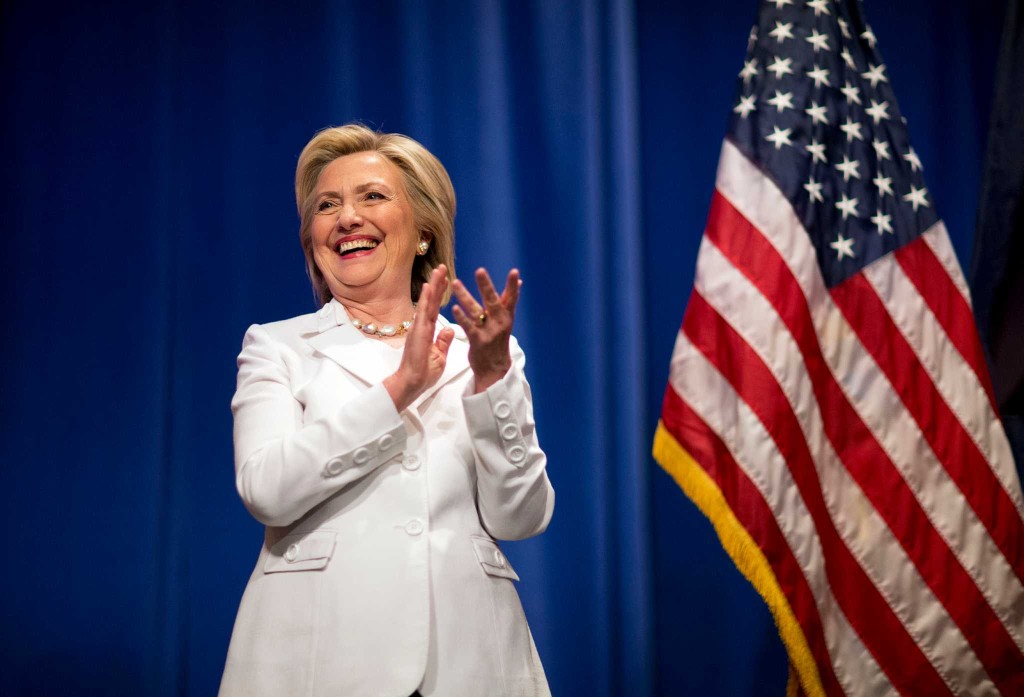
Hillary Rodham Clinton‘s campaign probably didn’t need a reminder of how crucial Latino voters could be to her presidential campaign. She got one anyway from Jeb Bush. The former Republican governor of Florida spoke fluent Spanish during his 2016 campaign kickoff this week, at which he introduced his wife, a native of Mexico, to an adoring crowd that cheered as he effortlessly deflected an attempt by immigration protests to interrupt his speech. “Ayúdennos a emprender una campaña que les da la bienvenida,” Bush said, which can be translated as, “Help us run a campaign that welcomes you.” Clinton will address the National Association of Latino Elected and Appointed Officials on Thursday in Las Vegas at a time when Bush’s bilingual pitch is prompting quiet pangs of concern among some Democratic strategists. They worry that a campaign that successfully presents Bush as the product of his Hispanic-infused South Florida home could cut into their party’s sizable demographic advantage with Latino voters, particularly in hard-fought states such as Florida, Colorado and Nevada. Bush comes across as “genuine and comfortable in his own skin,” said David Axelrod, a former strategist to President Barack Obama. “If he hangs tough and survives (the primary), Democrats should be sober. He would be a formidable opponent.” Bush may be the white scion of a political dynasty with deep roots in New England, but he has adopted Hispanic culture as his own. He made his career in the bilingual mecca of Miami, Spanish is his primary language at home, and he brags about buying cilantro to make Latin cuisine for his wife. On the campaign trail, Bush switches seamlessly between English and Spanish when answering questions, his skills in the language honed during the two years he spent in Venezuela as a young man. He also travels with Raul Henriques, a fresh-faced “body man” recently hired because Bush wanted a Spanish speaker. Republicans think Bush could help their party close a yawning political gap among Latino voters. GOP nominee Mitt Romney won just 27 percent of the Latino vote in 2012, the smallest margin in a decade. President George W. Bush, who had far weaker ties to the Hispanic community than his younger brother Jeb, earned as much as 40 percent of their vote during his 2004 re-election race. Maintaining a broad Democratic advantage among one of the country’s fastest-growing minority groups will be essential to Clinton’s path to the White House. Almost 28.2 million Hispanics will be eligible to vote in the 2016 presidential race, an increase of about 17 percent over 2012, according to an analysis of census data by the Center for American Progress, a liberal think tank. Clinton advisers have long singled Bush out from the rest of the crowded Republican field as a possible threat, arguing that his personal connection to the Latino community could help his campaign make inroads in several battleground states. “If Republicans were to win Florida and Ohio and Colorado, it’s hard to total up 270 for Democrats,” longtime Clinton confident Harold Ickes told reporters in November. For months, Clinton and her team have worked hard to develop and deepen relationships with Hispanic leaders. In May, she tapped Lorella Praeli, a leading immigrant-rights activist brought to the U.S. illegally as a young person, to lead outreach to Latino voters. Less than a month after announcing her plans to enter the race, Clinton called for a path to citizenship for undocumented immigrants. Her position left little political wiggle room for Republicans open to an immigration overhaul, Bush included, who favor granting legal status for some of the 11 million workers in the country illegally but not full citizenship. “We should offer hard-working, law-abiding immigrant families a path to citizenship,” Clinton said during her kickoff speech last weekend. “Not second-class status.” Campaigning in Iowa on Wednesday, Bush said he would support citizenship for some immigrants brought to the country illegally as children and a pathway to legal status for their parents, a step Obama took by executive order three years ago. But Bush’s efforts to woo Latinos may be complicated by the Republican primaries, where a vocal conservative minority holds outsized influence. In an indication of the potential toxicity of the issue to his primary bid, Bush had no plans to mention immigration during his Tuesday kickoff speech. But he couldn’t resist responding to the chants of protesters heckling him from the crowd with a pledge to tackle immigration legislation. “I believe what I believe, and I believe in comprehensive immigration reform,” he said in Iowa the following day. “People don’t agree with me in my own party, not everybody, but, trust me, there are a lot of people that have a differing view.” Republished with permission of The Associated Press.
