
Joe Biden eyes defeated candidates for key administration roles

In politics, there can sometimes be an upside to losing. President-elect Joe Biden is eyeing several Democrats who lost congressional reelection races last month for key positions in his administration. They include outgoing Reps. Abby Finkenauer of Iowa, Donna Shalala of Florida, and Sen. Doug Jones of Alabama. Their consideration continues a long Washington tradition of defeated politicians seeking shelter in a new White House. Landing a job in a new administration can both position the losing candidates for future campaigns and provide the incoming president with important relationships on Capitol Hill. “It’s good to have people who know how to roam the halls of Congress,” said Andrew Card, who directed George W. Bush’s transition and later served as the Republican president’s chief of staff. Biden’s transition team declined to comment on the prospects of any individual contender for an administration role. He has already unveiled much of his economic and national security team and is expected to announce picks soon for key health positions. But there are still a large number of major Cabinet positions to be filled, including attorney general and leaders of the departments of Labor, Commerce, and Transportation. As Biden considers his options, his personal connection with some of the defeated lawmakers could carry significance. Finkenauer, who is under consideration as Labor secretary, owes her start in politics in part to Biden. As a college student, she worked on his ill-fated 2008 presidential campaign. A decade later, he headlined a rally for her winning congressional campaign. She was a key surrogate for Biden ahead of the Iowa caucuses. “I know they have a long relationship, and it’s been mutually supportive,” said former Assistant Dubuque City Manager Teri Goodman, who is a decades-long Biden supporter and has watched Finkenauer’s rise. Finkenauer narrowly lost her bid for a second term in a rural northeast Iowa district. But since then, the former state legislator, who made a name promoting public employee unions, has had conversations with senior Biden transition officials about leading the Labor Department, according to Democratic sources familiar with the communications. Jones, meanwhile, is in the mix to lead the Justice Department, partly due to his work as a U.S. attorney who helped convict Ku Klux Klansmen for the Birmingham church bombing that killed four Black girls. He narrowly won a special Alabama Senate election in 2017 but lost reelection last month. He also has a longstanding personal relationship with Biden, dating to Biden’s first presidential campaign in 1988. Biden spoke at Jones’ campaign kickoff in 2017, saying of Jones, “He knows your heart and will never let you down,” and was the first to telephone him on Nov. 3 after he’d lost the seat to Republican Tommy Tuberville. Shalala is perhaps the most administration-ready of 2020′s losing Democratic class. She spent eight years as secretary of health and human services under Bill Clinton and then served as president of the University of Miami before winning a south Florida House seat in 2018. She has heard from Biden transition officials. Beyond the outgoing members of Congress, Biden is also considering his former rivals in the Democratic primary for jobs. He already tapped California Sen. Kamala Harris as his vice president. Biden is weighing roles for Pete Buttigieg, the former South Bend, Indiana mayor who mounted a surprisingly strong campaign in the early stretch of the Democratic primaries. Biden has expressed deep affection for Buttigieg, who was one of the first major candidates to drop out of the race and endorse Biden. Montana Gov. Steve Bullock, who lost his Senate bid after leaving the White House race, is part of discussions for a Biden administration role, perhaps as secretary of agriculture. Another name under consideration for agriculture is former North Dakota Sen. Heidi Heitkamp, who lost in 2018 but has been a champion of reinvigorating rural America. “If they think I can be helpful, then good,” Heitkamp told The Associated Press recently. Presidents have often sought losing rivals for positions. Republican Donald Trump chose fellow 2016 GOP presidential candidates Rick Perry as energy secretary and Ben Carson for housing and urban development. Democrat Barack Obama notably chose former rival Hillary Clinton to be secretary of state after the 2008 election. Missouri Sen. John Ashcroft’s defeat in 2000 paved the way for his four years as attorney general under George W. Bush, including during the aftermath of the 2001 terrorist attacks in the United States. Former Senate Majority Leader Tom Daschle of South Dakota, who lost the election to a third term in 2004, was tapped after the 2008 election by Obama to head health and human services, which would have put him at the forefront of the health care debate. Daschle withdrew from consideration after questions arose about his failure to properly report and pay income taxes. The most successful losing congressional candidate of the past 50 years is George H. W. Bush, who as a two-term Republican U.S. House member from Texas lost his 1970 bid for Senate against Democrat Lloyd Bentsen. As a consolation, President Richard Nixon picked Bush to be ambassador to the United Nations, a disappointment for the up-and-comer who was hoping for a treasury job. But the post led to an ambassadorship to China, and the experiences were valuable when as president he found himself leading a global coalition in Operation Desert Storm. “The significance is that was the beginning of his self schooling and expertise in foreign affairs,” said Chase Untermeyer, director of White House personnel during George H. W. Bush’s administration. In a White House led by a Capitol Hill veteran like Biden, a team with a background in Congress is particularly valuable to those around the president, since Biden remains well acquainted with the rules and many members. But considering Biden hasn’t been a senator in nearly a dozen years, Card said those with more recent experience in Congress will be helpful. “More than helping the president, these people can help the White House staff dealing with members of Congress,” said Card. “They know where
Vision 2020: Will mailed-in ballots be delivered on time?
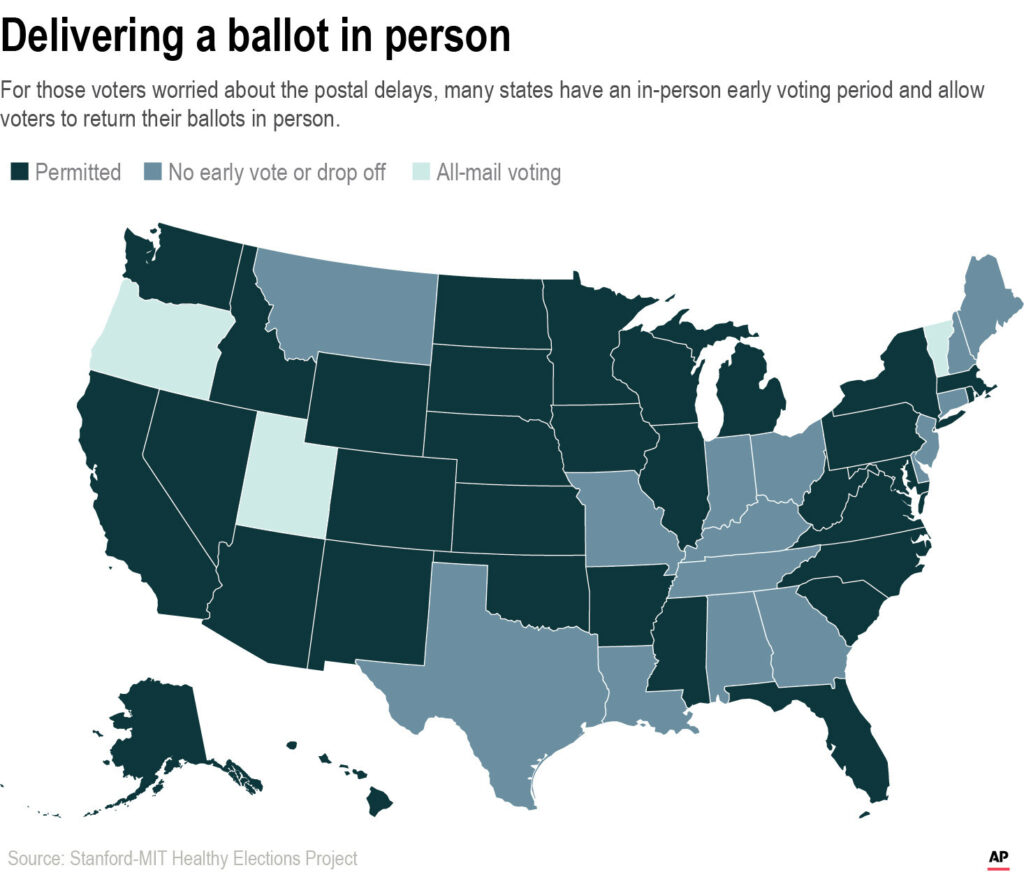
Can you trust the U.S. Postal Service to deliver your ballot on time? If you plan on voting by mail, election officials say it’s best to do it as early as possible so your ballot gets to its destination well before Election Day, which is Nov. 3. Postal officials have repeatedly said the agency has more than enough capacity to handle the surge of ballots this fall, and its leaders have committed to prioritizing election mail. But on-time delivery rates vary widely depending on where you live, and the service has been falling short of its internal goals to deliver all first-class mail within five days. On top of that, each state has different rules on whether it accepts mail ballots that arrive after Election Day. Some policies are the subject of court cases and could change before Nov. 3, so voters should check with their local election officials if they’re unsure. All that is to say, the earlier you mail your ballot, the better. It has been a tumultuous few months for the Postal Service. This summer, the agency’s new leader, Louis DeJoy, a major donor to the GOP and President Donald Trump, set in motion a series of controversial policy changes that have delayed deliveries nationwide. Then, not too long after DeJoy took over, Trump openly admitted he was starving the Postal Service of coronavirus relief money to make it harder for the agency to process ballots. The combination of Trump’s remarks and DeJoy’s policies have led to a lot of distrust in the agency and fears about political manipulation. The Postal Service has been sued several times in multiple states over the policy changes and has been handed a series of bruising court decisions blocking them. One judge in Washington state called them “a politically motivated attack on the efficiency of the Postal Service” before the election. The Postal Service agreed Wednesday to reverse changes that had slowed mail service nationwide, settling a lawsuit filed by Montana Gov. Steve Bullock. The changes had included reduced retail hours, removal of collection boxes and mail sorting machines, closure or consolidation of mail processing facilities, restriction of late or extra trips for timely mail delivery, and banning or restricting overtime. The agreement also requires the Postal Service to prioritize election mail. So, if you’re worried about voting by mail, what should you do? Consider early voting options in your state, check if your area has ballot drop boxes, or go to the polls on Election Day. Otherwise, return your ballot early and don’t wait until the last few days. Republished with the permission of the Associated Press.
Virus, stalled economy raise Democratic hopes to take Senate

Democrats have rising hopes of gaining the minimum three seats they’ll need to capture a majority.
U.S. states share, get creative in hunt for medical supplies

The U.S. Department of Health and Human Services confirmed Wednesday that the federal stockpile is officially bare.
Steve Bullock ends presidential campaign
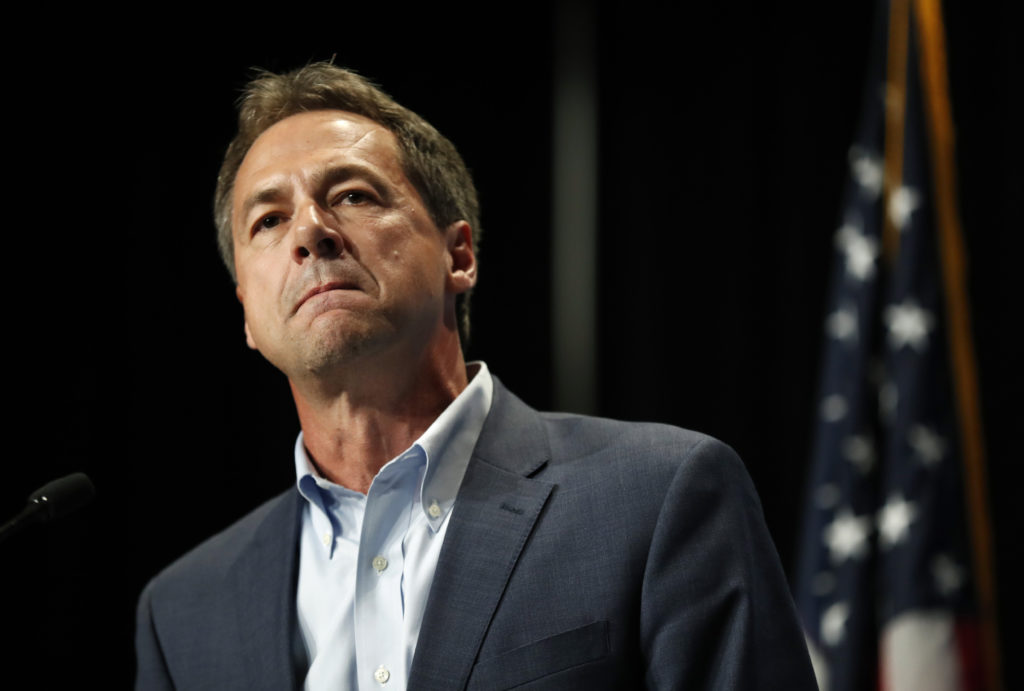
Montana Gov. Steve Bullock announced Monday that he’s ending his Democratic presidential campaign, saying it’s become clear that he won’t have a shot at being his party’s nominee. The two-term governor and former state attorney general tried to make the case that he was the best bet to beat President Donald Trump because he was the only Democratic candidate to win in a state that Trump won in 2016. But he got a late start, announcing his candidacy in May and joining nearly two dozen other Democratic candidates competing for attention and campaign donations. “While there were many obstacles we could not have anticipated when entering this race, it has become clear that in this moment, I won’t be able to break through to the top tier of this still-crowded field of candidates,” Bullock said in a statement. The governor said that he ran to win back places Democrats have lost and end the influence of “dark money” in politics. Those concerns have not changed, he said, but he leaves the race “filled with gratitude and optimism, inspired and energized by the good people I’ve had the privilege of meeting over the course of the campaign.” The 53-year-old struggled to raise money and register in the polls, managing to meet qualification thresholds for only one Democratic National Committee debate in July. He’s the third Western governor or former governor to drop out of the 2020 race after struggling to build a national profile and donor base against well-known alternatives like former Vice President Joe Biden and Vermont Sen. Bernie Sanders. Former Colorado Gov. John Hickenlooper dropped out in August to instead run for the Senate. His departure was followed quickly by that of Washington Gov. Jay Inslee, who is seeking reelection. Democrats had been pushing Bullock to give up his presidential bid and run instead for Senate, where first-term Republican Steve Daines is running for reelection. But Bullock has consistently and repeatedly said he has no interest in the Senate seat and that there are already strong candidates running against Daines. Bullock’s spokeswoman Galia Slayen reiterated that Monday. “While he plans to work hard to elect Democrats in the state and across the country in 2020, it will be in his capacity as a governor and a senior voice in the Democratic Party — not as a candidate for U.S. Senate,” Slayen said in a statement. Bullock had been exploring a presidential run since 2017, but he said he couldn’t announce his candidacy until he had finished his work in Helena, where the state legislature was meeting. He staked his presidential campaign on Iowa, and he made repeated trips to the state to campaign alongside prominent state Attorney General Tom Miller, the first statewide elected official in Iowa to endorse a 2020 candidate. Bullock stuck strictly to his campaign message of needing to win back rural Trump voters, noting he won reelection the day that Trump carried his state by 20 percentage points. He also touted his history as a crusader to eliminate the influence of anonymous and foreign money in elections. But he remained at the bottom of the polls and unfamiliar to many voters. His biggest national exposure appeared to come when he didn’t make the cut for the first debate, resulting in a slate of news stories and an appearance on “Late Night with Stephen Colbert.” Bullock was Montana’s attorney general for a term before he became governor in 2013. Before that, he worked as an assistant attorney general, as an attorney in private practice in Helena and for law firms in New York and Washington, D.C. By Michelle L. Price and Matt Volz Associated Press. Price reported from Las Vegas. Republished with the Permission of the Associated Press.
The pressure is now on Facebook to ban political ads

Twitter’s ban on political advertising is ratcheting up pressure on Facebook and Mark Zuckerberg to follow suit. But so far, that doesn’t appear likely to happen. Facebook’s policy is to accept paid political ads from candidates without fact-checking them or censoring them, even if they contain lies. And Zuckerberg doubled down on that stand Wednesday following Twitter’s announcement, reiterating that “political speech is important” and that Facebook is loath to interfere with it. Twitter, Facebook and other social media sites have come under fire over Russia’s use of such platforms to spread misinformation and sow political division in the U.S. during the 2016 presidential campaign. That debate has heated up again in recent weeks along with the 2020 race for the White house. Twitter chose to respond with a ban on all political advertising , suggesting that social media is so powerful that false or misleading messages pose a risk to democracy.The timing of the announcement, the same day as Facebook’s quarterly earnings report, seemed designed to goad Zuckerberg. “The pressure is going to be extremely strong on Facebook to do something similar, and if they don’t, the criticism of Facebook will only increase,” said Tim Bajarin, president of consultancy Creative Strategies. In fact, some of the Democratic presidential candidates immediately suggested Facebook follow Twitter’s lead. Montana Gov. Steve Bullock tweeted: “Good. Your turn, Facebook.” And Pete Buttigieg said, “I think other online platforms would do well to either accept their responsibility for truth or question whether they should be in the business at all.” But Zuckerberg stood firm. “This is complex stuff. Anyone who says the answer is simple hasn’t thought about the nuances and downstream challenges,” the Facebook CEO said. “I don’t think anyone can say that we are not doing what we believe or we haven’t thought hard about these issues.”As for refusing to fact-check political ads, Facebook has said it wants to provide politicians with a “level playing field” for communication and not intervene when they speak, regardless of what they’re saying. Banning political ads has its own challenges, starting with defining what exactly is political. For example, Greenpeace might not be able to buy an ad urging people to support legislation to fight climate change. But what if an oil company wanted to run an ad for its products that also seemed to come out against such legislation? Twitter and Facebook already take steps to prevent political manipulation by verifying the identities of political advertisers — measures prompted by the furor over Moscow’s interference. But the verifying systems, which rely on both humans and automated systems, have not been perfect. In one case, Facebook mistakenly took down ads for Bush’s baked beans because they contained the word “Bush” and the food company was not registered with Facebook as a political advertiser. Media organizations have also seen their ads flagged for review when they promoted news stories about candidates or important issues. And then there’s the question of what to do with individual posts from politicians or other opinion makers, which can carry political messages and be shared widely even though they are not paid ads. Details about Twitter’s new policy won’t be released until Nov. 15, a week before it takes effect. But Twitter does call for removing not just campaign advertisements but also ads on issues of legislative importance. That could include such topics as climate change, gun control and immigration. EMarketer analyst Debra Aho Williamson said Zuckerberg’s stance probably isn’t a financial decision, since political ads aren’t big moneymakers. Facebook, which had 2018 revenue of $55.8 billion, said Wednesday that it expects ads from politicians to account for less than 0.5% of its revenue next year. Twitter, which had revenue last year of about $3 billion, is thought to make even less from the ads; it said it brought in only $3 million from political ads during the 2018 midterms. “It is a really complicated decision,” Williamson said. “I think that Mark Zuckerberg is truly struggling with figuring out what is the best thing to do for the company and Facebook users.” Wedbush Securities managing director Michael Pachter likewise said the Facebook founder is trying to pull off a tricky balancing act. “Zuckerberg is trying to satisfy investors by growing revenues and satisfy regulators and legislators by cracking down on false and misleading ads, while maintaining the virtuous stance of being a defender of free speech,” Pachter said. Daniel Kreiss, a journalism professor at the University of North Carolina, said that a middle ground for Twitter and Facebook might be to allow political ads but to prohibit targeting, or showing them only to specific groups of people. If campaigns aren’t allowed to target, he said, messages will become broader and perhaps less misleading. Laura Packard, a partner at PowerThru, a digital consulting firm that works with left-of-center campaigns and advocacy groups, said Twitter’s ban was the right decision for voters.“This might make my work harder,” she said. “But in general, I think that if any platform cannot police misinformation and lies, then they shouldn’t offer paid advertising.” By Mae Anderson and Rachel Lerman AP Technology Writers AP reporter David Klepper in Providence, Rhode Island, contributed to this report. Mae Anderson reported from Atlanta. Republished with the permission of the Associated Press.
Twitter bans all political advertisements
Twitter is banning all political advertising from its service, saying social media companies give advertisers an unfair advantage in proliferating highly targeted, misleading messages. “While internet advertising is incredibly powerful and very effective for commercial advertisers, that power brings significant risks to politics, where it can be used to influence votes to affect the lives of millions,” Twitter CEO Jack Dorsey tweeted Wednesday in a series of tweets announcing the new policy. Facebook has taken fire since it disclosed earlier in October that it will not fact-check ads by politicians or their campaigns, which could allow them to lie freely. CEO Mark Zuckerberg told Congress last week that politicians have the right to free speech on Facebook. The issue suddenly arose in September when Twitter, along with Facebook and Google, refused to remove a misleading video ad from President Donald Trump‘s campaign that targeted former Vice President Joe Biden, a leading Democratic presidential candidate. In response, Democratic Sen. Elizabeth Warren, another presidential hopeful, ran her own ad on Facebook taking aim at Zuckerberg. The ad falsely claimed that Zuckerberg endorsed President Donald Trump for re-election, acknowledging the deliberate falsehood as necessary to make a point. Critics have called on Facebook to ban all political ads. These include CNN chief Jeff Zucker, who recently called the company’s policy of allowing lies “absolutely ludicrous” and advised the social media giant to sit out the 2020 election until it can figure out something better. Google and Facebook did not have immediate comments on Twitter’s policy change.Montana Gov. Steve Bullock, who is running a 2020 Democratic presidential campaign, retweeted Dorsey’s announcement, adding the comment “Good. Your turn, Facebook.”Dorsey said the company is recognizing that advertising on social media offers an unfair level of targeting compared to other mediums. It is not about free expression, he asserted. “This is about paying for reach. And paying to increase the reach of political speech has significant ramifications that today’s democratic infrastructure may not be prepared to handle,” he tweeted. “It’s worth stepping back in order to address.” Twitter currently only allows certified campaigns and organizations to run political ads for candidates and issues. It will ban both types of political ads. The company said some exceptions will be made, including ads that encourage voter turnout. It will describe those in a detailed policy it plans to release on Nov. 15. Federal campaigns are expected to spend the majority of advertising dollars on broadcast and cable channels during the 2020 election, according to advertising research firm Kantar, and about 20% of the total $6 billion in spending on digital ads.Twitter’s policy will start on Nov. 22. Republished with the permission of the Associated Press.
