
A Georgia trial arguing redistricting harmed Black voters could decide control of a U.S. House seat

Democrats could gain a seat in the U.S. House and multiple seats in Georgia’s Legislature, if a judge rules Republicans drew maps illegally weakening Black voters’ power. The trial beginning Tuesday is part of a wave of litigation progressing after the U.S. Supreme Court earlier this year stood behind its interpretation of the Voting Rights Act, rejecting Alabama’s challenge to the law. The Voting Rights Act says voting district lines can’t result in discriminatory effects against minority voters, who must be allowed a chance to elect candidates of their choosing. Court cases challenging district lines drawn after the 2020 Census could shape 2024 congressional elections in states beyond Alabama and Georgia, including Florida, Louisiana, South Carolina, and Texas. Taken as a whole, those cases could affect the narrow hold Republicans have on the U.S. House. In Georgia, U.S. District Judge Steve Jones is hearing what is expected to be a two-week case without a jury. If he rules against the state, he is likely to order Georgia’s Republican-controlled General Assembly to redraw districts to comply with the law. The trial yokes together three different cases, meaning Jones could rule for the challengers in some instances and not others. Jones already ruled in March 2022 that some parts of Georgia’s redistricting plans probably violate federal law. He allowed the new congressional and state legislative maps to be used for 2022’s elections, finding changes close to elections would have been too disruptive. Charles Bullock, a University of Georgia political scientist who studies redistricting, said he expects Jones to side with the plaintiffs. “He found the plaintiffs had proven the elements of a Section 2 violation at that point,” Bullock said of the earlier ruling. The plaintiffs challenging the districts argue there is room to draw another Black-majority congressional seat on the west side of metro Atlanta, as well as three more majority-Black state Senate districts and five additional majority-Black state house districts in various parts of the state. They point to Georgia’s addition of a half million Black residents from 2010 to 2020, nearly half of all population growth. “Despite these striking demographic changes, the enacted congressional plan fails to reflect the growth in Georgia’s Black population,” the plaintiffs challenging Georgia’s congressional map wrote in a summary of their case filed with the court. The state, though, argues the plaintiffs haven’t proved voters act the way they do because of race, arguing partisanship is a stronger motivator. Defense attorneys, for example, point to the role of partisanship in the original election of Democratic U.S. Rep. Lucy McBath in 2018. McBath, who is Black, first won office in a district with a small Black population. Lawmakers then redrew lines to make the district significantly more Republican, leading McBath to jump to and win reelection in a different district. The state also argues plaintiffs would rely so much on race to draw districts that it would be illegal. “That’s a defense you can offer is what the plaintiffs want would require putting considerations of race above everything else,” Bullock said. But Kareem Crayton, senior director for voting and representation at New York University’s Brennan Center for Justice, said Georgia’s claims that lawmakers didn’t consider race in drawing lines, only partisanship, should lead to questions about whether they considered if the lines discriminated. “It sounds like, so far, the state is saying, ‘We don’t talk about race at all.’ But then, is there a story to be told about?” Crayton said. “What does it mean to have a significant portion of your state that has not been able to access power?” Republicans held an 8-6 majority in Georgia’s U.S. House delegation in 2020, but majority-GOP state lawmakers redrew lines to eliminate one of those Democratic seats, boosting their majority to 9-5. If the plaintiffs win, the balance could revert to 8-6 Republicans. However, lawmakers also could try to convert McBath’s current seat into a majority Black seat. The GOP currently holds a 102-78 majority in the state House and a 33-23 majority in the state Senate. While a plaintiff’s victory is unlikely to flip control in either chamber, additional Black-majority districts in the Senate and House could elect Democrats who would narrow Republican margins. Republished with the permission of The Associated Press.
Judge refuses to toss discrimination lawsuits over Georgia voting districts
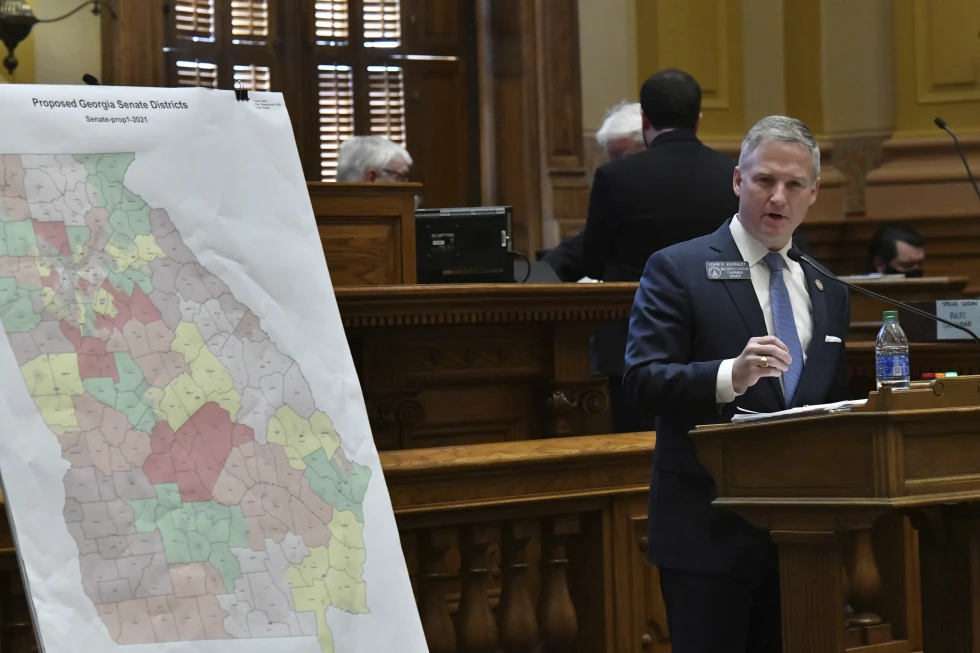
A judge has refused to dismiss lawsuits alleging Georgia’s congressional and legislative districts illegally discriminate against Black voters. U.S. District Judge Steve Jones ruled Monday that he could only decide disputes over the facts of the cases and the credibility of the witnesses after a full trial, which he set for September. “Additionally, given the gravity and importance of the right to an equal vote for all American citizens, the court will engage in a thorough and sifting review of the evidence that the parties will present in this case at a trial,” Jones wrote. The orders apply to three cases, one challenging the lines of Georgia’s 14 congressional districts and two challenging the lines of the 56 state Senate and 180 state House districts. All three lawsuits allege that the maps violate the federal voting rights act by weakening the growing electoral strength of Black voters. Plaintiffs want Jones to order one more congressional district be drawn where Black voters will be able to elect their chosen candidate. That could give Democrats one more congressional district. Republicans hold nine districts, and Democrats hold five after legislative Republicans redrew maps to improve their position from an 8-6 majority in 2020. The cases had been on hold while Alabama had challenged the Voting Rights Act. The U.S. Supreme Court last month stood behind its interpretation of the law, which says that district lines can’t result in discriminatory effects, rejecting Alabama’s attempt to change the rules. That cleared the way for the Georgia cases to move ahead. Jones has already said that it’s likely that some parts of Georgia’s redistricting plans violate federal law. However, last year, he allowed the new congressional and state legislative maps to be used for 2022’s elections, finding changes close to elections would have been too disruptive. In the state legislative cases, the challengers argue a map could include three additional majority Black state Senate districts and five additional majority-Black state House districts. Those changes, if approved, would be unlikely to cost Republicans partisan control of either legislative chamber. Jones has scheduled a joint trial for all three lawsuits starting Sept. 5, which means districts could be redrawn before the 2024 congressional and state legislative elections. The judge said one key argument advanced by the state to defend the maps — that divisions between Black and white voters are caused by partisanship and not race — didn’t apply at this stage of the case, saying only the effects of those divisions mattered now. He also rejected efforts by plaintiffs to win a ruling without a trial, saying he couldn’t rule “without making factual determinations, weighing evidence, and assessing the credibility of the experts.” At least two other cases were also filed challenging Georgia’s new maps. Republished with the permission of The Associated Press.
