
Judge blocks Ala. from ending Planned Parenthood funding

A federal judge has blocked Alabama’s effort end Medicaid funding to Planned Parenthood dealing a setback to Republican Gov. Robert Bentley. Wednesday morning U.S. District Judge Myron Thompson issued the 66-page decision directing the state to restore funding to the embattled group, stating the governor’s letter terminating the contract with Planned Parenthood Southeast (PPSE) failed to include a reason for the cancellation. In August, Bentley sent a letter terminating the state’s Medicaid contract with Planned Parenthood after the legitimacy of using any taxpayer dollars to fund the nation’s largest abortion provider was called into question after the pro-life group Center for Medical Progress (CMP) released of a series of undercover videos detailing Planned Parenthood’s harvest and sale of fetal organs and body parts after abortions. Following receipt of the letter, PPSE took the state to federal court, arguing the state didn’t have solid legal reason to end the Medicaid provider agreements with the two state clinics. Today’s ruling is the latest victory for Planned Parenthood in recent clashes with Republicans over funding. Susan Watson, Executive Director of American Civil Liberties Union of Alabama said, “Judge Thompson has rightly recognized that the State of Alabama’s termination of the Medicaid provider agreement is a violation of federal law. The State of Alabama cannot impermissibly target abortion providers for unfair treatment. Today’s ruling is a victory for the women of Alabama.” Following the order, Governor Bentley weighed in, “For the last two months, Alabama has denied payment to Planned Parenthood Southeast. The good news is that as a result of the strong opposition by Alabama and a few other states to the practice of accepting reimbursement for harvesting fetal organs, the national Planned Parenthood organization has changed course and will no longer continue this deplorable practice. I am disappointed, and vehemently disagree with the Court’s ruling today. We are reviewing the opinion and will determine the next legal steps within the appeal period.”
Prison overhaul wins final passage, goes to Gov. Robert Bentley
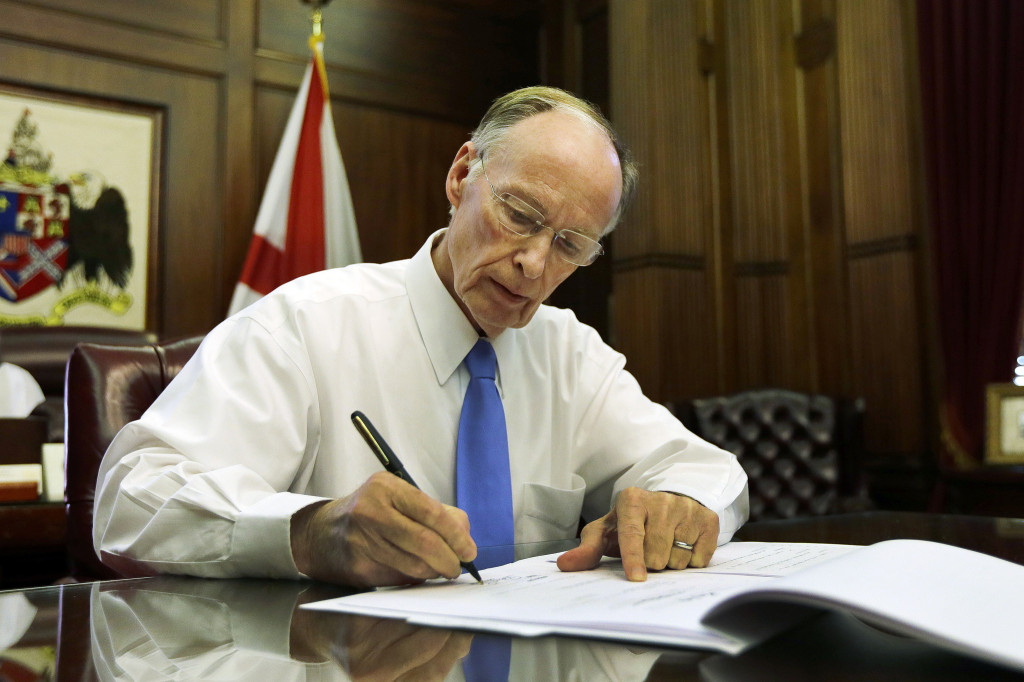
The Legislature on Thursday gave final approval to sweeping changes to sentencing and probation standards in an effort to relieve severe overcrowding in state prisons. Alabama prisons house nearly twice the number of inmates they were originally designed to hold, a crowding level that has been called both dangerous and one that puts the state in danger of federal intervention. “Public safety is first and foremost. It always has been. The system we’ve got right now does not work,” said bill sponsor Sen. Cam Ward, an Alabaster Republican. The approved legislation seeks to gradually reduce crowding during the next five years by steering low-level offenders away from prison with the creation of a new Class D felony category and making changes to probation and supervision to try to reduce recidivism. “It is going to allow us to have real systemic reforms over a five- or six-year period. It won’t happen immediately, but your Legislature is finally doing something right in regards to prisons. If we do nothing, you can guarantee this: The federal government or federal officers will do it for us, and we should be ashamed as elected officials that we allowed that to happen,” Ward said. The House of Representatives passed the bill on a 100-5 vote. The state Senate voted 27-0 to go along with House changes. Go.v Robert Bentley said he plans to sign the bill after a legal review. “Today’s passage of SB 67 is a historic day for Alabama as we take a significant step forward to address reform of Alabama’s criminal justice system,” Bentley said. The House also approved a related bill to steer $60 million for the construction of 1,500 to 2,000 new prison beds. That bill now moves to the Alabama Senate. The two bills are designed to bring prison populations down to 137 percent capacity in the next five years, Ward said. That’s a crowding level that federal courts have found acceptable when crowding lawsuits have been brought in other states. The Alabama prison system was placed in federal receivership in the 1970’s which led to a court-ordered release of inmates. The state prison system has been in an unfavorable spotlight again in recent years over overcrowding, low staffing levels and violence. The U.S. Department of Justice is investigating conditions at the state’s only prison for women after accusing the state of failing to protect inmates from sexual abuse and harassment. State inmates sued the state last year over medical care. Four inmates were killed during a 14-month period at St. Clair Correctional Facility in Springville. The facility was placed on lock-down last month because of a riot. The legislation was the product of a prison reform task force and crafted in conjunction with the Council of State Governments. Senators applauded Ward after passage of the bill he had worked on for the past year, balancing agreements with prosecutors, victims’ advocates and others. The bill would also: Provide for hiring more than 100 new probation officers. Currently probate and parole officer have caseloads of 200 people each. The hiring would take caseloads down to less than 100 each. The bill comes at an estimated annual price of $23 million, with much of the cost increase coming from hiring additional probation officers, Ward said. Mandate that people who commit technical parole violations, such as failing to show up for a drug test, would get a three-day stint in jail. The legislation won praise from a group that often criticizes bills moving in the Alabama Legislature. “The passage of this legislation shows that Alabama acknowledges there is a serious over-incarceration problem in our prisons and that it is dedicated to fixing it,” Susan Watson, executive director of the American Civil Liberties Union of Alabama, said. The conservative-leaning Alabama Policy Institute also praised the passage. “The work isn’t over, but we have now taken a significant step towards solving a problem that has been decades in the making,” API Vice President Katherine Robertson said. Republished with permission of The Associated Press.
Committee votes to let adoption agencies refuse gay couples

A House Committee voted Wednesday for a bill that would allow private adoption agencies to turn away gay couples on religious grounds. The House State Government Committee approved the bill, which now moves to the House floor. The bill would not allow groups to be forced to participate in adoptions and foster care placements that violate their religious beliefs. It would prohibit the state from refusing to license, or contract with, agencies and children’s homes that refuse the services on religious grounds. Supporters said it is needed to protect faith-affiliated adoption agencies such as children’s homes linked with the Baptist and Catholic churches. “This would protect them so they would not be required to place children in homes when it violates their religious convictions,” said Joe Godfrey, executive director of the interdenominational Alabama Citizens Action Program and a supporter of the bill. Godfrey said a Catholic adoption agency in another state had to close rather than participate in a state requirement to let gay couples adopt. The bill called the “Alabama Child Care Provider Inclusion Act” is one of several religious freedom bills being taken up across the country as state gay marriage bans have fallen to federal court rulings. Similar adoption bills were debated in Michigan and Florida. The bill does not specifically mention homosexuality, but proponents said it is in anticipation of legalized same-sex marriage. The U.S. Supreme Court will hear arguments next week on whether gays and lesbians have a right to marry nationwide. Susan Watson, executive director of the American Civil Liberties Union of Alabama, said the bill would legalize adoption discrimination — against a broad range of people — in the name of religion. “It’s like saying, ‘I don’t want to serve somebody black because I don’t like the way they look.’ It’s the same thing with this bill,” Rep. John Rogers, a Birmingham Democrat, said. Republished with permission of The Associated Press.
